In this guide
An EV tariff is an electricity import tariff built around when a car charges rather than how much the whole house uses. Most of them give a much lower unit rate overnight: Energy Saving Trust notes that most EV tariffs involve a lower rate for charging overnight, and Smart Energy GB puts it plainly, that EV tariffs typically charge a cheaper rate for electricity used at night1. The scale of the difference is the point. Which? records home charging on an off-peak tariff at 7p per kWh against a typical public rapid rate of 79p per kWh, and puts the cost per mile at 2p on an off-peak rate against 8p on a standard home rate3.
That gap is why around 85% of all EV charging happens at home, and why the tariff, not the charger, is usually the biggest single lever on running costs4. It is also why the market has split into two models. A time-of-use tariff simply makes electricity cheaper at certain hours and leaves the household to decide what runs then. A supplier-controlled tariff hands the scheduling to the energy company, which decides when the car draws power and moves it into the cheapest periods. The first gives control and requires discipline; the second gives convenience and requires trust in someone else's software.
What an EV tariff is and how it changes home charging
The Energy Ombudsman divides the market into two structures. A time-of-use tariff gives a cheaper rate for electricity used in a set window, usually overnight, and that rate normally applies to the whole home's consumption in the window. An add-on EV tariff works differently: the household keeps its existing tariff and receives separate EV charging discounts, credits or other benefits8. The distinction matters more than the headline rate, because it decides whether a washing machine, a heat pump or a home battery can also use the cheap hours.
Zapmap separates the same market a second way, into two-rate tariffs (time of use) and Type of Use tariffs. Type of Use tariffs offer cheaper rates just for the specific energy used to charge the EV, and the cheaper kWh cost applies at any time of day or night9. That is a genuinely different proposition: the saving follows the car rather than the clock, so a household that cannot charge overnight is not shut out.
What changes in practice is the shape of the household's electricity bill. A standard tariff prices every kilowatt hour the same. An EV tariff prices the car's energy, or the overnight hours, at a discount and recovers some of it on the peak rate. Zapmap warns that peak costs per unit typically increase a little on such plans, so households with higher daytime electricity consumption may end up worse off overall10. Costs also vary by region and by household, so the same tariff can produce different outcomes on two streets10.
For energy independence, an EV tariff does something specific and limited. It does not reduce the amount of electricity a household buys, and it does not remove the supplier. It changes when the household buys, which is the one form of independence a domestic customer can exercise without generating anything: the ability to take energy when the system is under least strain and priced lowest. That is a real gain, and it is a gain that depends entirely on the supplier's tariff design continuing to exist.
The main EV tariffs compared: rates, off-peak windows and eligibility

The published rates across the market are not directly comparable, because they are quoted on different bases and change with the wholesale market. What can be compared is structure.
| Tariff type | How the discount applies | Who it suits |
|---|---|---|
| Time of use (two-rate) | Cheaper rate across the home in a set window, usually overnight8 | Households that can shift other loads into the window |
| Type of Use | Cheaper rate on the energy that charges the car, at any hour9 | Households that cannot charge overnight |
| Add-on | Existing tariff kept, separate EV discount or credit8 | Households unwilling to move their whole supply |
| Subscription add-on | Extra monthly fee for unlimited smart EV charging11 | High-mileage drivers |
The underlying building blocks are standard. Ofgem's own modelling of smart meter performance treats dwelling electricity tariffs as one of a standard tariff, a 7-hour off-peak, a 10-hour off-peak, an 18-hour tariff or a 24-hour heating tariff, which shows how much of the market is still built from a small set of window lengths12. Electric vehicle off-peak tariffs have been part of the supplier landscape since at least 202113.
Eligibility is narrower than the marketing suggests. Zapmap notes that where off-peak or peak pricing has been displayed, this is part of the standard EV tariff rather than an option available for all customers10. In other words, the cheap window is not a menu item a household can select on any tariff; it is a product in its own right, with its own terms. The ivie Energy Sure tariff, for example, was offered to compatible households with heat pumps and EVs, which shows how tightly some products are scoped14.
The practical comparison a household can make is between the off-peak unit rate, the peak unit rate, the length and timing of the window, and whether the discount covers the whole home or only the car. A tariff with a very cheap window and a high peak rate rewards a household that can genuinely move its load. A tariff with a modest discount and a modest peak penalty is more forgiving of a household that cannot.
Intelligent Octopus Go: the UK's most popular EV tariff
Octopus Energy offers three EV tariffs, and Intelligent Octopus Go is the best known of them11. It is a supplier-controlled product: the supplier charges the car at times when energy is at its cheapest to save the customer as much as possible11. The household plugs in and sets a departure time; the scheduling is done by the supplier's platform, which can move charging outside the advertised window when the grid is particularly cheap.
That model has been tested at network level. UK Power Networks ran a trial showing that EVs on Intelligent Octopus Go, described as Octopus Energy's most popular smart tariff, could help manage renewable energy on the network15. The significance for a household is that the car becomes a flexible load the system can use, rather than a fixed evening demand. That is the mechanism by which a supplier can offer a lower rate: it is buying flexibility, not simply discounting energy.
The published rate for Intelligent Octopus Go is 8p per kWh, with one maker page quoting 8.4p per kWh until 1 October11. The off-peak window is described as 23:30 to 05:30, and separately as up to six hours of cheap charging every 24 hours, with one page describing six hours of super cheap smart charging each day11.
Octopus also offers an Intelligent Drive Pack, an add-on to an existing home energy tariff where customers pay an extra monthly subscription fee for unlimited smart EV charging11. That is a different bargain again: a flat fee rather than a unit rate, which suits a high-mileage driver and penalises a low-mileage one.
The independence question here is sharpest. On a supplier-controlled tariff the household gives up the decision about when the car charges. In exchange it gets a lower price and, in the trial evidence, a role in absorbing renewable generation15. The dependence is on the supplier's platform, its app and its continued willingness to run the product. If the platform changes or the tariff closes, the household is back to scheduling manually.
OVO Charge Anytime: charging at any hour, not just overnight
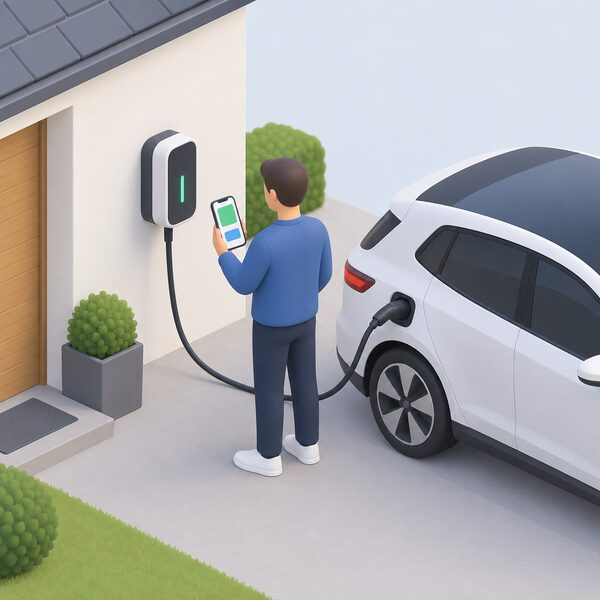
Charge Anytime is not a tariff. It is an add-on to existing tariffs, and a household must already be an OVO customer signed up to a home energy tariff, fixed or standard variable, to take it16. The mechanism is an app rather than a meter window: the customer adds a Charge Anytime plan to the OVO account and downloads the OVO Charge app to smart charge the EV16.
The proposition is that the cheap rate is not confined to a fixed overnight window. Because the supplier controls the charging session, it can place the energy in whatever period is cheapest, which in principle includes the middle of the day when solar generation is high. That is a meaningful difference from a fixed-window tariff for a household that is at home during the day, or one with solar panels.
The hardware side is where the two big supplier-controlled products meet. The Ohme Home Pro is described as one of the only chargers that can integrate with both Octopus and OVO's smart tariffs17. That makes the charger, rather than the car, the point of integration for many households, and it means the choice of charge point can determine which tariffs are available later.
For independence, Charge Anytime is the clearest example of the trade. The household keeps its existing tariff, so nothing about the supply arrangement changes, and gains a discount on the car's energy. What it gives up is the timing decision, and what it depends on is an app, a supplier relationship and a compatible charger. A household that changes supplier, or whose charger loses integration, loses the benefit without any change to the physical installation.
E.ON Next Drive, EDF GoElectric and Good Energy EV Charge
The remaining supplier products follow the same two patterns, with differences in window length and hardware bundling.
E.ON Next bundles chargers with its EV proposition. The Ohme ePod, Ohme Home Pro and zappi GLO chargers are offered with Wi-Fi or 3G/4G compatibility, solar charging compatibility, tethered or untethered options, and standard installation included18. That bundling matters for a household that wants one transaction rather than three, and it also means the charger choice is constrained by the supplier's list.
EDF's EV tariffs offer seven hours of lower-priced off-peak electricity every night, from 11pm to 6am, described on one page as 7 hours of cheaper off-peak electricity every night over the same window19. The two descriptions agree on the window and differ only in wording.
Good Energy's EV Charge gives five hours of low-cost electricity from midnight to 5am, described elsewhere as five hours per day only, from 12am to 5am19. Again the window is consistent across the two descriptions; the difference is whether the allowance is framed as a continuous period or a daily total.
The pattern across all three is a fixed overnight window of five to seven hours, which is shorter than the six hours Octopus describes and shorter than the 7-hour and 10-hour off-peak structures Ofgem models12. A shorter window is not automatically worse, but it concentrates the household's flexible load into a narrower period, which matters for a household charging two cars or running a heat pump as well.
What these products do for independence is modest and uniform. They lower the price of a fixed quantity of energy taken at a fixed time. They do not change the household's exposure to wholesale prices, to the supplier's continued operation, or to the grid. The one thing they do change is the household's own behaviour: a five-hour window forces a decision about what else runs overnight, and that decision is the household's, not the supplier's.
How much home charging actually costs per mile

The cost figures published across the market vary widely, and the variation is mostly about assumptions rather than prices.
Which? puts home charging on an off-peak or EV rate at 7p per kWh and 2p per mile, based on an average tested EV efficiency of 3.18 miles per kWh, against 8p per mile on a standard home rate of 24p per kWh3. Energy Saving Trust gives £8 for a full charge on an EV tariff or other time-of-use tariff, and separately £17 for a full charge, with the two figures appearing in the same guidance20.
ChargeUK's price comparison gives a home off-peak rate of 3.59p per kWh, a home price cap rate of 26.11p per kWh, and a blended 80% home / 20% rapid rate of 22.20p per kWh, with a cost of £158 over 7,100 miles on the off-peak basis21. That 3.59p figure is well below the 7p Which? uses, which suggests it reflects a particular tariff and period rather than a market average.
Which? also records that with an off-peak tariff it can cost less than £10 for a full charge5. Smart Energy GB gives a household example of two pence per mile in energy costs for a driver in Bedford charging with a smart meter2.
The independence point is that home charging is the cheapest place to buy energy for a car, and the tariff is what makes it so. NICEIC states that electric vehicle charging at home is likely to be cheaper than at a public EV station22, and Northern Ireland's official guidance goes further, that home charging is the least expensive way to charge an EV because lower home electricity tariffs can be used23. That is true across the UK, and it is the reason the tariff matters more than the charger.
Smart charging, integrations and what your charger or car must support
Smart charging is now a regulatory baseline rather than a feature. The Electric Vehicles (Smart Charge Points) Regulations 2021 require that domestic EV chargers must be smart, capable of responding to signals to shift charging to off-peak periods24. A charger installed in a UK home since those regulations took effect is therefore already able to do the basic thing an EV tariff needs.
What the regulations do not guarantee is integration with a particular supplier's platform. That is a commercial arrangement between the charger maker and the energy company, and it is where the practical constraints sit. The Ohme Home Pro integrates with both Octopus and OVO's smart tariffs17. The Simpson & Partners Home Series V3 is listed as smart tariff compatible with Octopus Intelligent Go17. The E.ON Next range covers the Ohme ePod, Ohme Home Pro and zappi GLO with Wi-Fi or 3G/4G connectivity and solar charging compatibility18.
The car can also be the integration point on some tariffs, where the supplier controls charging through the vehicle's own connectivity rather than the charger. Which route applies depends on the tariff and the vehicle, and it determines what happens if the household changes car or charger.
Energy Saving Trust notes that EV and other time-of-use tariffs typically require a smart meter1. The Energy Ombudsman is more precise: a household does not need a smart meter simply to charge an EV, but without one it may not be able to access some EV-specific tariffs, and for many EV-specific tariffs, particularly smart or time-of-use tariffs, a working smart meter is needed8. Smart Energy GB states that in most cases a smart meter is required to access EV tariffs2. Octopus's own position, as reported, is that a smart meter is needed to sign up to most if not all EV tariffs, because suppliers need to be certain when charging happened11.
For independence, smart charging is a two-sided arrangement. The charger is capable of responding to signals, which is what allows the household to take advantage of cheap periods and, in the network trial evidence, to help absorb renewable generation15. But the signal comes from outside the home, and the household's benefit depends on a supplier, an app and a platform that can change. The physical capability is the household's; the commercial benefit is rented.
Where EV tariffs fall short: peak rates, limits and restrictions
The limitations are structural, and they do not disappear with a bigger battery or a better charger.
- The peak rate is usually higher. Zapmap warns that peak costs per unit typically increase a little on such plans, so households with higher daytime electricity consumption may end up worse off overall10.
- The discount may not cover the whole home. An EV tariff usually applies the lower rate only to EV charging, not to the rest of the home's electricity use, compared with a standard time-of-use tariff25.
- The cheap window is a product, not an option. Where off-peak or peak pricing has been displayed, this is part of the standard EV tariff rather than an option available for all customers10.
- Costs vary by region and household, so the same tariff produces different outcomes in different places10.
- The window may be short. Five to seven hours is typical across the supplier products described above19.
- Supplier-controlled charging depends on the platform. The household gives up the timing decision and depends on the supplier's software continuing to work and the product continuing to exist.
The scale of the market is worth stating. Ofgem's consultation records that the proportion of home EV charge points that use an EV tariff is 62%6. That means a substantial minority of households with a home charge point are not on an EV tariff at all, and are paying standard rates for energy that could be bought more cheaply.
The independence reading is that an EV tariff is a partial and conditional gain. It lowers the price of energy the household still buys from a supplier, on terms the supplier sets, for a period the supplier defines, using hardware and software the supplier may change. It does not make the household self-sustaining, and it does not reduce the amount of energy drawn from the grid. What it does is give the household a reason to move its consumption to the hours when the system is cheapest, which is the closest thing to demand-side independence available without generating anything.
Grants, the eVED and what's changing for EV drivers
The grant landscape is closing rather than opening. The Electric Vehicle Chargepoint Grant is available for homeowners, renters and landlords26, and the household version covers renters and flat owners installing charge points at home27. The grant for renters and flat owners provides support towards the costs of the purchase and installation of EV charge points28, and the grant for households with on-street parking provides support towards the costs of the purchase and installation of EV chargepoints at residential properties when also installing a cross-pavement charging solution28.
The pavement channels grant exists to increase EV uptake by supporting residents without off-street parking to charge at home and benefit from cheaper domestic tariffs29. That objective is explicitly about access to the cheap tariff, not just about the hardware.
Eligibility has a sting. A household that has already claimed the grant, or its predecessors the Electric Vehicle Homecharge Scheme and the Domestic Recharge Scheme, cannot claim again30. The Workplace Charging Scheme covers up to 75% of the total costs of the purchase and installation of EV chargepoints, including VAT26.
On taxation, the picture is dated and provisional. The government's own publication on electric vehicle costs, charging and infrastructure was updated with vehicle tax rates31. Electric Vehicle Excise Duty is not intended to be introduced until April 202827, and the proposed duty is intended to take effect in April 2028, replacing EV tax exemptions27. From April 2028 battery-electric cars are set to pay 3p per mile and plug-in hybrids 1.5p per mile, on top of VED27. ChargeUK's analysis indicates that public-charging-reliant EV drivers would likely pay more than petrol and diesel again after its introduction21.
For a household weighing an EV tariff, the direction of travel is clear: the running-cost advantage of home charging is being protected by cheap overnight tariffs while the tax advantage is being withdrawn. The tariff is the part of the equation the household controls, and it is the part that will still be doing work after 2028.
Sources31 cited
- Charging electric vehicles, Energy Saving Trust, 2026
- Smart meter benefits for Britain, Smart Energy GB, 2026
- How much does it cost to charge an electric car, Which?, 2026
- Electric car charging costs: all you need to know, Zapmap, 2026
- Should I buy an electric car, Which?, 2026
- Smart meter Guaranteed Standards of Performance draft impact assessment, Ofgem, 2025
- EV charging VAT, Zapmap, 2026
- EV tariffs and home charging: what consumers need to know, Energy Ombudsman, 2026
- EV energy tariffs, Zapmap, 2024
- EV energy tariffs, Zapmap, 2024
- Octopus EV energy tariffs, Uswitch, 2025
- SAP 10.2, BRE Group, 2021
- We need level heads and clear policy, Solar Energy UK, 2021
- ivie Energy Sure: how we helped with home heating over winter, ivie, 2026
- UK first trial shows shifting EV charging can help manage renewable energy, UK Power Networks, 2024
- OVO EV energy tariffs, Uswitch, 2025
- Home electric vehicle chargers, Carwow, 2026
- How to do electric vehicle charging at home, E.ON Next, 2026
- EV energy tariffs, Uswitch, 2026
- Electric vehicles: debunking myths, Energy Saving Trust, 2025
- Reduced public charging prices could boost EV sales, ChargeUK, 2026
- Electric vehicle charger installation and maintenance, NICEIC, 2025
- Electric vehicles, nidirect, 2026
- Section 722 EV charging complete guide, Elec-Mate, 2026
- Does a hybrid car need an EV tariff, Uswitch, 2025
- Home and business grants schemes and advice, East Herts Council, 2026
- Electric vehicle charging, SMMT, 2025
- Funding schemes, OFTEC, 2026
- Apply for the electric vehicle pavement channels grant, GOV.UK, 2025
- Electric vehicle chargepoint grant for household eligibility, GOV.UK, 2026
- Electric vehicles: costs, charging and infrastructure, GOV.UK, 2025
 Solar and Battery Import TariffsWhat does a special import tariff actually get you when you have solar panels or a home battery?
 Supplier-Controlled ChargingSmart charging tariffs let your energy supplier decide when your car charges, usually overnight when electricity is cheaper.
 EV Charging Bolt-OnsCan you get cheap electricity for your car without changing the tariff for the rest of your home?
 Charging and Energy IndependenceCharging an electric car at home can cut your fuel costs, but how much does it really free you from the grid?
 Charging by Home TypeHow the practical and legal position for home EV charging changes by property type: flats and leasehold consent, terraced homes without frontage, shared car parks and metering, rural properties with long cable runs, and listed or conservation area homes.
 Electric Vehicle TariffsCharging an electric car at home can cost far less overnight, but only on special electricity plans.