In this guide
A fitted 7 kW home charge point in the UK generally lands between about £700 and £1,500 all in, and most published estimates cluster near £1,000. Which? reports that it now typically costs between £500 and £1,200 to buy and install a home EV charger, with 7 kW units costing around £900 bought and fitted1. A trade guide to the wiring rules for EV charging puts a typical domestic installation at £800 to £1,500 for the electrical work alone, excluding the charger unit2. A Checkatrade figure reported by uSwitch gives an average of £1,000 for parts and labour3.
The spread between those numbers is not sloppiness. It reflects three separable things: the price of the hardware, the labour and materials for a straightforward fit, and the extra work a particular house needs. Zapmap puts a typical 7 kW charge point at between £700 and £1,200 fully installed4; the Energy Saving Trust gives around £800 to £1,2005; the Planning Portal cites research showing installation costs ranging from £450 for a basic model to around £1,200 as power and capability increase6. Where a quote goes materially above that band, the reason is usually a long cable run, groundworks, or work on the consumer unit and incoming supply.
Around 1 million home EV chargers are estimated to be installed in the UK, so this is a well-trodden job rather than a bespoke one7. Most published prices do not state a VAT position, so the figures below should be read as quoted headline prices at the dates given; the closed Electric Vehicle Homecharge Scheme was one of the few that stated a cap inclusive of VAT.
What the published ranges actually say
No single authority publishes an official UK price for a fitted charge point, so the honest answer is a range built from several independent estimates taken at different dates. Lining them up shows how tight the middle of the market is.
| Source | Figure | What it covers | Date |
|---|---|---|---|
| Which? | £500 to £1,200; around £900 for 7 kW | Buy and install1 | Feb 2026 |
| Zapmap | £700 to £1,200 | 7 kW charge point fully installed4 | Jun 2025 |
| Energy Saving Trust | £800 to £1,200 | Typical home charge point installation5 | Sep 2025 |
| Checkatrade, via uSwitch | £1,000 | Parts and labour, average3 | Dec 2025 |
| Planning Portal | £450 to £1,200 | Basic model up to higher power and capability6 | 2026 |
| Fuse Energy | £800 to £1,200 | Standard 7 kW unit, hardware and basic installation9 | Sep 2026 |
| SMMT | Under £1,000 | Dedicated 3 kW or 7 kW unit installed by a qualified electrician10 | Dec 2024 |
| flexi-orb | £400 to £1,000 | Installation including the charge point11 | Apr 2025 |
The elec-mate figure of £800 to £1,500 is the outlier only because it isolates the electrical work and leaves the unit out2. Read alongside the others, it suggests that on a harder job the labour and materials can equal or exceed the hardware. Some makers quote differently again: E.ON Next has cited £500 to £1,500 for the charger itself with installation adding £500 to £1,00012, and myenergi states that its own installations typically start at £1,099 including the price of the charger13. Maker prices apply to that maker's own package and are not a market average.
Why the price varies: the unit, the cable run and the state of the electrics
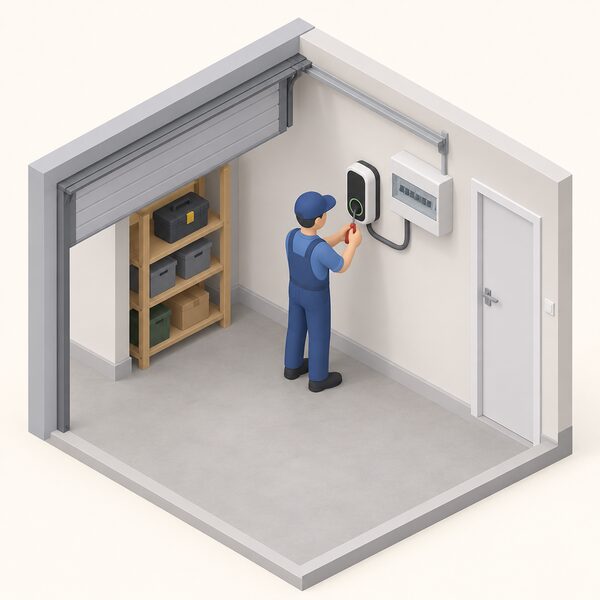
Three variables do most of the work. NICEIC lists the charging station model, the charging speed and the electrician's fees as the main determinants14. myenergi adds installation complexity and any electrical upgrades required15. Good Energy points to charger type, tethered or untethered, model choice, and custom requirements such as longer cables16.
Distance is the single most predictable cost driver. E.ON Next states that a cable run longer than 15 to 20 metres is likely to produce a higher quote for the extra materials and labour17. A charger on the garage wall next to the consumer unit is a short morning's work; one at the far end of a driveway, with the cable crossing or passing under a hard surface, is not.
The other is the age and condition of the existing installation. The most common extra costs cited for older homes are groundworks, such as digging a trench under a driveway, and remedial wiring to fix old safety issues found during the pre-installation checks17. Neither is discretionary once identified: a charge point cannot be certified on an installation that does not meet the standard.
Regional and household variation matters too. Network operators are explicit that they cannot price supply work in advance. UK Power Networks states that it is unable to provide an exact price or time frames online because they are determined by the specific work required, with a quotation issued after assessment and sometimes a site visit18.
Power rating, parking and the network connection
The power rating a household can install is not a free choice: it is set by the existing supply and by what the network will allow. Every installation must be registered with the local Distribution Network Operator, which is the body that decides whether the local network can carry the extra load and whether any limit or notification condition applies1. That registration sits alongside the physical requirements. Off-street parking is the starting condition, meaning a driveway, a garage or a dedicated parking space, because a fixed charge point must serve a place the car can reliably occupy2. Where that is absent, the household stays dependent on public charging and the question of rating does not arise.
The wiring itself is regulated work. Installation by a qualified electrician is a legal requirement, and fixed wiring work must comply with UK building regulations including Part P3. Testing and certification arrangements cover charge points for both home and commercial use, so the same competence regime follows the equipment across settings4. In practice this means the rating on the box is only the last step in a chain: supply capacity, DNO registration, compliant fixed wiring and certification all sit ahead of it.
For independence, the point is blunt. A home charger moves refuelling onto the household's own supply and, where paired with generation, onto electricity the household produces. It does not remove the grid connection, the supplier relationship or the network operator's authority over what may be connected. Around 1 million home EV chargers are estimated to be installed in the UK, every one of them still a point on somebody else's network5.
The standard power rating for a home charger is 7 kW4. Most home units are rated at either 3 kW or 7 kW11. Higher output requires a three-phase supply, which the great majority of UK homes do not have: Good Energy frames the choice as 7 kW single-phase or 22 kW three-phase16, and Which? states plainly that 22 kW chargers are the most expensive1.
Power affects price twice. It raises the hardware cost directly, and the Planning Portal's range runs from £450 for a basic model to around £1,200 as power and capabilities increase6. Where a household has no three-phase supply, a 22 kW unit is not a cheap upgrade but a supply change, which is network work priced case by case18.
Speed is the benefit, and for overnight charging it is often notional. myenergi states that a typical 60 kWh battery charged from a 22 kW home charger takes about 3 hours and costs the same as charging more slowly, because the energy delivered is identical19. For a car parked from evening to morning, 7 kW usually fills the battery within the cheap overnight window anyway. Further detail sits on EV charging speeds and times and 7kW vs 22kW home charger.
Tethered or untethered: the cable arrangement and its price effect
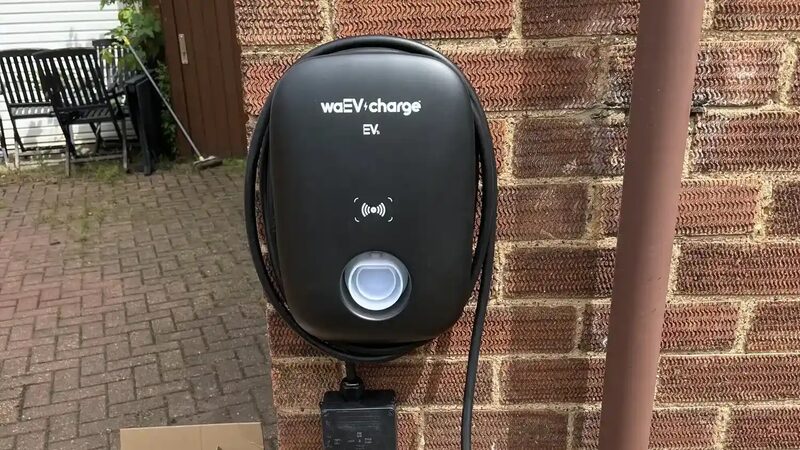
Tethered chargers come with a cable and connector already fitted; untethered units have a socket only, and the driver uses the car's own cable14. The difference shows up in the quote.
- Tethered: the cable is included in the price, so these typically cost more upfront21. Rolec describes tethered as generally the most convenient and the most popular option for home use, since the cable cannot be mislaid22.
- Untethered: these take up less space, tend to cost less, and accept any Type 2 compatible connector23. A charging cable may need to be bought separately, and the unit is less convenient day to day because the cable must be connected and disconnected each time21.
Zapmap sets out the constraint on the tethered side: with a tethered home charger you are limited by the connector type and by the cable length, unless you pay to have a replacement fitted23. That matters over a decade of ownership, during which the cars on the driveway may change. The trade-off is covered in more depth on tethered vs untethered EV charger and types of home EV charger.
What a standard installation includes, and what counts as extra
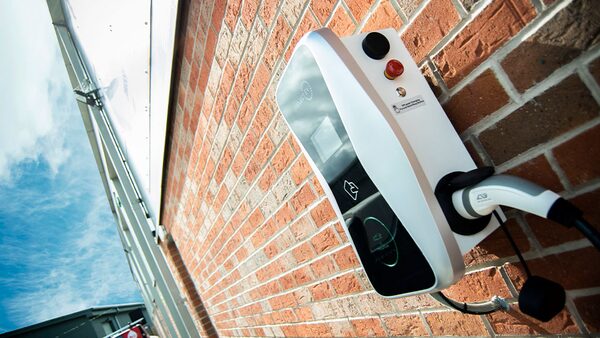
A fixed-price package normally covers the charging unit and its installation, including safety testing, plus the cables and cable protectors needed to connect everything up as unobtrusively as possible25.
What sits outside a typical package is where quotes diverge. E.ON Next publishes an exclusions list for its own installations covering:
- laying cables under floorboards or through loft spaces
- hardwiring an internet connection via ethernet, or extending a Wi-Fi signal
- a charging cable
- additional work required by the energy supplier or the electricity distribution provider, such as changes to the consumer unit
- trenching or ducting of cables underground24
That list is a maker's own terms, not a rule, but it tracks the common extras other sources name: groundworks and remedial wiring17, longer cable runs17, and custom requirements such as extended cables16. A quote that looks cheap against the £700 to £1,200 band is worth reading against exclusions of this kind before comparison.
Who can install one: qualified electricians, BS 7671 and DNO notification
The work involves high-voltage electricity and must comply with the IET Wiring Regulations, BS 7671; an installation must be carried out by a qualified electrician who can test and certify the work27. NICEIC states the requirement directly:
"Your EV charger must be installed in line with the current edition of BS 7671, the national standard for electrical installations"
uSwitch is equally plain that installation should always be done by a qualified and certified electrician28. Electricians registered on a Competent Person Scheme are deemed competent to self-certify their own work, which NICEIC says saves householders time and money compared with routing the job through building control14. Building regulations approval is always required when installing an EV home charger, with specific processes for notifying the local building control authority29.
Every installation also needs to be registered with the local Distribution Network Operator27. Some network operators run a connect-and-notify route: SSEN states that where the total demand of the property is 60 amps or less and there are no safety concerns, the installer does not need to apply in advance31. Where the supply cannot take the extra load, the network operator quotes for the upgrade separately18. See telling the network operator about a home EV charger and electrical requirements for a home EV charge point.
The chargepoint grant: renters and flat owners only
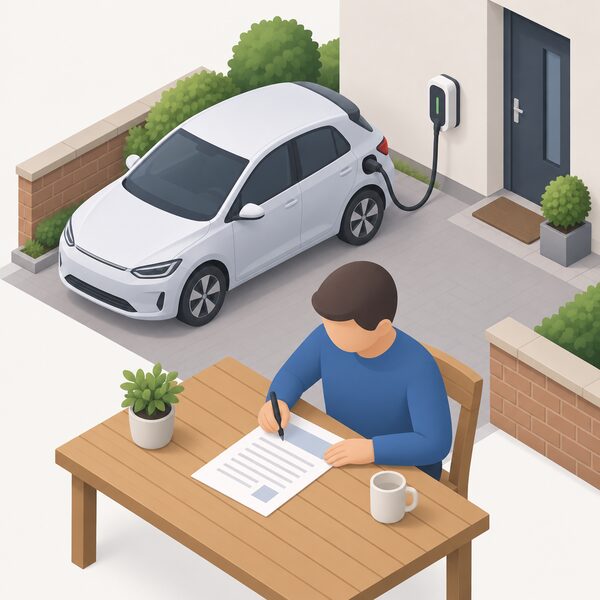
The government's chargepoint grant is not available to most homeowners. UK government guidance states that the grant provides up to £500 towards the cost of installing a chargepoint at the property8. Several independent and maker sources, some of them older, describe the same scheme as worth up to £350 per socket, or 75% of purchase and installation costs capped at £350, whichever is lower32.
Eligibility is narrow. An applicant must either own and live in a flat, including a flat bought through shared ownership, or rent and live in any residential property, and the home must have its own private off-street parking space, and the applicant must own or use an eligible vehicle34.
Fuller detail sits on the Electric Vehicle Chargepoint Grant for renters and flat owners and the EV chargepoint grant for landlords. For flats and rented homes, consent from the landlord, freeholder or management company is typically required before work goes ahead37. Where a private rental is involved, a landlord's separate electrical inspection obligations sit alongside this: an EICR is reported to cost a landlord approximately £150 to £300 depending on the size and location of the property, on the basis that no further work is needed38.
Survey, timescale and installation day
Installation is usually a single visit. uSwitch says it should only take a couple of hours or so28; waEV-charge says a standard installation typically takes just a few hours27; flexi-orb puts the average at four hours unless cabling must be run under floorboards or other preliminary work is needed11. Fuse Energy gives a wider window of a few hours to a full day depending on the complexity of the wiring and any electrical upgrades9.
A rough order of events:
- A survey, remote or on site, checking the parking arrangement, the route for the cable, the consumer unit and the incoming supply.
- Confirmation of the quote, including any extras the survey has identified such as groundworks or remedial wiring17.
- Notification or application to the Distribution Network Operator, depending on the property's demand27.
- Installation, testing and certification to BS 7671, with the certificate issued by the installer14.
- Commissioning of the smart features, which needs connectivity at the charger position. One installer suggests checking for at least two bars of signal there26.
Since 29 May 2025, installing chargepoints at home or at work has been described as quicker, simpler and cheaper following changes to the permissions regime19. The process is set out in more detail on home EV charge point installation.
Planning permission: usually not needed, with real exceptions
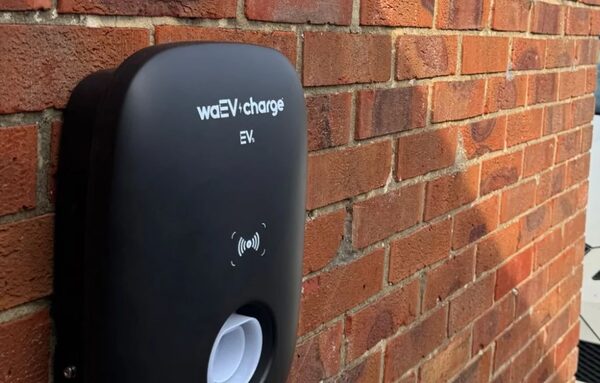
For a home with off-street parking, installing a domestic charger is likely to fall under permitted development, with no planning application required30. The Planning Portal's condition for a wall-mounted outlet is that the outlet and its casing will not exceed 0.2 cubic metres and that it is not on scheduled ancient monument land39. flexi-orb adds that the unit must be within the boundaries of the home, not within two metres of a highway, not over 1.6 m high for ground-mounted units, and not in or within the grounds of a listed building11.
Permission is usually required for:
- on-street parking, or where there is no off-street parking40
- conservation areas and listed buildings40
- areas where installation is restricted through article 4 directions40
- more than one upstand per parking space40
- a charger installed less than two metres from the highway41
Cross-pavement solutions are a separate case. For a permanent pavement crossing, permission from the Highways Authority will be required, and separate planning permission for the crossing solution may also be needed6. Pavement cable crossings sit outside the curtilage of the building, on highway pavement, so they are unlikely to be covered by householder permission for the charge point itself42.
Whatever the route, installing a home charger is classified as development, and it is up to the householder to ensure the correct permissions are in place40. Building regulations approval always applies29. The variations across the four nations are set out on planning permission for a home EV charge point.
What a home charger changes for running costs and independence
The reason the capital cost is worth setting against something is that home charging is consistently the cheapest place to put energy into a car. The Energy Saving Trust states that a dedicated chargepoint on a driveway or in a garage is the cheapest way to charge32. Zapmap makes the same point about timing: home charging is, in most cases, the cheapest time to recharge4. uSwitch notes that a home charger is solely for one household's use and usually the most affordable way of charging, as long as it is combined with an EV or time-of-use tariff43. In Northern Ireland, official guidance states that home charging is the least expensive way to charge an EV because lower home electricity tariffs can be used44.
The size of the saving depends on the tariff. The Energy Saving Trust gives £8 for a full charge at home on an EV or other time-of-use tariff, which typically requires a smart meter5. Electricity North West has cited around £20 for a full charge at home based on a typical 60 kWh battery and around 200 miles of range45. Public charging is priced differently again, with an additional fixed fee commonly applied on top of the per-kWh rate13. Running costs are worked through on what it costs to charge an electric car at home and the tariff side on EV energy tariffs.
On independence, the honest position is partial. A home charge point removes dependence on the public network and on whether a street bay is free, and it lets a household move its largest single load into cheap overnight hours or, with a solar-aware unit, into daylight surplus, which is covered on charging an EV from solar panels. What remains is substantial: the grid connection and the Distribution Network Operator's consent27, a licensed supplier and a tariff, a smart meter for time-of-use pricing5, and, for smart features, the manufacturer's cloud service and app, which need connectivity at the charger26. A charge point is a way of buying grid electricity more cheaply and more controllably, not a way of leaving the grid.
One further claim should be treated as an estimate rather than a certainty. Figures attributed to the National Association of Property Buyers suggest a charger could add between £3,000 and £5,000 to a property's value, depending on location, charger type and local public charging availability14. That is a reported estimate, not a measured resale outcome.
Sources45 cited
- Electric car charging at home, Which?, 2026-02-25
- Section 722 EV charging guide, Elec-Mate, 2026-07-02
- EV charging statistics, uSwitch, 2025-12-15
- Home charging guide, Zapmap, 2025-06-19
- Electric vehicles: debunking myths, Energy Saving Trust, 2025-09-22
- Electric vehicle chargers, Planning Portal, 2026
- Navigating the network: installing low carbon technology, Citizens Advice, 2026-07-01
- Government grants for low emission vehicles, GOV.UK, 2025-04-08
- EV charger installation, Durham, Fuse Energy, 2026-09-09
- EV buying guide, Zapmap, 2024-12-06
- Electric vehicle charge points, Flexi-Orb, 2025-04-22
- Will an EV charger add value to your house?, E.ON Next, 2024-06-20
- How much does it cost to charge an electric car?, myenergi, 2026-09-17
- EV charger installation and maintenance, NICEIC, 2025-08
- Electric car charging at home, myenergi, 2026-09-17
- What's involved in EV charger installation, Good Energy, 2026-01-22
- EV chargers in older homes: electrical upgrades explained, E.ON Next, 2026-09-17
- Electric vehicles: cost, time and what's involved, UK Power Networks, 2026-09-17
- Home charging guide, Zapmap, 2025-06-19
- EV charger installation, Solihull, Fuse Energy, 2026-08-28
- Difference between tethered and untethered chargers, myenergi, 2026-04-10
- Choosing the right EV charger for your home, Rolec, 2026-01-06
- Tethered vs untethered chargers, Zapmap, 2026-02-23
- EV charging connector types, E.ON Next, 2026-09-17
- EV charger home installation process, uSwitch, 2022-02-03
- 7 things to check before your home EV charger installation, waEV-charge, 2025-07-01
- Home EV charger installation: the complete UK guide, waEV-charge, 2025-06-11
- EV charging, uSwitch, 2026-09-19
- Building regulations for EV charging, Planning Portal, 2026-09-17
- Electric vehicle charging: house elements, Planning Portal, 2026
- EV connections, SSEN, 2026-09-19
- Charging electric vehicles, Energy Saving Trust, 2026-04-23
- Electric vehicles for home: charging, Electricity North West, 2026-09-19
- Electric vehicle chargepoint grant: eligibility, GOV.UK, 2026-09-17
- EV chargepoint grant for renters and flat owners, Find a grant, 2026-09-18
- Incentives for electric vehicles, SMMT, 2025-03-26
- EV charger installation, Westminster, Fuse Energy, 2026-08-15
- Electrical checks in privately rented homes, Electrical Safety First, 2026-09-19
- Permitted development and retrofit, Cotswold District Council, 2026-09-17
- Planning permission for electric vehicle charging, Planning Portal, 2026
- Cross-pavement charging solutions, Energy Saving Trust, 2025-07-18
- Approved pavement crossings, Planning Portal, 2026
- Charging an EV without a home charger, uSwitch, 2022-02-25
- Electric vehicles, nidirect, 2026-09-17
- Electric vehicles for home: costs and taxation, Electricity North West, 2022-12-05
 Cost to Charge an EV at HomeHow home charging cost is worked out from battery size, efficiency, the unit rate paid and the tariff behind it, with full-charge costs of about £8 to £17, cost per mile, annual running costs and what changes for EV owners from April 2028.
 Home Battery CostA home battery usually costs between one and a half and ten thousand pounds fitted, depending on size.
 Home Charger InstallationWho can fit a home EV charger, and does it need building regulations approval?
 Electrical RequirementsWill your home need a bigger electricity supply before a charge point can go in?
 The Full EV Charging GuideCharging an electric car at home usually means a wallbox, but do you need one, and what will it cost to fit and run?
 EV Charging Bolt-OnsCan you get cheap electricity for your car without changing the tariff for the rest of your home?