
In this comparison
For most UK homes the choice between a 7kW and a 22kW home charger is not really a choice. A 22kW charger needs a three-phase electricity supply, and that is rare in UK residential properties1. A single-phase supply, which is what most homes have, supports charging up to a maximum of 7.4kW2. That is why the standard power rating for a home charger is 7kW, and why a 7.4kW unit is one of the most common home installations in the UK3.
The two ratings sit inside the same category. Fast charging is defined as 7kW to 22kW, and a home charger is usually around 7kW5. So the question is not whether 22kW is faster, because on a three-phase supply it is, but whether a household can reach it and whether the car can accept it. Where a vehicle's maximum charge rate is 7kW, a 22kW charge point will not charge it any faster7.
The practical difference is time and range. A 7kW charger generally takes a car from 20 to 80 per cent within six to 12 hours, while a 22kW charger is quoted at one to two to six hours for the same window8. Range added runs at up to 30 miles per hour at 7.4kW and up to 90 miles per hour at 22kW9. Whether that matters depends on the supply, the car and how the household uses the vehicle.
7kW or 22kW: the short answer
A 7kW charger is what a single-phase home can support, and a 22kW charger is what a three-phase home can support. The supply decides the outcome before any product comparison begins. Single-phase 7.4kW is described as the standard domestic charger on a 32A dedicated circuit, while three-phase 11kW or 22kW units are described as commercial and some domestic installations, requiring a three-phase supply and a 16A or 32A three-phase circuit11.
The 22kW figure is not a domestic norm. A 22kW charge point is described as unusual for a home but may be used in some workplaces12. Homes with a three-phase AC supply can use a more powerful charger of up to 22kW, which is the condition that has to be met first13.
There is a second condition, on the vehicle side. If the car's maximum charge rate is 7kW, a 22kW charge point will not charge it any faster7. A 22kW charger offers significantly faster charging speeds, but only where the supply and the vehicle both allow it14.
For a household, the short answer is that 7kW is the realistic domestic rating and 22kW is the exception that follows a three-phase supply. The rest of this page sets out what each rating means, why the supply limit bites, what the times and costs look like, and which units can do both.
What the power ratings mean: 3.6kW, 7kW, 11kW and 22kW
The ratings describe how much power a charge point can deliver to the car, and they sit in bands that the industry uses consistently. Public AC charge points tend to be rated either 3kW, 7kW or 22kW12. Most home chargers are either rated at 3kW or 7kW15. The standard power rating for a home charger is 7kW3.
The bands matter because they map onto charging categories. Fast charging covers 7kW to 22kW, and fast charge points offer speeds between 7kW and 22kW6. Destination chargers, the kind found at hotels and car parks, are usually AC units between 7kW and 22kW17. Fast charging is also described as using alternating current rated usually at either 7kW or 22kW18.
| Rating | Typical use | Supply |
|---|---|---|
| 3kW | Slower home units and some public AC points12 | Single-phase |
| 7kW | Standard home charger; most common UK home installation3 | Single-phase |
| 7.4kW | Standard domestic charger on a 32A dedicated circuit11 | Single-phase |
| 11kW | Three-phase domestic and commercial installations11 | Three-phase |
| 22kW | Three-phase homes, workplaces, destination and public AC13 | Three-phase |
A 7kW home charger will charge a car three times faster than a three-pin plug, which is the comparison most households arrive with13. The jump from 3kW to 7kW is the one that changes daily life; the jump from 7kW to 22kW changes it only for households that already have three-phase power and a car that accepts more than 7kW.
Why most UK homes end up with a 7kW charger
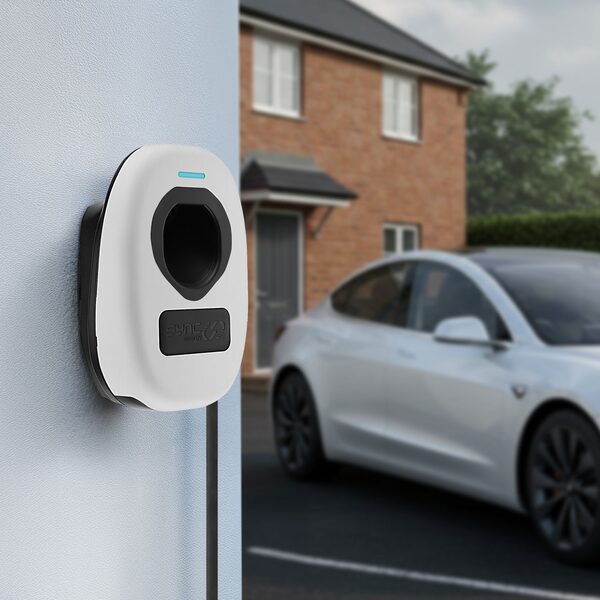
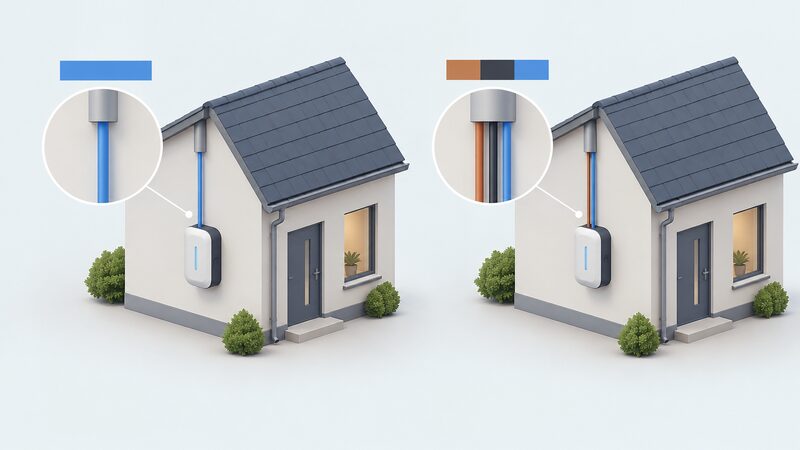
The reason is the electricity supply. A 7kW home charger uses single-phase electricity, as this is the current in most UK homes4. Home chargers require an AC single-phase supply, which most UK homes have, and charge at a rate of 7kW19. A 7.4kW charger is one of the most common home installations in the UK1.
The wiring behind it is standard. Single-phase 7.4kW is the standard domestic charger on a 32A dedicated circuit11. A single-phase 32 amp charger will charge at around 7.2 kW per hour20. Home chargers support power levels up to 7.4kW as most homes have one phase power21.
This is also why the domestic market settled where it did. Home chargers tend to be slower, usually around 7kW5. The standard power rating for a home charger is 7kW3. A 7kW unit is enough to refill a typical car overnight, which is when most home charging happens, so the incentive to go beyond it is limited to households with an unusual supply.
For energy independence, the 7kW charger is the point where a household stops depending on public networks for routine miles. The car is filled at home, on the home's own supply, at whatever tariff the household has chosen. What remains is dependence on the grid and on a supplier, and on the charger's maker for firmware and app functions. A 22kW unit does not change any of that; it only shortens the session.
The three-phase supply limit: where 22kW falls short
A 22kW charger requires a three-phase electricity supply, which is rare in UK residential properties1. Installing a 22kW charger typically requires a three-phase supply, which is uncommon in residential properties14. A 22kW charger needs a three-phase electric supply, which is why they are more commonly found in car parks rather than at UK homes4.
The single-phase ceiling is explicit. All cars can be charged using a single-phase supply but up to a maximum of 7.4kW2. Home chargers support power levels up to 7.4kW as most homes have one phase power21. There are faster home chargers, up to 22kW, but those need a three-phase power supply, which most homes do not have22. Chargers delivering up to 22kW at home require a three-phase electricity supply23.
Three-phase charging is a recognised mode. Mode 3 charging is described at three-phase 22kW24. Three-phase 11kW or 22kW installations require a three-phase supply and a 16A or 32A three-phase circuit11. So the equipment exists and the standard covers it; what is missing in most houses is the supply.
Where a household does have three-phase power, the 22kW option becomes real, and the vehicle becomes the next limit. Where it does not, the choice is between a 7kW charger and the cost of a supply upgrade, which is a network matter rather than a charger matter. The electrical requirements for a home EV charge point page covers what an installation needs, and telling the network operator about a home EV charger covers the notification step.
Charging speed and range added per hour

Range added per hour is the figure households actually feel. A level 2 charger will add 20 to 30 miles of charge for 7kW in an hour, or up to 90 miles in an hour of charging at 22kW, depending on the make and model of car4. A 7kW charger offers up to 30 miles per hour of charging18. A 22kW home charger is quoted at potentially around 90 miles of range per hour14.
Public points follow the same arithmetic. Public charging points usually charge at a 7kW rate, providing about 30 miles of range per hour of charge, though some charge at 22kW25. Destination chargers usually range between 7kW and 22kW5.
| Charger | Range added per hour | Source basis |
|---|---|---|
| 7kW | Up to 30 miles | Maker and independent guidance9 |
| 7.4kW | Up to 30 miles | Maker guidance9 |
| 22kW | Up to 90 miles | Maker guidance9 |
The range figures are estimates and depend on the car. A maker's own model pages show how much the vehicle shapes the outcome: the Nissan LEAF charging time and Tesla Model 3 charging cost pages carry the per-model numbers, and the EV charging speeds and times page sets the bands out in full.
The independence point is straightforward. At 30 miles per hour, an overnight session of several hours covers most daily driving from a home supply. At 90 miles per hour, the same session covers more, but only for a car that accepts the higher rate and a home that can deliver it. The charger does not create the speed; the supply and the vehicle do.
Charging times and running cost: does a bigger charger cost more to run?
Charging time is where the two ratings separate most clearly. A 7kW charger will generally charge a car from 20 to 80 per cent within six to 12 hours, while a 22kW charger will do so within one to two to six hours8. Fast chargers delivering 7 to 22kW usually take between four to eight hours to charge an EV battery26. Fast chargers between 7kW and 22kW will charge an EV in up to four hours27.
For a full battery, a typical EV battery of 60kWh takes approximately eight hours to charge fully from empty using a 7kW home charger14. A 7.4kW home charger will charge a typical 60kWh electric car battery from empty to full in just under eight hours9. A typical 7kW home charger would take around 7 hours 42 minutes for an average 54kWh battery19.
Official consultation figures put an EV charge point type 7kW at around 5 to 7 hours and a 22kW point at around 2 hours28.
| Charger | 20 to 80 per cent | Full charge |
|---|---|---|
| 7kW | Six to 12 hours8 | About 8 hours for 60kWh14 |
| 7.4kW | Not stated | Just under 8 hours for 60kWh9 |
| 22kW | One to two to six hours8 | Not stated |
On running cost, the charger rating does not change the price of the energy. The same battery takes the same kilowatt hours whatever rate it is delivered at, so the cost per kWh is set by the tariff, not the wallbox. What does change is the hardware price. A 7kW charger is quoted at around £900 to buy and install, described as a good choice for most10. A 22kW charger is described as the most expensive, requiring a three-phase connection10.
The EV charging running costs page covers tariff effects, and EV energy tariffs and how they change home charging covers time of use. For a household, the independence question is whether the car is filled at home on the household's own tariff. Both ratings do that; the 22kW unit does it faster and costs more to install.
Chargers that offer both 7kW and 22kW output
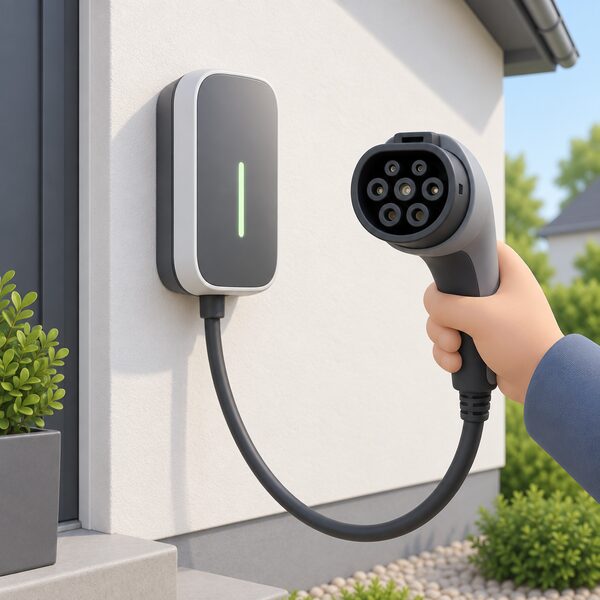
Some wallboxes are specified for both supplies, so the same unit delivers 7kW on single-phase and 22kW on three-phase. One open-source charger is specified as 7kW single-phase or 22kW three-phase29. That is the pattern to look for where a household expects a supply change, or where a three-phase property wants a single product line.
The category language helps here. Fast charging covers 7kW to 22kW, and fast chargers commonly deliver between 7kW and 22kW6. Fast charging type 2 is described as 7 to 22kW4. There are also 22kW chargers available, known as fast chargers, for a home or workplace, though the premises would need the supply to match19.
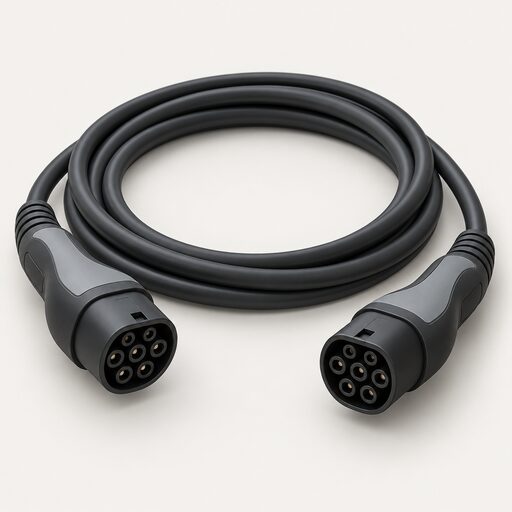
The connector is the same across the band. A home car charger is commonly a 7kW type 2 drawing just over 30A30. Type 2 is the standard domestic connector, and the EV connectors and charging cables page covers the plug and cable side in detail.
For a household weighing the two, the deciding facts are the supply, the vehicle's maximum charge rate and the installation cost. A dual-specification unit does not remove the three-phase requirement; it simply means the same box can be installed now at 7kW and deliver 22kW later if the supply allows. The types of home EV charger page covers tethered and untethered options, and the home EV charger cost page covers fitted prices. For the wider picture, the EV charging at home guide sets the ratings in context.
Sources30 cited
- EV charger installation Gloucestershire, Fuse Energy, 2026-08-25
- Home electrical infrastructure of the future, BEAMA, 2021-10
- Home charging, Zapmap, 2025-06-19
- EV charging and driving: a beginner's guide to going electric, Indra, 2026-02-02
- EV charger installation and maintenance, NICEIC, 2025-08
- Electric cars and energy bills, Uswitch, 2026-04-27
- LCT strategy, Energy Networks Association, 2026-09-17
- How long does it take to charge an electric car, Zapmap, 2026-04-15
- How long does an electric car take to charge, Pod Point, 2025-11-11
- Electric car charging at home, Which?, 2026-02-25
- Section 722 EV charging complete guide, Elec-Mate, 2026-07-02
- Guide to electric vehicle infrastructure, BEAMA, 2024-09
- Home charger, EDF Energy, 2026-09-17
- Which EV charger, Fuse Energy, 2026-04-25
- Tesla Model 3 charging, Zapmap, 2026
- EV charge points, Flexi-Orb, 2025-04-22
- Destination charging, Zapmap, 2026-02-26
- EV connector types, Uswitch, 2022-02-03
- How long does an electric car take to charge, myenergi, 2023-12-08
- Choosing an EV charging cable, Uswitch, 2022-02-04
- Connector types, Zapmap, 2026-05-20
- Home electric vehicle chargers, Carwow, 2026-01-09
- Electric car charging guide, Carwow, 2025-07-16
- RCDs for electric vehicle supply equipment, IET, 2024-05
- How to charge an electric car, Uswitch, 2022-02-02
- Electric vehicle charging, SMMT, 2025-06-25
- How to use electric car charging points, Which?, 2026-05-20
- Scottish building regulations: proposed changes to energy standards, Scottish Government, 2021-07-23
- EmonEVSE overview, OpenEnergyMonitor, 2026-09-17
- Energy management: why e-charging at home is a good plan, KNX, 2023-02-17
 EV Charging Speeds and TimesHow long an electric car takes to charge depends on the charger and the car together, so a faster charge point will not always speed things up.
 Cost to Charge an EV at HomeHow home charging cost is worked out from battery size, efficiency, the unit rate paid and the tariff behind it, with full-charge costs of about £8 to £17, cost per mile, annual running costs and what changes for EV owners from April 2028.
 Types of Home EV ChargerWhich home charger suits your car and your driveway?
 Electric Vehicle TariffsCharging an electric car at home can cost far less overnight, but only on special electricity plans.
 The Full EV Charging GuideCharging an electric car at home usually means a wallbox, but do you need one, and what will it cost to fit and run?
 Home EV Charger ManufacturersWhich home EV charger brands are worth considering, and how do you choose between them?