
In this answer
Short answer
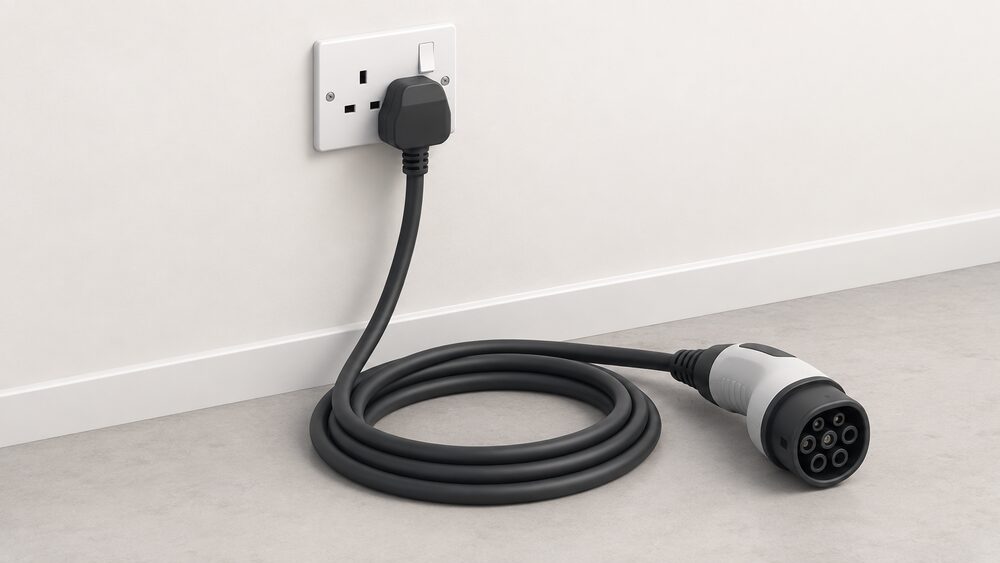
Yes, an electric car can be charged from an ordinary UK three-pin socket. A portable lead with a three-pin plug at one end and a Type 2 connector at the car end will do it, and it is the cable many new cars come with. What it will not do is charge quickly. A three-pin plug delivers around 2.3kW, and the same sources that confirm it works describe it as not recommended for regular use1.
The reason is time. One maker puts an average EV at 24 to 36 hours to fully charge from empty on a three-pin plug, and another says an average battery could take over 24 hours3. Independent guidance is in the same territory: at least 30 hours depending on the car, and around 30 hours to take a battery to 80%5. A dedicated charge point does the same job in a fraction of the time.
The second reason is safety. Charging from a three-pin plug is described as slow and as posing safety risks from the socket overheating or the continuous draw of high current2. One supplier advises avoiding a standard three-pin socket for regular use, calling it both very slow and a safety risk over extended periods7. Three-pin charging is best understood as an occasional fallback, not a household's main way of fuelling a car.
Charging speed: around 2.3kW from a standard socket
The headline figure is 2.3kW. That is what a standard three-pin plug delivers according to a charger maker, and it is repeated by a Northern Ireland supplier and by independent motoring guidance3. A connector guide gives approximately 2.3kW for a three-pin connector, and a product page describes the 2.3kW available from a regular three-pin plug2. Independent charging guidance calls domestic three-pin plugs "slow" chargers at around 2.3kW6.
Not every source agrees exactly. One independent guide gives 2.4kW for a regular three-pin wall socket, and another describes a standard plug running at 3kW5. A charger maker states that three-pin sockets can only draw up to 3kW14. 3kW in normal use, with 3kW as the ceiling a socket can supply rather than what a car will steadily draw.
What that means in practice is a slow trickle of energy. For context, 3kW chargers are grouped in one independent guide with faster units as taking between six and 12 hours to recharge a car to 20 to 80% or above11. A three-pin plug sits at the bottom of that band and often below it. The gap between a three-pin socket and a dedicated charge point is not a small difference in convenience; it is the difference between an overnight top-up and a two-day job.
For a household, this is the first place where energy independence is limited. A three-pin socket draws from the grid at whatever rate the socket allows, with no scheduling, no solar matching and no tariff awareness. It works, but it does not give the household any control over when or how cheaply the car charges.
Do I need a special cable to charge from a three-pin plug?
Yes, and it is a specific piece of equipment rather than an adapter. A three-pin charger is a portable charger that plugs into a standard three-pin domestic socket with a Type 2 connector at the car end15. That is the lead supplied with many electric cars, and it is what people mean by a "granny charger".
It is worth being clear about what this cable is not. It is not a Mode 3 connection. Mode 3 charging is provided by a dedicated circuit, which is the arrangement a wall-mounted charge point uses16. The distinction matters because Mode 3 is the mode the wiring regulations and installation standards are built around for regular charging, and a three-pin lead sits outside that.
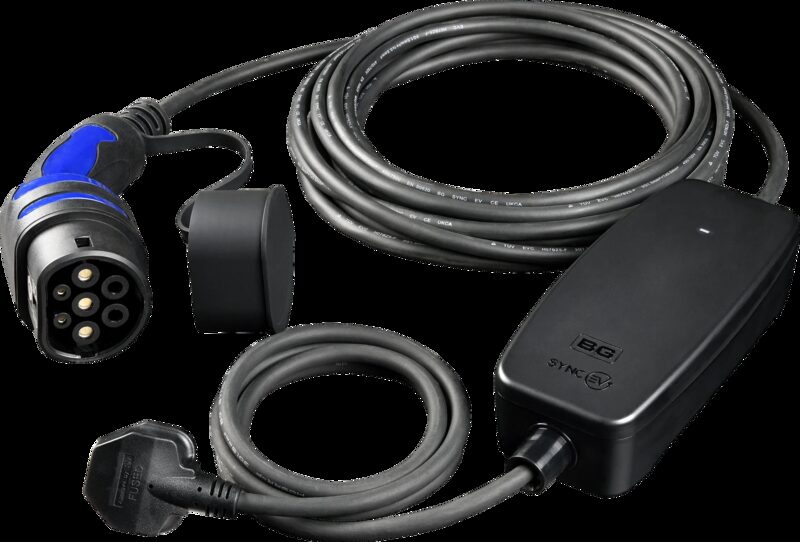
The cable also carries its own protection, which is part of why it exists as a product rather than a simple adapter. One maker's portable charging cable is described as safely charging a Type 2 electric vehicle from any UK three-pin socket with built-in protection17. That protection is in the lead, not in the socket, and it is one reason a household should not improvise with an extension lead.
Why a dedicated charge point is strongly recommended
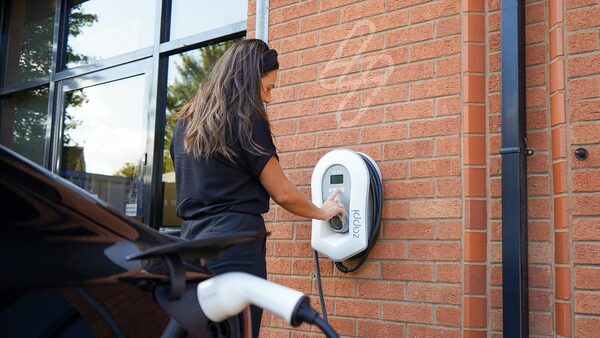
The case for a proper charge point rests on three things: circuit design, safety equipment and speed. Each EV charging point should be supplied by its own dedicated final circuit, according to independent guidance on the wiring rules18. The same principle appears in safety advice, which notes that slow charging equipment is not to be used with an extension lead, requires a dedicated circuit and ideally an EV-rated socket outlet19.
A charger maker puts it plainly: it is recommended that an electric vehicle owner installs a dedicated EV charger rather than relying on a normal socket1. Independent buying guidance says it is strongly recommended that those who need to charge regularly at home or the workplace get a dedicated EV charging point installed by an accredited installer20. The network operators' own guidance recommends a dedicated EV charge point over a standard household 13A socket to achieve faster charging speeds21.
There is also a cost trap in upgrading a socket rather than installing a charger. Even with an EV-rated three-pin socket, regulations require O-PEN protection, which can make the cost similar to or even higher than installing a proper home charger15. In other words, the cheap option stops being cheap once it is done to the standard the rules require.
For energy independence, this is the pivot point. A dedicated charge point on its own circuit is what makes timed charging, solar matching and smart tariffs possible. A three-pin socket leaves the household dependent on the grid at whatever moment the car is plugged in, with no lever to pull on price or timing.
Grants and help with installing a proper charge point
Government support exists, but the schemes have moved. The Electric Vehicle Chargepoint Grant for Households with On-Street Parking gives 75% off the cost to buy and install a socket, up to a maximum of £500, and requires an OZEV approved installer to complete the installation9. It is aimed at households without private off-street parking, and the conditions include not having already installed the chargepoint, since the grant cannot be backdated, having adequate on-street parking, and getting permission from the local highways authority22.
A separate grant covers renters and flat owners. The Electric Vehicle Chargepoint Grant helps towards the cost of installing an electric vehicle chargepoint socket at a property, and independent guidance puts it at up to £350 per socket for residential landlords, people living in flats and people who rent10. A further scheme exists for residential landlords who own a property and want to install a chargepoint there23.
| Scheme | Support | Key condition |
|---|---|---|
| Households with on-street parking | 75% off cost, up to £5009 | OZEV approved installer required9 |
| Renters and flat owners | Up to £350 per socket10 | Property must meet scheme criteria10 |
| Residential landlords | Grant towards installation at a rented property23 | Landlord must own the property23 |
Installation standards are not optional. Chargepoint installations must follow BS EN 61851, the IET wiring regulations BS 7671, the IET Code of Practice for Electric Vehicle Charging Equipment Installations, and the Electricity Safety, Quality and Continuity Regulations installation requirements24. Costs are obtained by contacting an OZEV-approved installer, who will quote for the specific property25.
For a household, the grant is the difference between a charge point being a discretionary purchase and an affordable one. It is also the point at which a home stops treating the car as a grid load and starts treating it as something the household can schedule.
Three-pin socket vs dedicated chargepoint: which fits which household
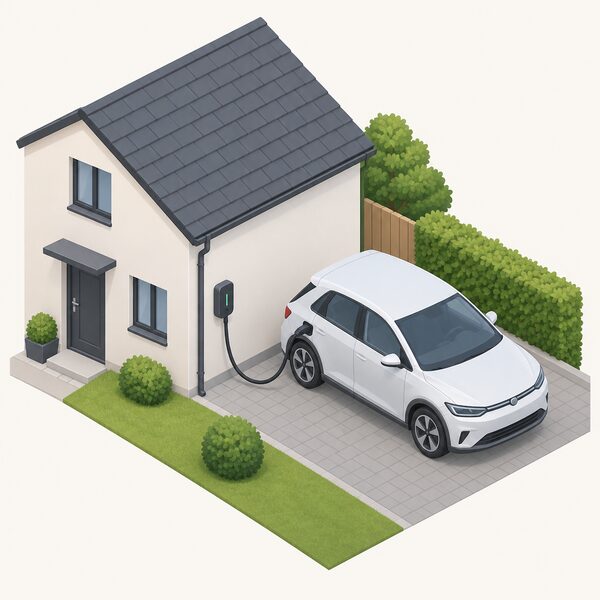
The choice is not really about preference; it is about parking, mileage and wiring. A household with a driveway or garage can install a dedicated chargepoint, which independent guidance describes as the cheapest way to charge an EV10. A household with only on-street parking faces a different set of options, and the grant structure reflects that.
The evidence on what drivers actually do is telling. In a Scottish consumer survey, around three quarters of drivers, 73%, used a charging point attached outside their house rather than a three-pin socket26. That is a strong signal that once a dedicated point is available, it becomes the default.
| Three-pin socket | Dedicated charge point | |
|---|---|---|
| Power | Around 2.3kW1 | 3kW and above11 |
| Full charge | 24 to 36 hours3 | Six to 12 hours to 20 to 80%11 |
| Circuit | Dedicated circuit required, ideally EV-rated socket19 | Own dedicated final circuit18 |
| Cost | No installation, but O-PEN protection can cost as much as a charger15 | Around £800 to £1,200 fitted8 |
| Grant | None | Up to £500 or £350 depending on scheme9 |
Certification is worth checking on any installed unit. Testing and certification for charge points covers both home and commercial use, and a recognised mark is one way to confirm a unit has been assessed27. Rapid public chargepoints are a separate matter again: they are the most expensive to use and are not suitable for all vehicle types28.
The independence question resolves fairly cleanly. A three-pin socket keeps a household tethered to the grid at the moment of plugging in, with no scheduling and no solar matching. A dedicated charge point, particularly a smart one, is what allows charging to be moved to cheaper hours or matched to rooftop generation. That is the difference between owning an electric car and running it on the household's own terms.
Sources28 cited
- Electric car charging at home, myenergi, 2026-09-17
- EV connector types, Zapmap, 2026-05-20
- Do I really need a home charger?, waEV-charge, 2025-07-24
- How to charge your electric car at home, Power NI, 2025-08-05
- Electric car charging at home, Which?, 2026-02-25
- Electric car charging guide, Carwow, 2025-07-16
- EV charging costs, Spirit Energy, 2026
- Electric vehicles: debunking myths, Energy Saving Trust, 2025-09-22
- Electric Vehicle Chargepoint Grant for Households with On-Street Parking, GOV.UK, 2026-09-17
- Charging electric vehicles, Energy Saving Trust, 2026-04-23
- How long does it take to charge an electric car, Zapmap, 2026-04-15
- Home electric vehicle chargers, Carwow, 2026-01-09
- EV charging, Uswitch, 2026-09-19
- Questions to ask before getting a home EV charger, Good Energy, 2026-01-22
- Are 3-pin chargers for EVs safe?, Indra, 2025-10-02
- RCDs for electric vehicle supply equipment, IET, 2024-05
- Sync Energy EV charging, Sync Energy, 2026-09-17
- Section 722 EV charging complete guide, Elec-Mate, 2026-07-02
- Ratings of electrical appliances, Electrical Safety First, 2026-09-19
- EV buying guide, Zapmap, 2024-12-06
- Connecting to the networks: LCT strategy, Energy Networks Association, 2026-09-17
- Electric vehicle chargepoint and infrastructure grants, Northern Ireland Department for Infrastructure, 2026-09-18
- Electric vehicle chargepoint grant for landlords, GOV.UK, 2026-09-17
- Electric vehicle chargepoint and infrastructure specifications, GOV.UK, 2023-10-10
- Electric vehicle chargepoint installers, GOV.UK, 2026-09-17
- Consumer experience of electric vehicles in Scotland, Consumer Scotland, 2024-08-11
- Powering trust in electric vehicle charging with BSI Kitemark certification, BSI, 2026-09-17
- Electric vehicle charge points, Flexi-Orb, 2025-04-22
 EV Charging Speeds and TimesHow long an electric car takes to charge depends on the charger and the car together, so a faster charge point will not always speed things up.
 Cost to Charge an EV at HomeHow home charging cost is worked out from battery size, efficiency, the unit rate paid and the tariff behind it, with full-charge costs of about £8 to £17, cost per mile, annual running costs and what changes for EV owners from April 2028.
 Electric Vehicle TariffsCharging an electric car at home can cost far less overnight, but only on special electricity plans.
 Accessible Charging and PAS 1899You are disabled or find charge points hard to use.
 The Full EV Charging GuideCharging an electric car at home usually means a wallbox, but do you need one, and what will it cost to fit and run?
 Home EV Charger CostA home charge point usually costs between seven hundred and fifteen hundred pounds fitted, with most people paying around a thousand.