
In this answer
Short answer
Yes, in summer a UK home can charge an electric car largely or entirely from its own roof, and the arithmetic is closer than most people expect. On 21 and 22 June 2026 a typical UK rooftop solar installation generated 15 kWh in a day, equivalent to five hours of daily air conditioning use, and the average across 1.88 million domestic-scale installations was 15.2 kWh1. A home charge point takes six to 12 hours to put 20 to 80 per cent or more into a car2. A summer day's generation and a night's charging therefore sit in the same order of magnitude, which is why the pairing works in June and why it stops working in December.
The qualification is that "entirely" depends on the car being plugged in while the sun is up, or on a battery holding the surplus until it is not. Without storage, a household might use only 30 to 50 per cent of what it generates3. With a battery, surplus solar is captured for later use, including overnight EV charging, rather than exported at a relatively low rate4.
The independent verdict is a qualified yes: solar panels can charge an electric car, though solar power alone is unlikely to be relied on year-round in the UK, especially in winter4. What follows is what that requires, how much a roof actually makes, and where the limits sit.
What charging an EV from solar actually requires
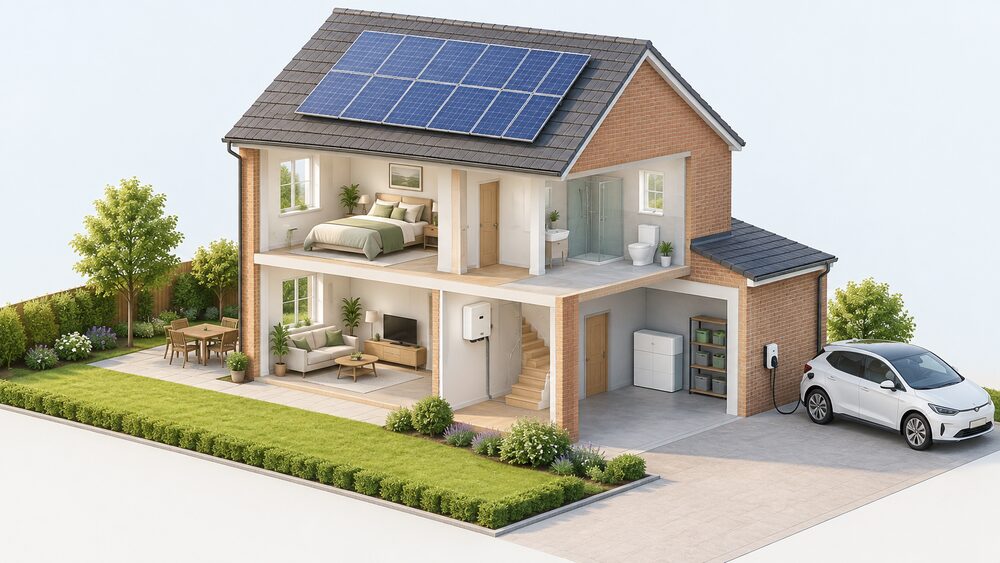
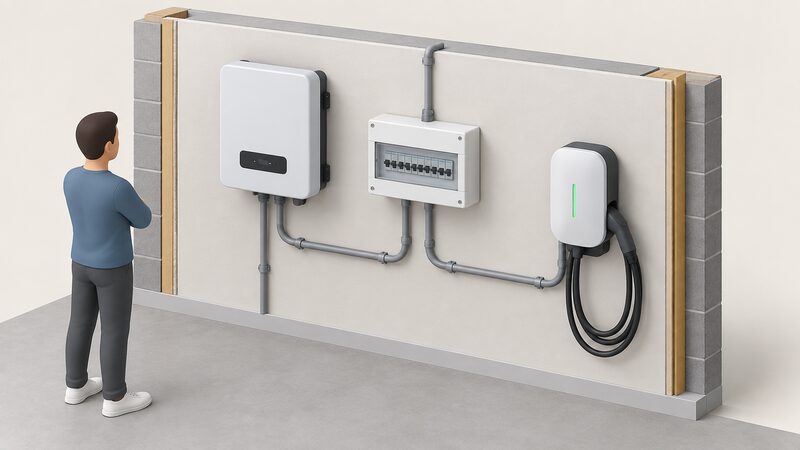
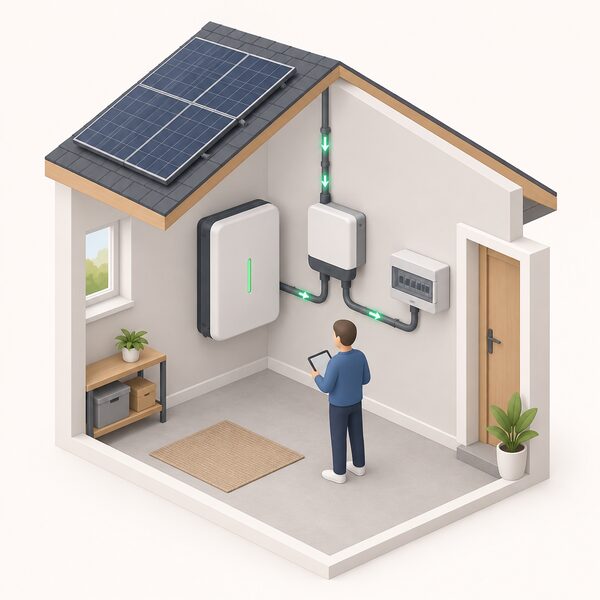
The chain from roof to battery has four links, and each one has to be present for the car to run on sunshine. Panels produce direct current, which needs to pass through a solar inverter to turn it into alternating current the home can use7. The inverter turns the DC electricity from the panels into AC electricity for the house8. The car then does the reverse: EV batteries require direct current to charge, and can accept alternating current only because the car converts it back to DC on board9.
The second requirement is a charge point. Battery-electric vehicles are charged from an external electricity supply, typically by plugging in to an EV charge point10. Installation of a solar EV charger typically requires the help of a certified solar installer and electrician11, and NICEIC lists renewables and electrics among the areas where competent-register householders should expect qualified work12.
The third is timing. Charging during the day maximises direct use of solar power, which the maker guidance describes as the cheapest and greenest option13. The fourth is optional but decisive for the word "entirely": a solar battery helps store excess energy, ensuring more consistent charging even when the sun is not shining13. A battery is not required, but it changes how much of the generation ends up in the car rather than the grid.
How much summer solar a UK roof can generate
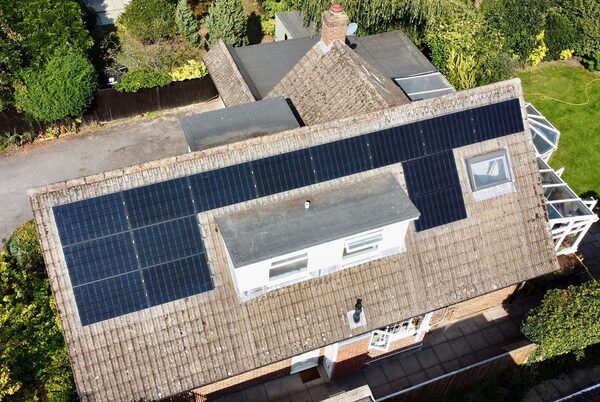
The headline summer figure is 15 kWh in a day for a typical installation, recorded on 21 and 22 June 2026, with the average across 1.88 million domestic-scale installations at 15.2 kWh1. Domestic-scale capacity in that measurement was 6.3 GW, meaning installations up to 10 kW1. That is the population the figure describes: ordinary homes, not solar farms.
Annual yield is the more useful planning number, because it smooths the seasons. In the UK, one kilowatt of panels can be expected to generate between 800 and 1,000 units (kilowatt-hours) of electricity per year5. A 4 kW system with a battery is illustrated at around 10 kWh of electricity per day14, which sits below the June peak and above the annual average, as a summer-weighted example should.
System size varies. Typically, most systems contain around 6 to 10 panels15. One maker's figure puts a single 450W panel at 507.9 kWh of generation16, though that is a manufacturer's own calculation and the independent annual yield range remains the safer basis for planning.
The seasonal spread is the point. A June day at 15 kWh and a December day from the same roof are not the same number, and the independent guidance is explicit that in summer a reasonably sized system can cover a significant portion of a typical household's EV charging needs, while in winter output drops considerably and grid top-ups become more necessary4. Any claim that a UK roof charges a car entirely from solar holds for the summer months and weakens from October.
Matching EV consumption to daily solar output
The matching problem is one of shape, not just volume. A car parked at home all day can absorb generation as it appears; a car that leaves at 7am and returns at 6pm cannot, unless a battery has stored the day's surplus. That is why the control layer matters as much as the panels.
Smart chargers work with solar panels, and sometimes with the energy bill, to charge the car at the best and cheapest time, usually when the panels are making the most power13. Some chargers have special modes to charge the EV only using the extra solar energy not being used in the house and otherwise sent back to the grid13. The ev.energy app describes a Solar Only Mode that matches the charge rate of the vehicle to the amount of solar power being exported, allowing the household to self-consume the generation entirely17. Home energy management systems take the same idea further, linking rooftop solar with EV chargers in a "green charging" mode where the car is powered purely by surplus solar energy18.
The ev.energy app describes a solar only mode that matches the charge rate of the vehicle to the amount of solar power being exported to the grid, so that the generation is entirely self-consumed rather than sold back17.
The hardware side is converging on the same principle. Growatt's THOR unit is described as combining PV and EV charger together to maximise the solar self-consumption rate and cut the bill19. waEV-charge states that its EV1s and EV1i chargers connect with solar panels, letting a household power the vehicle with renewable energy at no additional cost11. Kia's cost calculator produces estimated daily to yearly expenses for a driver working out what the car costs to run20.
Charging hardware: where the car meets the panels
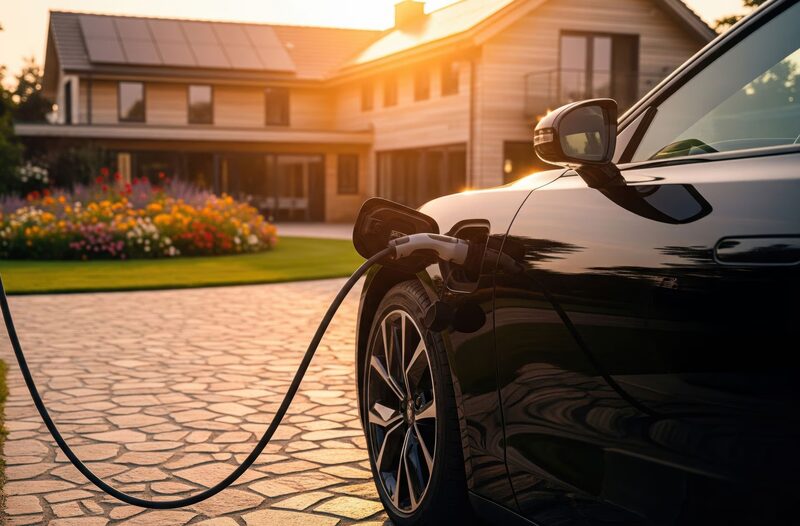
The charge point is the interface, and its power rating sets the ceiling on how much solar a car can take at once. Zapmap's figure for home chargers is six to 12 hours to recharge a car from 20 to 80 per cent or above2. The same six to 12 hour range applies to typical on-street charge points, depending on EV model, charger power rating and weather21.
Away from home, the public network is a different proposition. Destination charging devices are located at the end of a journey or where a driver may typically stop for an extended period, including retail car parks, leisure, education and transport sites, plus devices rated 49kW and below at hotels and restaurants22. That matters for the independence question: a household that charges at home on solar still depends on the public network for longer journeys, and the two are complements rather than substitutes.
Cabling is the last variable. EV batteries require DC power to charge, and AC power must be converted by the car9. A dedicated charge point handles the handshake and the timing; a three-pin cable does not offer the same control over when and how fast the car draws.
| Component | What it does | Figure |
|---|---|---|
| Solar panels | Generate DC electricity from daylight | 6 to 10 panels in a typical system15 |
| Inverter | Converts DC to household AC | Required for home use7 |
| Home charge point | Delivers electricity to the vehicle | Six to 12 hours for 20 to 80 per cent2 |
| Smart charger or HEMS | Matches charging to surplus solar | Solar Only and green charging modes18 |
| Home battery | Stores surplus for later charging | Captures energy otherwise exported4 |
Where solar alone falls short and a battery fills the gap
The shortfall has three causes: weather, season and timing. On the weather, solar PV requires only daylight and not direct sunlight to generate electricity23, and panels can still generate electricity on cloudy days and during winter, though they are more efficient in direct sunlight24. The same point is made by Northern Powergrid, which notes the cells can still generate some electricity on a cloudy day25, by the Commons Library, which states the cells do not need direct sunlight to work26, and by the Energy Saving Trust, which notes they can generate electricity even on cloudy days27. Oxfordshire County Council's guidance adds that even on a cloudy day, good generation can be achieved28.
What cloudy weather does not do is preserve the volume. Winter output drops considerably and grid top-ups become more necessary4. For most homeowners the practical reality is a hybrid approach where solar covers as much of the charging as it can and the grid fills the gaps4.
A battery addresses the timing problem directly. A home battery captures surplus solar energy for later use, including overnight EV charging, whereas without it unused solar electricity is wasted or exported to the grid, often at a relatively low rate4. Batteries can be charged from excess solar generation, from the mains supply, or from off-peak grid electricity on a time-of-use tariff29. In an integrated system, if solar production is insufficient and battery storage is depleted, the system automatically and seamlessly switches to drawing power from the utility grid30.
What it means for household energy independence
The independence a solar and EV pairing delivers is real but partial, and it is worth being exact about what remains. Solar panels capture the sun's energy and convert it into electricity for the home, or send it back to the grid in return for a payment known as the Smart Export Guarantee28. The generation itself comes from the sun's free energy23. What the household gains is a reduction in the electricity it buys, and a reduction in reliance on the grid, with the further effect that a home's Energy Performance Certificate can be improved32.
What remains is the grid connection, a supplier relationship, and the timing constraints of the weather. The economics reinforce the case for using generation on site: rates for selling electricity to the grid are much lower than tariffs for using electricity from the grid7, and charging from your own electricity is significantly cheaper than using grid power and far cheaper than petrol or diesel over the same distance4. The maker guidance agrees that using electricity made by your own panels is cheaper than buying it13.
Two further dependencies are worth naming. The first is the network: SSEN states that it does not provide specific compensation for being unable to charge an EV or export electricity from solar panels during a planned outage33. The second is scale. Plug-in solar, legal in Great Britain from 27 August 2026, is limited to around 800W maximum output, which is enough for everyday appliances but leaves higher-use appliances needing grid electricity6. The official consultation describes connecting plug-in solar systems without batteries directly to a standard mains socket34. That is a useful supplement to a household's generation, not a route to charging a car unaided.
For a household weighing the whole system, the relevant questions are how much of its own generation it actually uses, how a battery changes that ratio, and how the winter gap is covered. Those are treated in self-consumption, how much a battery increases self-consumption and the winter gap. The wider picture sits in the household energy independence guide.
Sources34 cited
- UK solar homes power equivalent of five hours of daily air con use during heatwave, Ember, 2026-06-21
- How long does it take to charge an electric car, Zapmap, 2026-04-15
- Solar panels, Uswitch, 2026-09-16
- Can solar panels charge electric cars?, The CPA, 2026-04-15
- Solar photovoltaic, CAT, 2026-03-10
- Plug-in solar panels, Energy Saving Trust, 2026-09-17
- Solar panels, London Borough of Hammersmith and Fulham, 2026-09-17
- Solar panel installation, Energy Saving Trust, 2026-09-07
- Choosing an EV charging cable, Uswitch, 2022-02-04
- EV basics, Zapmap, 2024-05-14
- Home installs, waEV-charge, 2026-09-17
- Renewables and electrics, NICEIC, 2026-09-17
- EV chargers for solar panel charging, E.ON Next, 2026-09-17
- What is the average solar panels output per day in the UK, E.ON Next, 2025-07-21
- MCS 032 2025 V1.0, MCS Certified, 2025-01-01
- How many solar panels do I need, Hive, 2025-12-09
- App features, ev.energy, 2026-09-17
- Smart energy management systems, Solax Power, 2026-04-08
- THOR 07AS-S/P/SE/PE, Growatt, 2026-09-17
- The benefits of using the Kia EV cost calculator, Kia UK, 2026-09-17
- On-street charging, Zapmap, 2026-02-26
- Electric vehicle public charging infrastructure statistics, July 2025, Department for Transport, 2025-07-24
- Generating your own energy: solar electricity, Welsh Government, 2026-09-17
- Solar photovoltaic PV, MCS Certified, 2026-07-30
- Solar power, Electricity North West, 2026-09-19
- Research briefing CBP-8090, House of Commons Library, 2026-09-17
- Can your toilet generate electricity?, Energy Saving Trust, 2025-12-11
- Solar panels, Oxfordshire County Council, 2026-09-17
- Solar panel battery storage, Which?, 2026-05-14
- The complete guide to solar EV charging at home, Solax Power, 2025-08-20
- Grid impacts of heat pumps, EVs and solar revealed, Energy Systems Catapult, 2025-08-18
- How do solar panels work, Smart Energy GB, 2026-03-16
- Planned power cuts, SSEN, 2026-09-19
- Plug-in solar consultation, Department for Energy Security and Net Zero, 2026-06-16
 Charging an EV from Solar PanelsCharging your car from solar panels means using the power your roof makes instead of sending it to the grid.
 Charging and Energy IndependenceCharging an electric car at home can cut your fuel costs, but how much does it really free you from the grid?
 Charging With a Home BatteryHow a home battery and an EV charger share one supply, whether a battery can usefully charge a car, and how combined systems are controlled so the battery is not discharged into the vehicle at a loss.
 The Full EV Charging GuideCharging an electric car at home usually means a wallbox, but do you need one, and what will it cost to fit and run?
 Whole-Home Energy DesignHeating and hot water use more energy than anything else at home, so that choice shapes everything.
 The Full Home Batteries GuideA home battery stores cheap or solar power for later, but will it really cut your bills enough to be worth it?