
In this guide
Most UK homes end up with a solar array of roughly 3.5 to 4.5 kWp. Household systems are typically up to 4kWp, and an average system of around 4kWp requires at least 20 square metres of roof space1. A typical domestic system is put at around 3.5 kWp by one independent consumer body2 and by the Energy Saving Trust3, while the Centre for Sustainable Energy describes a 3 to 4 kWp array as typical in the UK4. A 4kWp system can generate more than 3,000kWh of electricity per year5, which is comfortably above Ofgem's typical domestic consumption value of 2,500 kWh a year6.
That last comparison is the reason sizing is not simply a matter of matching annual generation to annual consumption. Solar output arrives in daylight and mostly in summer, while a household's demand is spread across evenings and winter. Without a battery, a home is reported to use only 30 to 50 per cent of what it generates7. The practical question is therefore not "how many kWh can the roof make" but "how many kWh can the household actually absorb", and it is that figure, not the nameplate capacity, which sets the value of an extra panel.
Size is arrived at from four constraints working together: annual electricity consumption in kWh, the occupancy pattern that determines when that consumption happens, the usable unshaded roof area, and the limits the distribution network and planning rules place on what can be connected and mounted. Where any one of those binds, it caps the system regardless of what the other three would allow.
Typical UK system sizes: 3.5 to 4.5 kWp for most homes
The independent and official figures cluster tightly. Around 3.5 kWp is described as the most common domestic size11, and the Energy Saving Trust gives about 3.5 kilowatt peak as the average for a UK domestic system3. Consumer testing bodies give around 4kWp as typical1, and a 4.5kWp system is described as covering 20 to 30 square metres of roof, typically using around 12 panels8. Solar Energy UK describes solar homes as typically carrying 3 to 5kW of panels12.
Manufacturer and retailer guidance runs higher, and the gap is worth understanding before reading a quote. One supplier puts most residential systems in the UK at 4 kW to 6 kW, with 10 kW or more reserved for larger homes or commercial use13; another states that homes on average need between 5 kW and 10 kW to cover their electricity use14. One retailer page goes further still, stating that average UK consumption of around 3,800kWh necessitates a 10,400W system15. That figure sits far outside every independent estimate here and reflects an assumption of covering all consumption directly from panels, which UK daylight patterns do not permit. Where a maker's figure and an independent figure disagree on this point, the independent range of 3 to 4.5 kWp is the one grounded in installed UK practice.
| Source type | Stated typical domestic size |
|---|---|
| Independent consumer guidance | around 3.5 kWp2 |
| Energy Saving Trust | about 3.5 kWp3 |
| Centre for Sustainable Energy | 3 to 4 kWp4 |
| Independent consumer guidance | around 4kWp1 |
| Trade body | 3 to 5kW per solar home12 |
| Retailer guidance | 4 kW to 6 kW13 |
For a household's independence, the honest reading of these numbers is that a typical UK array generates on the order of a household's annual consumption but supplies only part of it in real time. The grid connection remains, both as the route for surplus and as the supply for every dark hour.
Sizing by occupancy and consumption: what MGD 003 says

MGD 003 is the MCS guidance document that sets out a method to approximate the amount of electricity generated by a domestic solar PV system which might be self-consumed16. It is the engine behind the savings figure in an MCS-certified quote, and it is built around two inputs: how the household occupies the house during the day, and how much electricity it uses in a year.
The document's tables are indexed on exactly those two axes. There is one set for households in half the day and another for households out during the day, each subdivided into 500 kWh consumption bands: 2,000 to 2,499 kWh, 2,500 to 2,999 kWh, 3,000 to 3,499 kWh, 3,500 to 3,999 kWh, 4,000 to 4,499 kWh, 4,500 to 4,999 kWh and upward to 5,500 to 5,999 kWh, with a band from 1,500 to 1,999 kWh for lower-using households that are out during the day16.
| Occupancy | Consumption bands covered16 |
|---|---|
| In half the day | 2,000 to 2,499; 2,500 to 2,999; 3,000 to 3,499; 3,500 to 3,999; 4,000 to 4,499; 4,500 to 4,999; 5,500 to 5,999 kWh |
| Out during the day | 1,500 to 1,999; 2,000 to 2,499; 2,500 to 2,999; 3,000 to 3,499; 3,500 to 3,999; 4,000 to 4,499 kWh |
The method carries stated boundaries. Total annual domestic electricity consumption must be between 1,500 kWh and 6,000 kWh per year, and the total expected annual generation from the solar PV system must be less than 6,000 kWh per year10. Calculated self-consumption cannot exceed 95 per cent of the total annual generation10. It is also explicit that the method has not been designed to be used as an electrical energy storage system design or sizing tool10, so a battery size quoted alongside an MCS savings figure is not derived from it.
The practical consequence for a householder is that two identical roofs with identical arrays will produce different quoted savings if one home is occupied in the day and the other is not. Where the household is out during daylight, the same generation delivers less bill saving, and the case for a larger array weakens unless demand can be shifted or stored.
How to work out your own figure from an electricity bill
The starting point is a year's electricity consumption in kWh, taken from a bill, an annual statement or a smart meter record. The Energy Saving Trust's advice is to think first about how much energy the home uses and how much of it the household wants to generate, then use a solar panel calculator17, and its calculator tools estimate how many panels might be needed and how much could be saved on electricity bills each year18.
A crude sizing rule in circulation is to divide annual electricity usage in kWh by roughly 900, described as the typical UK generation per kW of installed capacity, to arrive at a system size in kW19. That rule is supplier guidance rather than an official method, but it lands near the independent figures: applied to Ofgem's typical 2,500 kWh6, it gives a system in the same region as the 3 to 4 kWp arrays that independent bodies describe as typical4.
A worked sequence:
- Take the annual kWh figure from the bill.
- Check which MCS occupancy category and consumption band the household falls into16.
- Divide annual kWh by around 900 for an indicative kW figure19.
- Test that figure against usable roof area: at least 20 square metres for 4kWp1.
- Ask the installer what self-consumption percentage their savings estimate assumes.
Note that indicative size is not the same as economic size. One illustrative calculation takes a system generating 3,000 kWh annually with 70 per cent self-consumed, directly offsetting 2,100 kWh of grid electricity20. Consumer analysis of solar savings has used 25.8p/kWh and estimated annual consumption of 2,500kWh a year in its modelling as of 1 June 202521. Savings from electricity bills are the principal income stream from a domestic system11.
Self-consumption: why a bigger system is not always better
Self-consumption is the hinge of the whole exercise. Without storage, a household might use only 30 to 50 per cent of what it generates7, with another estimate giving 30 to 40 per cent22. Every kWh above that is exported. It is not wasted, but it is paid at an export rate rather than displacing a retail-priced import, so each additional kWp added beyond the home's daytime demand earns less than the one before it.
Storage changes the arithmetic but does not remove the effect. Great British Energy says adding a battery to a solar installation increases self-consumption from 30 to 40 per cent to 70 to 80 per cent9. Other estimates agree in substance: 60 to 80 per cent with storage22, 80 per cent or more7, and 70 to 80 per cent with a properly sized system23. The MCS method's hard ceiling of 95 per cent of annual generation10 marks the outer bound of what any calculation should claim.
Oversizing also has a hardware consequence. If a solar inverter is too big it may operate inefficiently, and an unnecessarily large inverter can mean a higher up-front cost for no additional benefit24. Component matching matters here, and a complete system is said to ensure compatibility among components and correct inverter sizing24. Further detail sits on the solar inverters page and on export limitation.
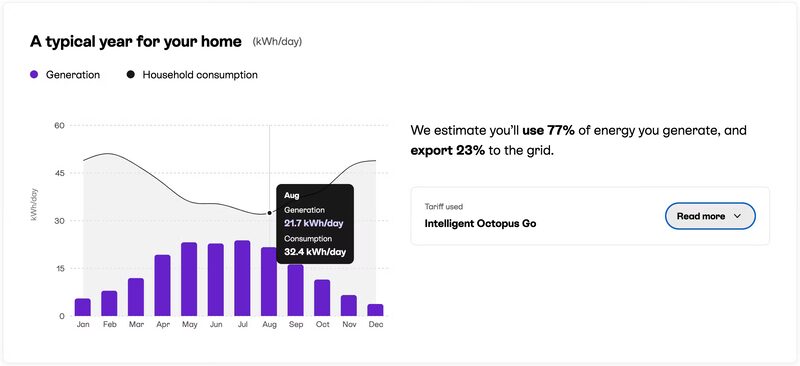
On independence: a larger array raises the share of annual kWh the home produces, but not the share it produces at the moment it is needed. Guidance for typical households gives 10 to 20 square metres of PV as generating between 20 and 40 per cent of a household's electricity needs25. The supply contract, the meter and the network connection remain in place at every size considered here.
How many panels: counts by house size
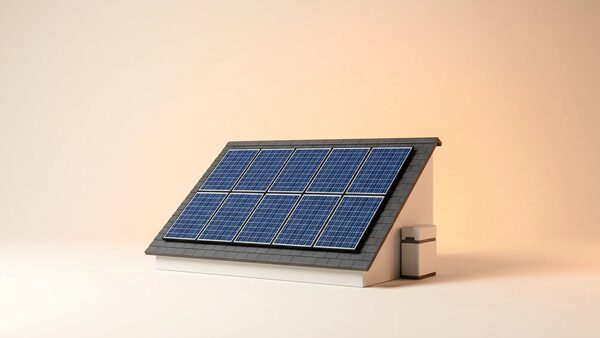
Panel counts follow from system size and module wattage, which is why published counts vary. A standard three-bedroom house is put at around 10 panels, against around six for an average one-bedroom house26; the same count of around 10 panels appears with a 3.5 system figure elsewhere27. A three-bedroom home has also been matched to 3.5 to 4.0 kW using 9 to 10 panels rated 400W each, against daily use of 8 to 10 kWh28, and an average UK household to between 3.5 kW and 5 kW, around 9 to 13 panels at 400W each28.
| Home | Size and panel count | Source type |
|---|---|---|
| One bedroom | around 6 panels26 | independent |
| Three bedrooms | around 10 panels26; 3.5 to 4.0 kW, 9 to 10 panels at 400W28 | independent; maker |
| Three to four bedrooms, around 2,700 kWh a year | 3kW, about 8 to 10 panels29 | maker |
| Four bedrooms | 4 to 5kW15; 5kW to 6kW, 16 to 20 panels13 | maker |
| Typical UK homeowner | 3 to 4 kW, 8 to 12 panels30 | maker |
Space follows the same pattern: a 3kW system is given as needing 20 square metres and a 5kW system 33 square metres13, which sits alongside the independent figure of at least 20 square metres for 4kWp1. Higher-efficiency modules cut the count for a given kWp, which is covered under panel specifications and efficiency.
Where batteries, EVs and heating change the calculation
Adding a battery, a heat pump or an electric car moves both the consumption figure and the occupancy assumption, so it changes the sizing input rather than just the equipment list.
Battery sizing is reported to depend on three factors: total daily electricity consumption, the power of the panels, and how and when electricity is used through the day23. Published rules of thumb differ: 5 to 10 kWh for homes with higher evening usage or those wanting to reduce grid reliance29; around 8 kWh for households of one to three bedrooms, and 9.5 kWh for a four-bedroom home31; a minimum of 10kWh for a 5kW system, or nearer 13kWh where future expansion is planned31. One household in a consumer account sized its batteries at approximately 10 per cent larger than its use during the 18 hours of daytime tariff32. These are supplier and householder figures, not an official method, and the MCS self-consumption calculation is explicitly not a storage sizing tool10.
A UK field study of solar PV with electric heating used systems from 3.89kW to 5.81kW with batteries between 6kWh and 13.5kWh33, which is a useful marker for what sizing looks like when electric heat is part of the load. For heating more generally, a 4kWp system could generate around 3,500kWh a year depending on where in the country it sits34.
For electric vehicles, seasonality dominates. In summer a reasonably sized system can cover a significant portion of a typical household's EV charging needs, while in winter output drops considerably and grid top-ups become more necessary35. Research trial work has monitored 72 homes with solar panels, batteries and EVs as a combined group36, reflecting how often the three now arrive together. One household with solar and a heat pump reported using around 3,000kWh of its output37.
Roof space, permitted development and other practical limits
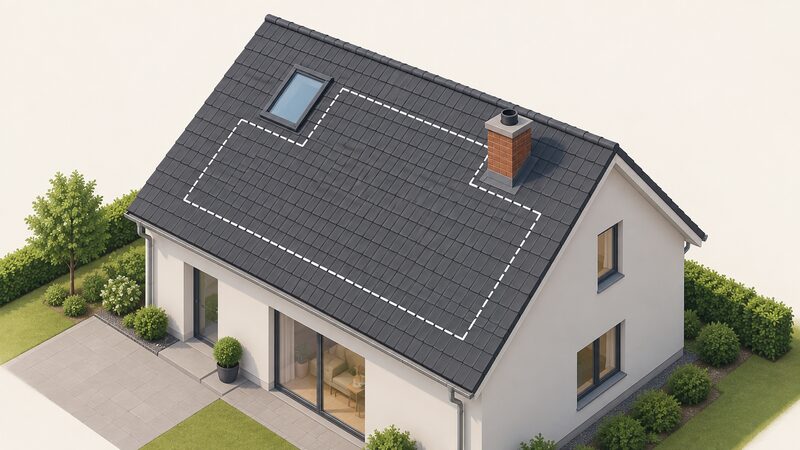
Roof area is the first hard stop. At least 20 square metres is needed for a 4kWp array1, and 20 to 30 square metres for 4.5kWp with around 12 panels8. Usable area is smaller than total area: the number of panels that fit may be limited by roof shape, skylights, shading from nearby buildings or trees, local planning or conservation area requirements, and local grid capacity and export limits38. Orientation and shading are treated in detail under roof orientation, pitch and shading.
Planning rules set dimensional limits rather than capacity limits for most homes. Panels on a house or block of flats should not protrude more than 200mm beyond the wall or roof39, and on a flat roof the highest part of the equipment could not be more than 600mm higher than the highest part of the roof, excluding the chimney, under the rules in force before 27 August 202640. Ground-mounted equipment requires planning permission if any part is taller than 4 metres, or if the length, height or depth of any part of the installation is more than 3m41.
The four nations diverge. In Scotland, flat roof systems can be installed under permitted development provided they do not protrude more than 1m from the roof surface, and before that change any rooftop installation of 50kW, approximately 220 square metres, or greater had to be subject to a full planning application, against a limit in England twenty times greater at 1MW, approximately 4,400 square metres, prior to its removal42. In Northern Ireland, the majority of small scale generation connection applications are up to 50kW for solar PV43. Nation-specific detail is on the England, Scotland, Wales and Northern Ireland pages, and connection rules under G98 and G99.
Where a fitted array is not the starting point
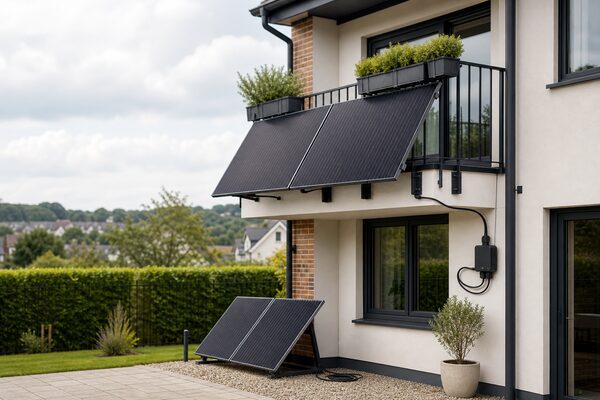
Not every household is sizing a full roof system. Plug-in solar is a distinct category with a much smaller ceiling: typical system size is given as 800W maximum, against 4.6kW for rooftop panels44. Analysis by Carbon Brief finds that plug-in solar could provide 400 kilowatt hours of electricity each year for a typical household from an 800W system, assuming the household is able to use 90 per cent of the output, described as typical for such installations45. That self-consumption assumption is far above the 30 to 50 per cent of a full roof array7, because the system is sized to baseload rather than to annual totals. The Energy Saving Trust's plug-in modelling uses annual household electricity use of 2,500 kWh, Ofgem's typical domestic consumption value6. See plug-in solar kits.
Installations are often not a case of one size fits all46, and system size is one of the factors used when valuing an existing installation, alongside a Feed-in Tariff rate and its remaining years. Once installed, solar panel systems need little maintenance, though the exact upkeep requirements should be confirmed with the installer before installing47. Sizing decisions made at quotation stage are, in practice, fixed for the life of the array, which makes the consumption figure and the occupancy assumption the two numbers most worth checking before signing.
Sources47 cited
- Buying advice for solar panels, Which?, 12 August 2026
- Solar panel myths debunked, Which?, 9 June 2026
- Heat pump questions answered, Energy Saving Trust, 27 May 2026
- A complete guide to solar PV, Centre for Sustainable Energy, November 2025
- Solar panel costs, Which?, 3 August 2026
- Plug-in solar panels advice, Energy Saving Trust, 17 September 2026
- Solar panels guide, Uswitch, 16 September 2026
- Solar panels advice, Energy Saving Trust, 27 August 2026
- Solar power and household energy, UK Parliament POST, 25 June 2026
- MCS 032 solar PV self-consumption, MCS, 1 January 2025
- Solar PV technology overview, Flexi-Orb, 22 April 2025
- 2026 set for record solar power take-up, Solar Energy UK, 14 September 2026
- Cost of installing solar panels, EcoFlow, 16 June 2025
- How much solar do I need for my house, Luxpower, 5 September 2025
- How many solar panels do I need, UK, Bluetti, 12 February 2024
- MGD 003 solar PV self-consumption, MCS, 1 April 2022
- Could you generate your own energy, Energy Saving Trust, 12 April 2024
- Energy tools and calculators, Energy Saving Trust, 12 December 2025
- Solar power for your home, Bluetti, 6 August 2026
- UK solar panel savings, Fuse Energy, 18 June 2026
- Are solar panels worth it?, Which?, 2025
- Are plug-in solar panels worth it, Spirit Energy, 31 July 2026
- Why solar battery storage matters, SunPower, 19 May 2026
- What size solar inverter do I need, Marley, 17 September 2026
- Plumbing with renewables, CIPHE, 17 September 2026
- How long do solar panels last, Uswitch, 13 July 2026
- How many solar panels, OVO Energy, 17 September 2026
- How much electricity does solar power produce, Jackery, 10 July 2026
- Solar panel calculator, EcoFlow, 7 April 2025
- Solar power for your home, Jackery, 11 June 2026
- What size battery do I need, UK, Bluetti, 27 May 2023
- Solar panel owners share pros and cons, Which?, 13 September 2024
- Evaluating solar PV with electric heating, National Energy Action, 3 July 2025
- Electric central heating, Which?, 22 September 2025
- Can solar panels charge electric cars, CPA, 15 April 2026
- Grid impacts of heat pumps, EVs and solar, Energy Systems Catapult, 18 August 2025
- Russell and Kate's story: solar panels and heat pump, Energy Saving Trust, 13 August 2026
- Solar panel installation, Energy Saving Trust, 7 September 2026
- Solar panels planning guidance, City of York Council, 17 September 2026
- Planning permission for solar equipment on a house, Planning Portal, 17 September 2026
- Planning permission for solar panels, Bristol City Council, 17 September 2026
- Scottish Government eases planning restrictions for solar energy, Solar Energy UK, 17 September 2026
- Generation connections FAQs, NIE Networks, 19 September 2026
- Plug-in solar panels, Which?, 15 September 2026
- How plug-in solar can save UK homes on energy bills, Carbon Brief, 2 April 2026
- Tim's story: solar panels and heat pump, Energy Saving Trust, 3 April 2025
- Solar panels, Home Energy Scotland, 20 September 2026
 Sizing a Self-Sufficient HomeHow many solar panels and how much battery storage does a home need to stop relying on the grid?
 What Size Battery?How much electricity does your home use in a day, and how much of that falls in the hours when power is cheap or your solar panels are generating?
 Solar PV Deployment StatisticsHow much solar power does the UK actually have, and how much of it sits on people's roofs?
 Solar Panel CostsA typical UK home pays somewhere between four and eleven thousand pounds for solar panels fitted, with most landing in the middle.
 Self-ConsumptionHow much of the electricity from your own solar panels do you actually use, and how much goes to the grid?
 Solar InvertersWhat does the box on the wall next to your solar panels do, and how long will it last?