In this guide
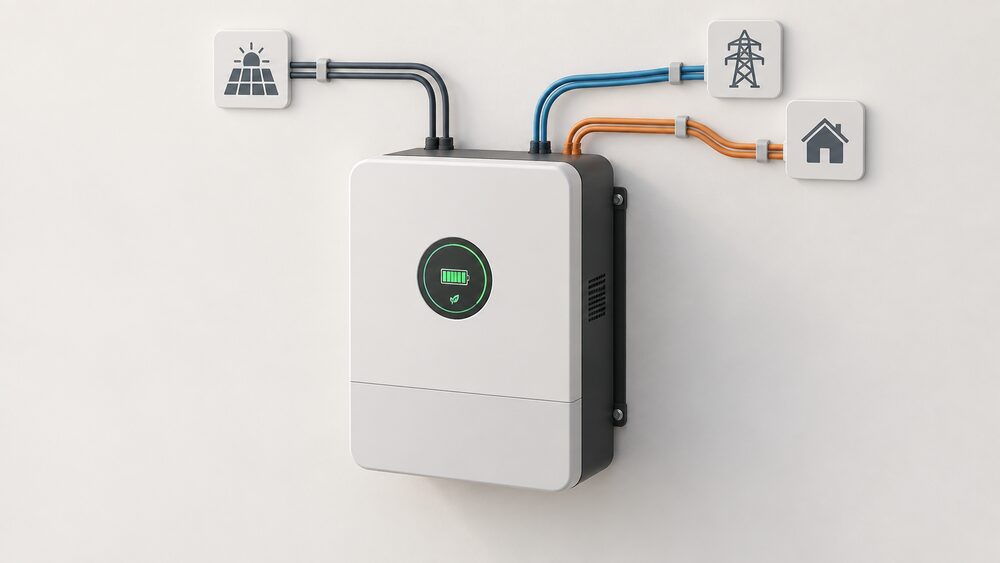
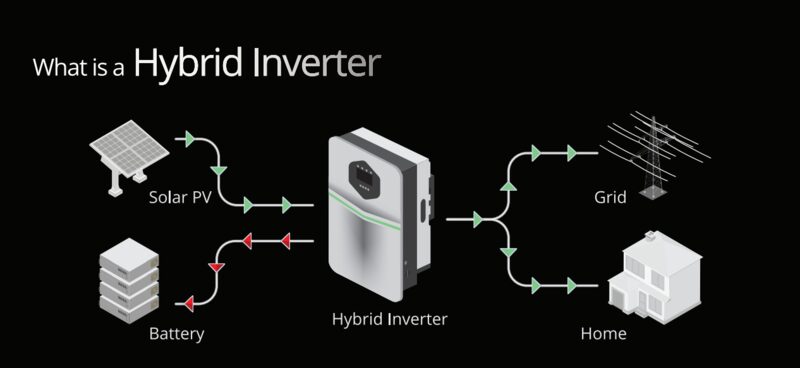
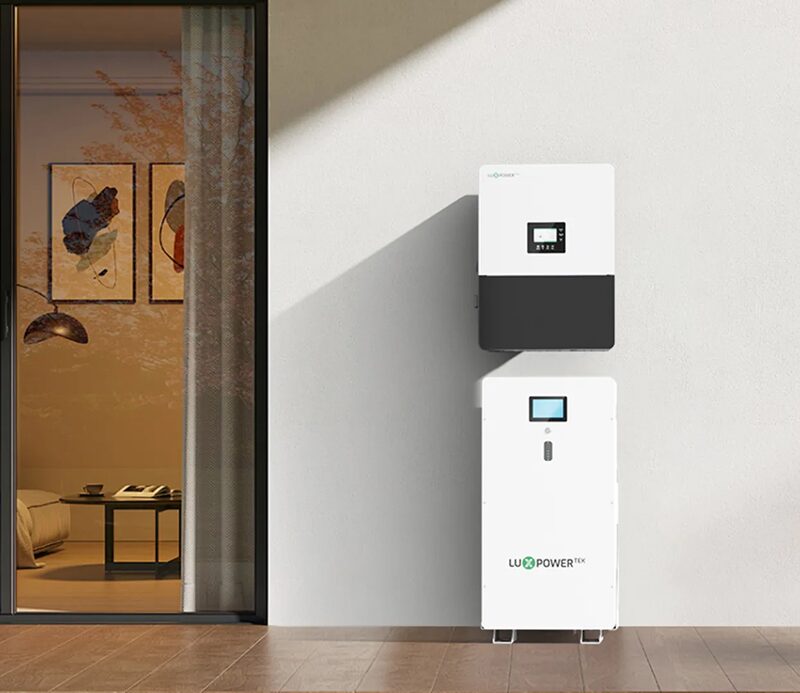
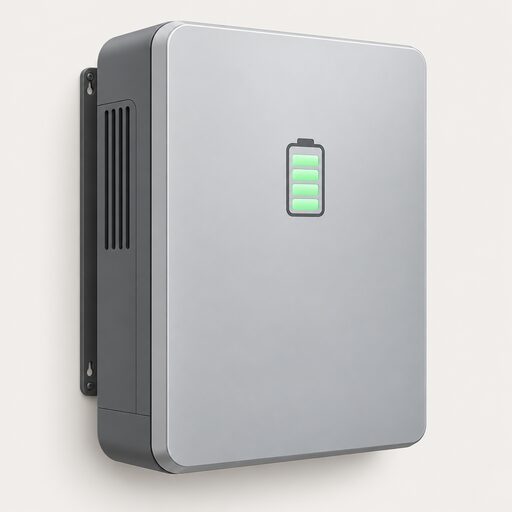
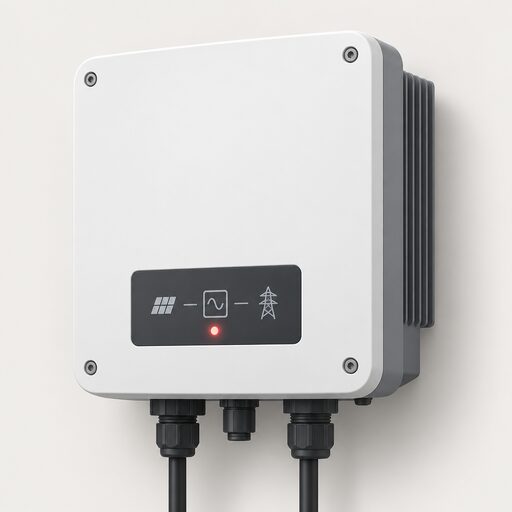
A hybrid solar inverter is a battery plus solar inverter in one unit1. It consolidates the capabilities of a traditional solar inverter and a battery inverter into a single device2, connecting to the grid while also managing battery storage3, and managing energy flows between four sources at once: the solar panels, the battery, the grid and the home's loads4. Some manufacturers go further and build the battery into the same enclosure, an all-in-one unit combining hybrid inverter and LiFePO4 battery on a single wall mount5.
The headline figures are straightforward. Conversion efficiency sits at 97 to 98% for a hybrid inverter according to LuxpowerTek6, with SolaX putting the class at 96 to 98%7. Single-phase residential units run from around 3 to 6 kW at the small end8 and 3.6 kW to 5.2 kW in a typical domestic specification1, while three-phase hybrids are sold from 8 kW up to 25 kW and beyond9. They are the most expensive of the three inverter types because of the battery integration, and the installation is more complex than for an ordinary grid-tied inverter3.
For household energy independence, the hybrid inverter is the component that makes self-consumption and outage backup possible in one box. It is also the component that concentrates the risk: a failure in the device results in the simultaneous loss of both solar generation and battery storage11, and the unit is typically compatible only with specific battery brands, which limits future upgrade options11. The grid connection, the export arrangement and the maker's firmware and app all remain part of the picture.
Three functions in one box: PV conversion, battery charging and grid management
A conventional storage system needs three things: an inverter to convert the panels' DC output into AC for household appliances13, a separate battery inverter to charge and discharge the battery, and a charge controller to govern it. A smart hybrid inverter combines the functionality of all three components, which reduces overall cost against buying them separately6.
The battery management is more than a switch. LuxpowerTek describes the hybrid inverter as controlling charging voltage, managing charging current, preventing overcharging and preventing deep discharge, with temperature monitoring, intelligent charging algorithms, depth-of-discharge control, battery balancing and automatic protection modes6. Those functions are what determine whether a battery reaches its rated cycle life or is worn out early.
Manufacturers describe the energy management the same way across the market. Sunsynk's hybrid range optimises power flow between solar PV, batteries, grid supply and generators14. LuxpowerTek's Hybrid Series covers PV, battery storage and grid-connected energy management in single-phase, split-phase and three-phase options15. Victron's MultiPlus-II inverter/charger is compatible with both solar charge controllers and grid-tie inverters, a different architecture reaching the same end16.
The practical consequence is decision-making: the inverter is deciding, minute by minute, whether a unit of solar generation goes to the house, to the battery or to the grid, and whether a shortfall is covered by the battery or by import. That logic, not the panel count, is what sets how much of a home's own generation it actually uses.
Efficiency: 97 to 98% in practice
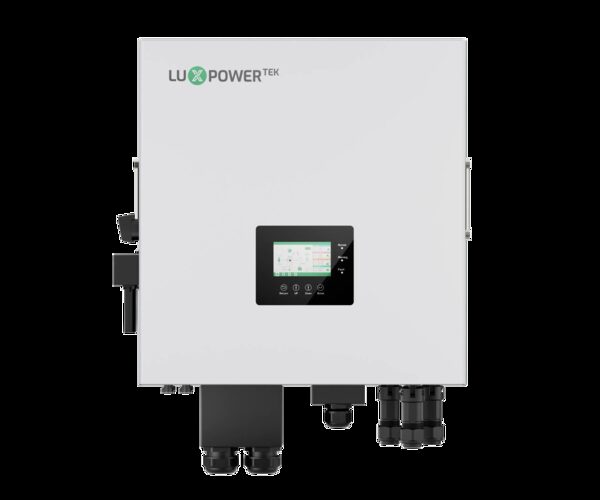
LuxpowerTek states that a hybrid solar inverter already achieves 97 to 98% efficiency, and sets 97% or higher as the level to look for6. SolaX gives a range of 96 to 98% for hybrids, within a wider statement that modern high-quality solar inverters should consistently operate between 95% and 98%, and that the most efficient inverters on the market reach peak efficiencies between 98% and 99%7.
The manufacturers do not entirely agree. SolaX elsewhere notes that hybrid inverters may show slightly lower peak efficiency than plain string units, around 95 to 97%17. LuxpowerTek gives maximum conversion efficiencies for its own hybrid models of between 96.0% and 97.5%, depending on the model and power rating18. Sungrow puts string inverter efficiency at often above 95%19, and one of its large multi-string commercial units, the SG125CX-P2, at 98.5%20. The gap between a hybrid and a string inverter is therefore small and model-specific, not a class difference.
Two published datasheet figures show how the numbers should be read. The myenergi libbi hybrid inverter is rated at 97.6% maximum PV efficiency and 97.0% Euro PV efficiency21. The Marley ES G2 hybrid inverter is rated at 97.6% maximum efficiency8. Maximum efficiency is measured at one favourable operating point; the Euro figure is a weighted average across a range of loads and is the more useful comparison for a house whose demand varies all day.
| Model | Rated efficiency | Source type |
|---|---|---|
| libbi hybrid inverter | 97.6% max PV, 97.0% Euro PV21 | maker datasheet |
| libbi 5 kW hybrid inverter | 97.6% max PV21 | maker datasheet |
| Marley ES G2 hybrid | 97.6% max8 | maker product page |
| LuxpowerTek hybrid range | 96.0% to 97.5%18 | maker |
| Sungrow SG125CX-P2 (multi-string) | 98.5%20 | maker |
A further loss applies whenever energy goes through the battery rather than straight to the house, since it is converted twice. Published inverter efficiency describes the conversion step only, not round-trip storage performance. More on how the conversion stage is rated is set out under solar inverters.
DC-coupled or AC-coupled: which arrangement fits which home
The distinction is where the battery joins the system. A DC-coupled system connects the battery directly to the solar panels before the inverter, tying the array and the storage together on the DC side of the hybrid inverter22. An AC-coupled system connects the battery after the solar inverter22.
The Centre for Sustainable Energy, an independent charity, states that DC coupling is typically more efficient and tends to be cheaper, though such a system might not be able to charge from the grid24. That caveat matters for households wanting to charge on a cheap overnight rate, and it depends on the specific equipment. Makers reach the same efficiency conclusion: Sunsynk states DC coupling is generally more efficient and preferred for new installs25, and Spirit Energy notes that DC coupled systems have a single unit acting as PV inverter and battery charger, making them ideal for new PV installations rather than retrofit26.
AC-coupled systems are often easier to retrofit to existing solar PV installations22, because the original array and inverter are left in place. GivEnergy's AC coupled inverter is described as integrating with existing solar panels, allowing battery storage to be added without altering the array27. Some hybrid inverters accept either: Sungrow states its hybrid inverters offer AC and DC coupling for flexible solar panel and battery connections28, and Tigo's hybrid inverter is offered as AC or DC coupled for new or retrofit installations29.
For homes still on the closed Feed-in Tariff there is an extra wrinkle. Good Energy states that DC-coupled batteries are more complicated to integrate with a FiT system but possible, particularly when replacing the inverter at the same time, and that this requires a hybrid inverter and a bi-directional meter providing a net reading30. SolarEdge's Home Battery is a DC-coupled system requiring a SolarEdge Home Wave or Hub inverter31.
| DC-coupled | AC-coupled | |
|---|---|---|
| Battery connects | Before the inverter, on the DC side22 | After the solar inverter22 |
| Efficiency | Typically more efficient24 | Extra conversion step |
| Cost | Tends to be cheaper24 | Existing inverter retained27 |
| Best fit | New PV installations26 | Retrofit to existing arrays22 |
| Grid charging | May not be possible24 |
Battery compatibility is set by the inverter, not the chemistry
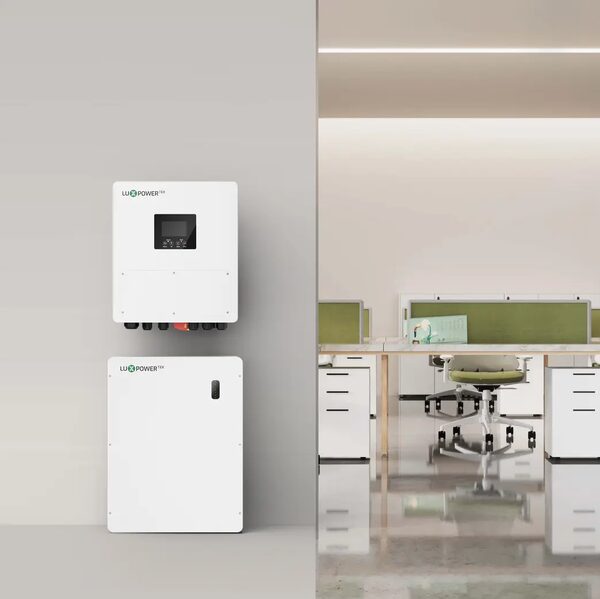
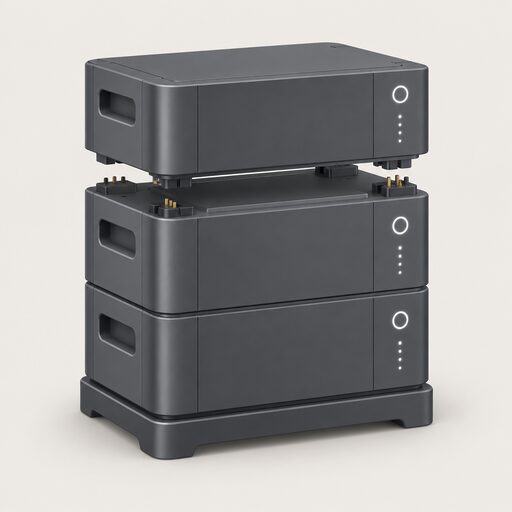
Hybrid inverters handle lithium-ion, lithium iron phosphate (LiFePO4) and lead-acid batteries as the common types6. Sungrow states they work best with lithium-ion batteries, especially LFP, which last longer and offer better efficiency than lead-acid32. New domestic storage in the UK is overwhelmingly LiFePO4: GivEnergy's Hybrid Inverter Gen 3 is designed to pair with modular LiFePO4 batteries so storage can be scaled as needs change27, and the Sunsynk All-in-One integrates a hybrid inverter and LiFePO4 battery in a single wall-mounted unit5.
Chemistry is rarely the binding constraint. The approved pairing list is. SolaX states plainly that a hybrid inverter is typically compatible only with specific battery brands, thereby limiting future upgrade options11. Sunsynk states its inverters are optimised for use with Sunsynk LiFePO4 batteries and are guaranteed compatible across the entire Sunsynk battery range25, which is a clear statement of how tightly the two ends are matched. Growatt's APX battery set is specified as working with the MOD-XH BP and MID-XH hybrid inverters33; its three-phase MOD 4000TL3-XH BP and MOD 8000TL3-XH BP are high-voltage battery class units34, so a low-voltage pack is not an option on those models.
There is also a single point of failure. SolaX notes that a failure in the hybrid device results in the simultaneous loss of both solar power generation and battery storage capabilities11. With a separate string inverter and AC battery, a fault in one leaves the other working. Further detail on retrofit options is covered under adding battery storage to a solar system.
Backup power during outages, and the limits of grid-connected mode
This is the function most households want and the one most often misunderstood. An on-grid inverter cannot function during a power outage because it relies on the grid3. A hybrid inverter can be different: SolaX describes the unit disconnecting from the utility when the grid goes down and continuing to power the home from the panels and the battery11. Sungrow states hybrids ensure backup power during outages3. Growatt describes its APX battery combined with a hybrid inverter as keeping selected circuits running during a grid outage, through the inverter's backup or EPS function33.
The phrase "selected circuits" is the key qualification. Backup is normally wired to a dedicated subset of the consumer unit, not the whole house, and its output is limited by the inverter and battery rating.
"However, most basic models cannot provide backup power (or offer very limited output) during grid outages."
That warning deserves weight. A hybrid inverter is not automatically a backup inverter. The capability depends on the model, on whether a changeover arrangement and a backup circuit were installed, and on whether a battery is fitted at all. Sunsynk's hybrids state support for grid-tied, off-grid and UPS operation14, which is an explicit claim of that capability; not every hybrid makes it.
The genuinely off-grid alternative carries its own penalties. SolaX notes that off-grid inverters require batteries, which significantly increases system cost and maintenance, that available power is limited by the battery and inverter capacity, and that the system may run out of power if solar generation is low and batteries are depleted, unless a backup generator is available11. LuxpowerTek adds that an off-grid inverter cannot export surplus energy, while a hybrid can37.
Anti-islanding protection is the safety mechanism behind all of this: a grid-connected inverter must stop feeding the network when the network is dead, to protect people working on the lines. SolarEdge's single-phase HD-Wave inverter lists utility monitoring, islanding protection, configurable power factor and country-configurable thresholds38. What happens to solar output in a cut is set out under do solar panels work in a power cut?.
Cost: the most expensive inverter type, and why
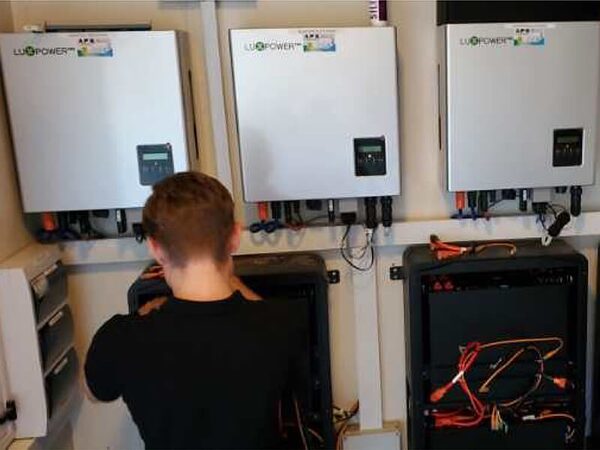
Sungrow states that on-grid systems are the most affordable while hybrid systems are the most expensive, because of the battery integration, and that hybrid inverters carry a higher upfront cost for their advanced features with a more complex installation process than other types3. SolaX attributes the higher cost to complex grid-synchronisation technology11. LuxpowerTek describes the initial cost as generally higher because of the advanced technology37.
No published retail price applies across the category: hybrid inverters are supplied and fitted as part of a system, and prices are installer-quoted. The one general figure available is from the Centre for Sustainable Energy, which puts the cost of replacing a solar inverter at about £500 to £1,00012. That is a replacement cost for an inverter generally rather than a hybrid specifically, and it is useful mainly as a sense of what a mid-life component swap involves rather than as a purchase price.
Against the higher cost sits an offsetting saving. Because a hybrid combines the solar inverter, battery inverter and charge controller in one device, buying one unit rather than three reduces overall costs6. And the operating case rests on time-of-use: LuxpowerTek describes storing energy during the day and using the stored energy during expensive evening hours6, with grid charging available when solar produces almost no electricity at night37. Whether that pays depends on the spread between import and export rates, which is a matter of tariff rather than hardware. Costs across a whole system are set out under how much do solar panels cost in the UK?.
Sizes and phases on the UK market
Domestic single-phase hybrids cluster at the low end. GivEnergy specifies single-phase hybrid inverters at 3.6 kW and 5.2 kW1. The Marley ES G2 is a single-phase hybrid ranging from 3 to 6 kW, designed to increase self-consumption of the solar generated8. myenergi's libbi is offered with a 5 kW inverter in its system configurations39. Sunsynk's single-phase hybrids are sold across a range of ratings14.
Three-phase is for larger homes and small commercial premises. Sunsynk's three-phase hybrids are described in one place as available from 8 kW to 30 kW, balancing load across all three phases and supporting multi-unit parallel operation, and in another as covering 8 kW to 12 kW9; the two statements on the same range do not agree, so both are given. Growatt's three-phase MOD TL3-XH BP hybrids are sold at 4 kW, 5 kW and 8 kW, all transformerless34. At the top of the residential and small-commercial band, Sungrow's SH25T is a 25 kW three-phase hybrid for three-phase residential and small commercial solar storage, backup and energy management10.
| Inverter | Phase | Rated power |
|---|---|---|
| GivEnergy single-phase hybrid | Single | 3.6 kW and 5.2 kW1 |
| Marley ES G2 | Single | 3 to 6 kW8 |
| myenergi libbi | Single | 5 kW39 |
| Growatt MOD 4000/5000/8000 TL3-XH BP | Three | 4, 5 and 8 kW34 |
| Sunsynk three-phase hybrids | Three | 8 to 30 kW (also stated as 8 to 12 kW)9 |
| Sungrow SH25T | Three | 25 kW10 |
Sungrow also markets a 5 kW hybrid for both residential use and commercial applications41, which indicates how far the same hardware stretches across duty types. Sizing the array that feeds these units is covered under what size solar system does a home need?.
Running without a battery, and what happens to the export
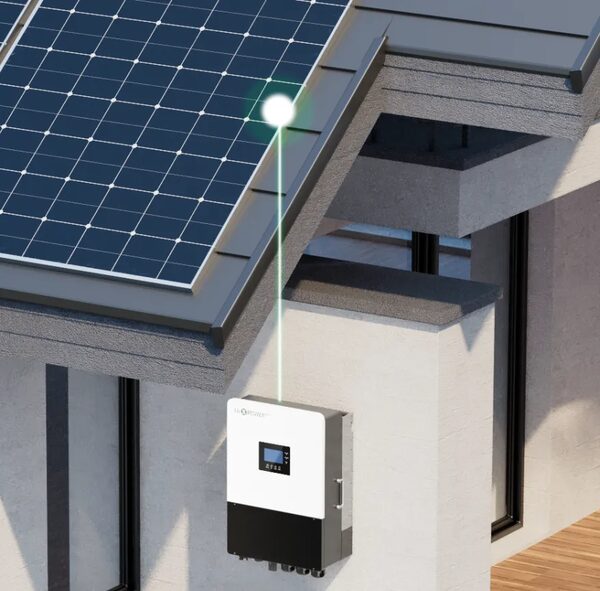
A hybrid inverter does not need a battery on day one. Sungrow states its hybrid inverter can run without a battery, but must be connected to energy-generating components such as PV panels, and to the grid28. SolaX describes the arrangement as flexible: hybrids can often operate without batteries, like a grid-tie inverter, or use them for backup11. Livoltek states simply that its hybrid inverter can work without a battery connected42. That makes the hybrid a battery-ready inverter: a household can install PV now and add storage later without replacing the conversion hardware, which is the main argument for paying the premium up front.
Without a battery the behaviour is that of a string inverter. Sunsynk describes pure grid-tied inverters as being for solar-only applications where battery storage is not required25; a hybrid simply does the same job with the battery ports idle. Surplus goes to the grid: Sungrow describes hybrid inverters transmitting surplus energy to the grid through bidirectional energy conversion28, and Oxfordshire County Council, an official body, describes selling surplus energy not used in the home back to the grid43. LuxpowerTek confirms that a hybrid can export surplus energy while an off-grid inverter cannot37.
Export can also be suppressed. Deye's hybrid inverters offer a Zero Export To Load mode, in which the inverter will neither provide power to the home load nor sell power to the grid, and a Zero Export To CT mode, in which the inverter will not sell power to the grid44. Those settings exist because some network connections are granted only on condition that nothing is exported. What that means for a connection application is covered under export limitation and G100, and the payment side under getting paid for solar export.
Monitoring, weather rating and where the data lives
Every hybrid inverter reports through its maker's platform. Sunsynk's three-phase hybrids feature real-time monitoring through the Sunsynk app, flexible time-of-use scheduling and grid protection functions9. SolarEdge's single-phase HD-Wave inverter includes built-in module-level monitoring38. That visibility is genuinely useful for spotting a failing string or a battery that stops cycling, but it is also a dependence: the scheduling and reporting run through the manufacturer's cloud and app, and a household that relies on time-of-use charging relies on that service continuing.
Weather rating determines siting. Growatt's MOD 5000TL3-XH BP comes with online monitoring and an IP65 enclosure for indoor and outdoor installation40. The Sungrow SH25T package is stated as suitable for outdoors10. The MOD 8000TL3-XH BP uses natural convection cooling35, which means no fan to fail but a need for clear air around the unit. All three Growatt three-phase models are transformerless34.
Fault reporting is by numbered code. On the Growatt MOD XH BP, error 202 means the DC input voltage exceeds the maximum tolerated value, 203 is PV isolation low, 400 is DC overload and 401 a DC high voltage fault. On the AC side, 301 is AC terminals inverted, 302 no AC connection, 303 NE abnormal, 305 an overload error and 403 unbalanced output current. Others cover the unit itself: 200 AFCI fault, 402 current too high, 405 relay error, 406 initialization error, 407 self-test error and 411 communication error45. Growatt gives service@growatt.tech as the contact for persistent errors45. In practice most of these are diagnosed by the installer, who holds the commissioning settings. Monitoring in general is covered under monitoring a solar PV system.
What a hybrid inverter does, and does not do, for independence
The honest position is that a hybrid inverter increases the share of a household's own generation it actually uses, and can keep selected circuits alive in a cut, but it does not disconnect the home from anything. The grid connection remains: the inverter connects to the grid while managing the battery3, and charges the battery from either the panels or the grid37. The supplier relationship remains, because import tariff and export payment set whether the storage pays. The manufacturer relationship remains, and is tighter than with a plain string inverter, because the battery is brand-matched11 and a single failure takes out both generation and storage11.
Against that, an existing PV system can be paired with a battery to store excess electricity for when it is most needed, as MCS, the certification body, describes46. Tigo positions the hybrid as designed to work as part of a solar-plus-storage architecture rather than handling only basic solar conversion47. That is the accurate framing: it is the control point of a storage system, not an escape from the grid. Genuine independence needs the off-grid architecture, with its own penalties in cost, maintenance and the risk of running out of power when generation is low11, as covered under off-grid solar. The comparison against a plain string unit is set out under string inverter vs hybrid inverter, and the wider system under solar PV.
Sources47 cited
- What comprises a typical GivEnergy system, GivEnergy, 2026-09-17
- Guide to solar hybrid inverters, SolaX Power, 2025-01-23
- Inverter technologies compared: off-grid, on-grid and hybrid, Sungrow, 2025-01-07
- How does a solar inverter work, Sunsynk, 2026-06-18
- Sunsynk All-in-One systems, Sunsynk, 2026-09-17
- Choosing the right hybrid inverter, LuxpowerTek, 2026-07-15
- High efficiency solar inverters, SolaX Power, 2026-05-27
- ES G2 hybrid inverter, Marley, 2026-09-17
- Three-phase hybrid inverters, Sunsynk, 2026-09-17
- Sungrow SBH 40kWh storage system with SH25T inverter, Alternergy, 2026-09-17
- Off-grid versus hybrid inverters, SolaX Power, 2026-03-13
- A complete guide to solar PV, Centre for Sustainable Energy, 2025-11
- Solar power facts, Energy Saving Trust, 2026-08-13
- Sunsynk Hybrid Inverter 8kW, Sunsynk, 2026-09-17
- LuxpowerTek products, LuxpowerTek, 2026-08-03
- MultiPlus-II inverter/charger datasheet, Victron Energy, 2026-09-17
- Types of solar inverters, SolaX Power, 2025-12-16
- LuxpowerTek price and efficiency comparison, LuxpowerTek, 2026-08-31
- Everything you should know about solar string inverters, Sungrow, 2026-09-17
- Maximising solar efficiency with multi-string inverters, Sungrow, 2026-09-17
- libbi datasheet, myenergi, 2026-09-17
- Solar panel battery storage, Fuse Energy, 2026-08-13
- Understanding PV and BESS coupling methods, AlphaESS, 2024-07-23
- Battery storage advice, Centre for Sustainable Energy, 2025-10
- Sunsynk inverters, Sunsynk, 2026-09-17
- Batteries, inverters and chargers knowledge base, Spirit Energy, 2026
- GivEnergy products, GivEnergy, 2026-09-17
- Sungrow hybrid inverter FAQs, Sungrow, 2024-11-07
- Inverter power output control, Tigo Energy, 2026-09-17
- How to upgrade your Feed-in Tariff solar system, Good Energy, 2026-07-23
- The best solar batteries explained, Good Energy, 2026-07-14
- Optimal configurations for a hybrid inverter, Sungrow, 2025-04-23
- Growatt APX 20kWh battery set, Growatt, 2026-09-17
- Growatt MOD 4000TL3-XH BP, Growatt, 2026-09-17
- Growatt MOD 8000TL3-XH BP, Growatt, 2026-09-17
- Sunsynk Hybrid Inverter 10kW, Sunsynk, 2026-09-17
- Hybrid inverter versus off-grid inverter, LuxpowerTek, 2024-07-24
- Single phase inverter with HD-Wave technology datasheet, SolarEdge, 2026-09-17
- libbi battery storage, myenergi, 2026-09-17
- Growatt MOD 5000TL3-XH BP, Growatt, 2026-09-17
- Sungrow 5kW hybrid inverter, Sungrow, 2026-09-17
- Livoltek learning centre, Livoltek, 2026-08-12
- Solar panels guidance, Oxfordshire County Council, 2026-09-17
- Deye solar energy storage solutions, Deye, 2026-09-17
- Growatt MOD XH BP inverter error descriptions, Growatt, 2024-01-30
- Solar photovoltaic PV for consumers, MCS, 2026-07-30
- Solar inverter replacement homeowner guide, Tigo Energy, 2026-09-02
 All-in-One Battery SystemsA single unit holding your battery and the equipment that turns its power into usable electricity.
 Inverters and Inverter-ChargersIf the power goes off, what actually keeps your fridge and boiler running?
 AC-Coupled vs DC-CoupledCan you add a battery to your existing solar panels without swapping the inverter, and does one kind waste more of your solar power than the other?
 The Full Home Batteries GuideA home battery stores cheap or solar power for later, but will it really cut your bills enough to be worth it?
 Islanding and Anti-IslandingWhy do solar panels switch off in a power cut, and can you keep the lights on anyway?
 Modular and Stackable BatteriesCan you buy a small home battery now and add more storage later?