In this guide
A grid-connected solar system is built to switch off when the grid fails. That is not a fault and it is not a setting a householder can change: it is anti-islanding protection, and it exists so that a home cannot energise a section of network that an engineer may be working on. The Energy Saving Trust states the position plainly for the newest class of product: "No. Plug-in solar panels are designed to switch off if there's a power cut."1
The same rule applies to a conventional rooftop array on a grid-tied inverter. Your solar panels will automatically switch off during a power cut, and this is a safety feature that prevents electricity being exported to the network; they usually restart on their own once power returns2. For plug-in solar devices, the interim product specification requires that the inverter automatically disconnect from the mains supply within 100 ms of losing it3.
Running a home through an outage therefore means building an intentional island: generation, storage and a means of separating the property from the network. Off-grid inverters do this by design, working independently of the grid and providing energy independence, but they need a battery bank and they carry the whole cost of it4. This page sets out what islanding is, why the shutdown is mandatory, which standards govern it, and what a household can and cannot do about it.
What islanding means and why it matters
Islanding is the condition in which a generator keeps supplying a section of the electricity network that has been disconnected from the wider grid. In a domestic setting it means a home's inverter continuing to energise the wiring after the mains supply has failed. The network operator's concern is straightforward: a line that is believed dead may still be live, and the people working on it, or a neighbour touching it, have no way of knowing.
The scale of domestic generation makes this a live question rather than a theoretical one. Solar deployment has grown to the point where the Committee on Climate Change reports that the roll-out of solar appears significantly off track against what is needed for decarbonisation, which is a statement about pace rather than absence: there is already a great deal of generation connected7. Solar Energy UK notes that the UK's solar deployment plays a crucial role in reducing emissions from the power sector while improving air quality, and that by displacing coal and gas generation it is helping the nation progress toward its net-zero targets8.
For an individual household, the practical consequence is that the grid connection is a two-way relationship with obligations attached. A home that generates is not simply a consumer with a panel on the roof; it is a connected generator, and the connection standards exist to make that safe for everyone else on the same network. That is the trade a grid-connected household makes: it gets to export and to draw power at will, and in return it must disconnect the moment the network loses voltage.
The independence question follows directly. A grid-tied system gives a household cheaper electricity and a lower carbon footprint, but it gives no resilience at all during an outage. The generation asset and the backup capability are separate things, and buying one does not buy the other.
Anti-islanding: the safety rule behind the shutdown
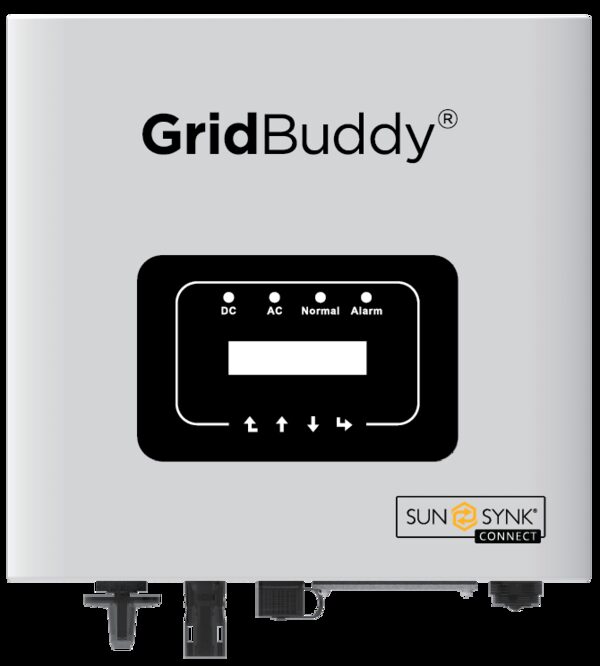
Anti-islanding is the function inside a grid-tied inverter that detects loss of mains and disconnects. It is not a discretionary feature. The interim product specification for plug-in solar devices, published by government, requires that the inverter automatically disconnect from the mains supply within 100 ms following disconnection from the mains supply3. A later version of the same specification repeats the same 100 ms requirement9.
That figure is worth dwelling on. One hundred milliseconds is a very short interval, and the inverter is not waiting to see whether the outage is brief; it is required to stop exporting almost immediately, because the danger to a person working on the line does not wait either.
The safety case for the wider category of home energy equipment is well established. Government states that the legal changes for plug-in solar follow rigorous, independent safety testing, covering all key electrical elements, which shows that compliant panels are safe and compatible with UK wiring10. That position is not universally held. The Electrical Contractors' Association has argued that plug-in solar products are not fit for purpose within the UK's safety-led electrical framework and should not be encouraged, and it notes that there are no consistent UK safety standards for them11.
What this means for a household is that the shutdown is not something to be worked around by configuration. It is the condition on which the connection was granted. Any arrangement that defeats it, whether by tampering with inverter settings or by wiring a generator into a socket circuit, removes the protection the network depends on.
What happens to your solar in a power cut
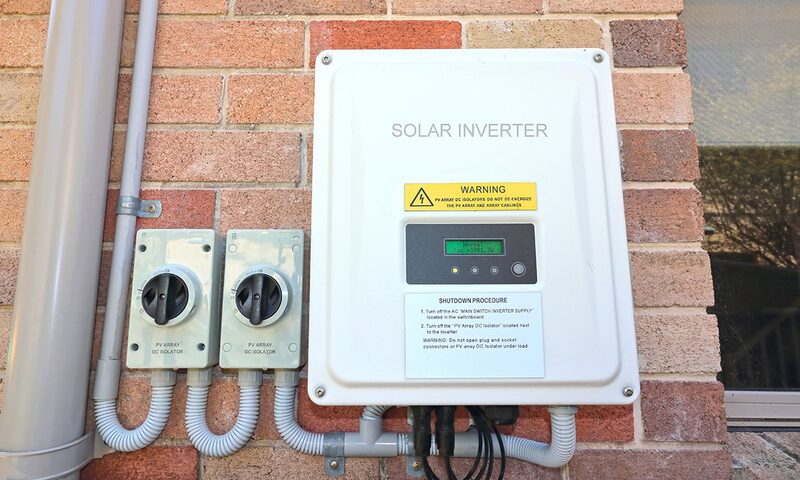
The sequence is consistent across sources. Your solar panels will automatically switch off during a power cut, and this is a safety feature that prevents electricity being exported to the network; they usually restart on their own once power returns2. The equipment itself is not harmed: low carbon technology including solar panels, heat pumps, EV chargers and batteries should not be damaged and will be ready to use again once power is restored2.
There is one exception worth knowing about, and it concerns planned outages rather than faults. Where an outage letter says a temporary generator will be used, the guidance is to turn off your solar panels before the planned outage, and turn them back on once mains power has been restored2. The reason is that a temporary generator supplying the street is a source that the array's anti-islanding protection may not be designed to coordinate with.
The financial picture during an outage is worth stating, because it is often assumed that a power cut costs a solar household nothing. It does: generation that cannot be used or exported is generation that earns nothing. The National Energy Efficiency Data Framework reports that the electricity savings from solar PV declined by around a fifth between Year 1 and Year 5 after installation for installations in England and Wales between 2011 and 201513. That decline is about household behaviour and system performance over time rather than outages, but it illustrates that solar savings are not a fixed quantity.
For plug-in solar specifically, the savings depend heavily on how much of the output is used in the home. Where a household uses only 50% of the solar output, annual savings would fall to around £6014. A report by trade body Solar Power Europe noted that sub-optimal placement such as balconies could cut 30 to 60% from optimal output14. None of that output is available during an outage.
G98 and G99: the UK grid connection standards
G98 and G99 are the engineering recommendations that govern how generation connects to the low-voltage distribution network in Great Britain. G98 covers connection and parallel operation for smaller, single-premises generation; G99 covers larger and more complex connections. The Energy Networks Association writes them: G98 is a UK engineering standard written by ENA6.
The standards are applied by distribution network operators when a household or business applies to connect. Electricity North West sets out the micro-generation and storage connection route for its area, which is the practical entry point for a domestic installation6. The application is not a formality: it is the mechanism by which the network operator knows what is connected where, and it is the reason the anti-islanding requirement is enforceable.
For plug-in solar devices, the interim specification requires compliance with the technical requirements for connection and parallel operation with low-voltage distribution networks in Great Britain, naming G983. The withdrawn earlier version of the specification named Engineering Recommendation G98 Issue 2 Amendment 1 for the same purpose9.
| Standard | Scope | Who writes it | Where it applies |
|---|---|---|---|
| G98 | Smaller, single-premises generation and parallel operation | Energy Networks Association6 | Great Britain3 |
| G99 | Larger and more complex connections | Energy Networks Association6 | Great Britain3 |
Inverter manufacturers expose these standards as settings. Sunsynk advises that G98/G99 should be enabled rather than the Northern Ireland variant G98/G99_NI, and warns that grid settings must not be taken outside G98 or G99 because doing so affects compliance with UK grid regulations12. That is a maker's instruction about its own equipment, and it is the clearest practical statement of where the boundary sits.
The independence implication is that a grid-connected household's equipment is configured to somebody else's standard, and that configuration is a condition of the connection rather than a preference. A household that wants to run through an outage is not looking for a different setting; it is looking for a different architecture.
From G83 and G59 to G98 and G99: what changed
The current standards replaced earlier ones. G98 was previously G83, and it is a UK engineering standard written by ENA6. G99 took over from G59 for larger connections. The change consolidated the smaller-scale route into a notification-based process for single-premises generation, which is why domestic installations are now handled under G98 rather than under the older arrangements.
The direction of travel since then has been towards more generation on the same networks, and towards more of it at the domestic scale. Government has stated its intention of ensuring solar panels are fitted on new homes in England as standard15. Great British Energy announced its first major rooftop solar project in March 2025, enabling around 200 schools and up to 200 hospitals in England to install rooftop solar power and complementary decarbonisation technologies16. The UK Solar Roadmap notes that solar uses 0.1% of total UK land16.
The connection standards have to absorb all of that. Solar Energy UK frames the task as modernising the national grid to accommodate the variable nature of solar power, alongside reducing dependence on fossil fuel imports8. Anti-islanding sits inside that modernisation: it is one of the conditions that makes it possible to have very large amounts of domestic generation on a network without making the network unsafe to work on.
For a household, the practical effect of the G83 to G98 transition is that the connection process for a domestic system is more standardised than it once was, and the inverter settings that satisfy it are a known quantity. The obligation to disconnect on loss of mains has not changed and is not expected to.
Off-grid inverters: the exception that keeps the lights on
An off-grid inverter is the one class of equipment that does not shut down in a power cut, because it has no grid connection to protect. Off-grid inverters work independently of the grid, and off-grid systems provide energy independence4. They suit rural or remote locations without grid access4.
The architecture is different in kind, not degree. A grid-tied inverter synchronises its output to the mains waveform and stops when that waveform disappears. An off-grid inverter creates the waveform itself, from a battery bank, and the household's wiring becomes its own small network. That is what makes it an island rather than a generator: there is no moment at which it is connected to the public network, so there is nothing for anti-islanding to protect.
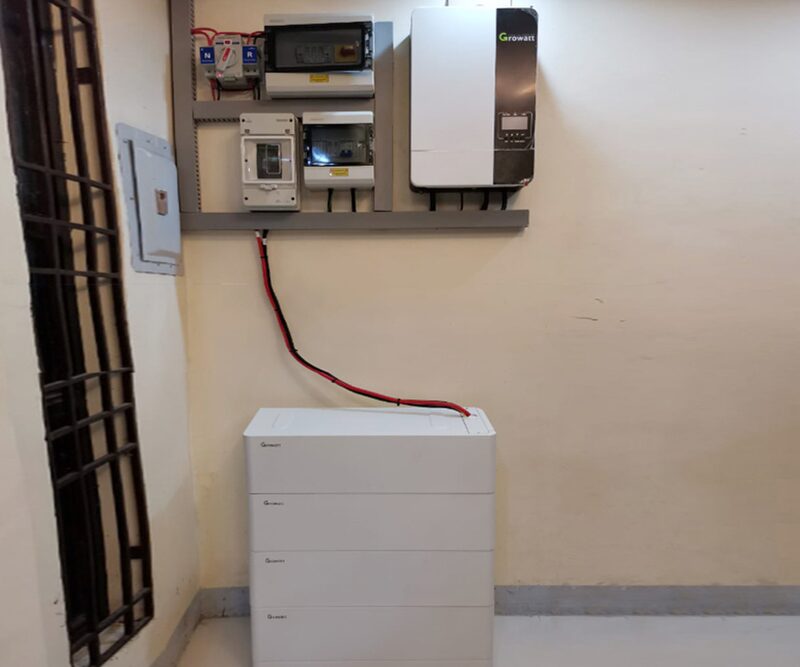
The trade-offs are substantial and should be stated as firmly as the benefit. An off-grid system needs a battery bank sized for the household's worst case, not its average, and that bank is the dominant cost and the dominant replacement item. There is no fallback to the grid when storage runs low, which means either a generator or a willingness to reduce consumption. And the household takes on the maintenance and monitoring that a network operator would otherwise carry.
For a grid-connected home that wants outage resilience without going off-grid, the equivalent arrangement is a battery system with a grid-forming inverter and a changeover that isolates the property from the network before the inverter energises the house wiring. That is a deliberate island, created under controlled conditions, and it is a different proposition from an off-grid installation. The pages on going off-grid and disconnecting from the electricity grid set out what a full separation involves.
Off-grid systems in practice: efficiency and maintenance
The comparison between off-grid and grid-tied inverters is usually framed as efficiency, but the sources frame it as capability and cost. On-grid systems are the most affordable, and on-grid inverters reduce electricity bills and enable net metering, but on-grid inverters cannot function during power outages4. Off-grid inverters ensure a steady power supply even during outages4.
That is the whole trade in three statements. A grid-tied system is cheaper and earns money through export and self-consumption; an off-grid system costs more and delivers continuity. Neither is more efficient in the abstract, because they are solving different problems.
Maintenance expectations are modest for the inverter itself. One documented UK installation reports that while there is no annual maintenance or service required, the inverter is likely to need replacing at some point17. In an off-grid system the battery bank is the component that carries the real wear, and its replacement is the main long-term cost. The household also carries responsibility for monitoring state of charge and for managing consumption when generation is low, which is a behavioural load that a grid connection removes entirely.
The seasonal dimension matters more off-grid than on it. A UK household running an island through winter is managing a gap between generation and demand that a grid connection would otherwise absorb, and the page on the winter gap covers how that mismatch is sized. The off-grid in winter page deals with the practical consequences.
What this means for independence is that off-grid operation delivers the strongest form of it and charges accordingly. The household is not dependent on a network operator, a supplier or an outage schedule. It is dependent instead on its own storage, its own maintenance and its own discipline, and those dependencies do not have a customer service line.
Islanding and battery storage: what a household can and cannot do
Battery storage changes the economics of a grid-connected home without changing its behaviour in a power cut, unless the system is specifically built to island. The Parliamentary research briefing on the subject reports that battery storage with solar increases annual savings from around £150 to £450 a year5. That is a saving on imported electricity, not a resilience feature.
What a household can do is install a battery system with a grid-forming inverter and a changeover arrangement that separates the property from the network before the inverter energises the house. What it cannot do is keep a standard grid-tied inverter running through an outage, or defeat anti-islanding by configuration. The 100 ms disconnection requirement applies to plug-in solar devices3, and the G98 and G99 settings on a conventional inverter are a condition of the connection12.
The distinction between a battery that saves money and a battery that provides backup is the single most important thing to establish before buying. A system sized for arbitrage and self-consumption may have no islanding capability at all, and the presence of a battery is not evidence of one. The pages on behind-the-meter systems and whole-home energy system design set out how the components fit together, and can a UK home be fully self-sufficient deals with the limits of the exercise.
The wider context is that domestic generation is being added faster than the network is being rebuilt around it. Solar Energy UK describes modernising the national grid to accommodate the variable nature of solar power as part of the task, alongside reducing dependence on fossil fuel imports8. Government has reported that Britain continues to break clean power records15. Anti-islanding is the mechanism that lets all of that happen without making the distribution network dangerous to touch, and it is the reason a household's independence, on a grid connection, stops at the meter.
Sources17 cited
- Plug-in solar panels, Energy Saving Trust, 2026-09-17
- Power cuts and emergencies, SSEN
- Plug-in solar final interim product specification, GOV.UK, 2026-07
- Inverter technologies compared: off-grid, on-grid and hybrid, Sungrow, 2025-01-07
- Battery storage and solar, UK Parliament, 2026-06-25
- Micro generation and storage connections, Electricity North West
- Progress in reducing emissions: 2025 report to Parliament, Climate Change Committee, 2025
- The UK's clean energy leadership, Solar Energy UK, 2024-11-29
- Plug-in solar interim product specification (withdrawn), GOV.UK, 2026-06
- Households can save as plug-in solar panels come to market, GOV.UK, 2026-08-26
- ECA welcomes Future Homes Standard but warns safety could be compromised, Electrical Contractors' Association, 2026-03-25
- UK grid voltage, Sunsynk, 2026-09-17
- National Energy Efficiency Data Framework: need report, GOV.UK, 2026-06-11
- How plug-in solar can save UK homes £1,100 on energy bills, Carbon Brief, 2026-04-02
- Britain continues to break clean power records, GOV.UK
- UK Solar Roadmap, GOV.UK, 2025-06
- Installing solar panels to help reduce your carbon footprint, Energy Saving Trust, 2025-09-24
 Backup Power and EPSWill your lights stay on when the power goes out?
 Island Mode and Black StartWhen the power goes off, why do solar panels stop working, and can a home keep its lights on anyway?
 Backup Power for HeatingWhy gas boilers, heat pumps and storage heaters stop in a power cut, what a portable power station can and cannot carry, how to size one, and what home battery systems do when the mains fails.
 Leaving the Electricity GridCan you really cut your home off the grid completely, and what does it cost to have your electricity supply removed for good?
 The Full Home Batteries GuideA home battery stores cheap or solar power for later, but will it really cut your bills enough to be worth it?
 Grants and Energy IndependenceCan you get a grant for solar panels or a battery?