In this guide
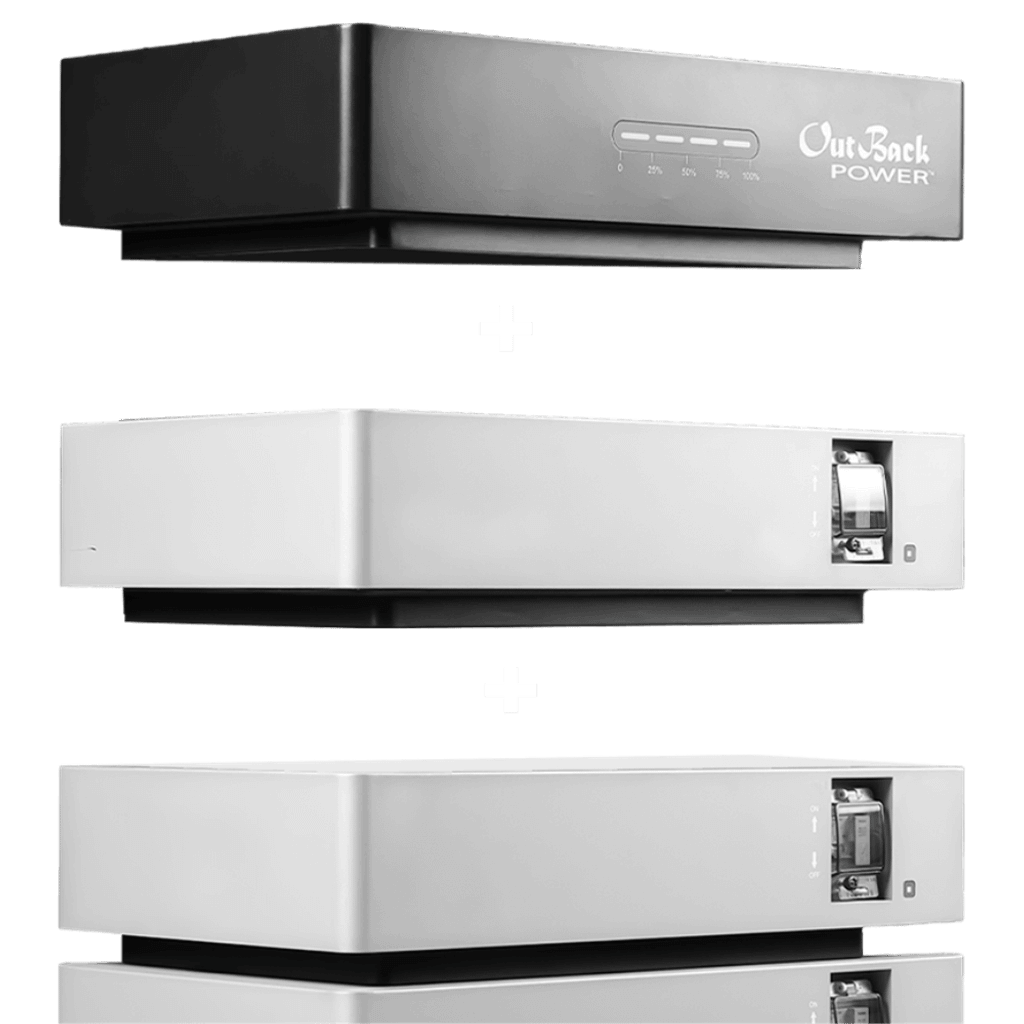
An OutBack Power inverter is an inverter-charger: it takes direct current from a battery bank and produces 230 Vac 50Hz electricity, the same shape of supply the mains provides, so ordinary appliances run from stored energy rather than from the network1. That single function is what makes the Radian and VFXR families relevant to a UK household that wants either whole-home backup or a supply where no grid connection exists at all.
The distinction that matters most is between an off-grid inverter and an on-grid one. An off-grid solar inverter works independently of the grid and ensures a steady power supply even during outages2. An on-grid inverter cannot function during power outages because it relies on the grid3. A hybrid inverter sits between the two: it combines the features of on-grid and off-grid systems, and when the grid goes down it disconnects from the utility and continues powering the home from solar panels and battery storage4.
For a household weighing independence, the trade is clear. An off-grid system provides energy independence and suits rural or remote locations without grid access, but it depends entirely on a battery bank that must be large enough to carry the load through cloudy or low-sunlight periods5. Batteries in off-grid systems are essential and need replacing every six to 10 years6. There is no supplier to fall back on and no network to import from.
What an OutBack Power inverter does: battery DC to household AC
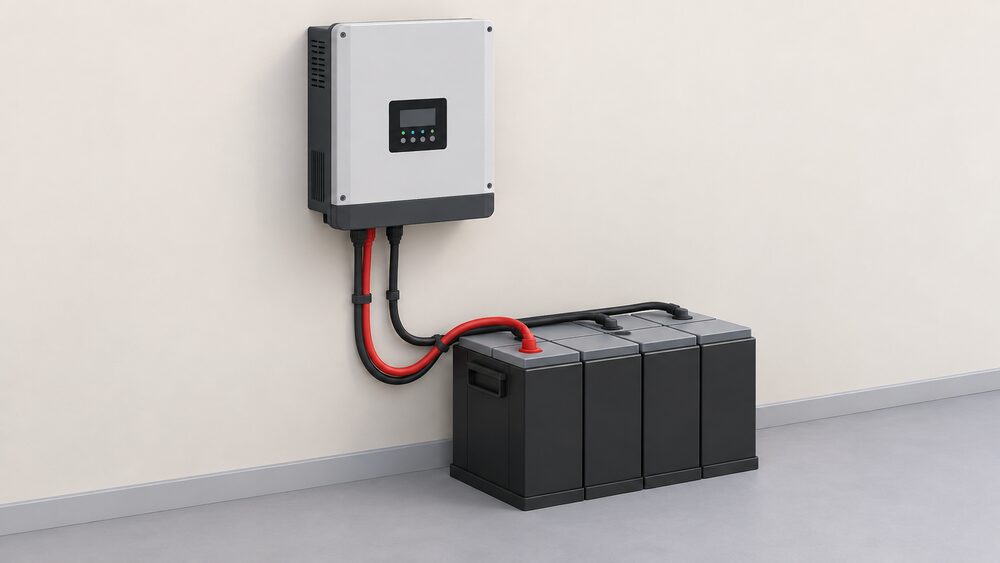
The core job is conversion. An inverter transforms direct current (DC) electricity into alternating current (AC) for mains appliances, and the low voltage DC output of panels or batteries becomes the 230 volts a home uses11. Off-grid inverters produce 230 Vac 50Hz electricity enabling common appliances to be run from a battery1. That is the whole proposition: stored DC in, usable AC out.
An inverter-charger adds the reverse direction. Where a generator or grid supply is available, the charger section refills the battery bank; where it is not, the inverter section drains it. This is why the same box can serve a remote cabin with a back-up generator and a rural house with a modest solar array. Many off-grid inverters only support battery integration, drawing charge only from the battery, which makes the battery bank the single point on which everything depends7.
The output standard matters for UK buyers. Off-grid solar inverters typically deliver 120V/60Hz or 220 to 240V/50Hz depending on region, so the European and UK variant is the one that matches British appliances7. A unit built for the North American market will not run a UK ring main without a transformer, and that is a specification point to confirm before ordering rather than after.
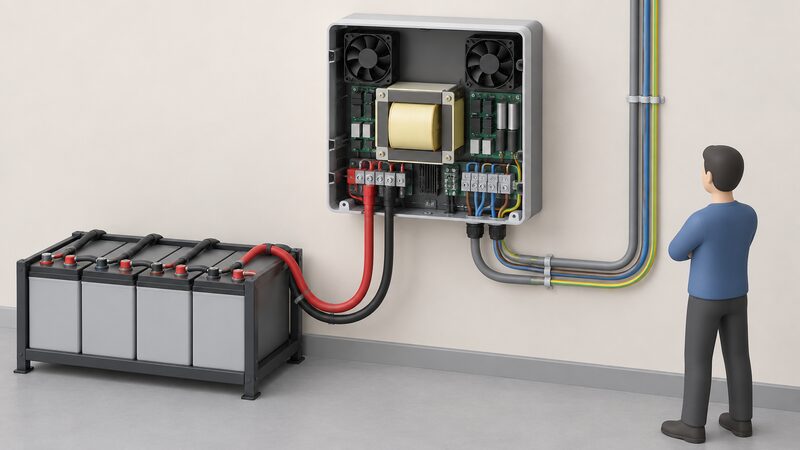
Off-grid Series: unreliable grids, remote sites and self-sufficient solar
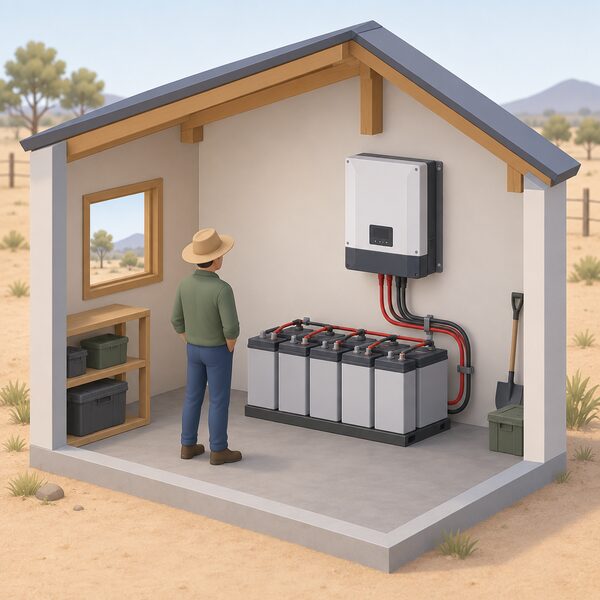
The purpose of an off-grid inverter is total energy independence and self-sufficiency in remote areas4. It operates independently from the grid, and the design intent is a supply that does not notice whether the network is up7. Off-grid inverters suit rural or remote locations without grid access, and are described as ideal for remote areas without grid access2.
That independence is not free. Off-grid and hybrid systems need additional components, making their installation more complex than a straightforward grid-tied array2. The battery bank has to be sized for the worst week of the year rather than the average day, because in off-grid systems the batteries must be large enough to meet your needs, and large batteries ensure power availability in cloudy or low-sunlight periods7. Off-grid systems also depend on battery quality for their overall efficiency2.
The failure mode is worth stating plainly. If the batteries are depleted, there is no power source until they are recharged, and charging takes time, especially in bad weather7. A household used to flicking a switch and getting power has to learn to watch state of charge. Where a generator is available it can bridge the gap, but that reintroduces a fuel dependency and a maintenance routine.
For a UK property already on the network, the same hardware can be used differently: as a backup supply that runs selected circuits when the grid fails, rather than as the only source. That is the hybrid pattern, and it is covered in more detail under island mode and black start and essential loads and backup circuits.
Where they fit: cabins, RVs, boats and rural homes
Off-grid solar inverters are described as ideal for cabins, RVs, boats, and rural areas with no grid access4. They are primarily known for remote applications such as vehicles, camping or outdoor events, and are also found on boats and recreational vehicles and in emergency backup roles7. The common thread is a location where a grid connection is absent, expensive to bring in, or unreliable.
| Application | Typical inverter size | Notes |
|---|---|---|
| Home backup or RV | 1500W to 3000W or more10 | Sized to the loads, not the building |
| Standard RV or camper | 2000W to 3000W10 | Described as the industry standard |
| Small off-grid supply | 12V, 24V or 48V DC to 230V AC1 | Battery voltage sets the input side |
| Plug-in solar (grid-tied) | Capped at 800VA14 | Different category, not off-grid |
The distinction between a cabin and a house is load, not sentiment. A cabin running lights, a fridge, a pump and a laptop sits comfortably in the lower part of that range. A rural home with an electric cooker, immersion heater or heat pump does not, and the inverter size climbs with every high-draw appliance added. Off-grid inverters are less efficient than hybrid equivalents and generally lower in initial cost, which is the trade a remote installation often accepts7.
For households comparing approaches, backup power by home type sets out how flats, rural homes and off-grid properties differ, and add a generator to off-grid solar covers the generator bridge.
Backup power during outages: solar and battery only
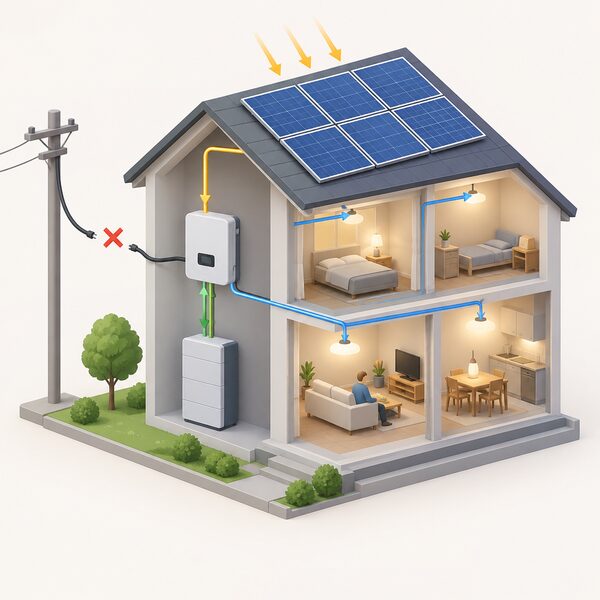
A hybrid solar inverter ensures backup power during outages, and when the grid goes down it disconnects from the utility and continues powering the home using solar panels and battery storage4. That is the mechanism: islanding from the network and running from stored energy. Actual performance depends on battery capacity, inverter power and solar availability12.
PV-only systems usually have no backup during outages, which is the single most common misunderstanding among households that have panels but no battery12. A grid-tied inverter without batteries has nothing to run on when the network fails, and a hybrid inverter in grid-connected mode without batteries does not have grid isolation, so it cannot power the home in a power outage15.
Where a battery is present, some systems reserve it deliberately. One manufacturer offers a Backup Only mode in which the battery power is reserved solely to provide backup power during outages, available for households with its own batteries and a Backup Interface, and intended for those who want to use the battery exclusively for power outages16. Independent guidance is blunter about the general case: not all systems are suitable for power cuts, and households are advised to ask the installer whether a battery will work in a power outage, and for how long17.
Hybrid vs off-grid: which setup suits which home
The two architectures answer different questions. A hybrid inverter combines the features of on-grid and off-grid systems, and is aimed at homeowners wanting to lower bills and have backup power during outages4. An off-grid inverter operates independently from the grid and is aimed at total self-sufficiency in remote areas7.
| Attribute | Off-grid inverter | Hybrid inverter |
|---|---|---|
| Grid connection | Operates independently7 | Can connect to the grid7 |
| Initial cost | Generally lower7 | Most expensive due to battery integration13 |
| Efficiency | Less efficient7 | Higher, with battery integration13 |
| Backup during outage | Steady supply from batteries2 | Disconnects from utility and runs on solar and battery4 |
| Best fit | Remote sites with no grid access2 | Homes wanting lower bills plus backup4 |
Cost is the clearest dividing line. On-grid systems are the most affordable, while hybrid systems are the most expensive due to battery integration13. Off-grid hardware is generally lower in initial cost than hybrid, but the battery bank it requires significantly increases system cost and maintenance, and available power is limited by the battery and inverter capacity7.
For a UK household on the network, the hybrid route keeps a supplier relationship and adds resilience. For a property with no connection, the off-grid route is the only one that works, and it accepts the battery bank as the price of independence. A side-by-side treatment of the two inverter-charger approaches is at Victron vs Outback inverter chargers, and the wider hardware context is in inverters and inverter-chargers.
Maintenance: what owning an off-grid inverter involves
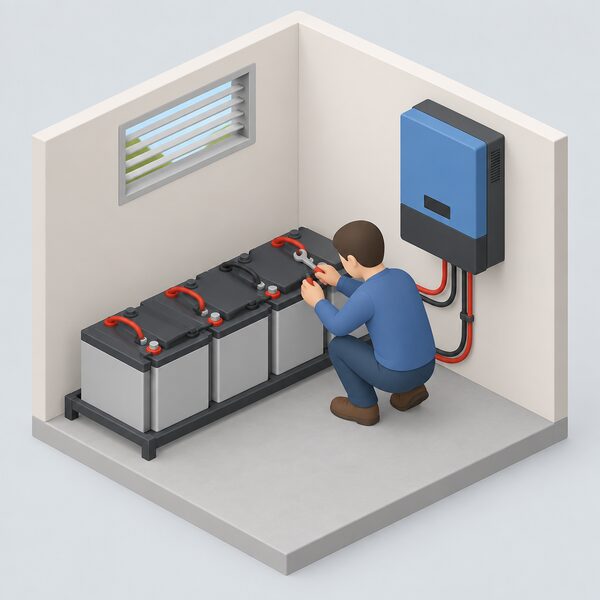
Off-grid inverters need maintenance, and the schedule is set by the battery bank rather than the electronics7. Batteries in off-grid systems are essential and will need replacing every six to 10 years6. If a system is off-grid, the batteries will also need replacing, which is a recurring cost that a grid-connected household never faces18.
The inverter itself has a finite life. Solar inverters typically need to be replaced every 10 to 15 years8. Other independent guidance puts the figure at 10 to 12 years, and elsewhere at around 12 years, so the published intervals differ and the range spans roughly a decade19. Within a 25 year period, the inverter will need replacing at least once20. A small wind turbine inverter may need replacing once during its lifetime6.
Installation complexity adds to the ownership burden. Off-grid and hybrid systems need additional components, making their installation more complex2. Siting matters too: an inverter should be out of the way and easily accessible for maintenance or monitoring21. For areas with relatively single application scenarios, an integrated off-grid output unit adds additional cost burden because of the relatively high cost of hardware and testing22.
Routine work is unglamorous: checking terminations, clearing ventilation, confirming the battery bank is holding capacity, and keeping firmware current. The wider schedule for this class of equipment is set out in maintaining and testing backup power equipment.
Warranty registration and the 48 hour rule
Warranty terms on inverters are longer than many households expect. Most inverters have warranties of five years as a minimum, which can often be extended by up to 15 years9. The condition attached to those terms is registration, and the window is short.
One official scheme specification requires inverter product registrations to activate guarantees and warranties to be completed within 48 hours of commissioning23. That is a scheme rule rather than a universal legal requirement, but it illustrates the pattern: the guarantee runs from a registered commissioning date, and a missed deadline can leave the household on the default term.
Registration needs the serial number, the commissioning date, the installer's details and the model. The serial number is normally on a label on the inverter chassis and repeated in the handover paperwork, so it is worth photographing on the day of installation. Where a system is registered through an installer portal, the household should still keep its own copy of the confirmation.
"Inverter product registrations to activate guarantees and warranties are to be completed within 48 hours of commissioning"
Rapid shutdown compatibility with Tigo
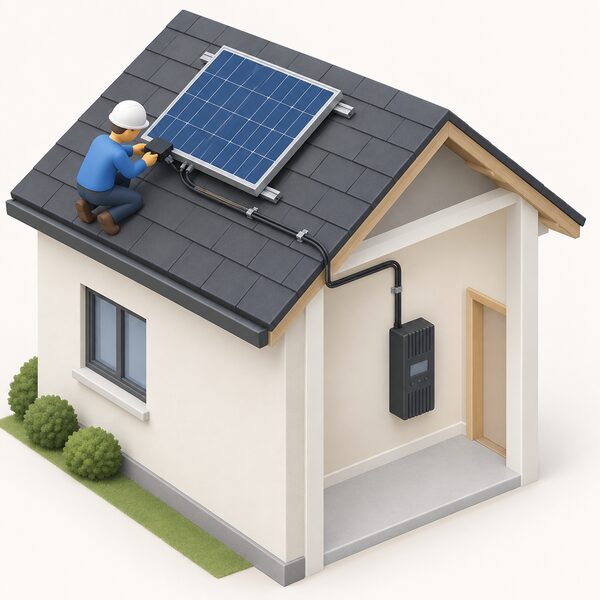
Rapid shutdown is a safety function that reduces voltage at the modules so firefighters can work on a roof safely. It is a North American requirement rather than a UK one, and the standards cited are the US National Electrical Code versions from 2014, 2017 and 202024. Tigo and OutBack announced compatibility between Tigo Fire Safety solutions and OutBack FLEXmax charge controllers for rapid shutdown in April 2020, which is the origin of the pairing householders encounter when reading about OutBack equipment.
The Tigo hardware that delivers it includes the TS4-A-O, which meets US NEC rapid shutdown requirements and complies with NEC 2014, 2017 and 2020, and the TS4-A-F, which complies with the same three versions24. The TS4-X-F lists rapid shutdown among its functions26. The Tigo Rapid Shutdown System Transmitter enables UL PVRSS certified rapid shutdown, and the Tigo GO Inverter is a battery storage ready hybrid inverter with a 50V starting voltage that provides rapid shutdown when paired with Tigo TS4 MLPE and works with the Tigo GO Battery26.
For a UK installation, the practical relevance is limited: the requirement that drives this hardware is American, and British installations follow different standards. The compatibility matters mainly to households importing equipment, to off-grid systems assembled from mixed-vendor parts, and to anyone reading US-oriented documentation and wondering whether the pieces fit together. The general safety framework for this equipment is covered in backup power safety and standards.
Sources27 cited
- Off-grid battery inverters, Wind & Sun, 2026
- Inverter technologies compared: off-grid, on-grid and hybrid, Sungrow, 2025
- Inverter technologies compared, Sungrow, 2025
- Off-grid vs hybrid inverter, SolaX Power, 2026
- Buying a house with solar panels, Energy Saving Trust, 2026
- Small wind turbines, MCS Certified, 2026
- Hybrid inverter vs off-grid inverter, LuxpowerTek, 2024
- Solar panel cleaning and maintenance, Energy Saving Trust, 2026
- Solar panels, Energy Saving Trust, 2026
- What size inverter do I need?, SolaX Power, 2026
- VAT energy saving materials and grant funded heating supplies, HM Revenue & Customs, 2026
- Solar power modes explained: self-consumption, solar export and backup power, Astronergy, 2026
- Inverter technologies compared, Sungrow, 2025
- Plug-in solar panels, Which?, 2026
- What is a hybrid inverter, LuxpowerTek, 2022
- Battery management, SolarEdge, 2026
- Solar panel battery storage, Which?, 2026
- Wind turbines, Uswitch, 2026
- Solar panel installation, maintenance and repair, NICEIC, 2026
- Solar panel installation, Which?, 2026
- What is a solar inverter, Marley, 2026
- Hybrid off-grid output of home energy storage, Dyness, 2024
- Barcud Solar Panel Installation Scheme Specification, Sell2Wales, 2026
- Tigo TS4-A-O, Tigo Energy, 2026
- Tigo TS4-A-F, Tigo Energy, 2026
- Tigo TS4-X-F, Tigo Energy, 2026
- Tigo GO Inverter, Tigo Energy, 2026