In this guide
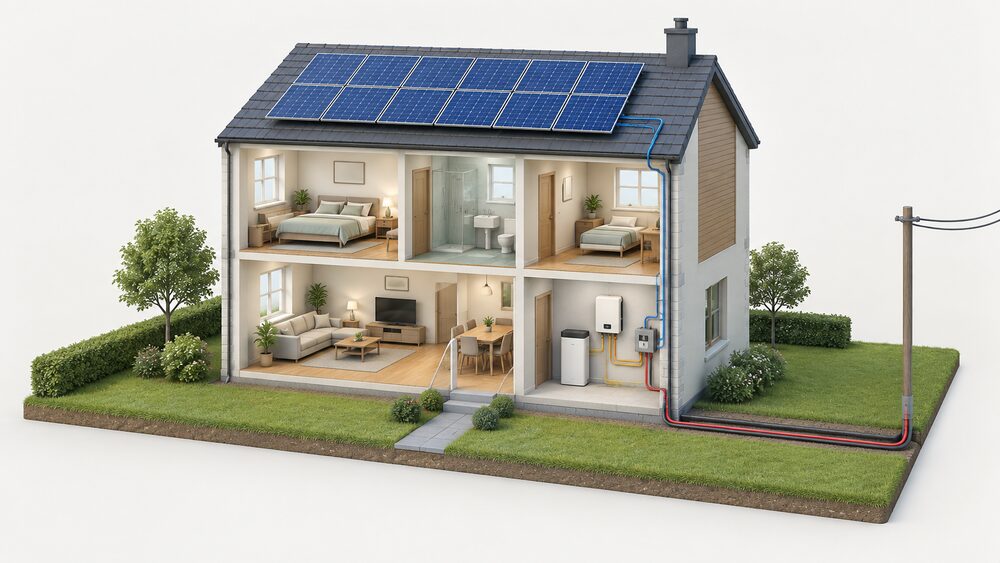
Island mode is the ability of a home's own equipment to keep running when the grid it is connected to has gone. The term comes from the idea that the property becomes an electrical island: a small, self-contained supply with no live connection to the wider network. The Committee on Climate Change describes the same concept in its guidance on a well-adapted energy system, noting that when a building or home has the functionality to operate independently from the grid, known as islanding, a vehicle can act as a backup power source in a power cut1.
The reason most homes cannot do this is anti-islanding protection. Solar panels and grid-tied inverters are built to stop exporting the moment the network goes down, because a live generator feeding a dead network is a hazard to anyone working on the lines. Energy Saving Trust states that solar panels typically cannot power a home during a power cut unless the property is off grid or has additional equipment2. Electricity North West puts it more bluntly: solar panels will automatically switch off during a power cut, a safety feature that prevents electricity being exported to the network3.
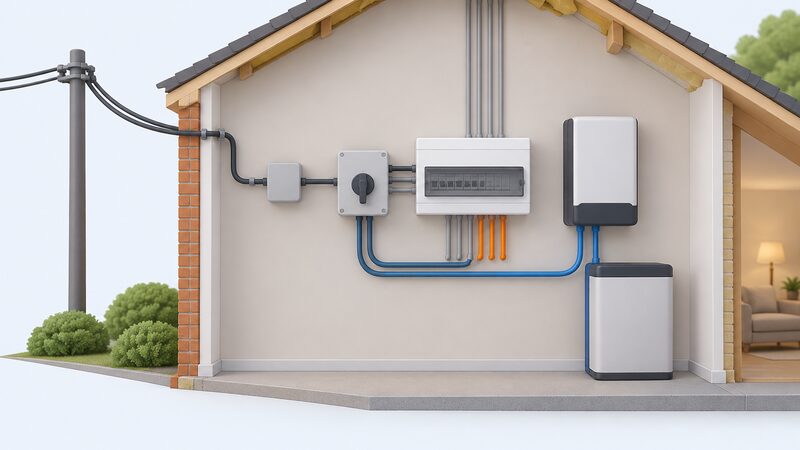
What changes the picture is a specific piece of hardware. A backup interface, an automatic transfer switch or an inverter with an emergency power supply output can disconnect the house from the mains and run a set of circuits from a battery. One maker states that its switch triggers an instant switch-over to the in-house battery storage system during a power failure within a few seconds, and that the process is completed within 5 to 10 seconds4. That is the whole subject in miniature: a deliberate disconnection, a short gap, then a supply that comes from inside the house rather than from the street.
What island mode is: your home as its own grid
Island mode is not a single product. It is a mode of operation that a combination of inverter, battery and switching gear can enter, and it exists on a spectrum from a single socket to a whole consumer unit.
At the simplest end, an off-grid inverter operates independently from the grid and depends only on solar panels or battery storage8. That is islanding by design: there is no mains connection to isolate from, so the question of anti-islanding protection does not arise. At the other end, a grid-tied home with a battery needs a deliberate mechanism to separate itself from the network before it can energise anything. One maker's backup switch does exactly this: the home is automatically disconnected from the mains, and then the back-up power takes over the supply via the in-house battery storage4.
The distinction matters because the two arrangements carry different obligations. A property that is genuinely off grid sits outside the connection rules that govern generators and storage. A property that is normally grid-connected but wants backup capability is still a connected installation, and its protection settings have to satisfy the network operator. That is why island mode is as much a regulatory question as an engineering one.
There is also a safety layer inside the equipment itself. Many newer inverters monitor the insulation resistance of the cables, powering down when a fault is detected9. That behaviour is separate from anti-islanding protection, but it produces a similar outcome for the householder: the equipment stops, and the reason is not always obvious from the front panel.
For a household, the practical meaning is straightforward. Island mode converts a battery from a device that shifts cheap electricity around into a device that can run part of the home when the grid is absent. What it does not do is remove dependence on the equipment maker, the installer and the battery's own state of charge. A home in island mode is self-sufficient for as long as its stored energy lasts, and no longer.
Island mode inverter power cut: what happens, second by second
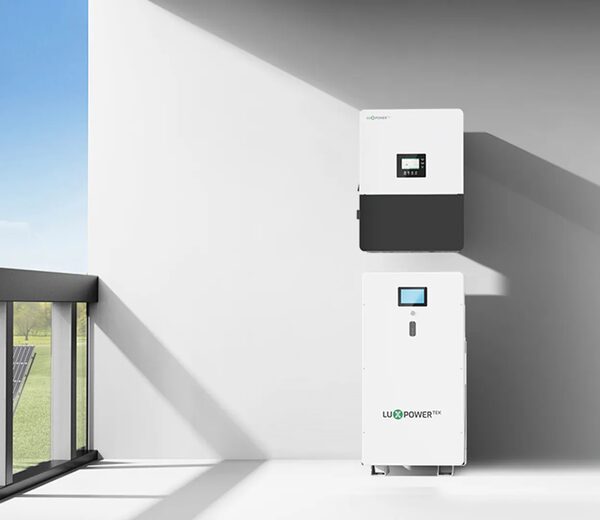
The sequence during a cut is short, but each step explains a symptom householders notice.
- The mains fails. The inverter detects that the grid voltage and frequency have gone outside the range it is set to accept, and it stops exporting. This is the anti-islanding function working as intended, and it is why solar panels stop working during a power cut for safety reasons, with most restarting automatically after power is restored3.
- The battery sits idle if there is no backup interface. The battery may be full, but nothing connects it to the house's wiring. Independent guidance is clear that not all batteries can deliver electricity during a power cut5, and that while some storage devices can provide back-up supplies, this is not always possible and households should check with their installer10.
- The backup interface transfers the supply. The device opens the connection to the mains and closes the connection to the battery-fed supply. One maker describes the sequence as the home being automatically disconnected from the mains, after which the back-up power takes over the supply via the in-house battery storage4.
- The backed-up circuits come back to life. The gap between those two states is the changeover time, and it is the reason clocks need resetting and some equipment restarts.
That gap is also why a home battery is not a substitute for a UPS on equipment that cannot tolerate any interruption at all.
Changeover time: 5 to 10 seconds with an automatic transfer switch
Changeover time is the interval between the grid failing and the backup supply taking over. It is the figure that decides whether a household notices the cut at all.
One maker states that its switch triggers an instant switch-over to the in-house battery storage system during a power failure within a few seconds, and that the process can be expected to be completed within 5 to 10 seconds4. That is a maker's figure for a specific product, and it should be read as such: changeover time is a design characteristic of the switching equipment, not a universal constant.
The reason a gap exists at all is that the transfer is mechanical and deliberate. The device has to confirm the grid has gone, open the mains connection and close the backup connection without ever bridging the two. A faster transfer generally means more capable hardware, and equipment that transfers fast enough to ride through the interruption entirely is a different class of product from a home battery backup output.
It is worth separating this from other switching times that appear in energy paperwork, because they are frequently confused.
| Process | Typical timescale | Source |
|---|---|---|
| Backup supply changeover | 5 to 10 seconds | Maker figure for one automatic transfer switch4 |
| Switching Feed-in Tariff generator registration | Around 4 to 5 weeks | Ofgem12 |
| Comparing energy and completing a switch | Just under 10 minutes on average | Uswitch13 |
| Smart meter installation | Typically 30 minutes for each meter, gas and electricity | Smart Energy GB14 |
None of the last three has anything to do with a power cut. For a household, the practical question is what the gap does to the equipment left running. A few seconds is enough to reset a broadband router, a boiler controller or a clock, and it is not enough to disturb a fridge or a freezer. The figure to look for is the one the maker publishes for the specific transfer device, and it should be read alongside what the backup output can actually supply.
Black start: how a battery restarts a house with no grid to draw from
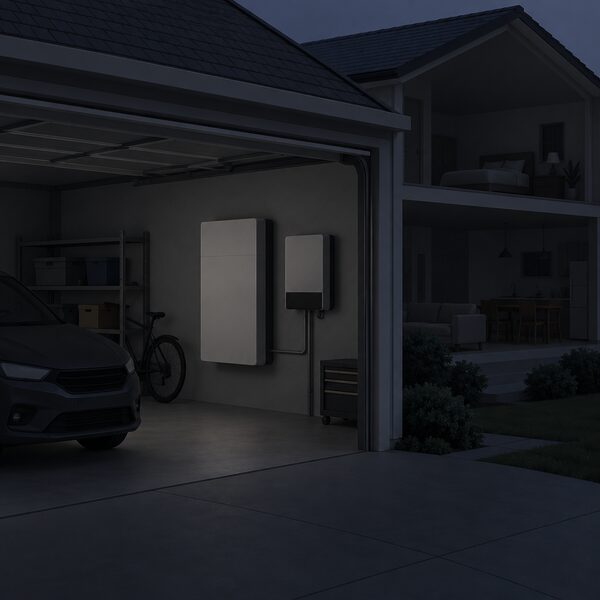
Black start is the ability to energise a property when there is no live grid to synchronise to. It is the difference between a battery that can hold charge and a battery that can run a house.
Most standard home battery installations are designed to shut down when the grid goes dark for safety reasons6. That is the default, and it is why a household can lose power with a fully charged battery sitting in the garage. To run during an outage, a standard installation needs a specific backup interface or a system capable of starting without grid power6.
The equipment that provides this is not the same as the equipment that charges the battery. A hybrid inverter charges the battery from the solar panel or the grid, using the grid to charge batteries when solar produces almost no electricity at night8. That grid-charging behaviour is useful in normal operation and irrelevant in a blackout, because the grid is the thing that has failed. An off-grid inverter, by contrast, operates independently from the grid and many only support battery integration, drawing charge only from the battery8.
That contrast explains why black start capability is a property of the whole system rather than of the battery alone. The inverter has to be able to form a voltage and frequency reference for the property, the battery has to be able to supply the inrush current that motors and compressors demand, and the switching gear has to have isolated the house from the network first.
Keeping solar alive during an outage: PV recharging the battery in island mode
A battery in island mode is a finite resource unless something can recharge it. Solar is the obvious candidate, and the usual answer is that it cannot help, with an important exception.
Energy Saving Trust states that solar panels typically cannot power a home during a power cut unless the home is off the grid or has additional equipment2. The reason is the same anti-islanding rule that stops export: panels switch off automatically during a power cut as a safety feature that prevents electricity being exported to the network3. Electricity North West adds that the equipment should not be damaged and will be ready to use again once power is restored, covering solar panels, heat pumps, EV chargers and batteries3.
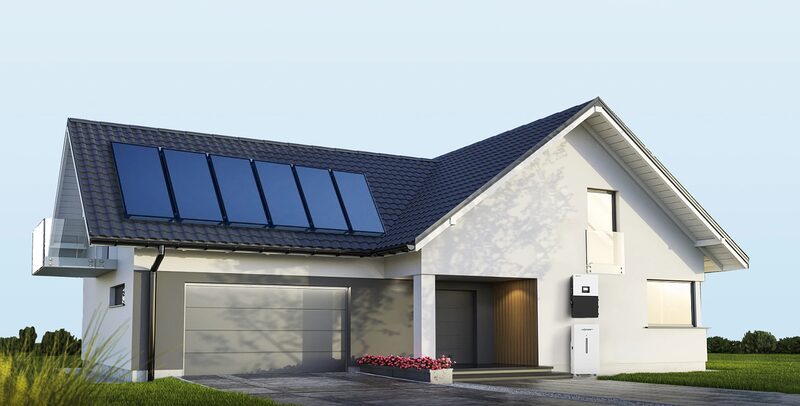
The exception is a system designed to keep the panels running in island mode. One maker states that with its switch, the PV system can continue to run without problems and the battery can also be charged during a public grid power outage4. The same product page lists battery and PV systems as energy sources and states that the battery can be recharged with the PV system8. That is the arrangement that turns a battery from a fixed reserve into a supply that can be topped up while the grid is down.
How much that matters depends on the weather and the season. Solar panels can generate electricity even on cloudy days15, so a winter outage does not mean zero generation, but the output is a fraction of a clear summer day's. A household relying on PV recharge during an outage is relying on the weather as well as on the equipment.
There is a second, quieter benefit to keeping the panels alive. A grid-tied system that shuts down for a long outage is idle capacity, and a system that keeps running is doing what it was bought to do. The limit is that the inverter has to be designed for it, and the backup output has to be sized for the loads the household wants to keep running.
Backup capability varies: what your inverter can and cannot run
The single most important thing to understand about backup is that it is a feature of specific models, not a property of batteries in general. Independent guidance states that not all batteries can deliver electricity during a power cut5, and that while some storage devices can provide back-up supplies, this is not always possible and households should check with their installer10. The Centre for Sustainable Energy adds that the more expensive battery systems can also provide electricity during a power cut16.
What the backup output can run is a separate question from whether it exists. A backup interface supplies a defined set of circuits, and the size of that set is a design decision made at installation. One maker's switch offers a choice between 3-phase or 1-phase supply, carries a maximum current of 3 x 63 A, and is rated IP65 for wall mounting with an ambient temperature range of -5°C to +40°C8. Those figures describe the transfer device, not the battery, and they set the ceiling on what can be connected to it.
| Feature | Figure for one maker's transfer switch | Source |
|---|---|---|
| Supply phases | 3-phase or 1-phase | 8 |
| Maximum current | 3 x 63 A | 8 |
| Enclosure rating | IP65, wall mounting | 8 |
| Ambient temperature range | -5°C to +40°C | 8 |
| Compatibility | DC coupled storage system from the same maker only | 4 |
The practical limits are the ones that apply to any battery supply. Motors and compressors draw a surge at start-up that is far above their running current, and a backup output sized for steady loads may not carry them. A household that wants a particular appliance to survive a cut needs that appliance on the backed-up circuits and within the output's capability, and the only reliable statement of that is the system design.
Grid connection rules: G98 and G99, and why they matter for backup
Every generator or storage asset connected to a UK distribution network operates under protection settings that are there to protect the network and the equipment. G98 and G99 are the technical standards that define those settings7. G98 is a UK engineering standard written by ENA, and was previously known as G8317. Its purpose is to ensure small-scale generation installations connect to the grid safely and do not compromise network stability, safety or power quality17.
The thresholds determine which route applies. G98 applies to smaller systems, typically those with an inverter output up to 3.68 kW per phase for single-phase connections7, while G99 Connection is required for larger systems over 16A, which includes most hybrid backup inverters18. All small generation installation categories demand that generating units are connected via either EREC G99 or G98 Type Tested Inverters2. For units installed before 27 April 2019, the G99 Fast Track process also permits EREC G59 or G83 Type Tested Inverters2.
The point that matters most for backup is a specific exclusion. If the storage is intended to be operated in island mode during a power outage, the fast track process is not applicable7. In other words, a household that wants genuine island-mode capability is not on the simplified connection route, and the network operator's assessment will be more involved. That is not a prohibition; it is a different process, and it reflects the fact that a system able to energise a property independently needs its protection settings examined rather than assumed.
For a household, the practical consequence is that island mode is a conversation with the installer and, through them, the network operator. The rules exist because a generator that keeps running into a dead network is dangerous, and the same rules that require anti-islanding protection are the ones that shape how a compliant backup system is built.
UPS versus battery backup: higher upfront cost, very low running costs
An uninterruptible power supply and a home battery backup solve overlapping problems in different ways, and the cost structures differ accordingly.
An off-grid inverter is generally lower in initial cost and less efficient than the alternatives8. Battery storage increases costs significantly19. The Centre for Sustainable Energy notes that the more expensive battery systems can also provide electricity during a power cut16, which places backup capability at the upper end of the home battery market rather than as a standard inclusion.
The running cost picture is the reverse of the upfront one. A battery backup has no fuel to buy and no combustion to maintain, and its losses are the conversion losses of the inverter and the standby consumption of the equipment. One maker's portable unit includes an ECO mode that automatically detects periods of inactivity and low power demand and turns off its inverter to reduce power consumption20, which illustrates the kind of design detail that keeps standby draw low. Off-grid inverters, by contrast, need maintenance8.
The comparison that matters for a household is not which technology is better in the abstract but which interruption each one covers. A UPS is sized for a specific load and a short runtime, and it transfers fast enough that the load does not notice. A home battery backup is sized for a set of circuits and a longer runtime, and it transfers in seconds. A household with equipment that cannot tolerate a gap needs the former; a household that wants the lights, broadband and fridge to keep going through an evening cut needs the latter.
Fault codes during a power cut: what 'no AC connection' and friends mean
Most fault codes that appear during a power cut are describing the power cut. Recognising that saves a household from diagnosing a fault that does not exist.
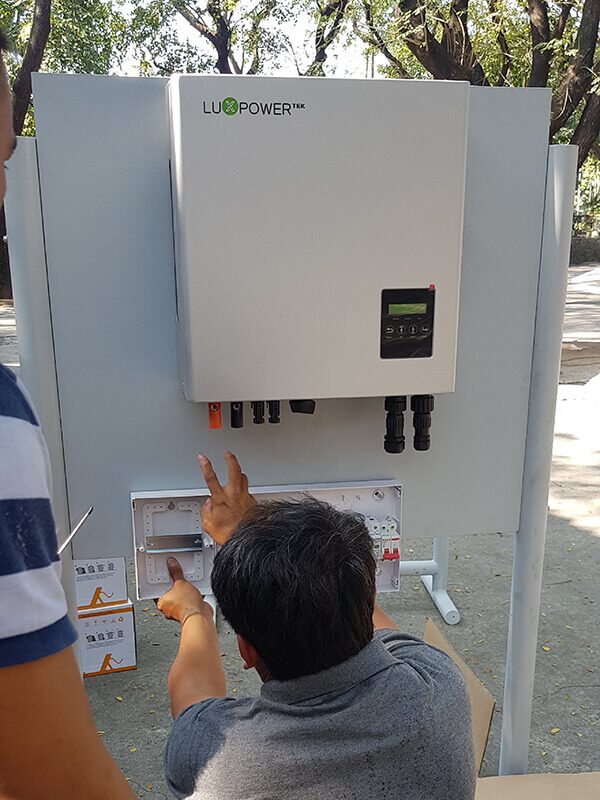
Growatt's storage inverter documentation lists Error 302 as No AC Connection, with the stated cause that the machine has no mains connection21. The suggested check is whether the wiring between the mains and the machine is correct and whether the wiring itself is reliable21. During a genuine outage, the wiring is fine and the mains is simply absent.
| Code | Reported meaning | What it usually indicates in a cut |
|---|---|---|
| Error 302 | No AC Connection; the machine has no mains connection21 | The grid is absent, not a fault |
| Status 107 | No AC grid detected; no stable AC grid is detected22 | The grid is absent, not a fault |
| Status 509 | Not enough power from the PV modules for 24 hours22 | Low solar yield, often seasonal |
| Status 307 | DC voltage too low; not enough voltage from the PV modules22 | Low solar yield |
| Status 522 | DC1 input voltage too low to start operation22 | Low solar yield |
| Status 306 | PV power low22 | Low solar yield |
| Status 65000 | No connection between the inverter and the storage system, or interrupted22 | A genuine communication fault |
| Error 300 / 304 | AC voltage or frequency out of range under the set safety regulations21 | A genuine grid or settings fault |
| Error 418 | Firmware programmed by the machine does not match21 | A genuine firmware fault |
| Error 500 | BMS COM Fault; battery-to-battery communication fails21 | A genuine communication fault |
| Error 505 | Battery reversed; terminals do not correspond to those marked21 | A genuine wiring fault |
| Error 506 | Battery Open; communication is good but the battery is not connected21 | A genuine connection fault |
What a household should expect in practice
The gap between a battery that stores electricity and a battery that runs a house during a cut is bridged by equipment, not by capacity. A household that wants island mode needs a backup interface or an inverter with an emergency power supply output, a battery that can supply the backed-up circuits, and a connection arrangement that satisfies the network operator's protection settings.
The limits are as firm as the benefits:
- Changeover takes seconds, so clocks and routers will reset4.
- The backup output supplies a defined set of circuits, not the whole house8.
- Solar will not help unless the system is designed to keep the panels running in island mode2.
- Compatibility is narrow, with at least one maker's switch working only with its own DC coupled storage system4.
- The arrangement depends on the equipment maker remaining in business and supporting the product, which is why the warranty terms and the company's status matter as much as the specification.
For a household thinking about energy independence, island mode is the point at which a home stops being a passive consumer of a network and becomes something that can operate without it for a period. That period is set by the battery, the weather and the loads, and it is worth being precise about all three before treating a battery as a substitute for the grid.
Sources22 cited
- Well-adapted energy system monitoring framework, Climate Change Committee, 2026-09-19
- Solar power facts, Energy Saving Trust, 2026-08-13
- Advice and support FAQs, Electricity North West, 2026-09-20
- Back-up power supply, RCT Power, 2026-09-19
- Battery storage advice, Centre for Sustainable Energy, 2025-10
- Is a solar battery worth it in 2026, LONGi, 2026
- G98 Single Premises guidance, Energy Networks Association, 2026-09-17
- RCT Power Switch specifications, RCT Power, 2026-09-19
- Hybrid inverter vs off-grid inverter, Luxpowertek, 2024-07-24
- Storage and renewable energy, Electricity North West, 2026-09-19
- Feed-in Tariffs generators, Ofgem, 2026-09-17
- Gas and electricity switching, Uswitch, 2026-09-17
- The smart meter installation process, Smart Energy GB, 2026-04-01
- Generating renewable electricity, Energy Saving Trust, 2025-12-11
- Making the most of your solar PV panels, Centre for Sustainable Energy, 2026-08
- Installations up to 3.68kW per phase at a single premises, SSEN, 2026-09-17
- Micro generation and storage connections, Electricity North West, 2026-09-19
- Installations above 3.68kW per phase but 50kW or less, SSEN, 2026-09-17
- Inverter technologies compared, Sungrow, 2025-01-07
- BLUETTI EB70, BLUETTI, 2026-09-19
- Storage inverter FAQ, Growatt, 2026-09-17
- State codes for SnapINverter, Primo, Symo and Eco, Fronius, 2026-09-17
 Islanding and Anti-IslandingWhy do solar panels switch off in a power cut, and can you keep the lights on anyway?
 Backup Power and EPSWill your lights stay on when the power goes out?
 Essential Loads and CircuitsWhich plugs and lights should stay on when the power goes off, and which can safely go without?
 Maintaining Backup PowerWill your generator actually start when the power goes off?
 Household Resilience and RiskWhat happens to your heating and lights if the power goes off for days?
 Off-Grid Battery SystemsHow many days of power do you need when there is no sun?