In this guide
When the lights go out anywhere in Scotland, the number to call is 105. It is free, it works across England, Scotland and Wales, and it routes the caller directly to the electricity network operator for that postcode rather than to an energy supplier1. Scotland is served by two of those operators: Scottish and Southern Electricity Networks (SSEN) in the north of Scotland, and the network covering central and southern Scotland, for which the listed emergency number is 0800 092 92903. The supplier who sends the bill has no crews and no role in restoring supply.
How long the operator has to get the power back depends on the weather. In normal conditions the Guaranteed Standards of Performance require restoration within 12 hours of an unplanned interruption; in severe storm category 1 weather that stretches to 24 hours, and in severe storm category 2 weather to 48 hours4. Miss the standard and compensation follows, usually paid automatically within 10 working days, with an extra £40 owed if the operator misses the payment4.
Alongside the statutory scheme, both network operators run the free Priority Services Register, and SSEN has gone further: it is distributing 20,000 free home battery packs across its central southern England and north of Scotland areas to Priority Services customers who need the most support6. Those batteries matter for a reason the Scottish statistics make plain: 18% of households in Scotland are prone to frequent power cuts7.
Who to call when the power goes off in Scotland
The 105 number is the single entry point. It is free, it applies in England, Scotland and Wales, and it connects the caller to the distribution network operator responsible for the local wires1. Northern Ireland is separate: the equivalent reporting number there is 03457 6436432. SSEN states its lines are open 24 hours a day, 365 days a year, and cuts or damage to equipment can also be reported through its PowerTrack website and app8.
In practice Scotland has a two-operator split. SSEN is responsible for powering homes in the north of Scotland, as well as central and southern England9. Central and southern Scotland is covered by the other operator, whose published emergency number for that area is 0800 092 92903. Dialling 105 removes the need to know which of the two applies. The operators list contact routes by network area, and SSEN's connections enquiries go to connections@ssen.co.uk, with a supply assessment line on 0800 048 3516 and safety concern numbers of 0800 300 999 and 0800 072 7282 depending on the network area1.
Separate from the wires, Scotland has its own free consumer energy advice service. Advice Direct Scotland runs energyadvice.scot for Scottish citizens with questions about their supplier, their supplier's complaints process or problems with energy bills, reachable on 0808 196 8660 or by online webchat10. For heating and efficiency questions rather than faults, Home Energy Scotland is on 0808 808 228211.
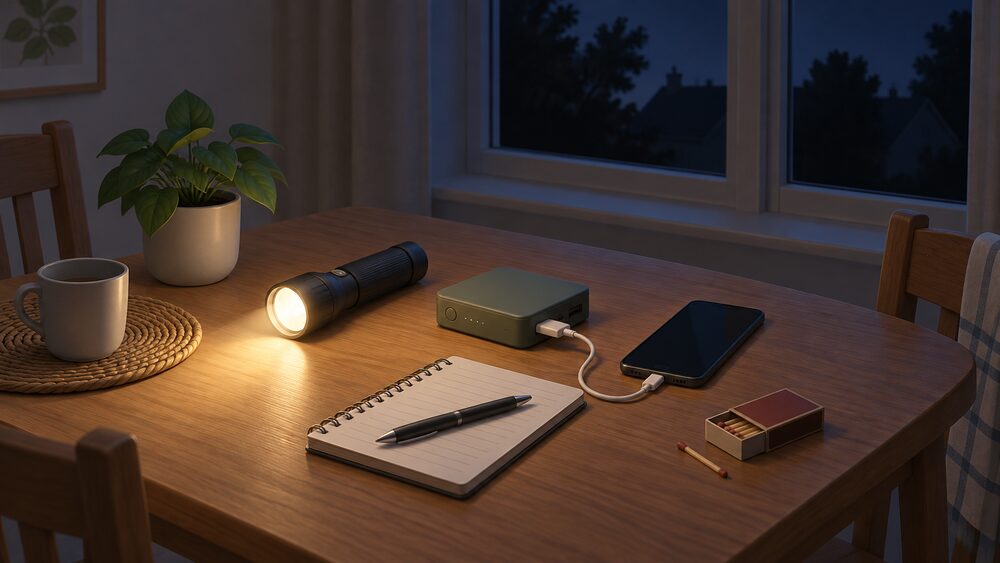
The dependence here is worth naming. A household with no supply and no mobile signal has no way to report the fault, and reporting is what triggers the clock on restoration standards and welfare support. Writing the reporting number down on paper, as network bodies suggest, is the simplest hedge against that2. More on the wider structure is set out in the guide to electricity network operators and the page on the 105 power cut number.
Restoration time limits: 12, 24 and 48 hours depending on the weather
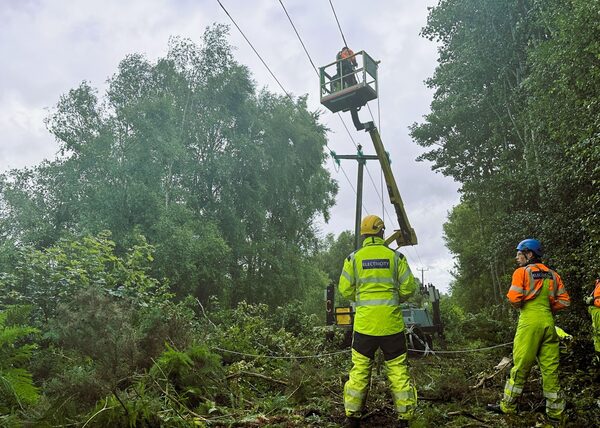
The Guaranteed Standards of Performance set a legal maximum on how long a network operator may leave a household off supply, and the maximum moves with the weather. Ofgem's position is 12 hours for interruptions outside of severe weather, 24 hours in severe storm category 1 weather, and 48 hours in severe storm category 2 weather4. SSEN's own statement of its performance standards puts the normal-conditions duty in its own words:
"if your electricity supply fails because of a problem in our network during normal weather conditions, we must restore it within 12 hours"
The weather categories exist because a storm that brings down hundreds of spans across the Highlands is not the same engineering problem as a single failed cable in a town. National Grid Electricity Distribution describes the same structure: in more extreme weather events or circumstances, the restoration time permitted under the Standards of Performance varies13. One consumer guide notes a further trigger, that the operator must restore supplies within 24 hours if a single fault disrupts more than 5,000 homes14.
Actual restoration is a different matter from the legal limit. SSEN has described weather-related outages as typically taking 12 to 24 hours depending on how easy it is for crews to reach the area, which in the north of Scotland can mean single-track roads, ferries and blocked access15. During one severe weather event SSEN restored supplies to over 25,000 homes and businesses that had lost supply the previous day, and in another it was still working to reconnect a remaining 22,000 properties on the following morning16. Geography, not indifference, is what puts remote and island households at the far end of a restoration queue.
Planned interruptions follow a different track again. For the rota disconnections used in a national supply emergency, temporary cuts would be shared across customers throughout England, Scotland and Wales18. That arrangement is covered in the page on rota power cuts.
Compensation for long interruptions: how much and how it is paid
Compensation under the Guaranteed Standards is calculated in blocks, and the arithmetic is unforgiving to anyone expecting a large sum. Ofgem's worked examples: a cut of more than 12 hours that lasts 36 hours attracts 2 additional £45 payments, adding up to £90; a cut of more than 24 hours that lasts 72 hours attracts 4 additional £45 payments, adding up to £1804. An extra £45 is due for every additional 12-hour period without electricity5. The maximum is £400 where the power cut affects 5,000 or more properties4. Businesses can get £120 for planned and unplanned power cuts4.
Citizens Advice sets out the same scheme with its initial payments named: where fewer than 5,000 homes were affected, £100 if power is off for 12 hours, then £45 for every 12 hours after that; where more than 5,000 homes were affected, £100 if power is off for longer than 24 hours, then £45 for every 12 hours, up to a maximum of £40019.
Storms are treated differently again. For a category 2 storm, Citizens Advice states £90 if the power was off for 48 hours, then £45 for every 6 extra hours without power, up to a maximum of £2,23519. National Grid Electricity Distribution describes a severe weather category 2 payment of £85 for power cuts lasting 48 hours from the time of notification and £40 for each 6-hour period thereafter13. The figures differ between these documents and the difference is not resolved here.
| Situation | Payment | Source |
|---|---|---|
| Unplanned cut, fewer than 5,000 homes | £100 at 12 hours, then £45 per 12 hours | 19 |
| Unplanned cut, more than 5,000 homes | £100 after 24 hours, then £45 per 12 hours, maximum £400 | 19 |
| Category 2 storm | £90 at 48 hours, then £45 per 6 hours, maximum £2,235 | 19 |
| Planned cut without 2 days' notice | £40 | 19 |
| More than 4 cuts of 3 hours or more, 1 April to 31 March | £100 extra | 4 |
| Missed automatic payment | £40 extra | 4 |
Repeated interruptions carry their own payment: an extra £100 where power has gone off more than four times between 1 April and 31 March the following year, with each cut lasting at least three hours4. SSEN's own repeat-cuts page puts the claimable figure at £95 on a similar trigger of four separate interruptions of more than three hours in the same financial year, so the two published figures differ21. Repeat-cut payments normally require a claim rather than arriving automatically4.
Separately from the statutory scheme, SSEN has run storm welfare payments: customers without power for more than 12 hours have been entitled to £30 per person for every day off supply, to cover the cost of food and drink, with receipts kept and claims made through SSEN's storm claim page22. People registered for Priority Services have also been able to claim reasonable costs for alternative accommodation if without power for more than 24 hours23. These are discretionary storm packages announced event by event, not a permanent entitlement.
Payment is normally automatic. The operator will pay automatically if it holds bank details, by cheque, cash or bank transfer, and cheques are typically sent to the property that has been without power5. Where an automatic payment is missed, an extra £40 may be owed4. For storm cuts, Citizens Advice advises contacting the operator to claim if nothing has arrived within four weeks of power coming back on19. The full mechanics are in the page on power cut compensation and the Guaranteed Standards.
The Priority Services Register: free extra help during a power cut
The Priority Services Register is a free service available across Great Britain, run by energy and water companies and by the electricity network operators25. SSEN states plainly that all its priority services are free26. More than 1.1 million SSEN customers were already signed up as of December 2025, and SSEN reported 1.2 million by February 202627.

Eligibility is broad. SSEN lists customers who are deaf or hard of hearing, have a disability, live with children under five, are blind or partially sighted, have a chronic illness, use medical equipment or aids reliant on electricity, or are over 6026. Registration takes a few minutes online through the Priority Services page, using a postcode, or by telephone on freephone 0800 294 325928.
What registration actually delivers:
- A personalised Power Cut Plan tailored to the customer's needs30
- Power cut updates and notice of disruption to supply, 24 hours a day, and advance warning of planned cuts28
- A dedicated support line28
- Information in large print, braille, audio, other languages or British Sign Language28
- Priority support with heating and cooking facilities if supply is cut off, and in some cases a welfare check or hot meals31
- An identification and password scheme for home visits, guarding against bogus callers31
- The option to add a nominated contact to deal with bills or help during a power cut on the customer's behalf33
Needs and circumstances are assessed at sign-up, which is what allows the operator to tailor the response rather than treat every registered household identically6. Details on who qualifies are expanded in the page on Priority Services Register eligibility and the practical steps in how to join the Priority Services Register.
SSEN's Home Battery Pack scheme: 20,000 free batteries
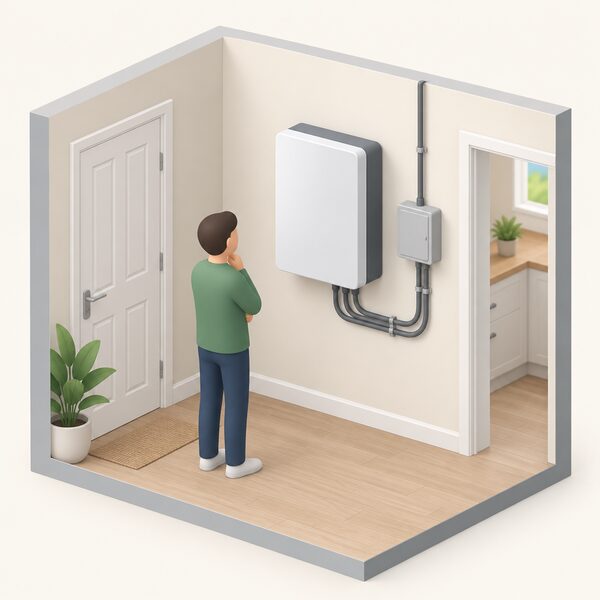
SSEN has begun delivering the first of 20,000 home battery packs to customers across its central southern England and north of Scotland network areas, given at no cost to certain Priority Services customers who need the most support6. More than six thousand customers had already accepted the offer, and SSEN reports that 94% of those offered a battery since the scheme launched at the beginning of February 2026 have accepted it30.
Eligibility is not open application. SSEN's own description sets the test:
"When customers sign up for Priority Services, their needs and circumstances are assessed. This process - together with data on the frequency of power cuts in their area - will determine if a customer is eligible for a battery"
In other words, two conditions operate together: an assessed need, and a local record of frequent interruptions. That second condition is why the scheme lands disproportionately in rural and island parts of the north of Scotland, where overhead lines and difficult access produce both more cuts and longer ones.
The scheme grew from a small pilot. During a six-month trial SSEN gave batteries to 28 customers who rely on powered medical equipment30. The medical claim is carefully hedged in SSEN's own words: subject to approval from the manufacturers of specialist in-home medical equipment, the battery may keep these devices operating for longer during a power cut6. That is a qualified statement about duration, not a guarantee of continuity, and it depends on a third party's approval. Energy Networks Association guidance is blunt on the point: anyone who needs medical equipment that requires electricity should check that back-up equipment is in working order34. The subject is treated at greater length in help during a power cut if you rely on medical equipment and the page on the SSEN Home Battery Pack scheme.
What a home battery pack can and cannot keep running
A portable battery pack is a bridge, not a substitute for the grid. It runs low-draw essentials for a period: lighting, phone and tablet charging, a router, and in some cases powered medical equipment for longer than would otherwise be possible6. It will not carry electric heating, an electric shower or a hob for any useful length of time.
Two limits are structural. First, batteries stop discharging before they are empty: the Energy Saving Trust notes systems stop at a set level, perhaps 20% of total storage capacity, so usable energy is less than headline capacity35. Second, and more often misunderstood, a fixed home battery installed with solar does not automatically work in an outage. Which? states that not all systems are suitable for protecting against power cuts, and advises asking the installer whether the battery will work in an outage and for how long36. The Centre for Sustainable Energy is equally direct that not all batteries can deliver electricity during a power cut37, and Electricity North West notes that in some cases storage devices can provide back-up supplies but this is not always possible38. Without islanding capability a battery shuts down with the grid for safety reasons.
Low-tech options still count. Portable power banks can hold enough power to charge a mobile several times and are worth having to hand39. A phone that still works is what keeps a household in contact with the operator and with family.
Equipment itself is generally not at risk. SSEN states that low carbon technology such as solar panels, heat pumps, EV chargers and batteries should not be damaged and will be ready to use again once power is restored40.
| Typically supported by a small battery pack | Typically beyond it |
|---|---|
| Lighting, phone and router charging39 | Electric heating and hot water |
| Some powered medical equipment, for longer, subject to manufacturer approval6 | Whole-house backup without an islanding-capable fixed system36 |
Building your own resilience in a Scottish home
Ownership of battery storage in Scotland remains thin. A Consumer Scotland survey found only very low levels of respondents stating they currently have battery storage at home, at 2%41. Public funding has narrowed rather than widened: from 6 June 2024 the Home Energy Scotland Grant and Loan stopped providing new referrals for solar PV and energy storage systems, including electric and heat batteries, and the Scottish Government's own progress reporting records the removal of solar PV and battery as eligible measures42. A trade roundtable described the removal of loan support for solar and battery installations in Scotland as a setback. Where the scheme still applies to storage at all, only one energy storage system may be funded, for example a heat battery or an electric battery.
That leaves most Scottish households self-funding any backup they want, in a country where 18% of households are prone to frequent power cuts7. The practical steps that cost nothing come first: registering for Priority Services, saving 105, and knowing whether the property is on SSEN's network or the central and southern Scotland network. Home Energy Scotland offers free and impartial advice on saving energy, making homes warmer, heating options for off-gas homes and funding for energy-saving improvements, with rural and off-gas households explicitly in scope44. SSEN also publishes an emergency planning portal for residential customers18.
Beyond that, households choose between three broad routes, covered elsewhere on this site: a portable power station for essential loads, a home UPS for a few devices through a short interruption, and a standby or portable generator where longer autonomy matters. Deciding what actually needs to stay on is the step that sizes all three, and is set out in essential loads and backup circuits. Households in rural or off-gas properties may find backup power by home type closer to their situation. The comparable arrangements elsewhere are in power cuts in Wales and power cuts in Northern Ireland.

The honest position on independence is this. A free battery pack, a Priority Services registration and a compensation payment all reduce the harm of a cut; none of them reduces the dependence. The household still relies on the operator's crews to reach the fault, on a phone network to report it, on a manufacturer's approval for medical equipment to be supported, and on a scheme SSEN can alter. Real autonomy in a power cut is a function of stored energy on the premises and of which circuits it can reach, and in Scotland that is now largely a private purchase.
Sources44 cited
- Find my network operator, Energy Networks Association, 2026-09-17
- Storms and bad weather, Energy Networks Association, 2026-09-17
- Scottish Power power cut guidance, EcoFlow, 2025-07-18
- Check if you can get a payment for a power cut, Ofgem, 2026
- Plan for a power cut, Ofgem, 2026
- SSEN gives 20,000 home battery packs to customers who need the most support, SSEN, 2026-02-24
- Fuel Poverty Awareness Day 2025: the importance of solid fuel, HETAS, 2025-11-26
- Electricity Supply Emergency Code, SSEN, 2026-09-19
- Priority Services for customers with sight loss, SSEN, 2026-09-19
- Complain about your energy supplier or network operator, Ofgem, 2026
- Keeping your home warm in winter, Met Office, 2026-09-20
- SSEN performance standards, SSEN, 2026-09-17
- Standards of Performance, National Grid Electricity Distribution, 2026-09-17
- Power cut compensation, BLUETTI UK, 2024-03-20
- Goring power cut and SSEN restoration times, EcoFlow, 2025-11-25
- SSEN restores supplies following high winds, SSEN, 2023-12-22
- Update on our response to Storm Floris, SSEN, 2025-08-05
- Emergency planning portal for residential customers, SSEN, 2026-09-19
- Get compensation if you have a power cut, Citizens Advice, 2026-09-17
- Get compensation if you have a power cut, Citizens Advice, 2026-09-17
- Repeat power cuts, SSEN, 2026-09-19
- Power supplies restored to the vast majority of customers, SSEN, 2025-08-06
- Final push in parts of the Highlands following Storm Amy, SSEN, 2025-10-07
- Power cut compensation, Energy Networks Association, 2026-09-17
- Getting extra support from your energy supplier, Citizens Advice, 2026-09-17
- Weather warning for northern Scotland, SSEN, 2025-12-31
- Help for people with lung conditions in power cuts, SSEN, 2025-12-16
- Helping customers save energy and prepare for power cuts, SSEN, 2026-02-17
- Priority Services community toolkit, SSEN, 2026-09-20
- Home Battery Packs, SSEN, 2026-09-17
- Home energy support schemes, Cheshire West and Chester Council, 2026-09-17
- Priority Services, SSEN, 2026-09-19
- Priority Services Register, Cadent Gas, 2026-09-20
- What happens in an energy shortage, Energy Networks Association, 2026-09-17
- Battery storage, Energy Saving Trust, 2026-08-19
- Solar panel battery storage, Which?, 2026-05-14
- Battery storage advice, Centre for Sustainable Energy, 2025-10
- Renewable energy storage, Electricity North West, 2026-09-19
- What to do in a power cut, Which?, 2026-06-04
- Planned power cuts, SSEN, 2026-09-19
- Consumers and the transition to net zero, Consumer Scotland, 2023-10-08
- Home Energy Scotland Grant and Loan eligibility changes, Scottish Government, 2025-10-02
- Home Energy Scotland Grant and Loan terms and conditions, Home Energy Scotland, 2024-06-05
- Home Energy Scotland programme, Energy Saving Trust, 2026-02-20
 Power Cuts in WalesWho do you call when the power goes out in Wales, and how long should it take to come back on?
 Vulnerable Households EnergyIf someone in your home relies on powered medical equipment, or needs extra warmth because of a health condition, what help is available?
 The Full Backup Power GuideHow long do UK power cuts usually last, and what can keep your fridge, heating or phone going until the power comes back?
 Suppliers in ScotlandWho do you contact in Scotland when something goes wrong with your supplier, whether that is British Gas, ScottishPower, SSE or another big name?
 Prepare a Home for a Power CutA household checklist for before, during and after an outage: what to keep charged and to hand, which appliances to switch off, how long food stays safe and what to do about medical equipment.
 Network Operators and 105When the lights go out, who do you actually ring?