
In this answer
Short answer
The Priority Services Register is a free record that energy suppliers and network operators keep of households that may need extra help during a power cut or a supply interruption. Joining it is a matter of contacting your utility suppliers directly and asking to be added. There is no charge, and with your permission the details are shared between network operators and suppliers, so households should only need to sign up once1.
What it buys a household is practical support rather than money. Ofgem states that for both planned and unplanned power cuts, network operators must offer customers on the priority service register extra help, giving the example of battery packs so that they can still charge phones or medical equipment1. Registered customers also get advance notice of planned interruptions, priority updates during an unplanned cut, and a direct number that gets them through to a dedicated team member3.
The register matters most to households whose independence is thinnest: those relying on powered medical equipment, refrigerated medicines, a stairlift or a heating system that stops when the electricity does. It does not remove that dependence. It shortens the gap between an outage starting and help arriving, and it puts the household on a list that network operators work through first.
What the Priority Services Register is and who qualifies
The register is not a voluntary goodwill scheme. Ofgem's consumer protection guidance for authorised persons states that they are required to establish and maintain a Priority Services Register, a record of consumers who have requested, or been identified and agreed to be on the register due to their personal circumstances or being in a vulnerable situation8. That obligation sits behind the support a household receives.
Eligibility is broader than most people assume. Medical need is one route, but the qualifying circumstances published by Cadent include relying on medical equipment that needs electricity or water, or needing refrigerated medicines; having children under five at home; a serious or chronic illness; anxiety, depression or another mental health condition; a disability; pensionable age; being blind or partially sighted; being deaf or hard of hearing; a lost or reduced sense of smell; needing support with language or communication; and short-term extra support because of a life change such as recovering from hospital or bereavement9.
Network operators publish their own versions of the same list. Scottish and Southern Electricity Networks states that customers are eligible if they are deaf or hard of hearing, have a disability, live with children under five, are blind or partially sighted, have a chronic illness, use medical equipment or aids reliant on electricity, or are over 6010. The Health and Safety Executive's older guidance uses the same broad categories: over 60, chronically sick, disabled, deaf or hearing-impaired, blind or visually impaired11. National Grid adds elderly, very ill, disabled, or reliance on power for medical equipment12.
The practical effect is that a household does not need a diagnosis or a benefits award to qualify. A short-term situation, such as coming home from hospital, can be enough. The register is designed to be joined and left as circumstances change.
How to join: contact your utility suppliers directly

The application route is deliberately low-tech. Carmarthenshire Council's guidance is explicit: to sign up for the Priority Services Register you will need to contact all your utility suppliers directly6. Citizens Advice frames the same step as getting extra help from your gas and electricity supplier by signing up to the register, covering priority calls, engineer passwords and moving a prepayment meter5. Its Welsh-language guidance repeats the instruction to contact your supplier and ask to be added13.
Once you apply, confirmation should follow. Citizens Advice states that your gas network operator and energy supplier should contact you to confirm you have been added to their register3. Scope describes the scope of a single application: register once, and your PSR request will go to your energy supplier, the company you pay your bills to, and your regional network companies including electricity, gas and water4.
Energy UK confirms the sharing arrangement: it is free to sign up to, and with permission, information is shared between network operators and suppliers, so people should only need to sign up once2. The register's purpose is to inform energy suppliers and distribution network operators about people who might need additional support2.
Water companies run parallel registers. Wales and West Utilities, for example, takes applications through an online form or by phone on 0800 072 6202 or by email at priorityservices@wwutilities.co.uk14. Gas distribution networks such as Cadent and SGN run their own registers alongside the electricity side9.
What support you can expect during a power cut
The support package has several strands, and they are consistent across network operators. UK Power Networks lists the help available during a power cut, signing up or updating details, information safety, and partner support17. The Met Office's power cut guidance describes the register as a free service and directs households to sign up in case of power cuts18.
Cheshire West and Chester Council summarises the benefits as priority support with heating and cooking facilities if your supply is cut off, advanced notice of power cuts, and an identification and password scheme for home visits19. Cadent adds that the register ensures you get extra help during an emergency outage, such as a power cut or supply interruption20. Cadent also notes that adding a nominated contact to deal with your bills or help in a power cut on your behalf is part of the offer9.
National Grid's register lists the additional services: a direct number to get straight through; an agreed password before visits; special help through the British Red Cross; being informed about planned interruptions; being kept up to date in an unplanned cut; and free 24 hour power cut alerts and text updates to medically dependent customers12.
Ofgem's consumer guidance sets the floor that network operators must meet. For both planned and unplanned power cuts, network operators must offer customers on the priority service register extra help, for example giving them battery packs so that they can still charge phones or medical equipment1. Energy Systems Catapult describes the same benefit as priority updates and notifications during power cuts or maintenance that may affect electricity or gas supplies22.
In Northern Ireland the equivalent is the Customer Care Register, run by NIE Networks. Calls from registered customers are given priority during a power cut23. NIE Networks also runs a separate critical care register for customers with medical support equipment that relies on power24.
Registering with Electricity North West: contact details and licence area

Electricity North West operates in North Western England, licence area ID 1625. Households in that area register through the company's Extra Care route, and the support is split into named strands including poor mobility, mental health care and temporary support26.
The contact details matter because they are the ones a household will use in an outage. Electricity North West's 24 hour emergency number is 105 or 0800 195 4141, selecting option 1, for electrical hazards or incidents and power cuts7. The company also publishes 0800 195 4141 for Extra Care enquiries26, and 0800 988 1732 for pre-application support calls29. A separate connections support line, 0800 988 1730, handles new connection enquiries30.
Call prioritisation depends on the register holding current details. Electricity North West states that customers who keep their contact details up to date with it will have their call prioritised straight through to a dedicated team member26. The same commitment appears across its poor mobility, mental health care and temporary support pages26.
If you rely on powered medical equipment
Medical dependence is the route that carries the most weight, and it is handled slightly differently from general registration. The Met Office states that if electricity is crucial for any medical equipment in the home, the householder can contact their DNO at any time, as they may be able to put the property on their Priority Register for assistance during any power outage18. The same guidance lists older and disabled people, and those who depend on electricity to keep medical or mobility equipment running, among those eligible to register18.
National Grid's eligibility wording covers households that are elderly, very ill, disabled or rely on power for medical equipment12. Wales and West Utilities describes the offer as extra support if you have medical equipment that relies on power and water14. SSEN's community toolkit lists use of medical equipment reliant on electricity or water as a qualifying circumstance31.
In Northern Ireland, NIE Networks advises customers with medical support equipment that relies on power to join its critical care register24. That sits alongside the Customer Care Register, which gives priority to calls from registered customers during a power cut23.
The register does not supply the equipment or guarantee continuity of supply. What it does is put the household on a list that network operators work through first, and it triggers the battery pack support that Ofgem requires operators to offer1. For a household running a ventilator, a dialysis machine, a powered wheelchair or refrigerated medicines, that is the difference between waiting in a queue and being called.
Households in this position often pair registration with their own backup arrangements. The Priority Services Register page explains the scheme in general terms, and help during a power cut if you rely on medical equipment covers the medical route in more detail. For households weighing up their own standby capacity, portable power stations and home UPS systems set out what can be kept running independently of the network.
Planned cuts and how registered customers are notified
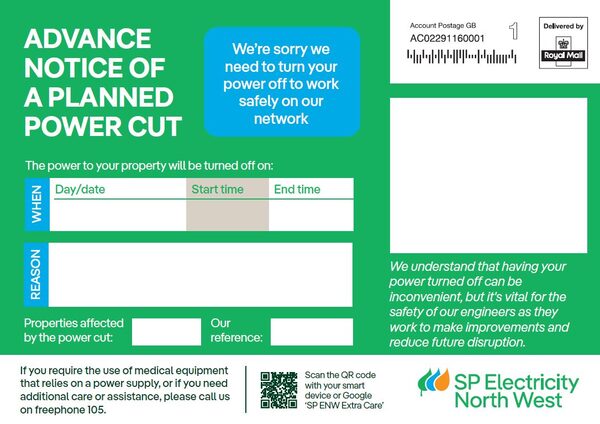
Planned interruptions are where the register earns its keep most reliably, because the notice arrives before the supply goes off. SSEN lists advance notice of planned power cuts where possible among the benefits of registration32. Cheshire West and Chester Council describes the same benefit as advanced notice of power cuts19. National Grid states that registered customers are informed about planned interruptions and kept up to date in an unplanned cut12.
The distinction between planned and unplanned matters for how the notification works. NIE Networks explains the difference between a planned and an unplanned power cut, and the two are handled differently: planned work is scheduled and notified, while a fault is not33. Registered customers get the advance warning where the work allows it, and priority updates where it does not.
Ofgem's guidance confirms that the extra help obligation applies to both planned and unplanned power cuts, so the battery pack support and the priority treatment are not limited to scheduled work1. Energy Systems Catapult frames the benefit as priority updates and notifications during power cuts or maintenance that may affect electricity or gas supplies22.
Two practical points follow. First, the notice depends on the contact details held, so a change of number or address needs to be passed to the supplier and the network operator. Second, the register is not a compensation scheme. Electricity North West states that it is unable to reimburse customers for food lost during a power cut, but it can provide a letter confirming the outage for insurance claims7. Households wanting to claim for spoiled food would look to their insurer, and the power cut compensation rules cover the interruption itself rather than its contents.
For households in the North West, the network operator support schemes page sets out how the Extra Care strands fit together, and who fixes a power cut explains the split between the network operator and the supplier. Households outside England can check the equivalent arrangements for Scotland, Wales and Northern Ireland, and the Priority Services Register page covers the scheme as a whole.
Sources33 cited
- Plan a power cut, Ofgem, 2026
- Vulnerable customers, Energy UK, 2026-09-04
- Getting extra support from your energy supplier, Citizens Advice, 2026-09-17
- Disability energy support, Scope, 2026-09-20
- Grants and benefits to help you pay your energy bills, Citizens Advice, 2026-09-17
- Heating your home, Carmarthenshire County Council, 2026-04-04
- Be summer ready, Electricity North West, 2026-09-19
- Heat networks consumer protection guidance decision, Ofgem, 2026-01-13
- Priority Services Register, Cadent Gas, 2026-09-20
- SSEN on alert as we prepare for Storm Eowyn, Scottish and Southern Electricity Networks, 2025-01-22
- Working with display screen equipment, Health and Safety Executive, 2011-09
- Who can join the Priority Services Register, National Grid, 2026-09-17
- You can't afford to top up your prepayment meter, Citizens Advice, 2026-09-17
- Priority Services Register promise, Wales and West Utilities, 2026-09-20
- Priority Services Register, SGN, 2026
- Reducing your energy usage, SGN, 2026
- Priority services, UK Power Networks, 2026-09-17
- What to do in a power cut, Met Office, 2026-09-20
- Support schemes, Cheshire West and Chester Council, 2026-09-17
- Priority Services Register, Cadent Gas, 2026-09-20
- Check if you can get payment for a power cut, Ofgem, 2026
- Consumer news, Energy Systems Catapult, 2026-09-17
- Customer Care Register, NIE Networks, 2026-09-20
- Critical care register, NIE Networks, 2026-09-20
- Connecting electric vehicles and heat pumps to the networks, Energy Networks Association, 2026-09-17
- Extra support for poor mobility, Electricity North West, 2026-09-20
- Extra support for mental health care, Electricity North West, 2026-09-20
- Temporary support, Electricity North West, 2026-09-20
- Connections FAQs, Electricity North West, 2026-09-20
- What to expect for 1 to 4 properties, Electricity North West, 2026-09-19
- Priority services community toolkit, Scottish and Southern Electricity Networks, 2026-09-20
- Priority services and dementia, Scottish and Southern Electricity Networks, 2026-09-19
- What's the difference between a planned and unplanned power cut, NIE Networks, 2026-09-20
 Prepare a Home for a Power CutA household checklist for before, during and after an outage: what to keep charged and to hand, which appliances to switch off, how long food stays safe and what to do about medical equipment.
 Vulnerable Households EnergyIf someone in your home relies on powered medical equipment, or needs extra warmth because of a health condition, what help is available?
 Power Cuts in Northern IrelandNorthern Ireland has a single electricity distribution network, run by NIE Networks, and its own reporting number, registers and compensation arrangements.
 Moving Home Energy ChecklistThe immediate energy tasks on moving in: finding the supplier and meters, taking opening readings, checking whether the meters are smart, setting up billing, prepayment top-ups, the Priority Services Register, and your rights as a buyer or renter.
 Power Cuts in WalesWho do you call when the power goes out in Wales, and how long should it take to come back on?
 Prepayment MetersHow do you top up a prepayment meter for gas or electricity, and what happens when the credit runs out?