
In this guide
A power cut is a small, ordinary failure of the grid, and most households can ride one out with a torch, a charged phone and the freezer door shut. The figures that matter are simple. Food keeps for up to about 4 hours in a fridge with the door closed, and a full freezer holds its temperature for about 48 hours, or about 24 hours if it is half full1. Call 105, free, to report an unplanned cut and reach your electricity network operator3.
Preparation is mostly about knowing three things before the lights go out: where your consumer unit is, which number to call, and whether anyone in the household depends on powered medical equipment. Network operators run free priority registers for households that need extra help, and Northern Ireland Electricity Networks runs a medical care register for people who rely on electricity for medical equipment4.
What follows is a checklist for before, during and after an outage, with the compensation rules that apply if the power stays off long enough. It covers the whole of the UK, with the differences between England, Scotland, Wales and Northern Ireland noted where they matter.
What to do before a power cut happens
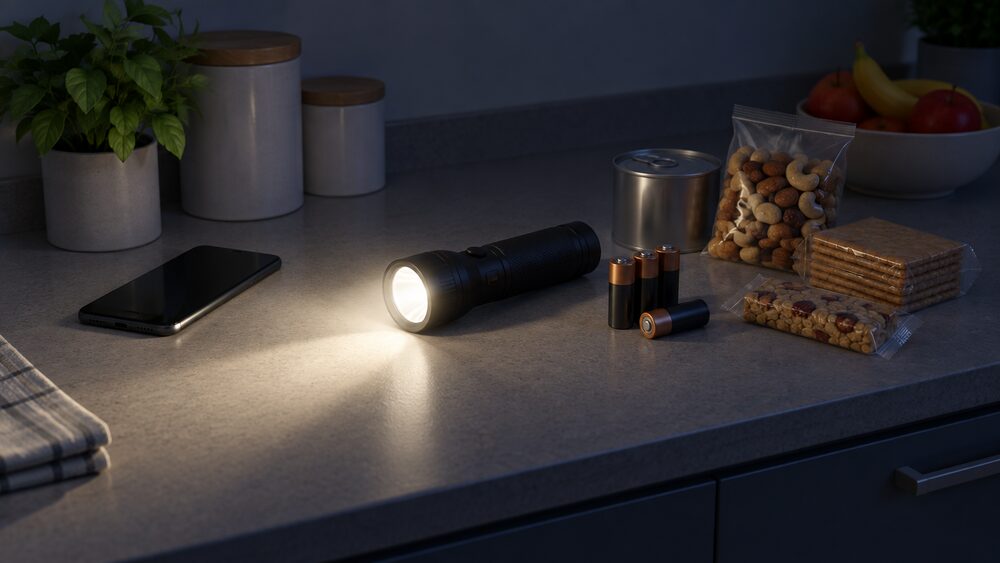
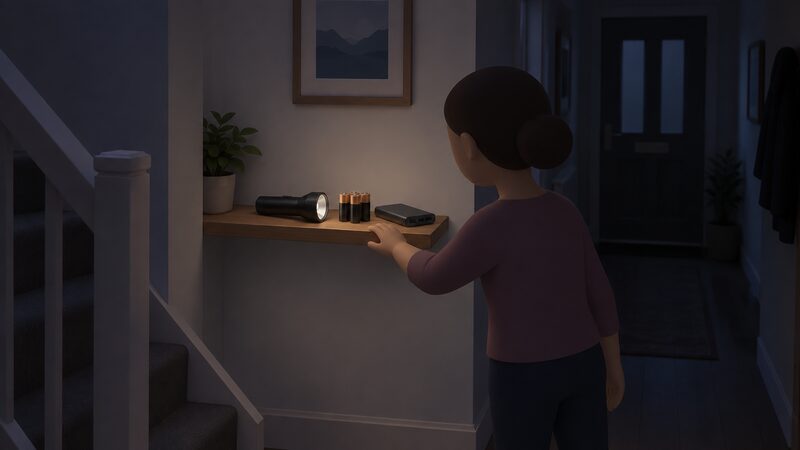
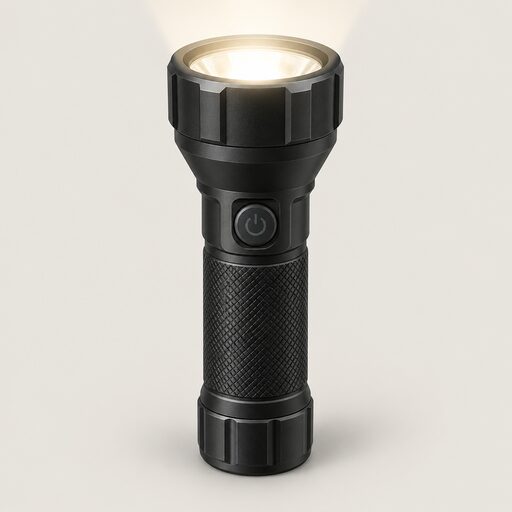
Most of the work happens in advance, and it costs nothing. Keep a torch and batteries in the house, and know where your fuse box is so it can be checked easily8. Keep a mobile phone fully charged so it can be used to go online for updates or to call if the power goes off9. Warm clothes, blankets and food that does not need heating should be within reach, not at the back of a cupboard10.
If a cut is planned, the preparation changes slightly. Turn the freezer temperature settings down a couple of hours before the power is due to be switched off, so the contents start colder11. Open or close any electric gates or access points while they still work, and back up work if anyone is studying or working from home12. Northern Ireland Electricity Networks adds a counter-intuitive instruction for planned emergency cuts: refrain from using more electricity in preparation, such as boiling kettles for flasks or charging phones, because the system is already struggling with demand and a surge from other areas may make the situation more unstable12.
Households on a priority register get advance notice of planned power cuts where possible, which gives time to charge hearing aids, visual alarms and vibrating alarms7. That single benefit is the strongest argument for joining before anything goes wrong, because it converts a surprise into a scheduled event.
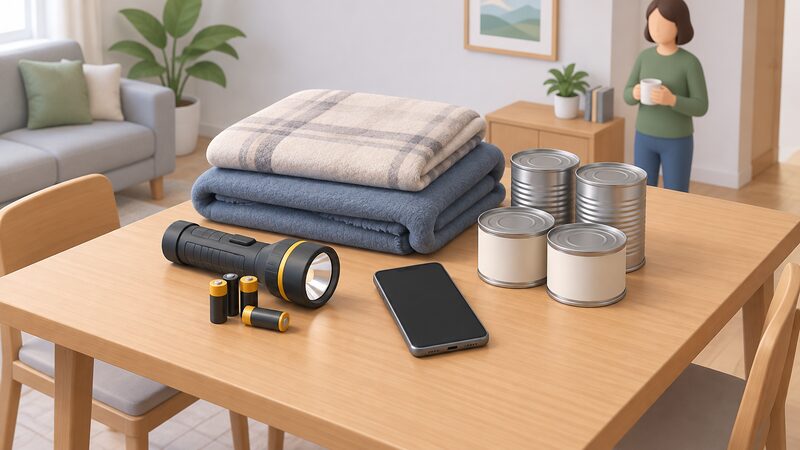
Your emergency kit: torches, charged phones and food that needs no cooking
The kit itself is modest. A torch and batteries, warm clothes, blankets and food that does not need heating cover the core of it10. Keep a torch handy in case of being without power during the night, and keep a mobile phone fully charged so it can be used to go online for updates or to call during a power cut9.
Two items are easy to forget. The first is a phone that works without the landline: gas boilers and heating, electrical appliances and your home's internet and landline connections will stop working in a power cut, so a cordless handset tied to a base unit is useless9. The second is a plan for anyone who needs to be contacted. In a planned emergency cut, mobile phone service will be extremely limited and might drop out entirely, so alternative arrangements need making in advance12.
For households with tropical fish, the kit extends further. Keep a battery-operated air pump, heater or generator ready, and monitor water temperature, using ice packs or heating pads as needed to stabilise it14. That is a niche case, but it is one of the few where an outage can kill within hours rather than days.
Know your fuse box and check the trip switch first
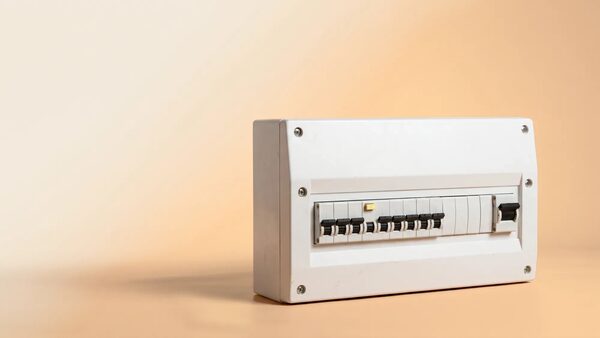
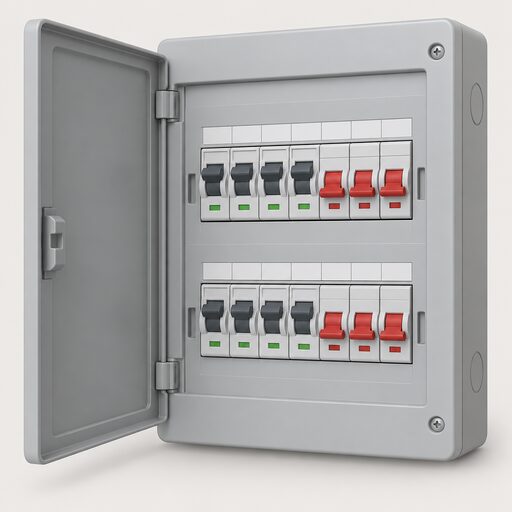
Before calling anyone, check whether the problem is inside the home. Trip switches sit on your consumer unit, sometimes called the fuse box, and if there is a fault with your wiring or one of your electrical appliances they turn off the power to the circuit the fault is on15. Checking the trip switch first rules out a fault with your own wiring or electrical items16. If your trip switches are pointing upward while your electricity is off, the fault is not in your home, and the next step is to check with your neighbours and street lights16.
The diagnosis is straightforward. If your neighbours still have power but your home does not, it is likely there is a problem with the fuses or trip switches in your home17. If your neighbours and street lights still have electricity, you may have a problem with your main fuse, or you could be involved in a power cut16. If their power is also off, do not assume the network operator has already been notified: always call to let them know17.
This check matters for a household's independence because it is the one part of an outage you control. A tripped circuit is yours to reset; a fault on the network is not. Knowing which one you have saves a call, and in a widespread event it saves the operator time too.
Who to call: reporting a power cut and the 105 helpline
The number is 105. It is a free call that puts you through to your electricity network operator, the company that owns the wires, rather than your energy supplier3. The operators introduced it as an easy-to-remember number that puts you through to the local people who can help during a power cut17. You can also report online and monitor progress through your operator's website18.
Call 105 if you have a power cut, and use it for updates as well as the initial report19. The distinction between operator and supplier catches people out: your supplier bills you for energy, but the network operator restores the supply, and it is the operator that handles compensation for a cut20. Ofgem's own guidance is blunt on the point: contact your network operator if you have a power cut or connection issues in your area21.
If the problem turns out to be a complaint rather than a report, the same route applies. Ofgem directs consumers to the network operator for power cuts and connection issues, and to the supplier for billing and account problems22.
How restoration is prioritised: hospitals first, then the largest numbers of homes

Restoration is not first-come, first-served, and it is not personal. Network operators work to restore power to affected areas but cannot prioritise individual households7. The practical effect is that a single rural property at the end of a spur may wait longer than a street of fifty houses on the same fault, because the work that returns the most customers is done first.
That is why the priority register does not promise a faster reconnection. What it does promise is different: priority support with heating and cooking facilities if your supply is cut off, advance notice of power cuts, and an identification and password scheme for home visits23. Network operators must offer extra help to register customers, for example giving them battery packs so that they can still charge phones or medical equipment24. The register exists to tailor services to households who may need extra help during a power cut, not to move them up a queue25.
For a household, the honest reading is this: the grid restores in bulk, and the register softens the experience rather than shortening it. Independence during an outage therefore comes from what you hold at home, not from what you are owed by the operator.
The Medical Care Register for households relying on powered medical equipment
Households that depend on electricity for medical equipment need a plan before the event, not during it. If you depend on power for medical equipment and do not already have your own power cut plan, speak to your healthcare provider9. Care and assisted living providers are advised to contact medical equipment and partner health care providers to prepare risk management plans for equipment losing power unexpectedly10.
Joining the register is free and direct. Contact your distribution network operator at any time if electricity is crucial for any medical equipment you have, as they may be able to put you on their priority register for assistance during any power outage17. Northern Ireland Electricity Networks runs a medical care register for householders who rely on electricity for medical equipment5. Electricity North West's equivalent is the free Extra Care register, for additional support in the event of a power cut18.
Eligibility for the priority services register is wider than medical equipment alone. You can join if you rely on electricity for medical reasons, use a stair lift, hoist or electric bed, have a specific communication need, or would find an unexpected power cut particularly distressing or difficult to cope with25. Some operators also offer a free personalised Power Cut Plan tailored to communication preferences, equipment and support needs7.
During the cut: keeping warm, keeping the freezer closed and leaving a light on
The core actions during an outage are few. Keep the freezer door closed to help preserve your food, and leave on a light so that you know when the power is back on5. Leave at least one light on so you know when your electricity is back on6. Fridge and freezer doors are best kept shut and not opened unnecessarily, because there is no knowing how long the outage may last7.
Switch off what should not restart unattended. Turn off electric cookers, heaters and sensitive electrical equipment such as televisions and computers8. Switch off all electrical appliances that are not designed to run unattended, for example cookers, grills, chip pans, hair straighteners and electric fires6. Turning off lights and electrical equipment that are not in use is also part of the same habit, and it leaves less to restart at once when supply returns7.
Check on people as well as appliances. Check on elderly or vulnerable neighbours, family and friends, and make them aware of planned emergency power cuts8. Never touch damaged electricity equipment4.

How long food stays safe: about 4 hours in a fridge, 48 hours in a full freezer
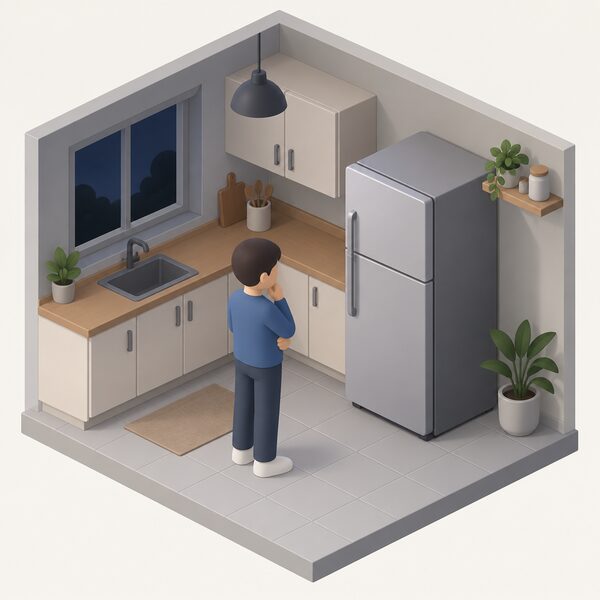
The headline figures are consistent across most sources. Food will stay cool for up to four hours in the fridge and remain frozen for 48 hours in the freezer, as long as the doors are kept closed1. A refrigerator will keep food cold for about 4 hours if the door is kept closed, and a full freezer will keep temperature for about 48 hours, or 24 hours if half full2. A full freezer may remain cold for up to 48 hours, while a half-full one holds for about 24 hours18.
Some operators publish shorter figures, and the difference is worth knowing. Northern Ireland Electricity Networks states that food should keep for between 4 and 6 hours in the fridge and 15 to 24 hours in the freezer if you can avoid opening it13. Electricity North West gives freezers 24 to 48 hours11. The two sets of figures are not reconciled, so the shorter figure is the safer basis for deciding whether to keep food.
| Storage | Safe duration with doors closed | Source |
|---|---|---|
| Fridge | Up to about 4 hours | 1 |
| Fridge (operator figure) | 4 to 6 hours | 13 |
| Full freezer | About 48 hours | 1 |
| Half-full freezer | About 24 hours | 2 |
| Freezer (operator figure) | 15 to 24 hours | 13 |
Practical measures help. To keep a fridge cold longer, add ice and pack food tightly in the drawers11. If the power is going to be out for an extended period, buy block ice to keep the refrigerator as cold as possible2. If in any doubt, dispose of food that appears to have defrosted8.
Generators and UPS devices: backup power done safely
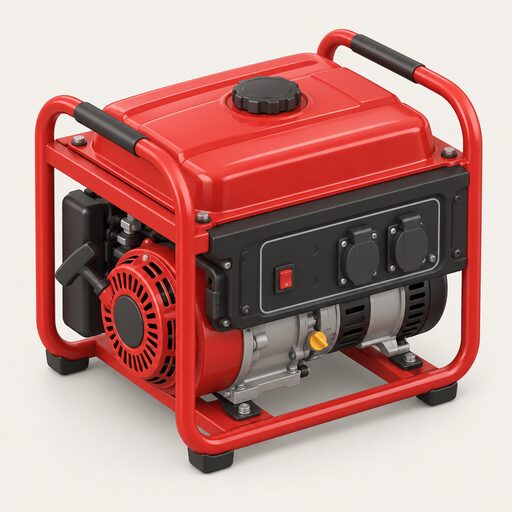
Backup power is where preparation meets real risk. A generator must be connected by a qualified professional, and in an emergency power cut scenario it will not be possible to connect generators13. If you already have a backup generator, check that it meets the power needs and connections you might have to support in an emergency10.
A battery-based uninterruptible power supply is the smaller option. These provide a few minutes of emergency battery backup if power fails, which is enough to shut equipment down cleanly rather than to ride out an outage10. For anyone working from home, that is the difference between a lost document and a lost afternoon.
At the system level, emergency preparedness and response covers early warning systems, staff training and protection measures, incident management protocols, and backup power for alternative supply26. That is the network's own resilience, and it is the reason most cuts are short. It is not a substitute for household preparation, because it protects the system rather than the individual property.
Smoke and heat alarms: one per floor, tested monthly, replaced every ten years
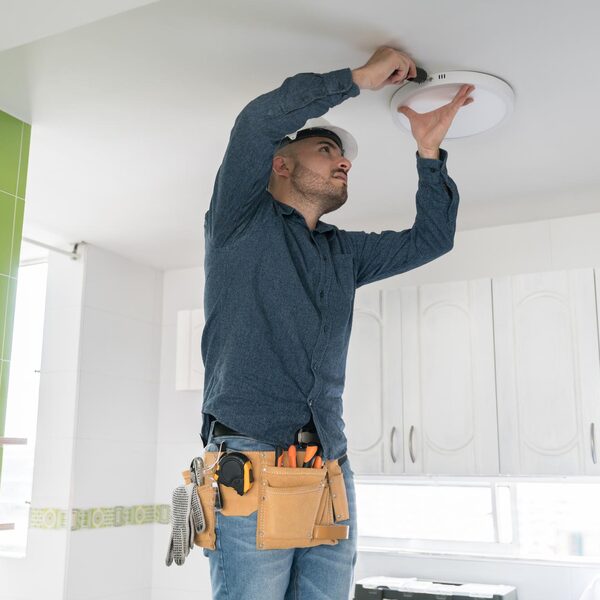
Alarms are part of power cut preparation because the risks change during an outage. Candles, torches and portable heaters all appear when the lights go out, and the alarms that would warn of a fire are the ones already installed. Ensure there is at least one smoke or heat alarm per floor in your property, and test alarms at least once a month27.
The maintenance routine is short enough to keep. Testing monthly catches a failed battery before it matters, and the same visit is a good moment to check that a torch still works and that the phone is charged. For households using portable heaters during an outage, the safety guidance on those appliances is separate and worth reading before use28.
After the cut: resetting clocks, insurance claims and severe-weather compensation
When power returns, some things need resetting. It may be necessary to adjust time switches and clocks when your power returns8. Power should return to your home automatically and, if it is a planned power cut, within one hour after the expected time of reconnection1. In a planned emergency cut, power might be switched off or reconnected around 30 minutes before or after the published time29.
Compensation depends on the type of cut. A household may be entitled to compensation after a power cut9. For unplanned cuts not caused by bad weather, the route is to call 105, and a claim should also bring an extra £40 compensation where the operator has not paid within 10 working days30. For planned cuts, the claim must be made within 1 month of the start of the power cut30. For repeated cuts, there are 3 months to claim after the end of March, and payment within 10 working days if the claim is accepted3. One independent guide gives a 30-day deadline for planned outages, so the two documents disagree on that point31.
Storm compensation follows its own scale. If you had a power cut because of a category 1 storm, you will get £90 if the power was off for 24 hours; for a category 2 storm, £90 if the power was off for 48 hours30. Payment is usually automatic, and if it has not arrived within 4 weeks of the power coming back on, contact the operator to make a claim30. Where fewer than 5,000 premises are affected in normal weather, compensation kicks in only after 12 hours31.
The four nations differ in the detail rather than the principle. Northern Ireland has its own planned emergency power cut framework and its own medical care register13. Citizens Advice publishes separate compensation guidance for Wales30. The compensation thresholds themselves are set nationally and apply across Great Britain.
Sources31 cited
- Prepare for a power cut, Ofgem, 2026
- Power cut advice, Energy Networks Association, 2026-09-17
- Get compensation if you have a power cut, Citizens Advice, 2026-09-17
- Power cut advice, Northern Ireland Electricity Networks, 2026-09-19
- Power cut help, Northern Ireland Electricity Networks, 2026-09-20
- Tips to help you during a power cut, Electricity North West, 2026-09-19
- Priority Services, SSEN Distribution, 2026-09-19
- Is there any action I should take when power is disrupted, Northern Ireland Electricity Networks, 2026-09-19
- Storms and bad weather, Energy Networks Association, 2026-09-17
- Care and assisted living providers, Energy Networks Association, 2026-09-17
- Tips to prepare for a power cut, Electricity North West, 2026-09-19
- Is there any action I should take in preparation, Northern Ireland Electricity Networks, 2026-09-20
- Emergency power cuts, Northern Ireland Electricity Networks, 2026-09-19
- What about my tropical fish, Northern Ireland Electricity Networks, 2026-09-19
- How to prepare for and stay safe during a power cut-a-power-cut), NICEIC, 2025-01-24
- Checks for if you are without power, Electricity North West, 2026-09-19
- What to do in a power cut, Met Office, 2026-09-20
- Be summer ready, Electricity North West, 2026-09-19
- Staying safe and warm this winter, Northern Gas Networks, 2025-11-03
- Check if you can get payment for a power cut, Ofgem, 2026
- Complain about your energy supplier or network operator, Ofgem, 2026
- Complain about your energy supplier, Ofgem, 2026
- Support schemes, Cheshire West and Chester Council, 2026-09-17
- Check if you can get payment for a power cut, Ofgem, 2026
- Who can join the Priority Services Register, National Grid Electricity Distribution, 2026-09-17
- Well-adapted energy system, Climate Change Committee, 2026-09-19
- Portable heaters, Electrical Safety First, 2026-09-17
- How do I keep food safe, Northern Ireland Electricity Networks, 2026-09-19
- Emergency power cuts, Electricity North West, 2026-09-19
- Get compensation if you have a power cut, Citizens Advice Wales, 2026-09-17
- How to get power cut compensation, Uswitch, 2025-06-23
 Vulnerable Households EnergyIf someone in your home relies on powered medical equipment, or needs extra warmth because of a health condition, what help is available?
 Prepare a Home for WinterA seasonal checklist covering heating and hot water checks, controls and timers, alarms, draughts, outside pipework and stocking up on off-grid fuel.
 The Full Backup Power GuideHow long do UK power cuts usually last, and what can keep your fridge, heating or phone going until the power comes back?
 Prepare Energy for StormsWhat to do before and during a storm or flood warning to protect meters, the consumer unit, heating equipment and fuel tanks.
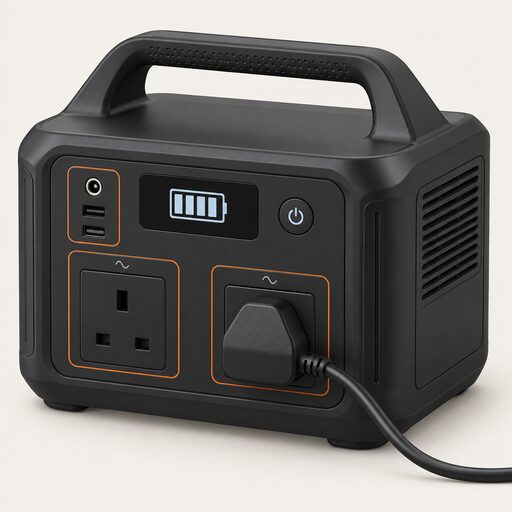 Backup Power for HeatingWhy gas boilers, heat pumps and storage heaters stop in a power cut, what a portable power station can and cannot carry, how to size one, and what home battery systems do when the mains fails.
 Essential Loads and CircuitsWhich plugs and lights should stay on when the power goes off, and which can safely go without?