
In this guide
A household energy problem almost always has one correct first call, and it is rarely the supplier. A gas escape goes to the National Gas Emergency Service on 0800 111 999, a freephone line that operates around the clock1. A power cut in Great Britain goes to 105, which connects the caller to the local electricity network operator, while Northern Ireland uses 03457 643 6432. Billing disputes, meter faults and refunds start with the supplier, and only escalate to the Energy Ombudsman once the supplier has had its chance4.
The distinction matters because the wrong call costs time. Network operators fix the wires and pipes; suppliers run accounts and tariffs; the Ombudsman settles disputes; and a separate set of publicly funded advice services handles grants, efficiency and debt. In Scotland that advice line is Home Energy Scotland on 0808 808 2282, free from landlines and most mobile networks5. In Northern Ireland it is NI Energy Advice on 0800 111 4455, free and open to all households, not only Housing Executive tenants6.
This page sets out which body handles what, which calls are free, and where the four UK nations diverge. It covers emergencies first, then power cuts, then the free advice services, complaints, scams, and the limits of what each organisation can actually do.
The numbers at a glance: which service handles which problem
The fastest way to route a problem is to ask what is actually broken. If gas is escaping, or suspected of escaping, the network's emergency service owns the response. If the electricity supply has failed, the distribution network operator owns it, and 105 exists precisely so that a householder does not need to know which operator covers the postcode2. If the meter, the bill or the account is wrong, the supplier owns it. If the supplier has failed to resolve a complaint, the Energy Ombudsman owns it.
The Energy Ombudsman is approved by Ofgem, the UK energy regulator, to handle service disputes in the energy sector, and it describes itself as an independent service, separate to Ofgem, for problems with an energy supplier, an energy broker, a network operator or a heat network supplier8. That separation is the point: Ofgem sets and enforces the rules, the Ombudsman decides individual disputes.
| Problem | First contact | Number or route |
|---|---|---|
| Gas escape or gas smell | National Gas Emergency Service (GB) | 0800 111 9991 |
| Gas escape in Northern Ireland | Gas emergency line | 0800 002 0013 |
| Power cut in Great Britain | Electricity network operator via 105 | 1052 |
| Power cut in Northern Ireland | NIE Networks | 03457 643 6433 |
| Bill, meter or account problem | Energy supplier | Supplier's own contact4 |
| Unresolved supplier complaint | Energy Ombudsman | 0330 440 16248 |
| Free energy advice in Scotland | Home Energy Scotland | 0808 808 22825 |
| Free energy advice in Northern Ireland | NI Energy Advice | 0800 111 44556 |
| Consumer problem in England or Wales | Citizens Advice consumer service | 0808 223 11334 |
| Energy efficiency scheme fraud | Ofgem counter fraud | counterfraud@ofgem.gov.uk9 |
Small businesses and microbusinesses have a separate route for bill support, handled through the government's business support helpline rather than the domestic services listed here10.
If you smell gas: the National Gas Emergency line and what to do first
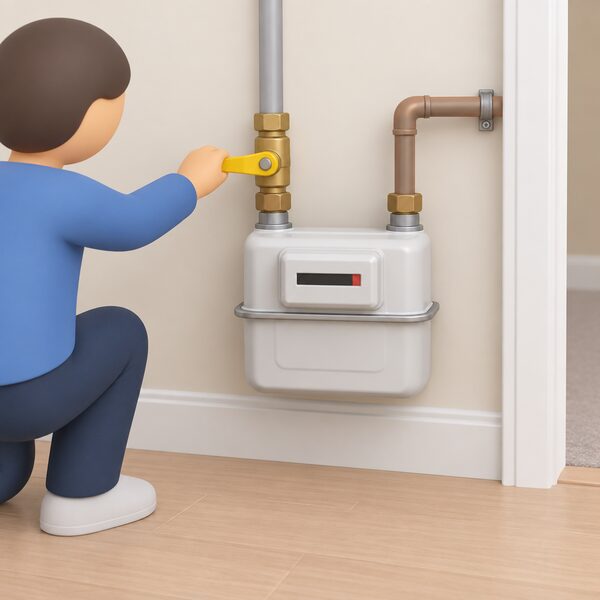
The gas emergency number in Great Britain is 0800 111 999, a freephone line run as the National Gas Emergency Service1. It is free to call and operates as a 24-hour helpline3. Northern Ireland has its own number, 0800 002 001, and the Republic of Ireland uses 1850 20 50 503. Deaf and hearing impaired callers in Great Britain can reach the same service through the free Relay UK app by dialling 18001 0800 111 99911.
The actions before and during the call are as important as the number. The published sequence is to open windows and doors to ventilate the gas, turn off the gas supply at the meter and at any gas appliances, and then call the National Gas Emergency number on 0800 111 99911. Ventilation comes first because it reduces the concentration of gas in the property; shutting the supply at the meter stops more gas entering the pipework.
Gas Safety Week 2026 ran from 14 to 20 September, with Northern Gas Networks marking it under a "Take No Chances" theme and issuing advice on servicing, carbon monoxide and gas emergencies12. The timing is a reminder that the emergency number is the end of a chain that starts with annual servicing and working carbon monoxide alarms, not a substitute for them.
For a household's energy independence, this is the clearest case of unavoidable dependence. A home can generate its own electricity, store heat and cut its bills, but a gas escape is a network event that only the network's emergency service can make safe. The number is worth knowing before it is needed.
Power cuts: who to call and how to report one
In Great Britain, the number to call for an unplanned power cut is 105, free of charge, and the call is routed to the electricity network operator for the area2. The same service can be reached online through the network company's own reporting tools3. The advantage of 105 is that it removes the need to identify the operator: the system does it from the calling line.
Northern Ireland is different. The power cut contact number there is 03457 643 6433. Households in Northern Ireland can also reach the Northern Ireland Energy Advice Service on 0800 111 4455, open 9am to 5pm Monday to Friday, for advice rather than fault reporting7.
There is a payment dimension that many households do not know about. Ofgem publishes guidance on whether a household can get payment for a power cut, which sets out the circumstances in which compensation is due2. That is a separate process from reporting the fault, and it runs through the network operator.
A power cut is the moment when a home's independence is tested. A property with a battery, a generator or a working off-grid setup keeps its lights on; a property without one is entirely dependent on the network, and the only useful action is to report the fault and wait. Preparing for that moment is covered in how to prepare a home for a power cut, and the sequence for shutting off supplies safely is in how to turn off the gas, water and electricity in an emergency.
Free advice services: Home Energy Scotland, NI Energy Advice and Citizens Advice

Three publicly funded advice services cover most of the UK, and each has a different geography and remit.
Home Energy Scotland is a free independent advice and referral scheme, funded by the Scottish Government, giving free impartial advice on energy efficiency and renewable energy in Scotland13. Its phone lines are open Monday to Friday 8am to 8pm, and 9am to 5pm on Saturdays, on 0808 808 2282, and calls are free from landlines and most mobile networks15. It also runs a Funding Finder tool for searching grants and support on improving a home's energy efficiency, reducing bills and making the home warmer16. Local authority pages across Scotland, from West Lothian to Argyll and Bute and the City of Edinburgh, route households to the same service for area-based schemes and efficiency advice15.
NI Energy Advice offers independent and impartial energy advice to domestic householders in Northern Ireland, plus referrals to energy grants and other sources of help17. It is funded by the Department for Communities and delivered by the Housing Executive, and it is for all households across Northern Ireland: you do not need to be a Housing Executive tenant, and the advice is free and impartial6. Its freephone number is 0800 111 4455, and its email is nienergyadvice@nihe.gov.uk6. The service covers energy saving in the home, energy efficiency grants and oil buying clubs20. The Consumer Council NI also gives free, independent and impartial energy advice to all domestic householders in Northern Ireland, offers an energy price comparison tool for all suppliers in Northern Ireland, and can investigate complaints about natural gas and electricity21.
Citizens Advice runs a free consumer service for people in England and Wales with problems with energy bills or supply, reachable on 0808 223 11334. In Scotland, energyadvice.scot provides a free service for Scottish citizens with questions about their energy supplier, the supplier's complaints process, or problems with their energy bills, on 0808 196 86604.
| Service | Nation | Number | Cost |
|---|---|---|---|
| Home Energy Scotland | Scotland | 0808 808 2282 | Free from landlines and most mobiles14 |
| energyadvice.scot | Scotland | 0808 196 8660 | Free service4 |
| Citizens Advice consumer service | England and Wales | 0808 223 1133 | Free consumer service4 |
| NI Energy Advice | Northern Ireland | 0800 111 4455 | Freephone, free and impartial6 |
| Northern Ireland Energy Advice Service | Northern Ireland | 0800 111 4455 | Open 9am to 5pm Monday to Friday7 |
Complaining about your energy supplier or company: where to start and when to escalate
The first step is always the supplier. Ofgem's guidance lists the issues that go to a supplier first: late, incorrect or missing bills, back billing, being overcharged, a faulty meter, poor customer service, and refusing to refund credit from an account4. The Energy Ombudsman states the same rule from its side: speak to your energy supplier first to raise a complaint, and if they cannot help, the Ombudsman aims to resolve the dispute fairly and impartially24. The Ombudsman's own consumer guidance puts it plainly: the first thing you need to do is log a dispute with your supplier25.
Escalation has defined triggers. A household can complain to the Energy Ombudsman if a reported problem is not fixed within eight weeks, if the household and the energy company cannot agree on how to fix it, if a deadlock letter is received, or if the household is not happy with the decision received4. The service is free if the issue is not resolved after eight weeks, or a deadlock letter is received, after complaining to the supplier first26. The Ombudsman's number for energy complaints is 0330 440 1624, with option 3 for heat networks8.
The same escalation route applies to specific situations. Where a supplier has installed a prepayment meter without permission, the household can contact the Energy Ombudsman if it is not happy with how the supplier handled the complaint27. Where the complaint concerns an Energy Company Obligation installation, Ofgem directs complaints to its own ECO4 complaints process page rather than to the supplier alone9.
"You must raise a complaint with your supplier in the first instance. If the issue isn't resolved after eight weeks, or you receive a deadlock letter, you can escalate your complaint to us."
The Citizens Advice consumer service can refer a household to the Extra Help Unit where the complaint is difficult or urgent, the household cannot deal with the supplier alone because of personal circumstances, the household is considered vulnerable, or there is a risk of disconnection from an energy supply4. That referral is a route to representation, not a substitute for the supplier complaint. The full sequence is set out in how to complain about an energy supplier and escalate it, and the specific escalation document is explained in what is a deadlock letter and when can I escalate my complaint.
Scams and bogus callers: Citizens Advice and Action Fraud
Energy scams split into two kinds: fraud against a household, and fraud within a government-backed efficiency scheme. The reporting routes differ.
For consumer problems in England and Wales, the Citizens Advice consumer service is the entry point, on 0808 223 1133, and it can refer serious or urgent cases onward4. In Scotland, energyadvice.scot handles the equivalent role on 0808 196 86604. In Northern Ireland, the Consumer Council gives free advice and can investigate complaints about natural gas and electricity22.
For fraud connected to the Energy Company Obligation, Ofgem asks that it be reported directly to counterfraud@ofgem.gov.uk9. That address exists because ECO is a regulated scheme with its own compliance regime, and mis-selling or false claims within it are a regulatory matter rather than a consumer dispute.
The practical rule is that no legitimate energy scheme requires payment upfront to release a grant, and no network operator cold-calls to demand payment for a power cut. Where a household is unsure whether a caller is genuine, the safe action is to end the call and ring the published number for the relevant body. The signs and reporting steps are set out in how to spot and report an energy scam.
What each service is and is not: advice, referrals and independence
The distinction between advice, referral and enforcement is the difference between a useful call and a wasted one.
Advice services explain options and, in some cases, search for funding. Home Energy Scotland gives free impartial advice on energy efficiency and renewable energy in Scotland and runs a Funding Finder for grants and support14. NI Energy Advice gives independent and impartial advice to domestic householders in Northern Ireland and makes referrals to energy grants and other sources of help17. The Energy Savings Advice Service covers England and Wales with free impartial advice on energy and renewables14. None of these bodies install anything, set tariffs or decide complaints.
Referral services pass a household to someone who can act. NI Energy Advice refers to grants and other help18. The Citizens Advice consumer service may refer to the Extra Help Unit in defined circumstances4. Suppliers themselves refer customers who are struggling to pay bills to organisations like Advice NI, which offers free, independent debt advice22.
Enforcement and dispute resolution sit elsewhere. The Energy Ombudsman is approved by Ofgem to handle service disputes and is independent of it8. Ofgem runs the compliance side of schemes such as ECO and takes fraud reports9. Network operators own the physical response to gas escapes and power cuts1.
For a household pursuing energy independence, these services are the free layer of the system: they do not reduce dependence on the grid or on gas, but they do reduce dependence on a supplier's goodwill when something goes wrong, and they are the route to the grants that fund efficiency work. The wider sequence is set out in how to take more control of your home's energy.
Which number for which nation: England, Wales, Scotland and Northern Ireland
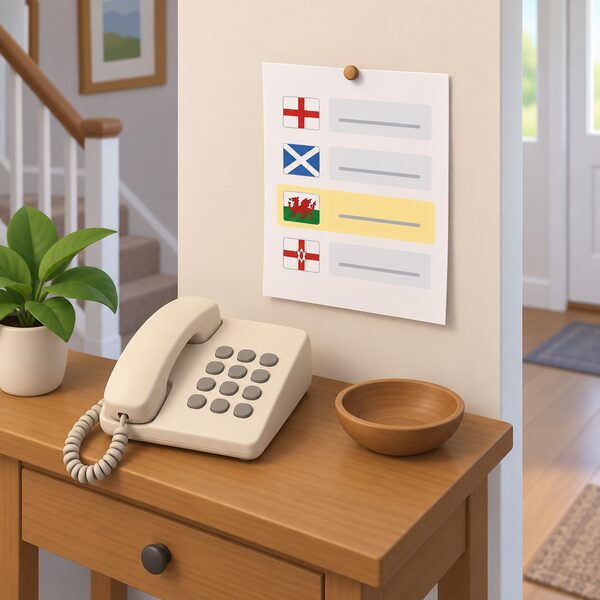
The four nations do not share a single set of numbers, and the differences are not cosmetic.
Gas emergencies are split between Great Britain and Northern Ireland: 0800 111 999 for Great Britain, 0800 002 001 for Northern Ireland1. Power cuts are split the same way: 105 across Great Britain, 03457 643 643 in Northern Ireland2.
Advice is devolved. Scotland has Home Energy Scotland on 0808 808 2282, free from landlines and most mobile networks, with phone lines open Monday to Friday 8am to 8pm and 9am to 5pm on Saturdays5. Northern Ireland has NI Energy Advice on 0800 111 4455, free and impartial, for all households6. England and Wales share the Citizens Advice consumer service on 0808 223 1133 and the Energy Savings Advice Service for energy and renewables advice4.
| Nation | Gas emergency | Power cut | Free energy advice |
|---|---|---|---|
| England | 0800 111 9991 | 1052 | Citizens Advice 0808 223 11334 |
| Wales | 0800 111 9991 | 1052 | Citizens Advice 0808 223 11334 |
| Scotland | 0800 111 9991 | 1052 | Home Energy Scotland 0808 808 22825 |
| Northern Ireland | 0800 002 0013 | 03457 643 6433 | NI Energy Advice 0800 111 44556 |
Beyond the core numbers, several organisations cover specific groups. National Energy Action offers advice and support to help people across England, Wales and Northern Ireland stay warm and manage energy costs, on 0800 304 715926. Crisis runs separate lines for England, Wales and Scotland: 08000 384838, 08000 495 459 and 0808 800 4444 respectively26. The British Gas Energy Trust can be reached on 01733 421 02129.
Northern Ireland also has its own grant and support landscape, which the advice line navigates. The Northern Ireland Sustainable Energy Programme publishes its list of schemes for 2026-27, with the Northern Ireland Energy Advice Service as the contact on 0800 111 44557. The Affordable Warmth Scheme is administered by the NI Housing Executive, with NI Energy Advice as the email contact19. Belfast City Council publishes cost-of-living and winter support routes20, and nidirect sets out advice for households struggling to pay energy bills, including referrals to organisations like Advice NI22. The Commercial Energy Saving Scheme is managed by Power NI, on 07551 008 477 or energysaving@powerni.co.uk7.
For households in England and Wales, the older Energy Saving Advice Service number, 0300 123 1234, appears in earlier government documentation31. The current advice routes are the Citizens Advice consumer service and the Energy Savings Advice Service4.
Sources31 cited
- Gas safety in the home: owner occupiers, Health and Safety Executive, 2026
- Check if you can get payment for a power cut, Ofgem, 2026
- Get winter ready, Energy Networks Association, 2026-09-17
- Complain about your energy supplier or network operator, Ofgem, 2026
- Home energy efficiency advice, Argyll and Bute Council, 2026-09-17
- NI Energy Advice, NI Housing Executive, 2026-09-17
- NISEP list of schemes 2026-27, Utility Regulator Northern Ireland, 2026-04
- Energy Ombudsman FAQs, Energy Ombudsman, 2026-09-19
- Energy Company Obligation: contacts, guidance and resources, Ofgem, 2026-09-17
- Get help with your home or business energy bills, Ofgem, 2026-09-17
- Smell gas, SGN, 2026
- Take No Chances with Gas Safety, Northern Gas Networks, 2026-09-14
- Heat in buildings: progress report 2025, Scottish Government, 2025-10-02
- Who to contact, Ofgem, 2026-09-17
- Energy Efficient Scotland area based schemes, West Lothian Council, 2026-09-17
- Financial help for energy efficiency and low carbon heating, City of Edinburgh Council, 2026-09-20
- Biomass, nidirect, 2026-09-17
- Heating technologies to suit your home, nidirect, 2026-09-17
- Affordable Warmth Scheme, NI Housing Executive, 2026-09-17
- Cost of living and winter support, Belfast City Council, 2026-09-20
- Low carbon heating, nidirect, 2026-09-17
- Advice if you're struggling to pay your energy bills, nidirect, 2026-09-17
- Complain about your energy supplier, Ofgem, 2026
- Facilitated complaints resolution, Energy Ombudsman, 2026-09-20
- Understanding your rights, Energy Ombudsman, 2026-09-20
- Worried about your energy bills, Energy Ombudsman, 2026-03-24
- Installing a prepayment meter without your permission, Ofgem, 2026
- Check energy suppliers can install prepayment meters without household permission, Ofgem, 2026
- Help with household costs, Isle of Anglesey County Council, 2026-09-20
- Closure of the Boiler Replacement Scheme, Department for Communities, 2026
- Domestic Renewable Heat Incentive: already installed before opening, Ofgem, 2015-02
 The Full How To GuideSwitching supplier, sending meter readings, sorting an EPC, claiming a grant, complaining when something goes wrong, coping in a power cut: where do you start with any of it?
 The Full Installers GuideHow do you find an installer you can trust, and what should you check before signing anything?
 The Full Statistics GuideHow many homes in the UK have solar panels, heat pumps or batteries?
 The Full Grants and Schemes GuideWhich grants can you actually get right now, and how do you apply for them?
 Energy Consumer BodiesWho do you call about an energy problem where you live?
 Who Supplies Your Energy?Not sure who bills you for gas or electricity?