

In this guide
Applying for a home energy grant in the UK is rarely a single form. Most funded schemes run through the same sequence: a checker or referral to establish eligibility, an assessment or survey of the property, an installer appointed under the scheme, and a claim or sign-off once the work is done. The largest single payment most households will meet is the Warm Home Discount, a £150 rebate off electricity bills that reaches around 6 million households and has been confirmed through to 2030-311.
The route depends on where you live and what you need. In England, Wales and Scotland the Warm Home Discount is largely automatic for eligible households, with a smaller broader group applying directly to their supplier3. Insulation and heating work is funded through the Energy Company Obligation, known as ECO4, which is closed to new applications in some areas and due to end on 31 December 20264. In Scotland, the Home Energy Scotland Grant and Loan Scheme offers up to £7,500 for energy-efficiency improvements such as insulation and up to £7,500 for clean heating systems such as heat pumps5. In Northern Ireland, NI Energy Advice is the referral route to grants and other help6.
What follows is the application process common to these schemes: what each one funds, the documents and checks involved, how long decisions take, what happens if a supplier stops trading, and the dates that matter.
What an energy grant is, and the schemes that exist
A home energy grant is funding awarded towards a specific improvement, usually insulation, heating or a renewable technology, rather than a cash payment to spend as you choose. The money comes from one of three places: a levy on energy bills administered by suppliers, a national government programme, or a local authority scheme. Energy supplier schemes and grants also cover paying off energy debt, which is a different kind of support from a measure grant8.
The schemes a household is most likely to meet are the Warm Home Discount, the Energy Company Obligation, the Home Energy Scotland Grant and Loan Scheme, and the various area-based and local authority schemes. Grant-awarding bodies include agencies like the Energy Saving Trust9. In Scotland, Energy Efficient Scotland Area Based Schemes provide home owners and landlords with access to grant funding which meets the Scottish Government's future minimum energy efficiency standards10.
Eligibility is not uniform. Grants for home energy efficiency are available to homeowners and private tenants11. Help to heat grants are aimed at the home owner-occupier12. The Green Homes Grant voucher scheme, now closed, provided grants to homeowners and landlords to make energy efficient improvements to homes, and its history is a reminder that schemes open and close on political timetables rather than household ones13.
For a household's energy independence, a grant changes the economics of a measure but not the underlying dependence. Insulation reduces how much energy the home needs, which is the most durable form of independence because it survives a change of supplier, tariff or fuel. A grant towards a heat pump or a boiler changes the equipment but leaves the home connected to the grid or the gas network. The grant is a contribution to the cost of a measure, not a route off the network.
Warm Home Discount: a £150 rebate on electricity bills

The Warm Home Discount is the widest-reaching scheme in the UK. It primarily provides support through the provision of £150 energy bill rebates, funded through a levy on all domestic gas and electricity customers1. It is a one-off discount off household electricity bills, not a payment into a bank account2. The scheme helps households in, or at risk of, fuel poverty with direct energy bill payments as well as other financial and energy-related support7.
The mechanics are simple. Energy suppliers with more than 1,000 domestic customers, plus other suppliers who elect to take part, offer the discount and recoup the costs from the energy bills of all their customers14. Around 6 million households now benefit from a £150 rebate off their winter energy bill, and the scheme has been confirmed through to 2030-312. From April 2026 the recovery of Warm Home Discount costs shifts from the standing charge to the unit rate2.
Eligibility in England and Wales rests on three conditions, all of which must have applied on the qualifying date: your energy supplier is part of the scheme, you or your partner get certain means-tested benefits, and your name or your partner's is on the electricity bill3. Core Group 1 in England and Wales covers receipt of the Guarantee Credit element of Pension Credit on the qualifying date for that scheme year14. Housing Benefit is one of the qualifying benefits3.
An annex with its own electricity supply where the resident receives a qualifying benefit and is named on the bill is eligible in its own right for 2026/20277. That matters for multigenerational households and converted properties where a relative lives in a self-contained part of the home.
The dependence the scheme leaves in place is the supplier relationship. The rebate is delivered through the electricity account, so it depends on a participating supplier, a live account and a name on the bill. It reduces a bill but does not reduce consumption, and it does not survive a move to a supplier outside the scheme.
ECO4: insulation and heating funded by energy suppliers, closing to new applications
The Energy Company Obligation is the main funded route to physical improvements. Under ECO4, obligated energy suppliers are required to reduce heating costs for low income and vulnerable households by funding energy efficiency, insulation and heating measures15. Qualifying householders can access funding to upgrade heating or improve home insulation through the government's Energy Company Obligation scheme16. ECO funding pays for energy efficiency measures such as heating improvements and insulation to be installed17.
The measures funded include insulation, boilers and central heating, and solar and renewable energy technologies13. The scheme's purpose is to reduce heating costs for low income and vulnerable households15.
There are several eligibility routes rather than one test: Help to Heat Group, Social Housing, LA Flex, In-Fill and Supplier Flex18. Local authority flexibility is what allows a council to widen eligibility beyond the benefit-linked core group, which is why the same household can be eligible in one area and not in the next.
Private landlords face an extra condition. They can only access ECO to replace an old heating system with a renewable heating system if the existing EPC is an E, F or G19. That is a narrower route than the one open to owner-occupiers.
The resident application route is not a form submitted to a government department. If you think you may qualify for ECO Funding, the published advice is to speak to an organisation who can offer you free and impartial energy and bill saving support and assess whether you might be eligible for funding17. In practice that means a council energy team, an advice agency or an installer working under the scheme.
For independence, ECO4 is the strongest of the grant routes because insulation permanently lowers the energy a home needs. It is also the most time-limited: a scheme with a published end date cannot be relied on as a standing entitlement.
Home Energy Scotland Grant and Loan: up to £7,500 for heating and insulation

Scotland runs its own scheme, separate from the supplier-funded routes. The Home Energy Scotland Grant and Loan Scheme helps eligible homeowners pay for energy efficiency improvements and clean heating systems20. It provides grants and loans to all domestic owner-occupiers in Scotland to install clean heat and energy efficiency measures21.
The headline figures are the reason the scheme is well known. For clean heating systems such as heat pumps, grant funding of up to £7,500 is available22. The scheme provides homeowners in Scotland a grant of £7,500 for clean heating systems23. Taken together, this could be up to £7,500 for energy-efficiency improvements such as insulation and up to £7,500 for clean heating systems such as heat pumps5.
The Home Energy Scotland Scheme offers grants to homeowners to install heat pumps24, and the wider programme provides grants and loans to install clean heat and energy efficiency measures25.
The application process has two stages, and the order matters. First, applicants submit an application to request funding before any work takes place. Once the work has been completed, they submit a claim20. Work started before an application is approved risks not being funded, which is the single most common way a Scottish application fails.
The scheme's published processing data covers monthly figures from April 2025 to January 2026, so a household can see how long applications and claims have been taking rather than relying on an estimate20.
For independence, the Scottish scheme is unusual in funding clean heating directly, which moves a home off gas rather than simply reducing the bill. The dependence that remains is electrical: a heat pump runs on electricity from the grid, so the household trades a gas connection for a larger electricity demand.
NI Energy Advice: the route to grants in Northern Ireland
Northern Ireland does not use the same application architecture as Great Britain. The entry point is NI Energy Advice, which can also make referrals to energy grants and other sources of help6. For grant information and energy advice, the published route is to contact NI Energy Advice by email or call 0800 1114 45511.
That referral model means a household does not apply to a scheme directly in the first instance. The adviser establishes what the property needs and what the household qualifies for, then points to the relevant grant or source of help. Grants for home energy efficiency are available to homeowners and private tenants11, so both tenures can be referred.
Low carbon heating is supported in Northern Ireland through its own published guidance6, which sits alongside the advice service rather than inside the GB supplier obligation. The practical consequence is that a Northern Ireland household should start with the advice line rather than with an energy supplier or a national application portal.
For independence, the referral route is a single point of contact, which is simpler for the household but concentrates the process in one service. The measures themselves work the same way as elsewhere: insulation reduces demand, and heating replacement changes the fuel.
Which scheme fits which household
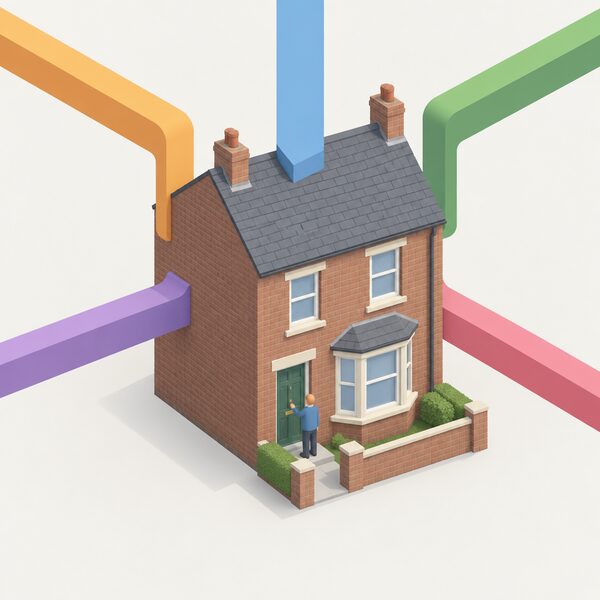
The schemes overlap in purpose but not in eligibility, and the same household can be in scope for one and out of scope for another. The table below sets out the main routes by what they fund and who they reach.
| Scheme | What it funds | Who it reaches | Status |
|---|---|---|---|
| Warm Home Discount | £150 off electricity bills | Eligible older and low-income consumers, via participating suppliers14 | Confirmed through to 2030-312 |
| ECO4 | Insulation, boilers and central heating, solar and renewable technologies13 | Low income and vulnerable households, via Help to Heat Group, Social Housing, LA Flex, In-Fill and Supplier Flex18 | Closed in some areas, due to end 31 December 20264 |
| Home Energy Scotland Grant and Loan | Up to £7,500 for insulation and up to £7,500 for clean heating5 | All domestic owner-occupiers in Scotland21 | Open, two-stage application and claim20 |
| NI Energy Advice | Referrals to energy grants and other help6 | Homeowners and private tenants in Northern Ireland11 | Open, referral route |
Two conditions cut across the table. The first is tenure: grants for home energy efficiency are available to homeowners and private tenants11, but private landlords can only access ECO to replace an old heating system with a renewable heating system if the existing EPC is an E, F or G19. The second is the benefit link: the Warm Home Discount requires receipt of certain means-tested benefits on the qualifying date3, while ECO4 has flexibility routes that can reach households outside the benefit core group18.
A household in Scotland can in principle be in scope for both the Warm Home Discount and the Home Energy Scotland scheme, because one is a bill rebate and the other funds measures. A household in England or Wales has the Warm Home Discount and ECO4 as the two main routes, with local authority schemes filling gaps. A household in Northern Ireland starts with NI Energy Advice.
How to apply, step by step
The sequence below is the one common to the funded schemes. Not every scheme uses every step, but the order is consistent, and the most common cause of a rejected application is doing the steps out of order.
- Check eligibility before anything else. For the Warm Home Discount, the majority of eligible households receive their rebates automatically through data matching, without applying7. For ECO4, the published advice is to speak to an organisation who can offer free and impartial energy and bill saving support and assess whether you might be eligible for funding17. For Scotland, the scheme is open to all domestic owner-occupiers21. For Northern Ireland, contact NI Energy Advice11.
- Establish the property's starting point. ECO4 eligibility routes include LA Flex and Supplier Flex, which allow a council or supplier to widen the criteria18. Private landlords need the existing EPC to be an E, F or G to access ECO for a renewable heating replacement19.
- Apply for funding before work starts. In Scotland this is explicit: applicants submit an application to request funding before any work takes place, then a claim once the work has been completed20. Work commissioned ahead of approval is the classic failure.
- Have the assessment or survey. The scheme or its installer confirms the measures and the cost. This is where the funded scope is fixed.
- Installation by an approved installer. The work is carried out under the scheme's rules, which is what makes the funding payable.
- Submit the claim and the sign-off paperwork. In Scotland the claim follows completion20. For supplier schemes, the rebate is applied to the electricity account.
On documents, the schemes are consistent about what they need to see: proof of the benefit or income position on the qualifying date, proof that the named person is on the electricity bill, and proof of the property and its tenure. The qualifying date is the anchor for the Warm Home Discount, and evidence is assessed as at that date rather than at the date of application7.
What happens if your supplier stops trading, or you switch

The Warm Home Discount is delivered through a supplier, so a change of supplier raises an obvious question. The answer is that the process is designed to be automatic. You do not need to do anything if your current supplier goes out of business. Ofgem automatically moves you to a new supplier, and makes sure your energy supply is not interrupted26.
Switching is also straightforward for households that pay a supplier directly. If you pay a supplier directly for the electricity or gas you use at home, you can choose to switch to a different supplier or tariff at any time26. Suppliers must switch your electricity or gas supply from your old supplier to your new supplier within 5 working days26.
The condition to watch is participation. Eligibility depends on your energy supplier being part of the scheme3. A move to a supplier that does not take part removes the route, and a move to one that does is a fresh eligibility question assessed against the qualifying date. The scheme's cost recovery also changed from April 2026, shifting from the standing charge to the unit rate, which alters how the levy appears on a bill rather than who qualifies2.
For independence, this is the clearest example of dependence that a grant does not remove. The rebate is tied to a supplier relationship and a named account. A household that wants to reduce that dependence is looking at measures that cut consumption, not at payments that reduce a bill.
Deadlines and dates to keep in mind
Dates decide more applications than eligibility does, because a scheme can close between a household becoming aware of it and getting a survey booked.
- 23 August 2026: the qualifying date for the Warm Home Discount for winter 2026 to 20277.
- 24 August 2025: the qualifying date for winter 2025/2614.
- 31 December 2026: the Energy Company Obligation scheme is due to end, with availability of help varying as the scheme is wound down4.
- April 2026: the point from which recovery of Warm Home Discount costs shifts from the standing charge to the unit rate2.
- 2030-31: the Warm Home Discount has been confirmed through to this point2.
- 1 April 2025 to 31 March 2028: under the Warm Homes: Social Housing Fund Wave 3, grant funding may be drawn down from 1 April 2025 and must be spent by 31 March 202827.
The Domestic Renewable Heat Incentive is a closed scheme and a useful illustration of how application windows work. For installations commissioned on or after 1 March 2019, an application could be made at any time before the scheme closed at midnight at the end of 31 March 2022. For installations commissioned before 1 March 2019, there was one year from the commissioning date shown on the MCS certificate to submit an application28.
One funding rule is worth stating plainly because it catches households trying to stack support. Funding for measures delivered under ECO4 must not be blended with funding from other government schemes or grants, including but not limited to Warm Home Discount, Boiler Upgrade Scheme, Social Housing Decarbonisation Fund and Home Upgrade Grant29. By contrast, under the Warm Homes: Social Housing Fund Wave 3, applicants may use funding from other government schemes, such as the Energy Company Obligation, to support works on the same home27. The two documents disagree on how far stacking is allowed, and the difference turns on which scheme is paying.
For a household's independence, the dates are the practical constraint. A scheme with a published end date rewards early application and penalises waiting for a better offer. The measures that most reduce dependence, insulation above all, are also the ones with the longest lead times, which is why the application sequence matters more than the choice of scheme.
Sources29 cited
- Warm Home Discount, Ofgem, 2026-09-17
- Warm Home Discount statistics 2025 to 2026, GOV.UK, 2026-09-17
- Warm Home Discount: if you live in England and Wales, GOV.UK, 2026-09-17
- ECO4 and ECO Flexible Eligibility, Breckland Council, 2026-09-17
- Home Energy Scotland Grant and Loan Scheme, House of Commons Library, 2026-05-13
- Low carbon heating, nidirect, 2026-09-17
- Warm Home Discount eligibility statement, England and Wales, 2026 to 2027, GOV.UK, 2026-09-17
- Get help with your home or business energy bills, Ofgem, 2026-09-17
- VAT energy saving materials and grant funded heating supplies, HMRC, 2026-09-17
- Area Based Schemes, Glasgow City Council, 2026-06-08
- Home heating, Belfast City Council, 2026-09-20
- Grants and funding, Tameside Council, 2026-09-17
- ECO4 scheme, West Lindsey District Council, 2025-07
- Park Homes Warm Home Discount Scheme, House of Commons Library, 2026-02-26
- ECO flexibility funding, Ceredigion County Council, 2026-09-17
- Energy Company Obligation (ECO) scheme, Leeds City Council, 2026-09-20
- Home energy efficiency, Bridgend County Borough Council, 2026-09-17
- ECO4 GBIS eligibility and pre-installation declaration, Ofgem, 2026-09-17
- Energy Company Obligation ECO4 scheme, Derbyshire County Council, 2026-09-17
- Home Energy Scotland Grant and Loan Scheme: application and claim processing times, Scottish Government, 2026-03-12
- Heat in Buildings progress report 2024, Scottish Government, 2024-10-10
- Energy saving home improvements, Scottish Government, 2026-09-17
- Heat in Buildings progress report 2025, Scottish Government, 2025-10-02
- The Heat in Buildings programme, Scottish Government, 2026-09-17
- Heat in Buildings progress report 2025, Scottish Government, 2026-09-17
- Switch your home energy supplier, Ofgem, 2026
- Warm Homes: Social Housing Fund Wave 3 scheme guidance addendum, GOV.UK, 2026-06
- Key terms explained: Domestic Renewable Heat Incentive, Ofgem, 2026-09-17
- Energy Company Obligation: homeowners and tenants, Ofgem, 2026-09-17
 The Full Grants and Schemes GuideWhich grants can you actually get right now, and how do you apply for them?
 Grant ScamsGrant schemes attract cold callers, doorstep sellers and fake approval letters using real scheme names.
 The Full How To GuideSwitching supplier, sending meter readings, sorting an EPC, claiming a grant, complaining when something goes wrong, coping in a power cut: where do you start with any of it?
 The Full Installers GuideHow do you find an installer you can trust, and what should you check before signing anything?
 Check Which Energy Grants ApplyWhich energy grants can you actually get right now, and which have closed?
 Why Energy Grants DifferWhere you live in the UK changes which home energy grants you can get.