
In this guide
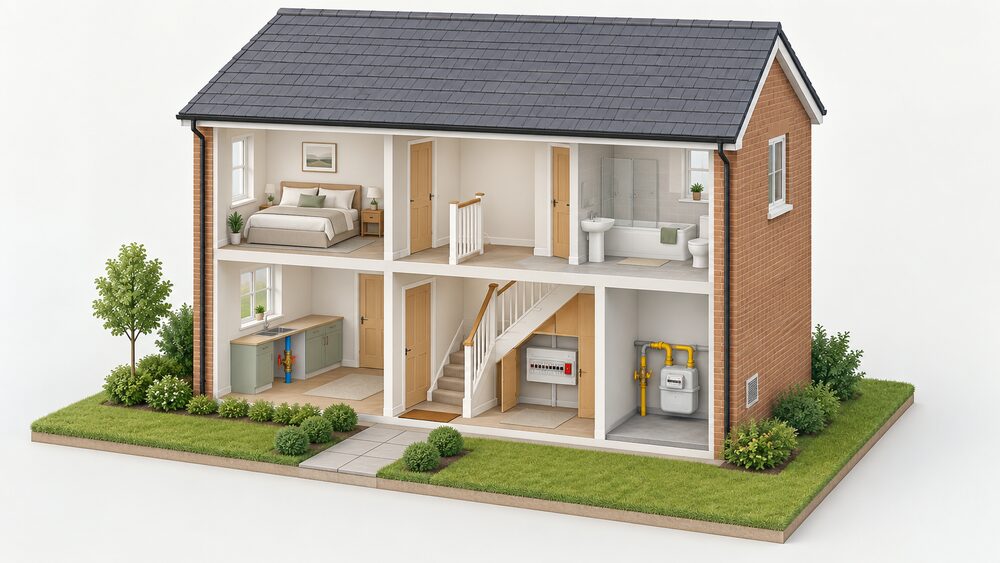
Every home has three shut-offs that matter in an emergency: the gas emergency control valve by the meter, the internal stopcock on the incoming water main, and the main switch on the consumer unit. Knowing where each one is, and how it moves, is the difference between a controlled five minutes and a flooded or gassed house.
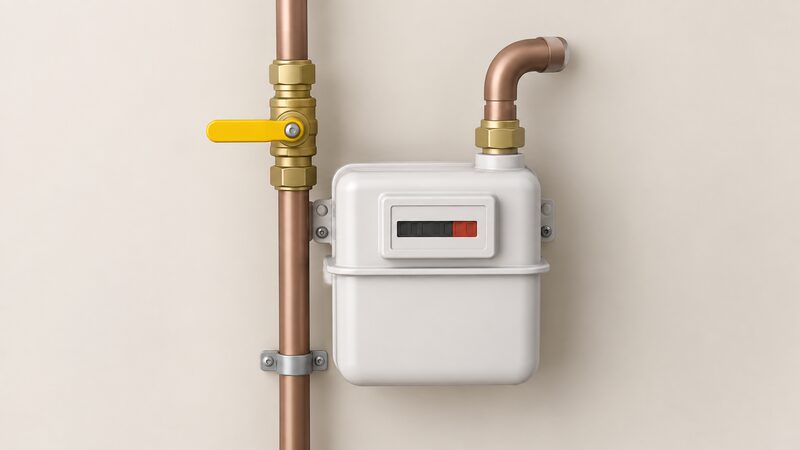
The gas valve is the one most people are told to use and the one with the strictest rules around it. The emergency control valve sits next to the gas meter, and it is closed by turning the handle 90 degrees1. The meter itself is the reference point: it is where the gas supply is turned off, whether on advice or in a gas emergency2. If the meter is in a cellar or basement, the advice changes: do not go down to it3.
The water stopcock is the least standardised of the three. It is the valve on the incoming main, and plumbing guidance is to check it still functions every six months, because a stopcock that has seized is no use in a burst4. The electrical main switch is on the consumer unit, the fusebox, and modern units contain circuit breakers that cut off a circuit quickly and can be safely reset after tripping5.
Why every household should know where its shut-offs are
The legal position on gas is that no person shall install a gas appliance without there being, at the inlet to it, a means of shutting off the supply of gas, unless it is not reasonably practicable9. That is a rule about installation, but it tells a householder something useful: every gas appliance should have its own isolation point as well as the meter valve. Regulation 26(5) of the same regulations requires that an appliance either be usable safely or be sealed off from the gas supply with an appropriate fitting before it is left connected9.
For water, the case for knowing the stopcock is about time. A burst pipe response starts with not touching electrics that have been affected by water, turning them off via the fusebox or consumer unit, and then turning off the water supply before seeking a plumbing professional4. The order matters: water and electricity together are the hazard, so the electrical supply is dealt with first if it is safe to do so.
For electricity, the consumer unit is the single point that isolates the whole installation. A unit with an RCD main switch can safely isolate the entire electrical supply of the home, with individual circuit breakers protecting each connected circuit5. That combination is what makes a planned isolation possible rather than a scramble.
There is also a wider point about dependence. A household that knows its three shut-offs can act on its own supply without waiting for a network operator, a supplier or an emergency engineer. What it cannot do is restore gas: once the emergency control valve is closed, only the relevant authorities advise when it is safe to turn supplies back on8. Independence at the shut-off is real; independence at the restoration is not.
Turning off the electricity at the consumer unit
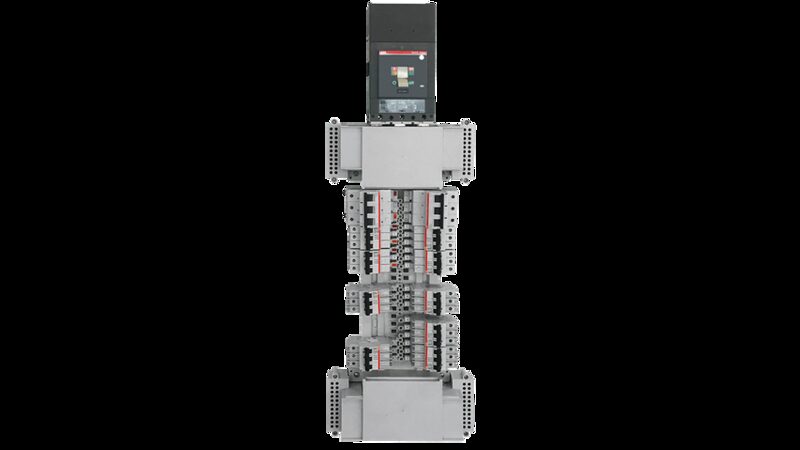
The consumer unit, still widely called the fusebox, is the distribution point for every circuit in the home. Modern units contain circuit breakers, which cut off electricity to a circuit more quickly than a fuse and can be safely reset after being tripped5. Older units may still have rewireable fuses, which need rewiring rather than resetting.
The main switch is the device that isolates the whole installation. On a unit with an RCD main switch, that single device can safely isolate the entire electrical supply of the home, while individual circuit breakers protect each connected circuit5. Where a household wants to isolate one circuit rather than the whole house, the individual breaker for that circuit is the device to use, and it is the same device that trips on a fault.
Flood guidance is the clearest official instruction on when to use the main switch: switch off the electricity supply at the fusebox, the consumer unit, if it is safe to do so8. The condition is doing real work. If the consumer unit is in a flooded area, or if reaching it means standing in water, the switch is not safe to operate and the supply should be left alone.
The sequence for a burst pipe follows the same logic. Do not touch electrics if these have been affected by water, and turn them off via the fuse box or consumer unit box; then, once the water supply is turned off, seek the assistance of a plumbing professional4. Turning off the water first while standing in a wet room with live electrics inverts the safety order.
What this means for independence is straightforward. The consumer unit gives a household a single, labelled point of control over its own installation, and the ability to isolate a circuit without calling anyone. What it does not give is any control over the supply upstream of the meter, which remains the distributor's.
The RCD: what it does and what it protects you from
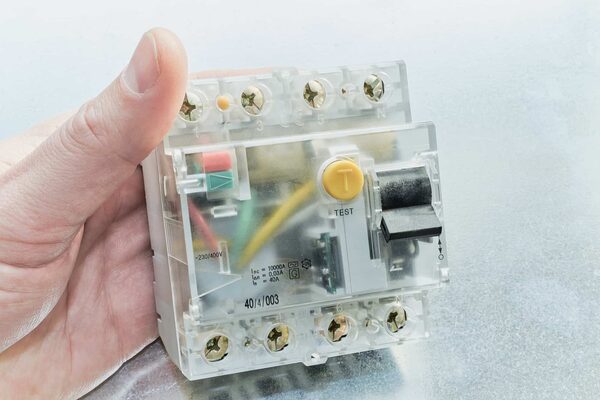
A residual current device in the consumer unit protects from electric shocks if a product is faulty10. That single sentence is the core of it, and it is repeated across consumer safety guidance: an RCD in the consumer unit protects against electric shocks if a product is faulty11, and it is a potentially life-saving device that, when installed in a fusebox, helps to protect householders against electric shock and electrocution12.
The mechanism is detection rather than reaction. Residual current devices immediately switch off the electricity if they detect a fault, and are designed to protect people from electric shocks and earth faults5. A residual current device is defined in Scottish Government guidance as a device to reduce the risk of electrocution and fire by breaking the circuit in the event of a fault13.
What it protects against is worth separating from what it does not. An RCD does not prevent a fault occurring, does not stop a shock being felt, and does not make wiring safe to touch. It reduces the duration and severity of a fault current through a person. Where there is no RCD protection at all, the recommended fallback is an RCD plug on the socket where the product is plugged in10. That advice appears in guidance on portable heaters, smart home devices and recycling electricals alike, which suggests it is a general household measure rather than a product-specific one.
"An RCD is a potentially life-saving device that, when installed in a fusebox, helps to protect householders against electric shock and electrocution."
For a household's independence, the RCD is the device that makes the electrical installation self-protecting to a degree. It acts without a person present and without a call to anyone. The limit is that it protects circuits it is fitted to, and older installations may have partial or no protection, which is a matter for an electrical inspection rather than a householder's own remedy.
Where the RCD is: traditionally under the stairs
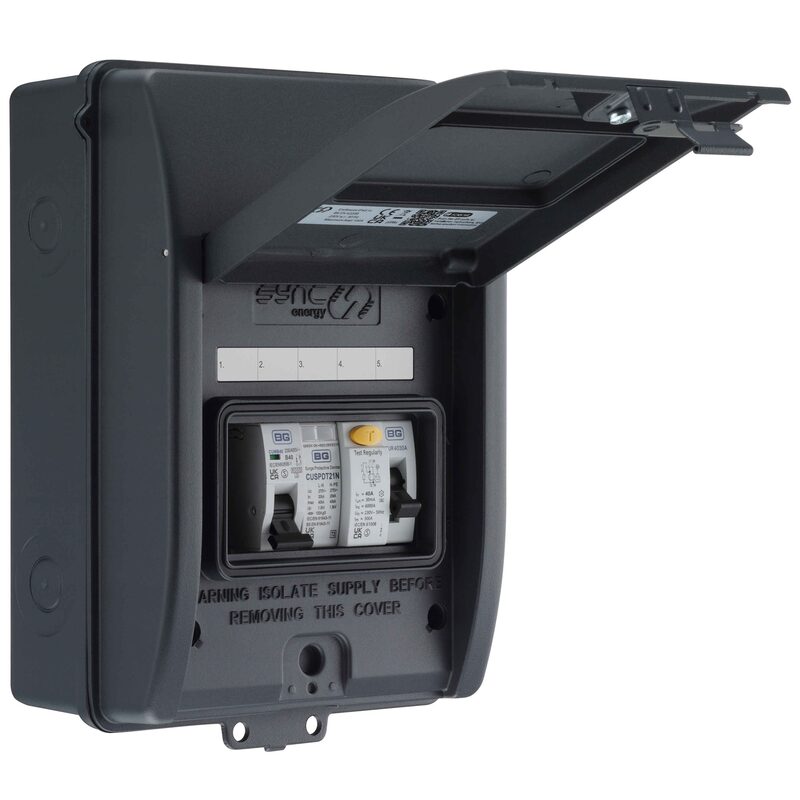
The RCD is normally inside the consumer unit, and the consumer unit is traditionally under the stairs, though it may equally be in a hallway, garage, utility room or cupboard. The location is not standardised, which is why the practical advice is to find it before it is needed rather than during a flood.
Configuration varies with the age of the installation. A unit may come with an RCD main switch and individual circuit breakers protecting each connected circuit5. In that arrangement there is one RCD device covering the installation, and a fault on any protected circuit can take out the whole RCD rather than a single circuit. Newer units more often use residual current circuit breakers with overcurrent protection, known as RCBOs, which combine the functions of an RCD and a circuit breaker5. With RCBOs, a fault trips only the circuit concerned.
That difference matters in an emergency. On a single-RCD unit, a trip can leave the household working out which circuit caused it. On an RCBO unit, the tripped device identifies the circuit directly. Neither arrangement changes where the main switch is or how it operates.
Where there is no RCD protection, the fallback is an RCD plug on the socket where the product is plugged in11. That is a portable device rather than a fixed one, and it protects only what is plugged through it.
Testing your RCD every three months
Electrical Safety First advises testing your RCDs every three months6. The test is the button on the device itself, and it is designed to simulate a fault so the mechanism operates.
The one practical consequence is worth knowing in advance: testing it switches the electricity in the home off momentarily and so causes electric clocks to need resetting12. That is the whole cost of the test. A device that does not trip when the button is pressed is not providing protection, and the next step is an electrician rather than a second press.
The three-month interval sits alongside other household safety intervals, and it is useful to see them together because they are often confused.
| Check | Interval | Who says so |
|---|---|---|
| RCD test | Every three months6 | Electrical Safety First |
| Gas appliance safety check | At least every 12 months by a Gas Safe registered engineer7 | Health and Safety Executive |
| Gas safety check on each appliance and flue | Every year16 | Health and Safety Executive |
| Stopcock function check | Every six months4 | Chartered Institute of Plumbing and Heating Engineering |
The gas figures are the ones with legal weight behind them in rented property. A landlord must ensure that a gas safety check is done every year on each gas appliance and flue16. For owner occupiers the Health and Safety Executive strongly advises that gas appliances and flues are regularly checked for safety at least once every 12 months17, and advises all gas consumers to have appliances checked for safety at least every 12 months by a Gas Safe registered engineer7.
For a household's independence, the RCD test is the cheapest form of self-reliance on the list: no callout, no certificate, no cost. It is also the one most often skipped, because nothing appears to be wrong until the day it matters.
Turning off the gas in an emergency
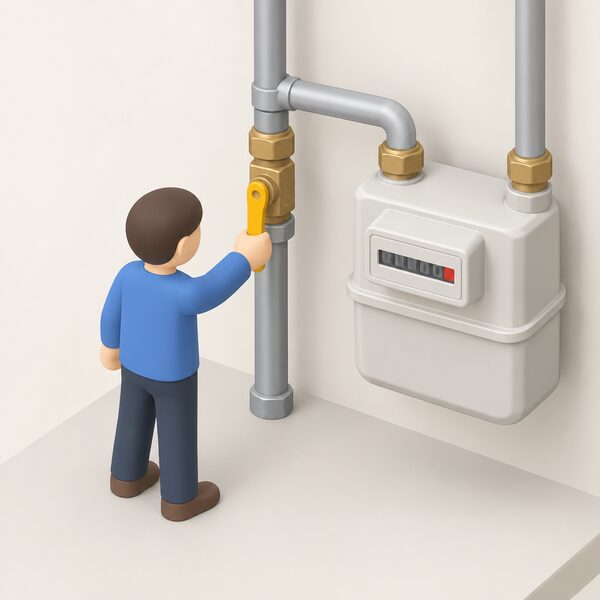
The gas emergency control valve is next to the meter, and the operation is a 90 degree turn. Locate the mains tap near the gas meter and turn the handle 90 degrees to shut off the gas supply1. Where there is no label present, turn the emergency control handle through 90 degrees to close the valve3. The same instruction appears in flood guidance: turn off your gas at the emergency control handle, normally located next to the meter, when advised to evacuate by an authorised agency18.
The exception is consistent across sources and is a safety rule rather than a preference. Switch off the gas at the meter using the emergency control valve unless the meter is in the cellar or basement19. If it is safe and you are able to do so, turn off your gas at the emergency control handle, but do not attempt it if the meter is in a cellar or basement3. Gas can accumulate in a basement, and the valve is in the space where the risk is greatest.
Before any planned gas isolation, the appliances come first. Before you start, you must turn off your gas appliances, such as a central heating boiler, fireplace, hob or oven20. The same principle applies to evacuation: ensure gas appliances are switched off before evacuating18.
The prohibited actions are as important as the valve. Do not use electrical appliances, smoke or use naked flames, or stay in a cellar or basement with a smell of gas22. Avoid smoking, burning any naked flames such as candles or matches, or using any electrical devices, including switches, doorbells and mobile phones21. The reason is that a switch, a doorbell or a phone can produce a spark at the moment it operates.
Carbon monoxide is a separate emergency with its own actions: switch off the appliance and shut off the gas supply at the meter control valve, open all doors and windows to ventilate the room, and visit a GP to report suspected exposure23.
What this means for independence is that gas is the least independent of the three supplies. A household can close the valve, but it cannot reopen it on its own authority, and it cannot remove the supply without the supplier's involvement. If there is a gas meter at the property and the aim is to remove the gas pipe, the first step is to contact the energy supplier to end the gas supply contract and arrange for the gas meter to be removed24.
Turning off the water at the stopcock
The stopcock is the valve on the incoming water main, and it is the one shut-off with no universal location. It is commonly under the kitchen sink, but it may be in a downstairs cloakroom, a utility room, an airing cupboard or an external chamber. The practical test is not where it is but whether it turns.
Plumbing guidance is to check it still functions every six months4. A stopcock that has not been operated for years can seize, and a seized valve discovered during a burst is a valve that does not exist. The check is a partial turn and back, not a full closure, so that the household knows the valve moves.
For a property left empty in winter, the sequence is more thorough. Turn off the water supply via the stop-valve, open the taps and run off any remaining water, and drain the pipes to make sure they are completely empty4. That is the standard protection against a frozen and burst pipe in an unoccupied home.
The order of operations in a live emergency is the part that catches people out. Do not touch electrics if these have been affected by water and turn them off via the fuse box or consumer unit box; then, once the water supply is turned off, seek the assistance of a plumbing professional4. Electricity first, water second, plumber third.
Where a property has been flooded, the gas supply has its own instruction: if you have been flooded and it is safe to do so, turn off your gas supply at the gas meter18. Flood damage electrical safety advice adds that other services, such as gas, should be arranged to be turned off by the service providers8.
For independence, the stopcock is the most self-contained of the three. A household can close it, reopen it and test it without involving anyone. The dependence that remains is on the water undertaker upstream of the valve, and on a plumber for anything beyond the isolation itself.
RDC-DD and BS IEC 62955: the newer protection standard

Direct current protection is a newer layer, driven by electric vehicle charging. An RDC-DD is a residual direct current detecting device complying with BS IEC 6295525. BS EN 62955:2018 provides requirements for RDC-DDs to be used for Mode 3 charging of electric vehicles25.
The reason a separate device is needed is that DC residual current can blind a conventional RCD. For Mode 3 charging, a Type A or Type F RCD is required where protection against DC residual current in the form of an RDC-DD is provided within the electric vehicle supply equipment25. The requirements for RDC-PDs, a related device with integrated AC, pulsating DC and 6 mA DC detection, evaluation and mechanical switching, are provided in Annex O of BS IEC 62955:201825.
RCD types are not interchangeable, and the type determines what the device can detect. A Type AC RCD trips on alternating sinusoidal residual current and is designed for equipment that is resistive, capacitive or inductive and without any electronic components26. A Type A RCD covers circuits with electronic components, including inverters, Class 1 IT equipment, power supplies for Class II equipment, lighting equipment including dimmers and LED drivers, induction hobs, and electric vehicle charging equipment with smooth residual DC current less than 6 mA26. A Type B RCD covers inverters, uninterruptible power supplies, photovoltaic systems, lifts, escalators, welding equipment, industrial machines, and electric vehicle charging equipment with smooth residual DC current greater than 6 mA26. A Type S RCD is a sinusoidal residual current device incorporating a time delay26.
The standards landscape around these devices is set out in the wiring regulations. Electrical safety standards means the standards for electrical installations in the eighteenth edition of the Wiring Regulations, published by the Institution of Engineering and Technology and the British Standards Institution as BS 7671:201827. RCDs in electric vehicle supply equipment are required to comply with one of BS EN 61008-1, BS EN 61009-1, BS EN 60947-2 or BS EN 6242325. Residual current circuit-breakers are covered by BS EN 61008, BS 4293 and BS EN 6242326.
For a household, the practical point is that an EV charger is not simply a socket. It carries its own protection requirements, and the type of RCD in the installation has to match what is being connected. That is a matter for the installer and the inspection report, not for a householder to determine from the consumer unit label.
Restoring supply, and what not to touch
Restoration is where household independence stops. Flood damage electrical safety advice is that the electricity and gas supplies should remain off until advised by them it is safe to turn them back on8. The "them" is the relevant authorities, and the instruction covers both supplies.
The gas position is the stricter of the two. A gas disconnection carried out under a legal obligation in health and safety legislation is regulated by the Health and Safety Executive, and gas distribution networks cannot charge customers for it28. A voluntary disconnection, carried out at the consumer's request and not required under health and safety legislation, is charged at a reasonable and cost reflective rate approved under the network's connection charging methodology28. The legal basis for disconnection work sits in the Gas Safety (Installation and Use) Regulations 1998, the Pipeline Safety Regulations 1996 and the Gas Safety (Management) Regulations 199628.
Electricity has its own emergency mechanism. Rota disconnection means the deliberate disconnection of customers' electricity supplies by the relevant electricity distributor for a set duration on a rota basis so as to reduce the demand for electricity to the level of capacity that is available29. That is a distributor action, not a household one, and it is the clearest illustration of where control actually sits.
There is a separate and quieter form of disconnection worth naming. When a household stops using energy entirely due to affordability, it is called self-disconnection30. It is not an emergency isolation, but it is a supply going off, and it is the one form of disconnection a household controls entirely.
What a household must not touch is short and firm. Do not touch any exposed wires, they may still be live8. Do not use electrical appliances, smoke or use naked flames, or stay in a cellar or basement with a smell of gas22. Do not turn any power or light switches on or off where gas is suspected19. And where a supply has been isolated in a flood, it stays off until the authorities say otherwise8.
The independence a household has is real but bounded: it can isolate its own gas, water and electricity, and it can test its own RCD. It cannot restore gas, it cannot override a distributor's rota disconnection, and it cannot make a flooded installation safe. Knowing the three shut-offs is the part that belongs to the householder.
Sources30 cited
- Got an engineer coming, Cadent Gas, 2026-09-20
- Make the right call, Cadent Gas, 2026-09-20
- Be winter ready, SGN, 2026
- Don't be frozen out, Chartered Institute of Plumbing and Heating Engineering, 2024-01-11
- Consumer units and fuse boxes, NICEIC, 2025-09
- Electricity made easy, Electrical Safety First, 2026-09-19
- Gas appliances: get them checked, Health and Safety Executive, 2011-09
- Flood damage and electrical safety, Electrical Safety First, 2026-09-19
- Gas Safety (Installation and Use) Regulations 1998, legislation.gov.uk, 1998-10-03
- Portable heaters, Electrical Safety First, 2026-09-17
- Energy and rating labels, Electrical Safety First, 2026-09-19
- Spring forward into electrical safety, Electrical Safety First, 2026-09-19
- Regulations to modify the repairing standard, Scottish Government, 2019-03-01
- Smart homes, Electrical Safety First, 2026-09-19
- Recycling electricals and batteries, Electrical Safety First, 2026-09-17
- Gas safety checks: what, Health and Safety Executive, 2026
- Gas safety: owner occupiers, Health and Safety Executive, 2026
- Flood advice, Cadent Gas, 2026-09-20
- Emergency engineer visit, Cadent Gas, 2026-09-20
- Gas off, Northern Gas Networks, 2026-08-24
- Gas leaks safety, Uswitch, 2026-06-01
- Smell gas, WW Utilities, 2026-09-20
- Carbon monoxide, Health and Safety Executive, 2026
- Disconnecting from the gas network, Institution of Gas Engineers and Managers, 2026-09-20
- RCDs for electric vehicle supply equipment, Institution of Engineering and Technology, 2024-05
- Which RCD type, Institution of Engineering and Technology, 2019-09
- Electrical safety standards, Northern Ireland, legislation.gov.uk, 2024-11-27
- Call for input: disconnections, Ofgem, 2025-01-13
- Consultation on amendments to the Electricity (Standards of Performance) Regulations 2015%20Regulations%2020151680596597411.pdf), Ofgem, 2023-04-04
- Tackling fuel poverty in Scotland, Scottish Government, 2021-12-23
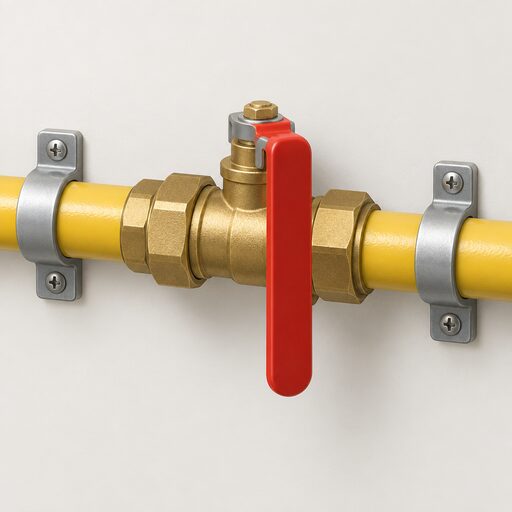 Smell Gas or Suspect COThe emergency steps for a suspected gas escape or carbon monoxide alarm, including ventilation, ignition sources and turning the supply off at the emergency control valve.
 Gas Supply EmergenciesIf gas runs short, will my home lose supply?
 Prepare a Home for a Power CutA household checklist for before, during and after an outage: what to keep charged and to hand, which appliances to switch off, how long food stays safe and what to do about medical equipment.
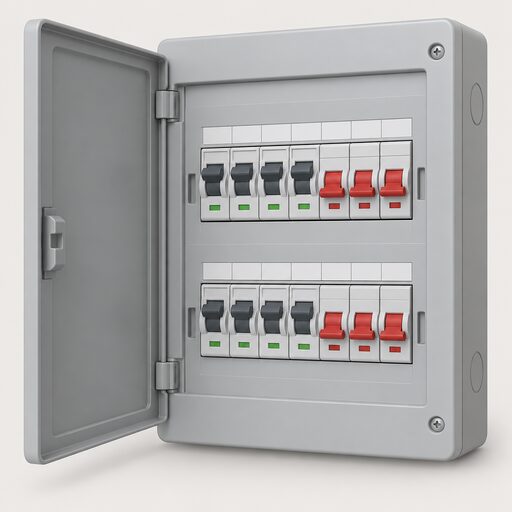 Essential Loads and CircuitsWhich plugs and lights should stay on when the power goes off, and which can safely go without?
 Prepare Energy for StormsWhat to do before and during a storm or flood warning to protect meters, the consumer unit, heating equipment and fuel tanks.
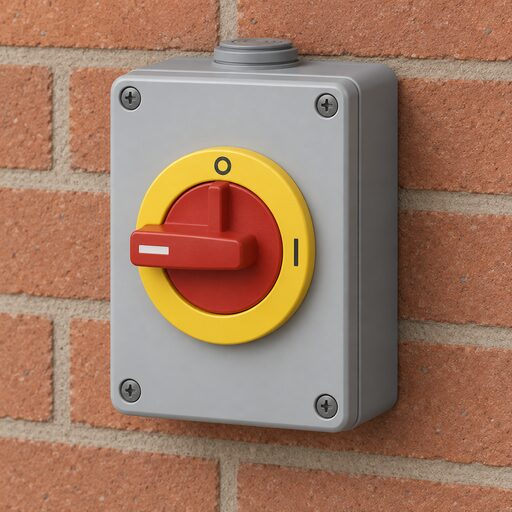 EV Charge Point Faults and FixesDescribes the common failure patterns on domestic charge points: tripped protective devices, lost connectivity, stuck cables and locks, error indications and charging that stops early.