

In this guide
Preparing a home for winter in the UK is mostly a matter of timing. The British public tend to hold off putting the heating on until around mid-October, so the checks that make that first cold week uneventful need doing in September and early October, not in November when engineers are booked out1. The work divides into three groups: the gas or oil appliance and its flue, which needs a registered engineer; the water and heating circuit, much of which a household can handle; and the building itself, where draught-proofing is the cheapest heat-loss measure available.
The case for doing it early is not only comfort. Independent research found that 83% of UK adults said they had changed how they heat or ventilate their home this winter because of cost, and 31% reported damp in a previous home2. A heating system that is serviced, bled and balanced before the season starts runs closer to its design efficiency, and alarms that are tested and in date are what stand between a household and a carbon monoxide incident.
Why autumn is the time to prepare your home for winter
The seasonal argument for autumn work rests on two things: how long a booking takes to arrange, and how much of the winter's cost is decided before the cold arrives. A boiler service booked towards the end of the summer is easier to schedule than one booked in the first cold snap, and the same guidance treats 12 months as the recommended maximum interval between services, so a household whose last visit was more than a year ago is already overdue8.
There is a wider context that makes the autumn window useful. The Climate Change Committee's progress report to Parliament notes that hotter heatwaves could see 92% of existing homes overheat, creating dangerous conditions for vulnerable people9. That is a summer risk, but it points to the same conclusion for winter: the fabric and the services of a home are what determine how it performs, and both are cheaper to adjust outside the season when they are being used hard. The Committee's work with Arup on overheating considers what factors influence risk, how homes can be adapted or upgraded to mitigate the impacts and how much that costs, and covers retrofit needed to mitigate risk up to a 4°C global warming scenario10.
Cost pressure is the other reason autumn matters. The Warm Home Discount has existed since 2011 as a fuel poverty reduction scheme, reducing the energy costs of low-income and vulnerable households across Great Britain, and it is administered on a scheme year that runs from April to March11. Households that expect to rely on it should confirm their position before the winter bills land rather than after. Some households may be eligible for grant funding for draughtproofing as part of the government's new Warm Homes Plan, and local authority schemes have offered free simple home energy measures including LED lighting and draught proofing5.
The practical sequence for most homes runs: service the appliance, deal with the heating circuit, then the building fabric, then the alarms, then the winter routine. The sections below follow that order.
The annual boiler service: what it covers, what it costs and why it matters

An annual service is essential for keeping a boiler running efficiently and safely, and many providers will only cover you if you have one14. That single condition explains why the service sits at the top of the checklist: it is both a safety check and, for anyone with a cover plan, the thing that keeps the plan valid.
During a service a Gas Safe registered engineer will carry out maintenance checks on all the key parts of your boiler8. The scope is the appliance and its combustion, not the whole heating system, which is why bleeding radiators and checking controls are separate jobs further down this page.
On price, published figures are thin and vary by provider. HomeServe advertises annual boiler services at £126, and boiler cover from £6.99 a month, which gives round-the-clock access to qualified, Gas Safe-registered engineers4. Many households buy the service as part of a cover arrangement rather than as a standalone visit, and the terms of those arrangements differ enough that the price alone does not tell you what is included. Where no published price exists, servicing is installer-quoted, and the figure depends on the boiler type, its condition and the area.
The independence point is straightforward. A serviced boiler is one whose combustion has been measured and whose safety devices have been looked at by someone qualified to judge them. Nothing about a service reduces a household's dependence on the gas grid or on a supplier, but it does reduce the chance that the dependence fails at the worst moment, in the first cold week of January.
Servicing rules and warranty conditions: homeowners, landlords and Gas Safe engineers
The legal position differs sharply between owner-occupiers and landlords, and it differs again in the detail across the four nations.
For landlords, independent guidance is unambiguous: a landlord is legally required to service a boiler on an annual basis in all of their properties8. Official guidance for Northern Ireland states that the landlord is responsible for servicing boilers and appliances annually and must provide an up-to-date gas safety record, which is a legal requirement15. The same duty is expressed in Great Britain as an obligation to make sure that gas pipework, flues and appliances are in good condition and checked every year by a Gas Safe registered engineer16. Landlords are responsible for ensuring that annual gas safety checks are carried out in their properties by a Gas Safe Registered Engineer17.
For owner-occupiers there is no equivalent legal duty, but there is a practical one. Always use a Gas Safe registered engineer to fit, fix and check your appliances16. That applies to the service, to any repair, and to the installation of a replacement.
"You must make sure that gas pipework, flues and appliances are in good condition and checked every year by a Gas Safe registered engineer"
Carbon monoxide is the reason the engineer requirement is not negotiable. The Smoke and Carbon Monoxide Alarm (Amendment) Regulations 2022 require landlords to ensure any room used as living accommodation which contains a fuel-burning appliance is equipped with a carbon monoxide alarm, excluding gas cookers17. Building Regulations Document J for England and Wales states that any new or replacement solid-fuel appliances require a BS EN 50291 kitemarked carbon monoxide alarm17. Northern Ireland's gas safety guidance carries the same theme for households generally15.
Warranty conditions sit alongside the law. Manufacturers commonly require an annual service by a registered engineer to keep cover valid, and a boiler that has not been serviced can have a claim refused. The boiler service frequency page sets out the intervals in more detail, and DIY boiler repairs and warranty covers what voids cover.
Bleeding radiators and clearing sludge: getting the heating system ready
Bleeding radiators means releasing trapped air so hot water can circulate properly and heat the radiator evenly18. It is one of the few heating jobs a household can do without an engineer, and it is worth doing before the season starts rather than during it.
The method is simple but has a precondition: work through the process step by step with the heating switched off and the radiator cool18. The sequence most guides give is to turn on the heating and wait for all radiators to heat up so pressure builds, then identify radiators with trapped air and switch the heating off before bleeding19. If an individual radiator is warmer in some places than others, it may well need bleeding, which you can do yourself3. Energy Saving Trust's viewing checklist puts it plainly: bleed any radiators to make sure they're working effectively20.
The signs that a radiator needs attention are consistent across sources. The clearest signs are a radiator that is cold at the top, slow to warm up or making gurgling noises18. A second list adds radiators not heating up properly, cold patches across the top, gurgling or bubbling noises, increased heating bills, and damp or mouldy patches on walls19. The overlap between trapped air and sludge is real: both produce cold patches and noise, and a system that needs bleeding repeatedly through the winter is usually telling you something about the water inside it.
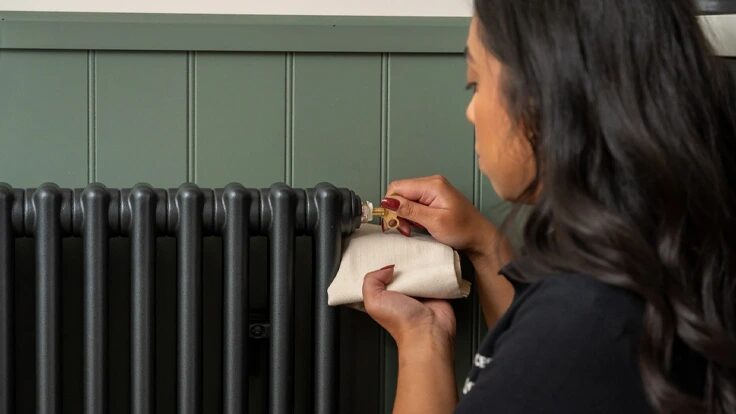
Two related jobs belong in the same autumn session. A frozen condensate pipe stops a condensing boiler, and the remedy is warm, not boiling water thawing a frozen condensate pipe, followed by a reset3. The full method is on the thawing a frozen condensate pipe page. Separately, systems that were not designed for flexible operation can work against their owners: research has identified buffer tanks calling for heat during high-price periods, and thermostatic radiator valves blocking attempts to preheat spaces before high-price periods21. Setting valves and timers deliberately, rather than leaving them where they were, is part of getting the system ready.
Draught-proofing: the cheapest way to cut heat loss
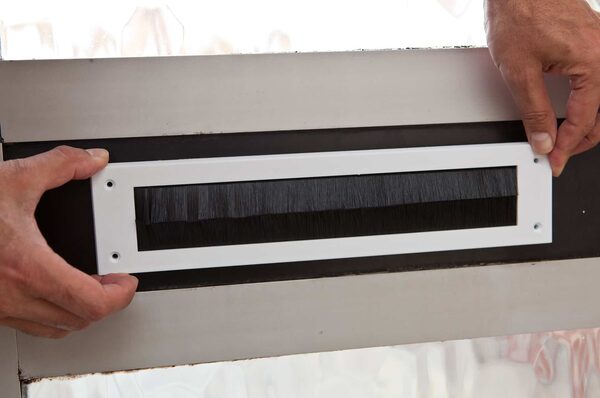
Draught-proofing is the lowest-cost fabric measure available, and the published savings are modest but real. Draughtproofing your windows and doors could save you up to £35 in energy a year5. A second figure from the same source gives £25 to £50 a year for DIY installation and professional whole house installation, depending on what you plan to draughtproof5. The two figures are not directly comparable: one covers windows and doors only, the other covers a wider scope. Both are estimates, and both assume the work is done properly and ventilation is not compromised.
The reason the savings are small is that draughts are a comfort and heat-loss problem rather than the dominant one. Insulation and heating efficiency matter more to the total bill. But draught-proofing has two advantages that larger measures do not: it can be done in an afternoon, and much of it is reversible.
There is a tax dimension that reduces the cost. Draught stripping for windows and doors is listed in legislation as an energy-saving material22, and official guidance confirms that draught stripping, for example insulation fixed around windows and doors, qualifies for a lower rate of VAT23. The same guidance lists draught stripping as a material fixed around windows, interior and exterior doors, and loft hatches to reduce draughts24.
That warning is the limit of the whole exercise. A house sealed too tightly traps moisture, and moisture produces the damp and mould that independent research already links to 31% of adults reporting damp in a previous home2. The overall proportion of English dwellings affected by damp and mould has fallen over the past decade, down 17% across all homes, which suggests the balance is achievable2. The draught-proofing for renters page covers the reversible options.
Where to find and fix draughts: doors, windows, chimneys, loft hatches and floors
The routes are predictable, and working through them in order covers most of the loss.
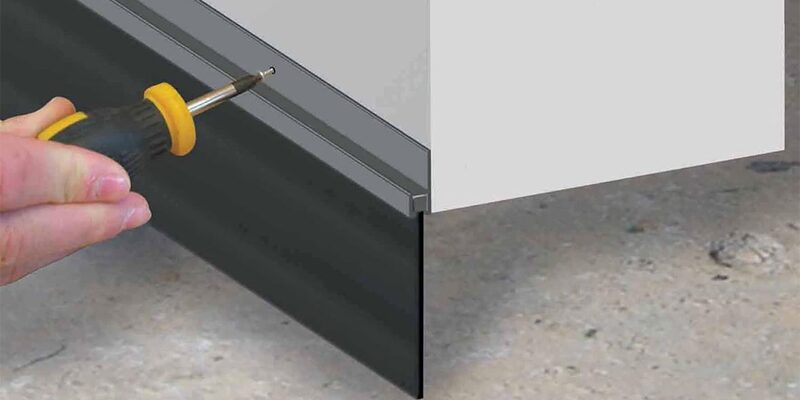
- Windows and doors. Draught stripping is fixed around windows, interior and exterior doors, and loft hatches to reduce draughts24. For exterior doors, use foam, metal or plastic draught-excluder strips around the door frame, fit brush strips along the bottom of the doors, and consider a curtain or a snake draught excluder25.
- Unused chimneys. Chimney draught excluders such as chimney sheep or balloons are available from most DIY stores, but remove it in summer to let the air circulate, and do not install on any chimneys that are in use25.
- Loft hatches. Covered by the same draught stripping material24.
- Floors and gaps. The general principle is to close the gap without sealing the ventilation path the building needs.
Finding the draughts is easier with the house closed up and the heating on. Independent guidance on viewing a home lists damp and mould, condensation, draughts and poor ventilation as the things to check closely, which is a useful checklist for an existing home as well as a prospective one20. The Centre for Sustainable Energy's DIY guidance was reviewed in July 2026 and remains the practical reference for the individual measures25.
For rented homes the position is different. Official guidance for private rented housing fitness checks says the landlord should make sure roof spaces are insulated, replace draughty ill-fitting windows and doors, draught proof external doors and windows (but not rooms containing an open-flue gas appliance), insulate exposed water pipes, and fit the hot water tank with a good quality insulation jacket26. Those are landlord duties, not tenant ones. Where a landlord has not acted, the draught-proofing for renters page sets out what tenants can do without altering the property.
Chimney sweeping and Chimney Fire Safety Week: how often and who to book
For anyone burning wood or solid fuel, the chimney is the part of the winter system most likely to cause a fire, and the sweeping interval is the control. HETAS encourages having your chimney swept at least twice a year when burning wood6. Its approved sweep guidance repeats the figure: your chimney should be swept at least once a year when burning smokeless fuels and at least twice a year when burning wood fuel7.
A separate HETAS schedule gives different intervals by fuel: wood burning quarterly when in use, coal twice per year, and oil fired once per year27. The documents therefore disagree on wood, with one giving at least twice a year and another quarterly when in use. The safe reading is that twice a year is the floor and a stove in heavy use needs more.
Chimney Fire Safety Week is the annual prompt. The campaign aims to raise awareness of the dangers of chimney fires and the common causes, encouraging safe operation, appropriate fuel selection, and regular appliance and chimney maintenance28. The 2026 campaign ran from 7 to 13 September, with the hashtag #CFSW202628.
Booking is straightforward if the sweep is approved. HETAS Approved Chimney Sweeps must hold public liability insurance cover of at least £2 million, appropriate indemnity and liability cover, risk assessments, and have a complaints procedure7. They will show an ID card on arrival6. Following a successful sweep, your HETAS Approved Chimney Sweep will provide you with a certificate, which is evidence that your chimney has been professionally swept and can be used for insurance purposes if required7.
Preparation matters as much as booking. Let the fire go out completely the day before the scheduled time of cleaning, avoid using the fire or stove for several hours prior, and clear the ash pan and space around the stove6. Ash disposal has its own safety rules, covered on the recycling electrical items and batteries page alongside other waste streams27.
Smoke and heat alarms: one per floor, tested monthly, replaced every ten years
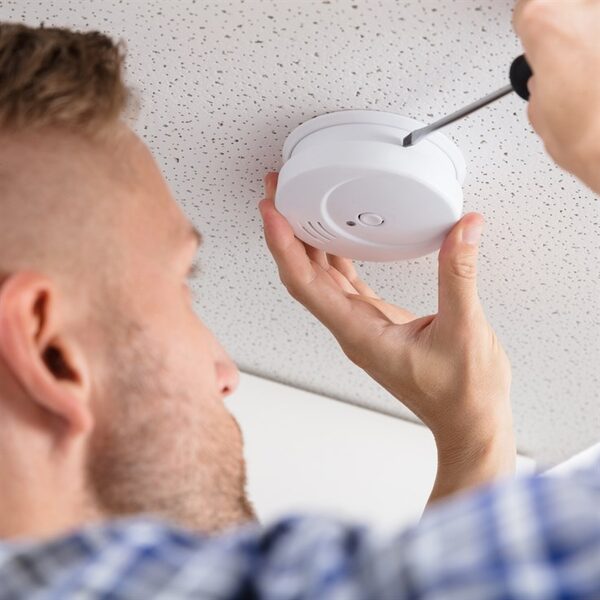
Alarms are the cheapest life-safety item on the list and the one most often left untested. The maintenance routine is short: test alarms at least once a month29. The replacement rule is equally clear: replace them every ten years or when the replace by date is reached30.
Coverage should be at least one smoke or heat alarm per floor in your property29. Where a scheme specifies placement in more detail, the pattern is one smoke alarm in the living room or the room you use most, one smoke alarm in every hallway or landing, and one heat alarm in the kitchen31. Heat rather than smoke in the kitchen avoids nuisance alarms from cooking.
Interlinking is where the rules diverge across the four nations. Official guidance for landlords in Wales requires smoke alarms to be connected to the electrical supply and inter-linked with all other smoke alarms connected to the electrical supply32. The Scottish scheme rules specify interlinked alarms in dwelling houses where energy efficiency measures are installed31. Northern Ireland's gas safety guidance covers carbon monoxide alarms alongside gas safety generally15, and the 2022 Regulations set the carbon monoxide requirement for rooms with fuel-burning appliances in England17.
| Alarm type | Placement | Testing | Replacement |
|---|---|---|---|
| Smoke | Living room or most-used room; every hallway or landing31 | Monthly29 | Ten years or by the replace-by date30 |
| Heat | Kitchen31 | Monthly29 | Ten years or by the replace-by date30 |
| Carbon monoxide | Any room with a fuel-burning appliance, excluding gas cookers17 | Monthly29 | Ten years or by the replace-by date30 |
Portable heaters used to supplement a cold room carry their own safety requirements, set out by Electrical Safety First30. The testing smoke and heat alarms page covers the full routine, and reporting a gas emergency covers what to do if an alarm sounds.
Testing the heating early and planning the winter routine
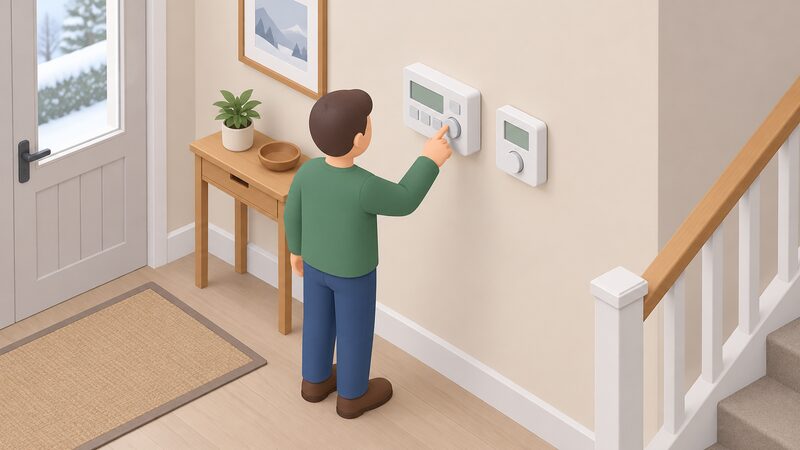
The final step is to run the system before it is needed. Turning the heating on during a mild week in early October, with the windows open, tests the boiler, the pump, the radiators and the controls while an engineer can still be booked without an emergency callout. It also surfaces the problems that only appear under load: a radiator that stays cold, a zone valve that does not open, a thermostat that reads the wrong room.
The wider direction of travel is worth knowing because it affects what a household plans for. The Warm Homes Plan's expansion of rooftop solar and home battery storage is part of the UK's transition to clean energy33. The Heat Pump Ready Programme aims to develop innovative technology and ensure the innovation is tested and trialled in homes so that the real-world impact is understood34. Research on the transition to heat pumps for households at risk of fuel poverty combined in-depth interviews with households at risk of fuel poverty, technical home audits, analysis of monitored heat pump performance data, cost modelling and a review of existing evidence35. A recent UK trial has investigated preheating homes during periods of low-cost electricity and then switching heat pumps off during expensive periods21.
What this means for independence is mixed. A serviced boiler, bled radiators and sealed draughts reduce the amount of gas or oil a home needs and make the dependence on the grid and the supplier less costly, but they do not remove it. A wood stove with a swept chimney and dry fuel is more independent still, at the cost of the labour and the particulate and safety rules that come with burning. The measures that shift the balance furthest, solar, batteries and a heat pump, are the ones the current programmes are testing and funding, and they are covered on the home energy how-to pillar and the energy independence step by step page.
Sources35 cited
- Switching on your heating, Act on Energy, 2026
- Mouldy Nation report, Uswitch, 2026
- How to keep your boiler working in cold weather, Which?, 2025
- HomeServe boiler cover, Uswitch, 2026
- Draught-proofing, Which?, 2026
- How to sweep a chimney, HETAS, 2026
- How to save money on a chimney sweep, HETAS, 2026
- Boiler servicing guide, Confused.com, 2025
- Progress in reducing emissions: 2026 report to Parliament, Climate Change Committee, 2026
- Addressing overheating risk in existing UK homes, Climate Change Committee, 2026
- Warm Home Discount, Ofgem, 2026
- Warm Home Discount annual report, scheme year 14, Ofgem, 2026
- Energy saving grants and funding, Tameside Council, 2026
- How to choose the best boiler cover, Which?, 2025
- Gas safety and carbon monoxide, nidirect, 2025
- Carbon monoxide safety, SGN, 2026
- Carbon monoxide, WW Utilities, 2026
- How to bleed a radiator, Smart Energy GB, 2026
- How to bleed a radiator, Uswitch, 2026
- Energy saving house viewing tips, Energy Saving Trust, 2026
- Efficiency and flexibility: a UK perspective on heat pumps, Heat Pumping Technologies, 2024
- Value Added Tax Act 1994, Schedule 8, legislation.gov.uk, 2026
- Tax on shopping: energy-saving products, GOV.UK, 2026
- VAT energy saving materials, HMRC, 2026
- DIY draught-proofing, Centre for Sustainable Energy, 2026
- Checking your home is fit to live in, nidirect, 2026
- Safe disposal of stove ash, HETAS, 2026
- Chimney Fire Safety Week assets, HETAS, 2026
- Energy and rating labels, Electrical Safety First, 2026
- Portable heaters, Electrical Safety First, 2026
- Area Based Scheme guidance, Scottish Government, 2024
- Fitness for human habitation guidance for landlords, Welsh Government, 2022
- Well adapted energy system, Climate Change Committee, 2026
- Building regulations: roof, Welsh Government, 2026
- Transition to heat pumps for households at risk of fuel poverty, GOV.UK, 2026
 Prepare a Home for a Power CutA household checklist for before, during and after an outage: what to keep charged and to hand, which appliances to switch off, how long food stays safe and what to do about medical equipment.
 Prepare Energy for StormsWhat to do before and during a storm or flood warning to protect meters, the consumer unit, heating equipment and fuel tanks.
 Going Off-Grid in the UKA whole-picture account of an off-grid UK home: electricity, heat, hot water, cooking, water and waste, and the seasonal management it demands.
 Arrange an Electrical InspectionHow to find and check a registered electrician, what an Electrical Installation Condition Report covers and the intervals usually recommended for owner-occupied homes.
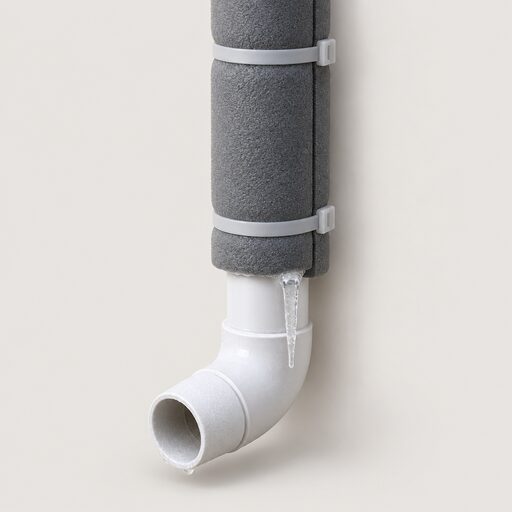 Prevent Frozen PipesMeasures that reduce freezing risk in lofts, garages and outbuildings, and the steps to take when a pipe has already frozen or burst.
 The Full Heat Pumps GuideWill a heat pump keep my house warm in winter, and what does one cost to buy and run?