On this page
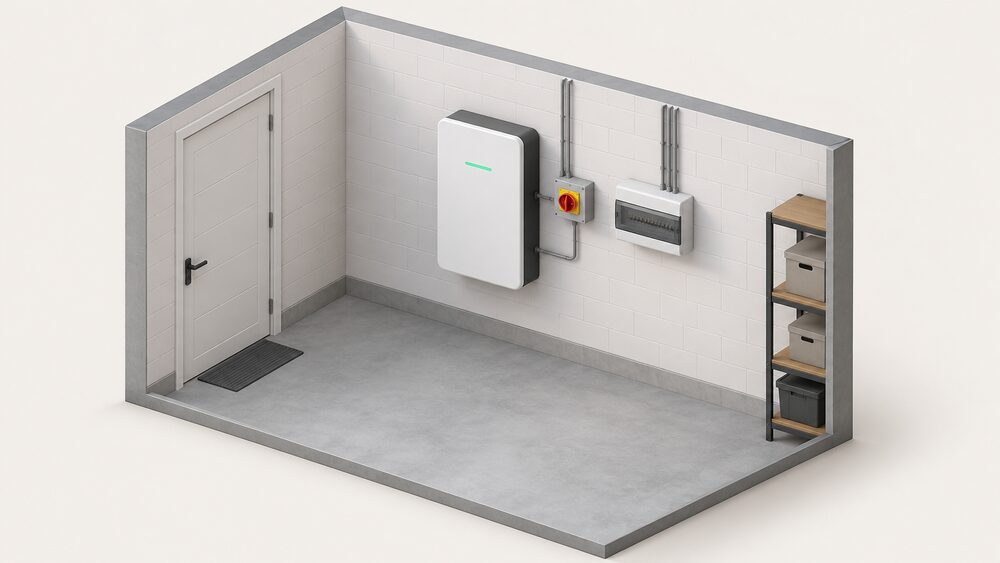
A home battery stores electricity until your household needs it: as Solar Energy UK puts it, batteries are "a way for homeowners to store excess electricity produced from their solar system"1. The payoff is sizeable when the two are paired. Centre for Sustainable Energy reports that domestic battery systems can store as much electricity as a household typically uses in a day, enabling a PV system to provide up to 70% of a household's annual electricity demand2. Batteries are also increasingly bought on their own, charged overnight on a cheap time-of-use tariff, a market that was already running at just under 3,000 registered installations in January 20253.
Official scheme guidance defines domestic batteries as electrochemical batteries installed to be used in conjunction with solar PV panels in residential buildings4, though in practice a battery works with or without panels. A newer category is also emerging: the Energy Services Association is working on an evidence-based framework for the safe deployment of plug-in battery energy storage systems in UK homes5.
Buying well is mostly about asking the right questions before you sign, and knowing what a compliant quote and handover look like. This page sets out those questions in order, from sizing to warranty small print.
What a home battery actually does in a UK household
The core job is time-shifting. Electricity that would otherwise be exported, or bought at an expensive time, is stored and used later. With solar, that means evening use of daytime generation; without solar, it means daytime use of cheap overnight electricity. Centre for Sustainable Energy's figure of up to 70% of annual demand covered is the headline benefit for a solar household, and it rests on the battery holding roughly a day's typical consumption2.
Most home batteries use lithium ion chemistry, the same family of cells found in laptops, mobile phones, e-scooters and mobility vehicles, as North Wales Fire and Rescue Service notes when describing the average UK home8. That matters for buying in two ways. First, the safety rules that apply to these devices, including always using the correct battery and charger and charging to the manufacturer's instructions, apply to a wall-mounted home battery too8. Second, it explains why installation standards and fire-safety siting rules exist, and why a quote that never mentions them is a warning sign.
For energy independence, a battery reduces dependence on the grid at peak times and on buying electricity at the worst prices. It does not remove the grid connection, the supplier relationship, or dependence on the manufacturer's company for warranty cover and replacement parts. Plug-in systems, a growing segment, are the subject of an ongoing safety framework rather than a settled rulebook, so treat claims in that market with extra care5.
Sizing: capacity, power output and your daily use
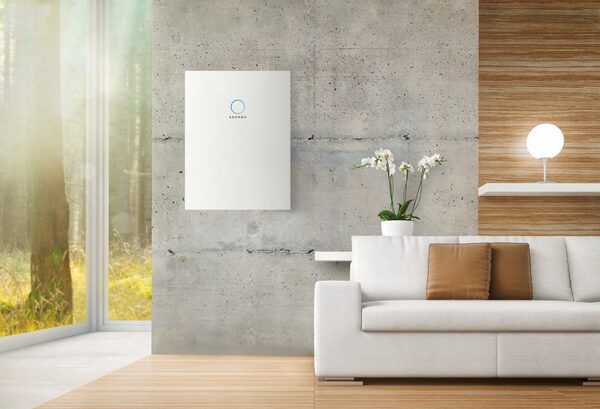
The right size follows from two numbers: how much electricity the household uses in a day, and how much of it falls at times the battery can cover. Centre for Sustainable Energy's benchmark, a battery storing as much electricity as a household typically uses in a day, is the practical starting point for a solar household2. A battery much smaller than daily use fills and empties quickly and leaves demand uncovered; one much larger spends much of its life part-empty, which is poor value per kWh.
Power output matters as much as capacity, and quotes often bury it. A battery that stores plenty but discharges slowly cannot run a kettle alongside a washing machine. Ask each installer for both figures, the usable capacity in kWh and the continuous discharge power in kW, and for the depth of discharge the warranty assumes. Our pages on battery capacity and usable capacity and battery power ratings explain what the numbers mean.
Independent advice is consistent on process: "It's always best to get a quote from at least three installers, as installation costs can vary."7 Give all three the same usage information so the sizes they propose are comparable.
AC-coupled, DC-coupled or all-in-one: which setup fits your home
The coupling question is really a question about what your home already has. An AC-coupled battery "connects on the AC side of your home's electrical system"7, which makes it a parallel addition rather than a change to the solar installation itself. Centre for Sustainable Energy's guidance is direct: "In general, AC-coupled batteries are probably better if you already have PV as they are easier to retrofit"6. For a household with panels already on the roof, that is usually the answer.
A DC-coupled battery sits on the direct-current side, between the panels and the inverter, which is the natural arrangement when solar and battery are designed and installed together. An all-in-one unit packages battery, inverter and sometimes backup switching in a single product, which simplifies the quote but locks the specification to one maker's ecosystem. Our pages on AC and DC coupling and all-in-one systems cover the trade-offs in detail.
The combination of solar, battery and an electric vehicle is now the most common multi-technology setup in real homes: Energy Systems Catapult's Living Lab found EV + solar + battery adopted in 289 homes, 14% of the low-carbon-technology homes studied, as of November 20259. If an EV is on the horizon, say so at quoting stage, because the load it adds changes both the sizing and the electrical work.
For independence, the choice has a long tail: an all-in-one system ties monitoring, updates and warranty to one company, while a modular AC-coupled setup can often accept a different maker's battery later. Ask what happens to each component if the manufacturer stops trading.
Questions to ask an installer before you commit
The questions below separate a considered quote from a price on the back of an envelope. Ask them of every installer, and compare the answers side by side.
- Accreditation. "Make sure your installer is certified by the Microgeneration Certification Scheme (MCS)"6. Ask for the certificate number.
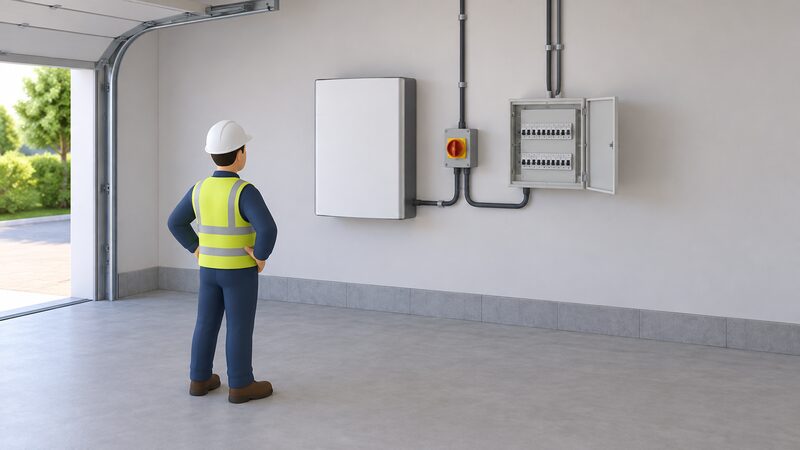
- Supply and earthing assessment. For significant new electrical load, the professional duties are explicit in the IET Code of Practice for EV charging equipment: assess the adequacy of the supply capacity for the new load plus any existing load, and assess the adequacy of the earthing, before installing10. A battery installer should be doing the same checks; ask what they found.
- Network notification. Installers are expected to notify the network operator of new equipment: Electricity North West asks installers to contact it before a charge point install12, and NIE Networks requires notification of installations in its area10. Ask who notifies your local network operator, and about G98 and G99 if generation is involved.
- Backup. Not all batteries can deliver electricity during a power cut6. Ask whether backup is included, what it would run, and what it adds to the price.
- Future additions. Consumer guidance on solar offers says to establish "whether the consumer can add to the system at a later date"13. Ask whether extra battery modules can be added, and at what cost.
- Charges. The same guidance says to check "any additional charges"13: scaffolding, meter changes, extra cabling, consumer unit upgrades.
- Commissioning. Ask what standard the installation will be commissioned to, and who signs it off.
Get each answer in writing as part of the quote, not as a verbal assurance on the day.
Cost, payback and how the sums work
Home battery prices are installer-quoted: there is no single published UK price, so treat any headline figure in an advert as the start of a conversation rather than the cost of your installation. What you can pin down before signing is the structure of the price and the tax position.
On VAT, the rules turn on what is being supplied. HMRC guidance on energy-saving materials explains that where solar panels and batteries form a single supply, "it was necessary to include the cost of all materials relating to the solar panel and battery and which were left in place after the installation"14. In plain terms, the VAT treatment of a combined solar-and-battery installation depends on the whole package, not on splitting the invoice. Our page on the VAT rate on home battery storage works through the positions; ask each installer to state the VAT rate applied and why.
Payback works differently with and without solar. With solar, the saving comes from displaced imports: electricity you generated but would otherwise have exported for a few pence, now used in the house instead. Without solar, the saving is the gap between your cheapest overnight rate and your daytime rate, multiplied by usable capacity and round-trip efficiency, every cycle. Both sums depend on tariffs you can change or leave, so ask the installer to show the tariff assumptions in the quote rather than a single "payback period" figure. Our pages on home battery cost and payback and savings set out the arithmetic.
Finally, check what the quote excludes. Additional charges beyond the headline price are a known pitfall in domestic renewables13, and a quote that lists exclusions openly is easier to compare than one that does not.
Warranty and lifetime: what the cycle count really tells you
Two independent figures frame the lifetime question, and they differ. Centre for Sustainable Energy gives a typical battery lifespan of 8 to 12 years6. Electricity North West states that "good quality systems are expensive and will need replacing every five to ten years depending on how much they're used."15 Both cannot describe the same fleet of products; the difference is usage, since a battery cycled hard every night ages faster than one used occasionally. Treat replacement as a planned cost somewhere in that five-to-twelve-year window, and ask what the warranty promises at the end of it.
Cycle-based warranties need careful reading. Many battery storage manufacturers advertise warranties based on a fixed number of charge and discharge cycles, such as 10,000 cycles over ten years16. The risk is in the definition: "With some battery systems, even a brief discharge followed by a recharge can be counted as a full cycle."16 A battery working with a time-of-use tariff, topping up and draining several times a day, can accumulate cycles far faster than one cycle per day, and the limit may be reached much sooner than expected.
Throughput limits work the same way. myenergi's libbi warranty states: "If you choose to connect to a third party system or manually operate the Battery pack outside of our Controller, the warranty expires when a maximum of 3MWh/per kWh usable capacity has been reached."17 That is a concrete example of a warranty whose terms change with how the battery is operated, and of a condition that ties the owner to the maker's own control ecosystem.
Questions to ask, then: how many cycles or how much throughput ends the warranty; what counts as a cycle; what retained capacity is promised at the end; and whether using a third-party control system or tariff service voids anything. Our page on home battery warranties goes deeper.
The pre-signature checklist
Before you sign anything, work through this list. Each item comes from official or independent guidance rather than sales material.
- MCS certification confirmed. The installer is certified by the Microgeneration Certification Scheme6.
- Compliant commissioning promised. Approved Document L requires on-site storage connected to on-site generation to be commissioned in accordance with the manufacturer's instructions and a commissioning procedure such as the MCS battery installation standard, MIS 301218.
- Building regulations handled. Most electrical work in homes requires an installer registered with a competent person scheme, or approval from a Building Control body19. Ask which route applies and who notifies.
- Handover paperwork listed. Ask what commissioning sheet, test results and warranty registrations you will receive on the day.
- Every charge itemised. The quote lists any additional charges, not just the headline price13.
- Grant conditions understood. If a grant or loan is funding the work, check the rules on changing installer: Green Homes Wales requires contact and re-validation before installation starts if the installer or measure changes, with no guarantee of approval, particularly if more grant would become payable21.
- Backup answer in writing. Whether the system works in a power cut, and what it powers6.
Collective purchase schemes run by councils, such as Switch Together Birmingham and Solar Together Norfolk, offer a structured route in which households register and receive quotes under scheme rules, and both explicitly accept households adding battery storage to existing solar panels22. They do not remove the need for this checklist; the questions still apply to any quote they generate.
Owning a battery: tariffs, export and what independence means
Once installed, a battery changes your relationship with your supplier rather than ending it. The gains come from tariff arbitrage: time-of-use tariffs that make electricity cheap overnight are the engine of the standalone battery market, and analysis of how such tariffs interact with household technology is an active area of work3. Our page on batteries and smart tariffs covers which arrangements work.
If you have an older solar installation, two official rules matter. First, under the closed Feed-in Tariffs scheme, "installation of battery storage with your FIT installation" must be reported to the FIT licensee24. Second, Ofgem's guidance for generators covers the co-location of storage with installations receiving a Smart Export Guarantee tariff, including a dedicated appendix on battery storage alongside SEG installations25. Ask your supplier and the installer who handles these notifications, because getting them wrong can affect payments.
Independence in practice is partial, and it is worth being clear-eyed about it. A battery shifts when you buy electricity, cuts exposure to peak prices and, on the more expensive systems, keeps some circuits running in a power cut2. It does not generate anything, it ages and will need replacing within its working life6, and its warranty and control software tie you to the manufacturer for as long as you own it. The households getting the most from batteries are those who treat them as one part of a wider setup: solar where possible, an EV where relevant, and a tariff that rewards the shifting the battery does9.
Sources25 sources
- Solar energy overview, Solar Energy UK
- Making the most of your solar PV panels, Centre for Sustainable Energy
- Can time-of-use tariffs make heat pumps cheaper to run, Nesta
- WHSHF wave 3 scheme guidance, May 2026 addendum, Department for Energy Security and Net Zero
- Plug-in battery energy storage systems, Energy Services Association
- Battery storage advice, Centre for Sustainable Energy
- Everything you need to know about battery storage, Plymouth Energy Community
- Lithium ion batteries at home, North Wales Fire and Rescue Service
- What can the Living Lab tell us about home energy technology adoption, Energy Systems Catapult
- EVs and heat pumps FAQs, NIE Networks
- Apply for a new connection, EVs, Electricity North West
- Electric vehicles for home charging, Electricity North West
- Information regarding free solar PV systems, Renewable Energy Consumer Code
- VAT: energy saving materials and grant funded heating supplies, HMRC
- Renewable energy storage, Electricity North West
- SunPower warranty: a guarantee for greater returns, SunPower
- myenergi libbi system warranty terms and conditions, myenergi
- Approved Document L, Volume 1: Dwellings, Ministry of Housing, Communities and Local Government
- Building regulations approval, GOV.UK
- Building regulations: electrics, Welsh Government
- Green Homes Wales loan standard terms and conditions, Development Bank of Wales
- Switch Together Birmingham: buying solar panels and battery storage, Birmingham City Council
- Solar Together Norfolk, South Norfolk and Broadland District Councils
- Feed-in Tariffs scheme closure, Ofgem
- Co-location of electricity storage and hydrogen production under the RO, FIT, REGO and SEG, Ofgem
 How to Choose a Home BatteryWhat should you look for when buying a home battery in the UK?