In this guide
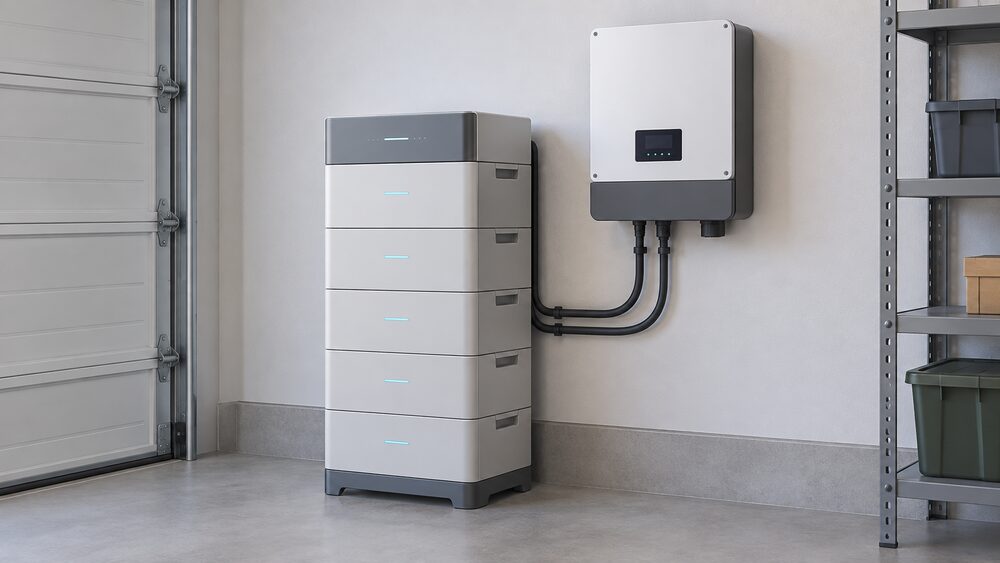
A stackable home battery is built from identical modules that join together and work as one battery, so a household can install a modest amount of storage and add more units later. Fogstar's 48V stackable battery, for example, is sold in 5.12kWh units that the maker says can be scaled "starting from 5.12kWh and scaled to unlimited capacity"1, while its larger modular stack starts at 16.1kWh and grows to 64.4kWh in a single stack2.
In practice, the ceiling is set by the system rather than the idea. Hanchu's high-voltage stackable series takes 3 to 12 modules3; a BYD Battery-Box Premium HVM tower takes 3 to 8 modules, and up to three identical towers can be joined in parallel4. The inverter, its firmware, the maker's rules on mixing older and newer modules, the warranty terms and whether the same module is still on sale years later all decide how far a system can actually grow.
For cost, the Energy Saving Trust puts home battery storage at £1,500 to £10,000, with a 5kWh system around £4,6005. Modular batteries let that spend be spread over time, but they do not remove a household's dependence on the grid in winter, on the inverter maker's software, or on a single manufacturer continuing to make compatible modules.
One battery made of many modules
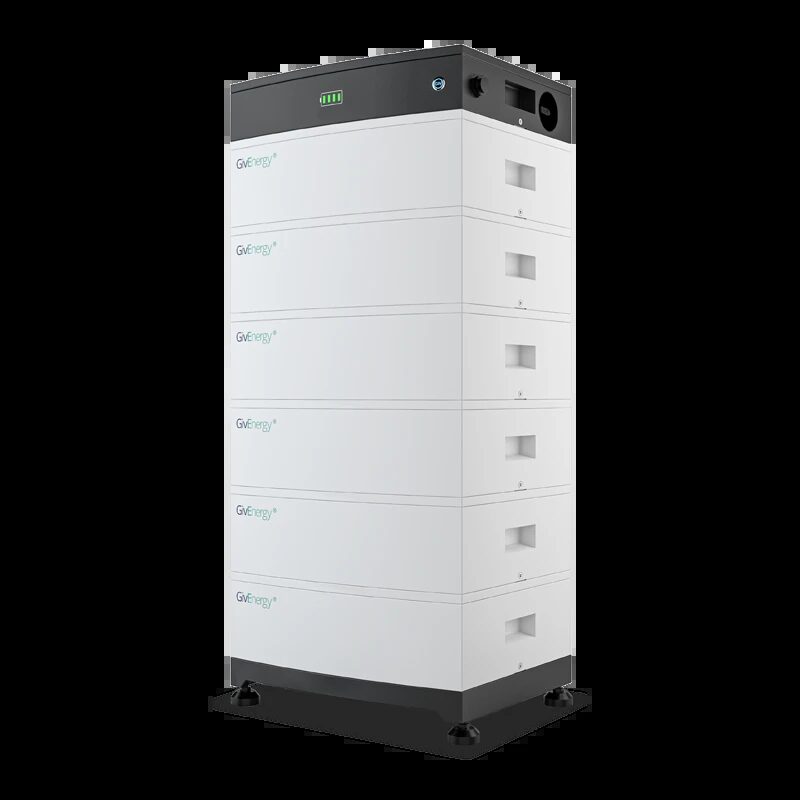
The defining feature of a stackable battery is that the modules share control and behave as one store of energy. GivEnergy describes its stackable battery as having a "Modular design [that] allows for multiple units to be installed in parallel" and states it is designed to work alongside its High Voltage product range6. Its high-voltage datasheet lists a "Robust Multi Point Monitoring BMS Pre Installed", modular design with flexible sizes, and a BMS that can be upgraded7. The battery management system (BMS) is the part that watches every cell, balances the modules and tells the inverter how much it may charge or draw; a fuller account sits in the page on battery management systems.
Two physical forms dominate. In a stacked tower, modules sit on top of one another on a base, as with BYD's Battery-Box Premium HVM, whose datasheet states that "Two versions of HVM module are adaptable with each other and can be stacked in one tower"8. In a rack system, flat modules slide into a cabinet, as with Fogstar's server-rack batteries. A third arrangement, used by SolarEdge, connects several separate battery units to one inverter: the maker says its Home Hub inverters can "Increase system capacity by connecting multiple battery modules per inverter"9.
Makers across the market describe their ranges in these terms. Sync Energy's Flow Battery Stack is "a standalone modular unit that connects to a compatible Flow hybrid inverter"10. Sungrow says its residential system is "easy to expand, upgrade, or reconfigure at any time"11; SolaX says capacity can grow to accommodate electric vehicle charging and additional solar arrays12; SMA calls its Home Storage battery modular and expandable at any time13; GivEnergy says "add extra batteries as your energy needs grow"14; and myenergi describes libbi as "Modular battery storage that adapts to your needs"15. These are maker descriptions, not independent tests.
For independence, the design matters because storage lets a home use its own solar electricity later in the day. The Energy Saving Trust notes that pairing solar with a battery lets a household store renewable electricity to run a heat pump, making it less reliant on grid electricity16.
Start small, add later: how capacity grows
The case for a modular battery is that a household's needs change. ScottishPower states that its "modular designs allow you to purchase additional storage as your needs change"17, and Sync Energy says homeowners can "start small and expand by adding additional 5.1 kWh modules as energy needs increase"10. SolaX's sizing guidance suggests 10 to 15kWh for households using time-of-use tariffs as they add electric vehicles or heat pumps18, which is well above the size many homes start with.
How the extra capacity arrives depends on how the battery is coupled to the home's electrics:
- Hybrid (DC-coupled) systems: Hoymiles states that "For most hybrid solutions, you just stack multiple batteries to scale up the storage capacity"19. The existing inverter's power rating does not change, so a bigger battery lasts longer but cannot deliver power faster.
- AC-coupled systems: capacity can be expanded by adding "multiple energy storage units or microinverters as needed", and both battery storage and system output power grow together19. The trade-off is covered on AC-coupled and DC-coupled home batteries.
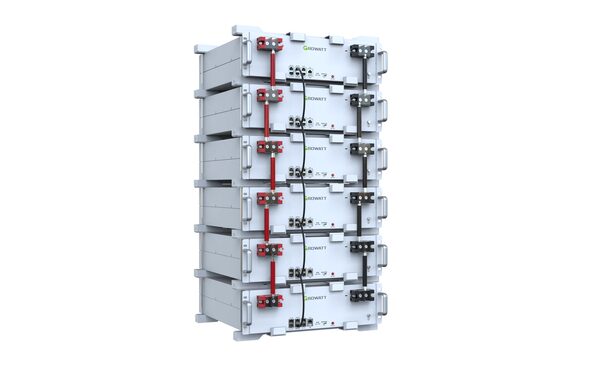
The ranges makers publish give a sense of the spread. Growatt's AXE battery offers "Flexible capacity options, 5kWh to 50kWh" with a modular, stacked design20. GoodWe's ESA offers "5-48 kWh per system (up to 6 modules per stack)"21. Fox ESS describes two approaches in its own range: selected EP models expand by adding further battery units in parallel, while EQ products use a modular, stackable high-voltage architecture22.
What limits later expansion is rarely the battery alone:
- Inverter rating: the inverter sets how much power can flow in and out, and how many modules it will recognise.
- Firmware: the battery and inverter must share a working communication protocol, and updates can change what is supported.
- Warranty terms: adding modules may be allowed only within the maker's conditions.
- Module availability: the same model, or a compatible successor, must still be on sale.
A modular battery therefore trades one kind of dependence for another. It avoids a large upfront purchase, but a household relies on the maker to keep supplying compatible units. For sizing from the start, see what size home battery a home needs and adding more batteries later.
Fogstar 5.12kWh 51.2V: 5,120Wh per unit, 100A charge and discharge
Fogstar sells two closely related 5.12kWh units: a rack-mounted 51.2V battery and a floor-standing 48V stackable battery. Both use a nominal 51.2V and 100Ah23. The rack battery is built from "Grade A LiFePO4 cells and a PACE 100A BMS"23; lithium iron phosphate chemistry is explained in home battery chemistries.
| Specification | Fogstar Energy 5.12kWh 51.2V Rack Battery | Fogstar Energy Stackable 48V 5.12kWh Battery |
|---|---|---|
| Energy | 5,120Wh per battery23 | 5.12kWh, "fully useable"1 |
| Nominal voltage | 51.2V23 | 51.2V1 |
| Capacity | 100Ah23 | 100Ah1 |
| Charge current | 100A per unit (maximum)23 | 50A rated at 25°C1 |
| Discharge current | 100A per unit23 | 100A rated and maximum1 |
| Maximum charge voltage | 57.6V23 | Not stated |
| Discharge cut-off voltage | 43.2V23 | Not stated |
| Temperature | Discharge -20°C to 60°C23 | Charge 0 to 40°C; discharge -20°C to 40°C1 |
| Weight | 45.2kg per battery23 | Not stated |
| Price | Not stated | £749.991 |
The two products differ in charging. The rack battery's maximum charge current is 100A per unit23, while the stackable battery gives a rated charge current of 50A at 25°C1. A rated figure is what the maker expects in normal use; a maximum is a ceiling. At 51.2V nominal, these currents set how fast each unit can fill and empty, a subject covered in battery power ratings and C-rate.
Because units join in parallel, currents add up while voltage stays at 51.2V. Fogstar gives "100A per unit (300A system)" for its three-battery bundle24 and "100A per unit (600A system)" for the larger cabinet23. The inverter must be able to handle the combined current, which is one reason inverter rating limits growth.
The "fully useable" claim matters because many batteries hold back part of their stated capacity. Nominal and usable figures are explained on battery capacity and usable capacity. Fogstar's wider range is described on Fogstar Energy home batteries and the Fogstar Energy 16.1kWh battery.
Bundles: 15kWh and 30kWh in a glass rack cabinet
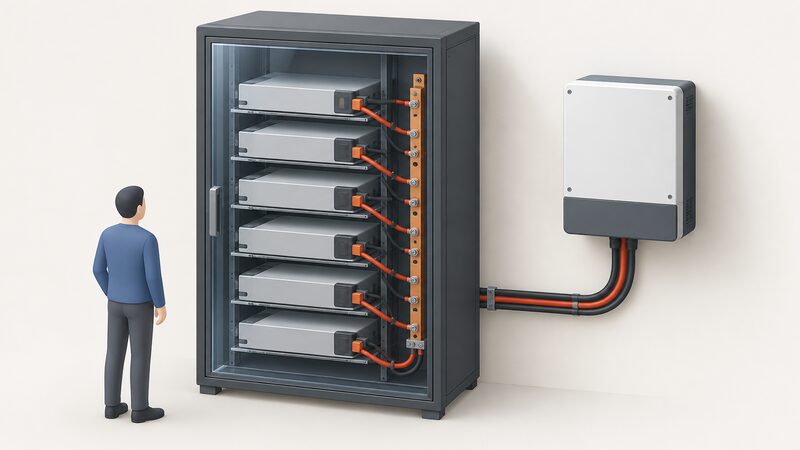
Fogstar sells its rack batteries as cabinet bundles rather than loose units. The larger is "the 6 Rack Cabinet (30kWh capacity)", and "a [3 Rack Cabinet (15kWh)] for smaller installations" is also offered25. The three-battery bundle is rated at 300A combined discharge24, and the six-battery arrangement at 600A23.
| Bundle | Batteries | Capacity | Combined maximum discharge |
|---|---|---|---|
| Fogstar 3 Rack Cabinet | 3 × 5,120Wh | 15kWh25 | 300A24 |
| Fogstar 6 Rack Cabinet | 6 × 5,120Wh | 30kWh25 | 600A23 |
A cabinet sets its own expansion ceiling: once its slots are filled, more storage means a second cabinet or a different arrangement. Weight also adds up, since each rack battery is 45.2kg23, so a full six-battery cabinet is a substantial load on a floor.
For scale, BLUETTI's guidance on storage without solar gives the useful household range as "roughly 3kWh to 15kWh"26. A 30kWh cabinet is double the top of that range; it suits households with high demand, such as those running an electric vehicle or heat pump, or those building towards off-grid battery systems. Growatt's AXE 15kWh set is another example of a stacked product sold at the same 15kWh point20.
High-voltage stacks: 3 to 12 modules with a smart BMS
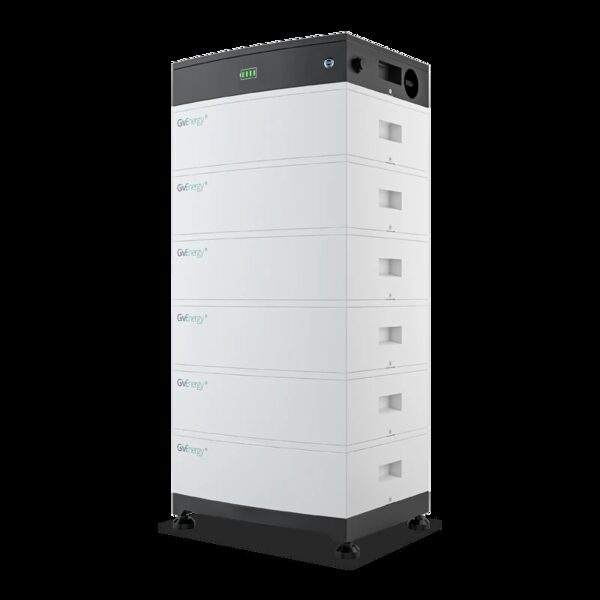
High-voltage stackable batteries connect modules in series inside a tower, so voltage rises with each module added. That is why these systems quote a minimum as well as a maximum module count: a tower needs enough modules to reach the voltage its inverter expects. Hanchu's HOME-ESS-HV stackable series is "Stackable with 3~12 battery modules" and uses a smart BMS3. BYD's Battery-Box Premium HVM "is composed of 3 to 8 B-Plus HVM 2.71 battery modules"4.
| System | Modules | Further expansion |
|---|---|---|
| Hanchu HOME-ESS-HV Stackable Series | 3 to 12 modules3 | Not stated |
| BYD Battery-Box Premium HVM | 3 to 8 modules per tower4 | Up to 3 identical towers in parallel27 |
| BYD Battery-Box Premium HVS | Not stated | Up to 3 identical towers in parallel27 |
| GoodWe ESA 3-10K | Up to 6 modules per stack21 | 5 to 48 kWh per system21 |
| SolarEdge Home Battery | Up to 3 or up to 5 per inverter (sources disagree)28 | Not stated |
| GivEnergy High Voltage Stackable | Modular, flexible sizes7 | Parallel units6 |
The SolarEdge figures conflict. Good Energy's summary gives "Up to 3 modules can be connected per inverter" and, in the same document, scalability of up to 5 modules28.
GivEnergy lists "Stackable, BMS Upgradeable, IP65" as the advantages of its high-voltage range7. An upgradeable BMS matters for expansion because new modules or new inverter firmware may need the controller to be updated. Brand pages cover each range: Hanchu, BYD Battery-Box, GoodWe, SolarEdge, GivEnergy, Growatt AXE and Fox ESS PowerQ.
Parallel connection: how towers and units are joined
Between whole batteries, expansion is almost always by parallel connection, which adds capacity and current while keeping voltage the same. The low-voltage Fogstar units described above join this way, as their combined current ratings show24. GivEnergy's stackable battery allows "multiple units to be installed in parallel"6, and Fox ESS's EP models expand "through additional battery units installed in parallel"22.
Makers set firm limits on parallel links. BYD's documents give these rules:
- Battery-Box Premium HVS and HVM: "direct parallel connection of up to 3 identical" towers27.
- Battery-Box Premium LVS Lite: "up to 8 Modules Connected in Parallel"29.
- LVS Lite parallel towers: "Parallel tower function only available for 1 to 4 battery modules per tower."29
The word "identical" in BYD's rule is the point households most often meet when expanding years later: a second tower must match the first. Parallel batteries at different voltages or states of charge push current into one another until they equalise, which is why makers control what may be joined and why the BMS coordinates the whole bank. Connecting batteries in series beyond what a maker designs for is outside the maker's stated configurations. The UK wiring rules that apply to any installation are described in the standards governing home battery installation.
Mixing old and new modules
Rules on mixing ages differ by maker. GoodWe states that its ESA system allows users to "Mix-and-match old and new battery modules for expansions"21. BYD states that its two versions of HVM module can be stacked in one tower8. Neither statement extends to other brands, and BYD's parallel rule still requires identical towers27. Older modules will also have lost some capacity through use, as described on cycle life and degradation.
Cold weather: heating that allows charging below freezing

Lithium iron phosphate cells without heating cannot safely charge below about freezing, and makers' temperature windows reflect this. Fogstar's stackable battery charges between 0 and 40°C and discharges from -20°C to 40°C1; GivEnergy's high-voltage stackable battery charges from 0°C to 55°C and discharges from -10°C to 55°C, with storage from -30°C to 60°C7. A battery in an unheated garage or on an external wall can therefore supply the home on a frosty morning but refuse to charge until it warms.
Some makers add heaters to close that gap:
| Product | Low-temperature behaviour |
|---|---|
| Sync Energy Flow Battery Stacks | Integrated heating enables charging below 5°C10 |
| APsystems APbattery series | Self-heating; charging down to -5°C30 |
| Dyness PowerBox G2 | Charges and operates as low as -20°C with optional automatic self-heating31 |
| Galvani sodium-ion battery module | Charging temperature -20°C to 55°C32 |
Sync Energy describes its heating as making the battery "suitable for colder climates"10. The Galvani figure comes from a different chemistry, sodium-ion, rather than a heater32. Heating draws energy from the battery or the grid, so a heated battery in a cold space uses some of its own store. Siting advice is on ventilation, temperature and operating conditions and where a home battery can be installed.
Winter also changes how full a battery gets. The Energy Saving Trust notes that a battery can store excess solar or charge when the tariff is cheap, then supply the home at night or when prices are high5. For solar charging, the Consumer Protection Association notes that in winter "output drops considerably and grid top-ups become more necessary"33. Adding modules raises how much can be stored; it does not raise how much the panels produce in December, so winter self-sufficiency still depends on the grid and on tariff charging. See batteries and smart tariffs.
Inverter compatibility: CAN and RS485 links with pre-loaded protocols
A stackable battery only works if the inverter can read its BMS. Most use a CAN or RS485 data link. GivEnergy's high-voltage stackable batteries communicate over CAN BUS7; BYD's Battery-Box Premium HVS and HVM over CAN/RS48527; and the Galvani stackable sodium-ion system over "RS485 / CAN"32.
Low-voltage batteries sold separately from an inverter depend on the inverter brand recognising their protocol. Fogstar states:
"Compatible with major LV inverter brands including Victron, Sunsynk, LuxPower and more."
Brand pages cover Victron, Sunsynk and LuxPower.
Many high-voltage stacks, by contrast, pair with one maker's inverters. GivEnergy designs its stackable battery for its own High Voltage range6, and Sync Energy's stack connects to a compatible Flow hybrid inverter10. This closed pairing tends to simplify commissioning but ties later expansion to one company's product line and firmware. An open-protocol battery spreads that dependence across several inverter makers, although compatibility can still change with a firmware update on either side. Monitoring through the inverter's app or cloud service is covered in monitoring a home battery.
Price, warranty and lifespan
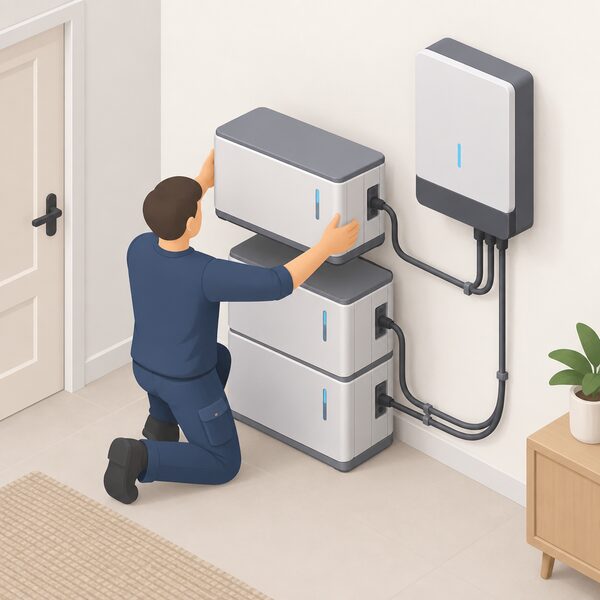
Fogstar lists its Stackable 48V 5.12kWh battery at £749.99 (read 20 September 2026; the listing does not state VAT treatment)1. That is the battery alone, before inverter, cabinet, cabling and installation. Installed system costs from UK independent and official sources are set out below.
| Source | Figure | Scope |
|---|---|---|
| Energy Saving Trust | £1,500 to £10,000; 5kWh around £4,6005 | Home battery storage |
| Parliamentary Office of Science and Technology | Up to £10,000; typical 5kWh around £4,60034 | Citing Energy Saving Trust, 2026 |
| ClimateXChange | £2,800 to £4,500 battery-only; £4,500 to £7,000 installed35 | 8 to 10 kWh, March 2026 |
| Plymouth Energy Community | £2,500 to £10,000 fully installed; average around £4,000 to £6,00036 | 4kWh to 10kWh systems |
The difference between the ClimateXChange battery-only and installed figures shows how much of the cost sits outside the battery itself. That share matters for modular systems: adding a module later carries its own installer visit, which is part of why staged expansion can cost more in total than buying the full size at once. The Centre for Sustainable Energy puts payback for domestic battery storage "in the region of 8 to 12 years, which is similar to their reported lifespan"37. More detail is on home battery cost and savings and payback.
On warranties, Which? notes that "Battery systems often come with a 10-year warranty"38. GivEnergy states a 12-year warranty on its high-voltage stackable batteries7, and SolarEdge a 10-year warranty on its Home Battery28. What a warranty covers, including retained capacity, energy throughput and installation conditions, is set out in each maker's terms; see home battery warranties.
Availability in the UK: Dyness PowerBox G2 and stock
Module availability decides whether a stack can grow. A household planning to add units later is exposed to exactly this kind of wait, and to the risk that a model is replaced by one that is not compatible.
Its PowerBox G2 is given a capacity span of 10.24 to 512kWh, with optional automatic self-heating for operation as low as -20°C31. The maker's published installation example is in Ireland, a PV and AC-coupled project from June 202539; it is not a UK case. UK prices for the PowerBox G2 are set by distributors and installers. The range is described on Dyness home batteries.
What a modular battery does for independence
A stackable battery lets a household grow its own storage alongside solar panels, an electric vehicle or a heat pump without replacing the first battery. That raises how much of its own generation a home can use, and with backup wiring can keep essentials running in a power cut; see battery backup in a power cut.
Dependence remains in four places. The grid still supplies most winter charging. The inverter maker controls compatibility through firmware. The battery maker controls which modules may be added, and whether old and new may mix. And supply of matching modules is not guaranteed, as current December waiting lists show. The broader picture is set out in home batteries and household energy independence and the home battery storage guide.
Sources39 cited
- Fogstar Energy Stackable 48V 5.12kWh Battery, Fogstar, 2026-09-20
- Fogstar Energy battery showdown for 48V off-grid setups, Fogstar, 2026-06-17
- Hanchu ESS home, Hanchu ESS, 2026-09-17
- BYD Battery-Box, BYD, 2026-09-17
- Battery storage advice, Energy Saving Trust, 2026-08-19
- UK datasheet: Stackable Batteries, GivEnergy, 2026-09-17
- High Voltage Stackable Batteries datasheet, GivEnergy, 2026-09-17
- Battery-Box Premium HVM datasheet (BCU 2.0), BYD, 2026-09-17
- SolarEdge Home Hub inverters (UK), SolarEdge, 2026-09-17
- Flow Battery Stacks, Sync Energy, 2026-09-17
- Residential PV, ESS and EV charging solution, Sungrow, 2026-09-17
- Residential ESS solutions, SolaX Power, 2026
- Products overview, SMA UK, 2026-09-17
- Home battery storage without solar, GivEnergy, 2026-01-20
- myenergi installations: libbi and eddi, myenergi, 2026
- How to ensure a heat pump runs efficiently, Energy Saving Trust, 2026-05-19
- Solar battery, ScottishPower, 2026-09-17
- What size solar battery do I need?, SolaX Power, 2026-07-03
- DC-coupled vs AC-coupled vs hybrid battery storage, Hoymiles, 2025-09-23
- Growatt AXE battery 15kWh, Growatt, 2026-09-17
- GoodWe ESA 10kW all-in-one hybrid inverter, Alternergy, 2026-09-17
- Modular battery storage for a scalable home energy system, Fox ESS, 2026-09-17
- Fogstar Energy 30kWh 51.2V rack glass cabinet bundle, Fogstar, 2026-09-19
- Fogstar Energy 15kWh 51.2V rack battery bundle, Fogstar, 2026-09-19
- Fogstar server rack battery glass cabinet, 30kWh, Fogstar, 2026-09-19
- Solar battery storage collection, Fogstar, 2026-09-19
- Battery-Box Premium HVS and HVM datasheet, BYD, 2026-09-17
- The best solar batteries explained, Good Energy, 2026-07-14
- Battery-Box Premium LVS Lite datasheet, BYD, 2026-09-17
- APstorage, APsystems, 2026-08-15
- PowerBox G2 keeps homes warm through stormy nights, Dyness, 2025-06
- Galvani sodium-ion battery, Eleven Energy, 2026-09-17
- Can solar panels charge electric cars?, Consumer Protection Association, 2026-04-15
- POSTnote 771, UK Parliament, 2026-06-25
- Balancing investment in clean heat and energy efficiency in Scottish housing retrofit, ClimateXChange, 2026
- Everything you need to know about battery storage, Plymouth Energy Community, 2026-09-20
- Battery storage advice, Centre for Sustainable Energy, 2025-10
- Solar panel battery storage, Which?, 2026-05-14
- Dyness installation case study, Ireland, Dyness, 2025-06
 Home Battery Install StatisticsHow many homes in the UK actually have a battery, and is that number growing quickly?
 Siting and LocationWhere can a home battery actually go?
 All-in-One Battery SystemsA single unit holding your battery and the equipment that turns its power into usable electricity.
 The Full Home Batteries GuideA home battery stores cheap or solar power for later, but will it really cut your bills enough to be worth it?
 Ventilation and TemperatureWhere can you put a home battery so it stays warm enough in winter and cool enough in summer?
 Heat Batteries with Heat PumpsCan a heat battery replace a hot water cylinder if you have no space for one?