In this guide
Solis is a Chinese inverter manufacturer that describes itself as a top three global manufacturer of solar inverters and a leading provider of energy storage solutions1. For a UK household, what it sells is the box that sits between the solar panels, the battery and the house: a hybrid inverter that decides when to charge, when to discharge and what happens when the grid goes down. It is a maker, not an installer, so the equipment reaches a home through a distributor and an electrician.
The core of the residential offer is a single-phase hybrid range running from 3kW to 6kW, with three-phase models above that2. Solis states that its storage inverters are compatible with a wide range of battery brands, and separately warns that installing them with non-compatible battery systems may result in serious damage, with no liability accepted for the losses that follow3. Compatibility is therefore the single most important thing to establish before purchase, and it varies between markets.
What a Solis storage inverter does for a home
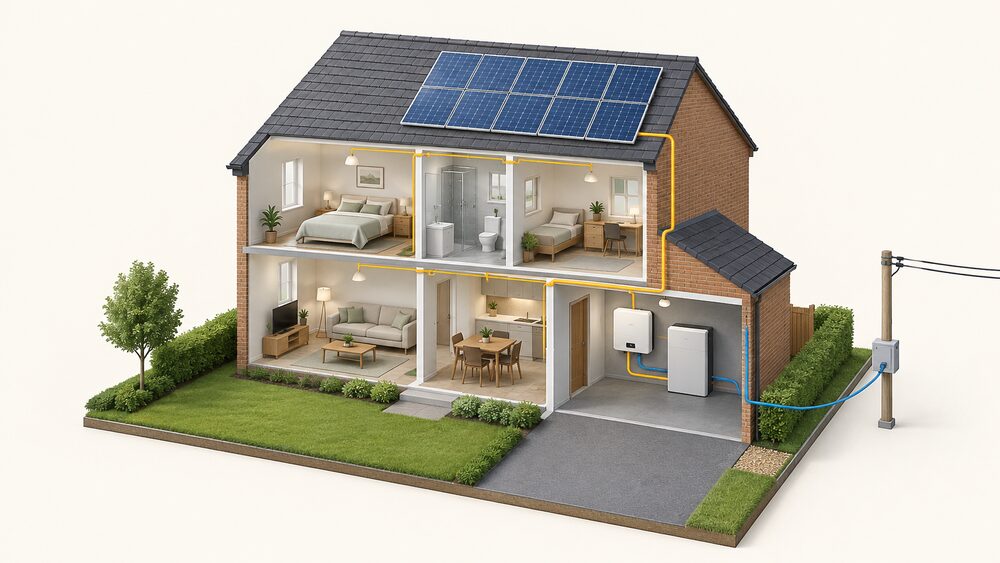
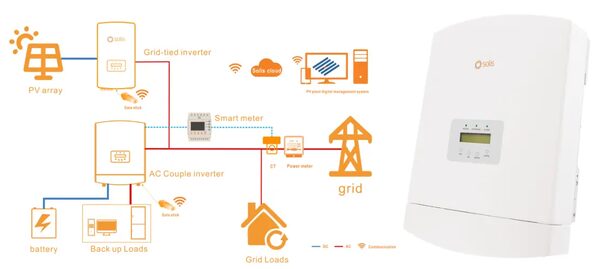
A hybrid solar and storage system, in Solis's own description, consists mainly of solar panels, batteries, one or more hybrid inverters, grid-connected loads and backup (critical) loads8. The inverter is the component that manages all of it. Solis lists four functions that matter to a householder: fast charging technology for more efficient battery charging, fast switchover of backup power generation equipment to ensure supply to critical equipment, an intelligent EMS system providing 24-hour online monitoring with self-adaptive adjustment and management of the battery, and support for remote upgrade and parameter adjustment3.
The backup function is the one that changes how a home behaves in a power cut. Solis states that the inverter discharges the battery in case of power failure to ensure the uninterrupted operation of home appliances, and goes further, claiming that solar power generation combined with battery storage can provide continuous power for home appliances for days3. That claim depends on the size of the battery, the weather and the load, and it is the maker's own. What is not in doubt is the principle: a hybrid inverter with a backup circuit keeps selected circuits alive when the grid fails, which is the difference between a battery that saves money and a battery that also provides resilience.
Safety features are listed alongside the performance ones. Optional AFCI DC arc protection is described as actively switching within 0.3 seconds to prevent fires and protect family and property3. Solis also states that its products support multiple parallel expansion, increasing the capacity of the energy storage system and its load-carrying capacity8. For a household, that means the system can grow: a second inverter or a larger battery bank can be added later rather than replacing what is already installed. The limits are the same as for any grid-tied battery: the house remains connected to the grid, to a supplier, and to the manufacturer for firmware and monitoring.
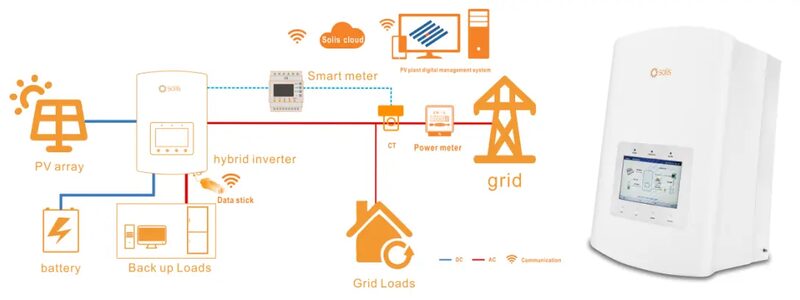
The range: 3kW to 6kW single-phase and larger three-phase models
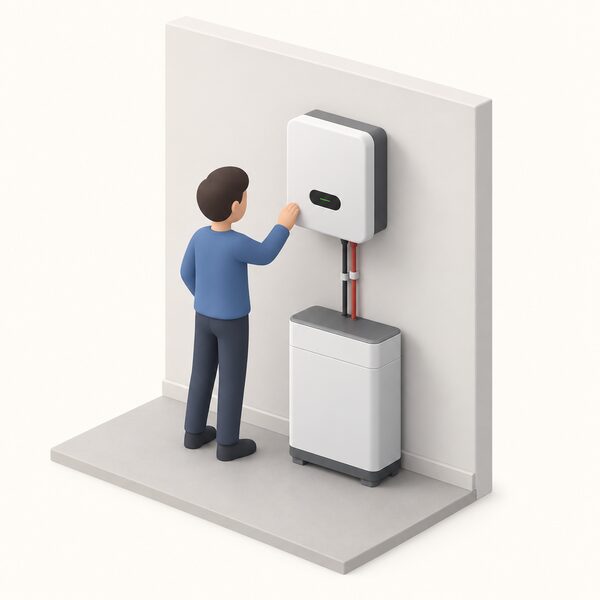
Solis built its residential storage reputation on a single-phase hybrid range with operating capacities from 3kW to 6kW, announced in 2020 with a maximum charging and discharging current of 100A and a maximum charging and discharging power of 5kW5. That 100A figure is what allows a battery to deliver meaningful power to a house rather than trickling into it, and it is why the same inverter can run a kettle or a shower circuit during a backup event.
Above the single-phase range sit the three-phase models. Solis describes a three-phase range covering 8kW to 12kW that balances loads across all phases to maximise solar utilisation, and separately an available power range from 8kW to 30kW with multi-unit parallel operation for higher capacity deployments4. Three-phase supply is common in larger UK homes and in properties with a heat pump or a workshop, and it changes the inverter choice: a single-phase hybrid cannot serve a three-phase installation without compromise.
| Solis storage range | Type | Stated power | Notes |
|---|---|---|---|
| Single-phase hybrid | Hybrid | 3kW to 6kW2 | 100A charge and discharge current5 |
| Three-phase hybrid | Hybrid | 8kW to 12kW4 | Balances loads across all phases4 |
| Three-phase hybrid, extended | Hybrid | 8kW to 30kW4 | Multi-unit parallel operation4 |
The S6 three-phase storage line is the current generation for larger homes and small commercial sites. Solis states that the S6-EH3P(8-15)K-L, S6-EH3P(12-20)K-H and S6-EH3P(30-50)K-H are compatible with battery models from global brands including BYD, LG Energy Solutions, Dyness and Pylon Tech6. For a UK house with a three-phase supply and a large array, that is the part of the catalogue that applies. For the majority of homes on single-phase, the 3kW to 6kW hybrid remains the relevant range, and the choice within it comes down to array size and whether the property has an electric vehicle or heat pump to absorb the stored energy.
Battery compatibility: 42-58V Li-ion and lead-acid, from LG Chem to BYD and PylonTech
Solis storage inverters are compatible with LG Chem, BYD, PylonTech, Aboet and other 42-58V Li-ion and lead-acid battery energy storage products, according to the maker's own announcement of the range5. That voltage band is the low-voltage end of the market, which is where most retrofit batteries sit, and it is why a Solis inverter can often be paired with a battery that is already on site.
The maker's position on compatibility is deliberately broad and deliberately cautious at the same time. Solis states that its energy storage inverters are compatible with a wide range of battery brands for ultimate flexibility, and in the same material warns that installing Solis inverters with non-compatible battery systems may result in serious damage, and that Solis is not responsible for any damages or losses incurred due to the installation or operation of Solis inverters with non-compatible battery models3. It also states that the compatibility of specific battery models with Solis energy storage inverters varies across different markets3. The practical consequence is that a battery approved for a Solis inverter in one country may not be approved in the UK, and the approval list is the document that matters.
For households with an existing grid-tied solar system and no battery, Solis describes a specific route: upgrading by adding an AC coupled battery inverter such as the Solis RAI, installed alongside batteries and connected directly to the panel or mains9. That is the retrofit path, and it avoids replacing a working string inverter. The battery reserve function, which keeps a portion of charge back for backup, is available in Solis energy storage inverters from the fifth generation onwards10. Older units do not have it. More on the two wiring approaches is at AC-coupled and DC-coupled home batteries, and on the battery side of the pairing, Pylontech and BYD both make units named in the compatibility lists.
Fast charging, backup on power failure and remote upgrades
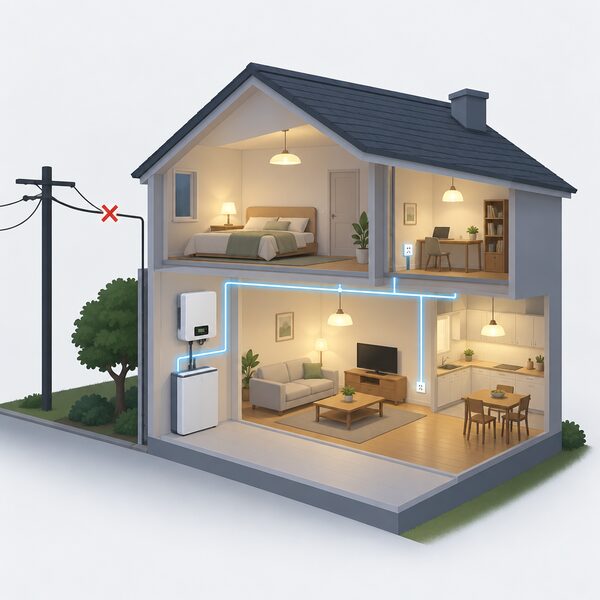
The features Solis promotes for its storage inverters are a package rather than a list of separate parts. Fast charging technology is described as making battery charging more efficient; backup switching is described as fast switchover of backup power generation equipment to ensure supply to critical equipment; and the intelligent EMS system provides 24-hour online monitoring with self-adaptive adjustment and management of the battery to improve reliability3. Remote upgrade and parameter adjustment are supported, which means firmware and settings can be changed without a site visit3.
The smart charge and discharge functionality extends this into tariff management. Solis states that the system charges batteries during low-price periods, reducing costs, and discharges them during high-price periods, maximising savings or earnings7. The company announced the expansion of these smart battery charging and discharging solutions to customers in 14 countries across Europe in October 20247. That is the mechanism behind time-of-use tariff stacking, and it is the same logic that appears in SolisAI, which charges the battery during low-cost, off-peak hours and uses stored energy during expensive peak periods, described by the maker as "store low, use high"11.
Remote upgrade capability is convenient and it is also a dependence. Firmware, parameter changes and monitoring run through the manufacturer's platform and, in most installations, through the household's broadband connection. A Solis system will generate, store and supply power without an internet connection, but the optimisation layer, the remote diagnostics and the app-based visibility do not. That is the trade a household makes with any cloud-connected inverter, and it is worth stating plainly rather than treating as a footnote. The wider picture on monitoring and local access is at Monitoring a home battery.
Retrofit or new install: which Solis setup fits which home
Solis states that its residential and commercial storage solutions are designed to support retrofit applications12. That matters in the UK because retrofit is now the norm rather than the exception: battery storage is included with around half of all retrofit solar installations, according to Solar Energy UK13. A household adding storage to panels fitted years ago is the mainstream case, not a niche one.
There are two routes. Where the existing system has a grid-tied string inverter that is still working, an AC coupled battery inverter such as the Solis RAI is installed alongside the battery and connected directly to the panel or mains, leaving the original inverter in place9. Where the household is starting fresh, or replacing the inverter, a hybrid unit does the whole job: it manages the panels and the battery together, which is generally the tidier arrangement for a new installation.
The financial context has shifted in favour of retrofit. The Energy Saving Trust's response to the Treasury's consultation on VAT relief for energy saving materials states that battery storage retrofitted to a solar panel or other qualifying material should be included in the relief14. That is a consultation response rather than a settled rule, and the VAT position on a given installation should be confirmed with the installer. What it signals is that retrofit storage is being treated as part of the same policy family as the panels themselves.
"Yes. Battery storage offers a clear example of a technology that meets the three objectives outlined as part of this consultation."
Scotland is the part of the UK where the retrofit picture is most affected by regulation. Solar Energy UK has argued that new Scottish building regulations have damaged the case for solar on new builds, describing the effect in terms of a solar success story being undermined15. For a Scottish household, the practical question is less about which Solis inverter and more about whether the building's existing supply, metering and permissions support storage at all. Guidance on the general retrofit decision is at Which homes suit battery storage.
Recent developments: FlexAIO, SolisAI and the S6 storage line
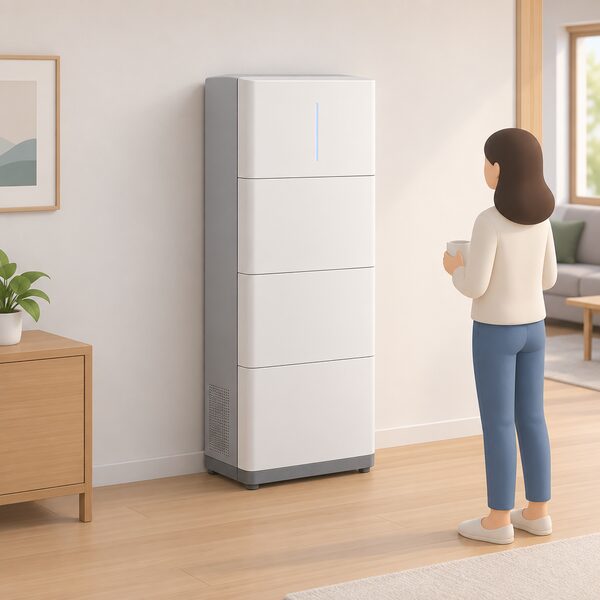
Solis used Intersolar Europe 2026 in Munich to present its storage retrofit and AI energy management solutions, including the newly launched FlexAIO platform and Solis AI energy management12. FlexAIO is described as a residential all-in-one energy storage platform with an integrated stacked design, and the same announcement refers to flexible system design and faster deployment12. For larger residential, commercial and industrial applications, Solis also showcased FlexCore-ID and FlexCore-OD1.
SolisAI is the software layer. Solis describes it as the company's smart energy management system, built around an integrated solar and energy storage setup, which charges the battery during low-cost, off-peak hours and uses stored energy during expensive peak periods11. A Solis seminar article on the subject reported a Belgian household case study showing around a 17.9% electricity cost reduction over nearly one year11. That is a single case study reported by the maker, not a UK average, and it should be read as an illustration of the mechanism rather than a forecast.
The S6 storage line continues to expand. The catalogue has added a three-phase high voltage storage inverter supporting PV input up to 100kW, and a three-phase high voltage unit supporting 100% three-phase unbalanced output and 200% PV input capacity16. These are large machines by domestic standards, and they sit above the residential range. The direction of travel is clear: Solis is building out three-phase storage for bigger properties and small commercial sites, while the single-phase 3kW to 6kW hybrid remains the domestic workhorse. Households weighing an all-in-one unit against a separate inverter and battery should compare the two approaches at All-in-one home battery systems.
Support, fault codes and the 5G discontinuation
Solis publishes a UK service hotline on +44 151 453 6515 for service calls6. The company also states that local teams across Europe provide product guidance, training, technical support and after-sales service tailored to local market needs1. For a household, the practical route to support runs through the installer who commissioned the system first, with the maker's hotline behind that.
Fault diagnosis is where the maker's platform does real work. SolisCloud is described as delivering advanced diagnostics with string-level fault finding6. That means the monitoring platform can identify which string of panels is underperforming, not merely that something is wrong. Fault codes themselves are not standardised across brands, models or firmware versions, and the same number can have different meanings on different equipment17. A code read off a Solis inverter should be checked against that model's own documentation rather than a generic list. The general approach to alarms is covered at My battery is showing an alarm.
Warranty registration is not published as a single UK procedure in the material available here. Solis directs owners to the product and technical team in their specific country or market for confirmation of what a given inverter and battery combination is approved for3. In practice, registration runs through the distributor or installer who supplied the unit. For comparison, SolaX requires registration within 90 days of the commissioning date and upgrades warranty where the inverter is paired with a SolaX battery and connected to its cloud with generation data uploaded18. Solis does not publish an equivalent term in the material here, so the warranty position on a Solis system should be confirmed in writing at the point of purchase. The general principles are at Home battery warranties.
What owning a Solis system means for energy independence
The case for a home battery is measurable. Great British Energy states that adding a battery to a solar installation increases self-consumption from 30 to 40% to 70 to 80%7. The Energy Saving Trust advises considering battery storage where a system does not already have it, so that surplus electricity is stored rather than exported21. Which? describes the function in the plainest terms: home storage batteries store your electricity to use later, making your energy system more independent from the National Grid22.
That is what a Solis hybrid inverter delivers. It lets a household use its own generation in the evening, shift consumption away from peak prices, and keep critical circuits running when the grid fails3. The independence is real but partial, and the remaining dependencies are worth naming. The house stays connected to the grid and to a supplier for whatever the panels and battery cannot cover. The battery is a purchased component from a third party, not a Solis product, so the household depends on two manufacturers rather than one. Remote monitoring, firmware updates and the smart tariff logic run through Solis's platform and a broadband connection. And the equipment itself is made by a company whose support and warranty terms are administered through distributors and installers rather than directly.
For a household already on the gas grid, a battery does nothing about heating, which remains a separate question covered at Can a home battery run a heat pump or charge an EV. For a household with an existing solar array and no storage, the retrofit route through an AC coupled inverter is the lowest-disruption option9. The wider context on what storage can and cannot deliver is at Home batteries and household energy independence, and the full picture of the UK market is at Home battery storage.
Sources22 cited
- Solis to showcase full scenario energy storage solutions at Intersolar Europe 2026, Solis Inverters, 2026-06-17
- Types of residential energy storage systems, Solis Inverters, 2022-05-13
- Energy Storage Solutions, Solis Inverters, 2026-09-17
- Three-Phase Hybrid Inverters, Sunsynk, 2026-09-17
- Solis news 2020, Solis Inverters, 2020-10-21
- Solis and TUV Rheinland announce strategic partnership during Intersolar 2024, Solis Inverters, 2024-06-20
- Solis launches smart charge discharge functionality, Solis Inverters, 2024-10-23
- Understanding the battery reserve function and its importance, Solis Inverters, 2024-11-28
- Upgrade a grid-tied solar PV system to an energy storage system, Solis Inverters, 2021-05-18
- Solis service and support, Solis Inverters, 2026-09-17
- Lower energy bills made simple with SolisAI, Solis Inverters, 2026-03-21
- Solis storage retrofit and AI energy management at Intersolar 2026, Solis Inverters, 2026-06
- New Scottish building regulations torpedo a solar success story, Solar Energy UK, 2024-01-30
- Our response to the Treasury's consultation on VAT relief for energy saving materials, Energy Saving Trust, 2025-10-08
- Solis residential solutions, Solis Inverters, 2026-09-17
- Solis inverter catalogue, Solis Inverters, 2026-09
- Solar inverter fault codes, SolaX Power, 2026-08-12
- Solar inverter warranty, SolaX Power, 2026-06-18
- SolaX warranty, SolaX Power, 2026-09-17
- SolaX UK warranty, SolaX Power, 2026-09-17
- Buying a house with solar panels, Energy Saving Trust, 2026-08-13
- Solar panel battery storage, Which?, 2026-05-14
 Solis solar invertersIf a Solis inverter has appeared on a solar quote, what is it, what does it do when the grid goes down, and which batteries can be paired with it?