In this guide
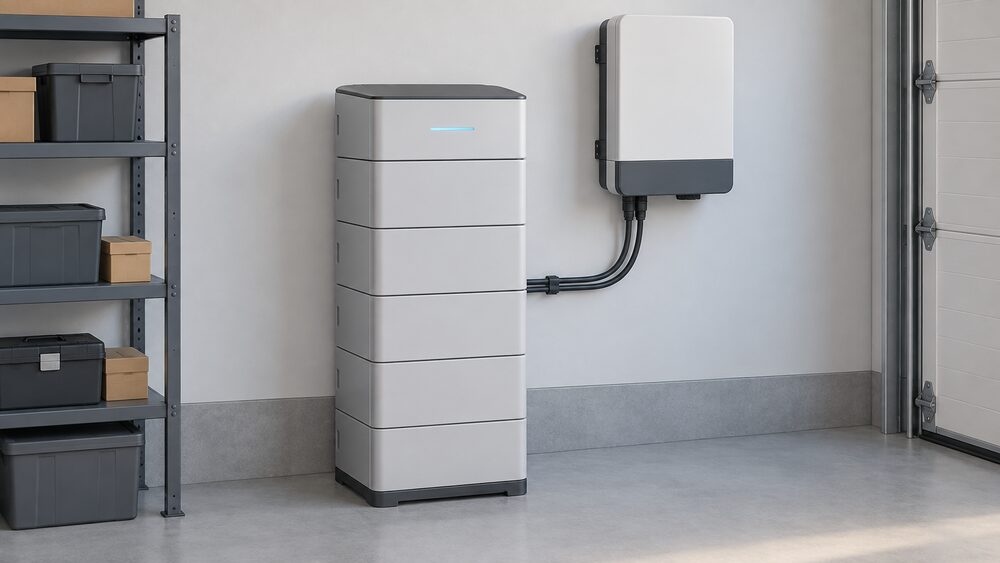
BYD Battery-Box is a modular lithium iron phosphate (LFP) home battery range sold in the UK in two broad families: low-voltage systems built around 48V modules, and high-voltage systems built around stacked modules with a battery control unit. The low-voltage side covers the Premium LVS, the LVS Lite, the LV Flex and the LV Flex Lite; the high-voltage side covers the Premium HVS, HVM, HVS+, HVM+, HVE and HVB1. Every one of them is cobalt-free LFP, and every one is designed to run with an external inverter rather than as a self-contained unit1.
The headline numbers are wide because the range is wide. A single Premium LVS stack takes 1 to 6 modules for 4.0 to 24.0 kWh usable, and up to 16 such stacks can run in parallel for a maximum of 256 kWh2. The Premium LVL starts at 15.4 kWh and extends to 983 kWh using parallel interconnection of up to 64 batteries6. The HVE reaches 70.74 kWh with up to four modules per system and up to three systems in parallel7.
What that buys a household is storage it can size to its own consumption and expand later, on a chemistry chosen for safety and cycle life rather than energy density. What it does not buy is independence from the grid, from an inverter manufacturer, or from BYD's own warranty terms, which are conditional and time-limited.
The range at a glance: LVS, HVS, HVM and LVL
The naming is the first thing to get straight, because the letters describe voltage and module size rather than quality. LVS and LVL are low-voltage 48V systems; HVS, HVM, HVE and HVB are high-voltage systems. Within the high-voltage group, the letter after HV indicates module capacity: HVS modules are the smaller ones, HVM modules larger, and HVE larger again.
The Premium HVS is composed of 2 to 5 HVS battery modules together with a battery control unit and a base5. The Premium HVM takes 3 to 8 HVM modules in series for a usable capacity of 8.3 to 22.1 kWh5. The HVS+ and HVM+ are the current versions of those two families, described as modular high voltage lithium iron phosphate battery packs with tool-less connection9. The HVE is a later high-voltage design with wall and floor mounting options7, and the HVB is a flexible expandable design that accepts additional modules at any state of charge10.
On the low-voltage side, the Premium LVS is the mainstream stack, the LVS Lite is a simplified version, and the LV Flex and LV Flex Lite are separate low-voltage families with their own datasheets3. The Premium LVL is the high-capacity 48V option, sold as a 15.4 kWh module and built out from there6.
| Family | Voltage | Module count | Usable capacity | Enclosure |
|---|---|---|---|---|
| Premium LVS | 48V | 1 to 6 per stack | 4.0 to 24.0 kWh per stack2 | IP552 |
| Premium LVS Lite | 48V | 1 to 4 per tower | up to 32 kWh in parallel3 | IP553 |
| Premium HVS | HV | 2 to 5 modules plus BCU and base5 | 8.3 to 22.1 kWh on HVM5 | IP555 |
| Premium HVM | HV | 3 to 8 modules in series5 | 8.3 to 22.1 kWh5 | IP5512 |
| HVS+ / HVM+ | HV | 2 models available13 | 38.4 kWh (HVS+), 66.2 kWh (HVM+)9 | IP559 |
| HVE | HV | up to 4 per system7 | 70.74 kWh maximum7 | IP657 |
| HVB | HV | expandable at any SOC10 | up to 3 towers in parallel10 | IP5510 |
| Premium LVL | 48V | up to 64 in parallel6 | 15.4 to 983 kWh6 | IP20 or IP55 BMU11 |
Chemistry and safety: cobalt-free LFP throughout
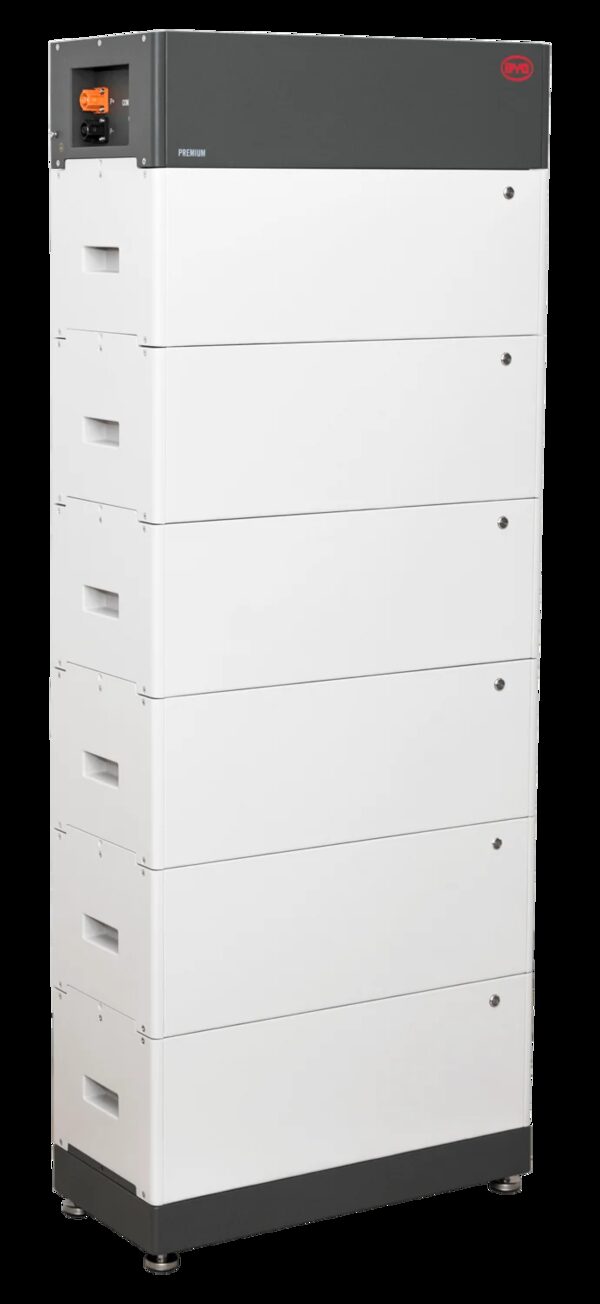
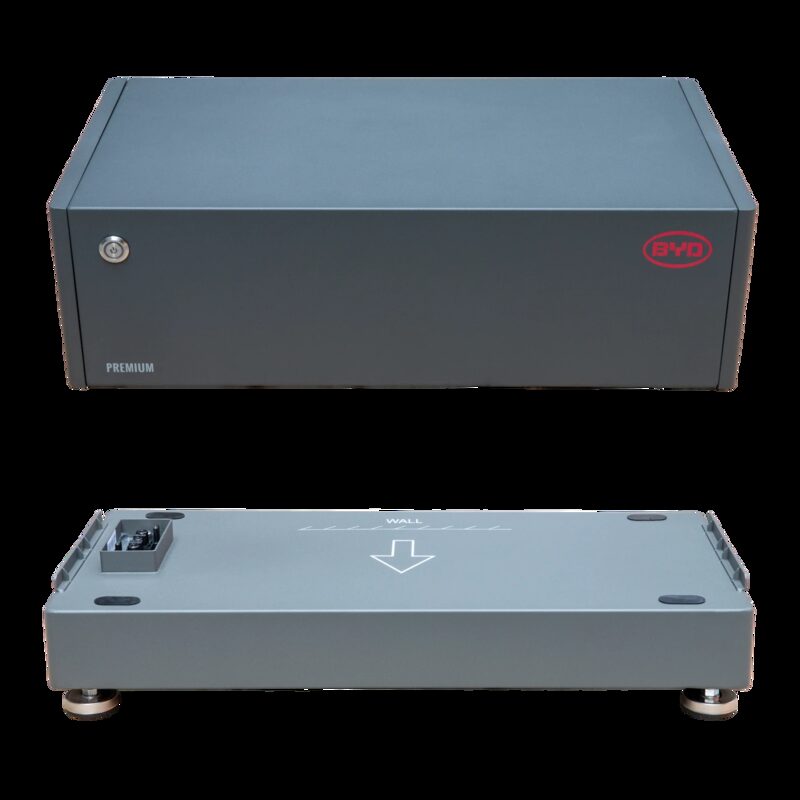
Every Battery-Box family uses lithium iron phosphate, and BYD states the chemistry is cobalt free1. The Premium LVS, LVS Lite, LV Flex, LV Flex Lite, HVE, HVB and Premium LVL all carry the same description in their own documentation2. The older B-Box uses LiFePO4, which is the same chemistry under its mineral name13.
LFP matters to a household for three reasons. It does not use cobalt, so the supply chain avoids one of the more contested materials in lithium batteries. It is comparatively tolerant of high temperatures and of being held at a full state of charge, which suits a battery that sits in a garage or on an external wall absorbing solar generation through the day. And it generally trades energy density for cycle life, which is why LFP packs are physically larger than the equivalent capacity in nickel manganese cobalt.
Safety certification is stated rather than implied. BYD says the Battery-Box meets the highest safety standards such as VDE 2510-50 for the HVS, HVM and LVS families, and the same standard is repeated on the HVS+ and HVM+ pages1. VDE 2510-50 is a German test specification for stationary battery storage with lithium cells, covering electrical, mechanical, thermal and environmental stresses.
Capacity and scalability: from 4.0 kWh to 64 modules in parallel
The range is built so that a household can start small and add modules rather than replace the system. A single Premium LVS stack takes between 1 and 6 battery modules for 4.0 to 24.0 kWh usable capacity, and up to 16 such stacks can be connected in parallel for a maximum of 256 kWh2. The LVS Lite takes 1 to 4 modules per tower, with a maximum of 8 modules in parallel giving 32 kWh, and the parallel tower function is available only for 1 to 4 modules per tower3.
At the top of the low-voltage range, the Premium LVL starts at 15.4 kWh and extends to 983 kWh using parallel interconnection of up to 64 batteries6. The LV Flex datasheet gives the same 64-module ceiling at 320 kWh4.
The high-voltage families scale differently because each tower has a fixed module count. The HVE reaches 70.74 kWh with up to four modules per system and up to three systems in parallel7. The HVS+ reaches 38.4 kWh and the HVM+ 66.2 kWh through direct parallel connection of up to three identical units9. The Premium HVM reaches the same 66.2 kWh maximum5. The HVB accepts additional modules at any state of charge, up to three towers in parallel10.
For a typical UK house, the practical band is the bottom of that range. A single LVS stack or a small HVM tower covers most domestic demand, and the larger figures exist for commercial and multi-unit installations. The value of the modular design is that capacity can be matched to measured consumption rather than guessed at the outset. More on sizing is at what size home battery you need and on expansion at adding more batteries later.
Efficiency and standards: VDE 2510-50 and top inspection rankings
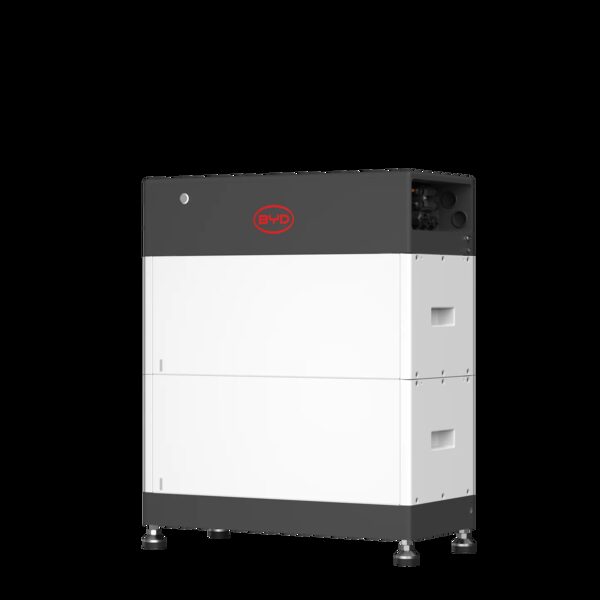
BYD publishes a round-trip efficiency of at least 95% for the LV Flex4. That is the figure for energy out divided by energy in across a full cycle, and it sits at the upper end of what LFP systems achieve. The Power-Box TH inverter range is listed at above 98.2% inverter efficiency, which is a separate measurement covering the conversion stage rather than the battery14.
Independent validation is thinner than the maker's own claims, but there is some. The Energy Performance Validation Scheme lists battery storage within its validation scope15, and the Fronius GEN24 Plus paired with the BYD Battery-Box Premium achieved top rankings in the Energy Storage Inspection 2024, described as a strong impression for the fifth consecutive time16. That inspection is run in Germany and tests complete systems rather than cells, so it reflects how the battery behaves with a specific inverter.
The standards position is clearer. VDE 2510-50 appears across the HVS, HVM, LVS, HVS+ and HVM+ documentation1. The Premium HVM datasheet lists the environment as indoor or outdoor, which matters because it confirms the enclosure is intended for external mounting rather than a plant room only12. Communication on the HVM runs over CAN or RS48512.
What this means in practice is that the battery is certified to a recognised stationary storage standard and has been tested in at least one independent system-level inspection. It does not mean every installation performs to the datasheet figure, because round-trip efficiency in a real house includes standby consumption, inverter losses and the way the system is scheduled. The general principles are set out at round-trip efficiency and standby losses.
Warranty: ten years to 60% usable energy, and what starts the clock
The Premium warranty is a performance guarantee as well as a defects guarantee. BYD warrants the product will be free from defects in materials or workmanship for ten years from the warranty start date, and separately guarantees that the battery will retain 60% of its usable energy for ten years from that date, or reach the minimum throughput energy, whichever comes first8. The B-Box warranty uses the same structure: 10 years or energy throughput, whichever comes first17.
The throughput condition is the one households most often miss. A battery that is cycled hard every day can reach its minimum throughput allowance before the ten years are up, and at that point the performance guarantee is satisfied even though the calendar term has not expired. The warranty document gives a module usable energy of 2.78 kWh and a rated capacity of 54Ah, so the allowance is expressed per module rather than as one number for a whole system8.
The start date is defined rather than assumed. It is the first day after six months from the production date of the product, or at the original buyer's choice the first day after thirty days from the delivery date if proven in writing8. There is also an installation deadline: the product must be installed within one month from the warranty start date, and failing that is listed among the conditions that can affect cover8.
"retain sixty per cent (60%) of its Usable Energy for ten (10) years from the Warranty Start Date; or (ii) reach the Minimum Throughput Energy, whichever comes first"
Two further conditions are worth knowing. The warranty requires operation with a BYD certified inverter named on the compatible inverter list, and using an inverter that is not on that list is excluded8. Any replaced product or parts must be made available for collection within four weeks after the replacement, otherwise BYD may invoice the replacement at full market price8. Independent guidance puts the typical battery warranty at ten years, so BYD's term is in line with the market rather than ahead of it18. The wider picture is at home battery warranties.
Compatibility: external inverters, single and three phase
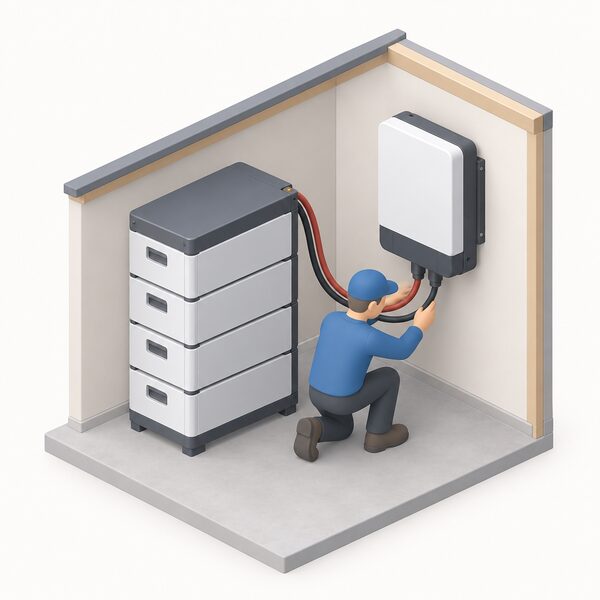
No Battery-Box is a complete system on its own. The Premium LVS is described as a modular 48V LFP battery pack for use with an external inverter, and the Premium LVL as a high capacity 48V LFP battery for use with an external inverter2. The HVS and HVM families carry the same requirement5.
Compatibility is broad but not unlimited. BYD states the LVS is compatible with market leading single and three phase inverters, and the HVS+ and HVM+ with leading single and three phase high voltage battery inverters2. The LV Flex datasheet says the same for market leading single and three phase inverters4. The warranty narrows this to a formal list: the product must be operated with a BYD certified inverter specified in the compatible inverter list published at bydbatterybox.com8.
That list is versioned and updated. The HVL compatible inverter list was updated to version 1.4 on 19 February 2024, setting minimum BMU and BMS firmware versions for SMA, Solis and GoodWe inverters19. The Premium LVL compatible inverter list was updated to V2.5 with a document date of 16 May 202520. The version in force at the time of installation is the one that governs the warranty.
BYD also makes its own inverters for the high-voltage side. The Power-Box SH single phase hybrid inverter is designed for use with the Battery-Box HVE storage system, with dual MPPT tracking, flexible backup and up to 200% PV oversizing7. The Power-Box TH three phase hybrid inverter range is listed as coming soon with expected availability in Q4 202614. Up to three Power-Box TH inverters can be connected in parallel, each with up to 70.7 kWh of storage, allowing systems up to 45kW output including during backup and 212 kWh of storage capacity14.
For a household, the practical consequence is that the battery choice and the inverter choice are linked. A system already built around a particular inverter brand may or may not accept a Battery-Box, and the answer sits in the compatible inverter list rather than in a general claim of compatibility. The coupling arrangements are explained at AC-coupled and DC-coupled battery systems.
Prices: LVS modules from £252.01, LVL modules at £4,622.42
There is no manufacturer list price for an installed Battery-Box system. The figures that exist are component prices from UK distributors, before installation, and they should be read as indicative rather than as a quote.
| Component | Capacity | Price | Source |
|---|---|---|---|
| Premium LVS power distribution unit (base and top) | n/a | £252.01 | 2 |
| Premium LVS Module | 4.00 kWh | £1,030.81 | 2 |
| Premium HVS+ Module | 2.56 kWh | £798.11 | 9 |
| Premium HVM+ Module | 2.76 kWh | £869.49 | 9 |
| HVE Module | n/a | £1,210.94 | 7 |
| HVE Module | n/a | £1,767.32 | 7 |
| Premium LVL Module | 15.4 kWh | £4,622.42 | 6 |
| LVL/LVS BMU | n/a | £104.37 | 11 |
| LVL/LVS BMU, IP55 | n/a | £110.73 | 11 |
| BCU+ for HVB, HVS+, HVM+ | n/a | £458.20 | 10 |
| LVS Connectors | n/a | from £26.50 | 13 |
The Premium LVL module price is given as £4,622.42 excluding tax on one listing23. The Premium HVS and HVM range is listed from £470.93 across three models, and the HVS+ and HVM+ from £798.1121. 83 plus VAT and another at £1,465 including VAT, so both figures stand and the VAT position should be confirmed at the point of sale.
For context, independent guidance puts Ovo solar packages with a battery starting at around £2,50025. That is a whole-package figure rather than a component price, and it is not directly comparable with the module prices above. Installation, mounting, cabling, inverter and commissioning are all additional, and prices are installer-quoted. The broader cost picture is at how much a home battery costs in the UK.
Installation and ownership: IP55, plug design and the Be Connect app
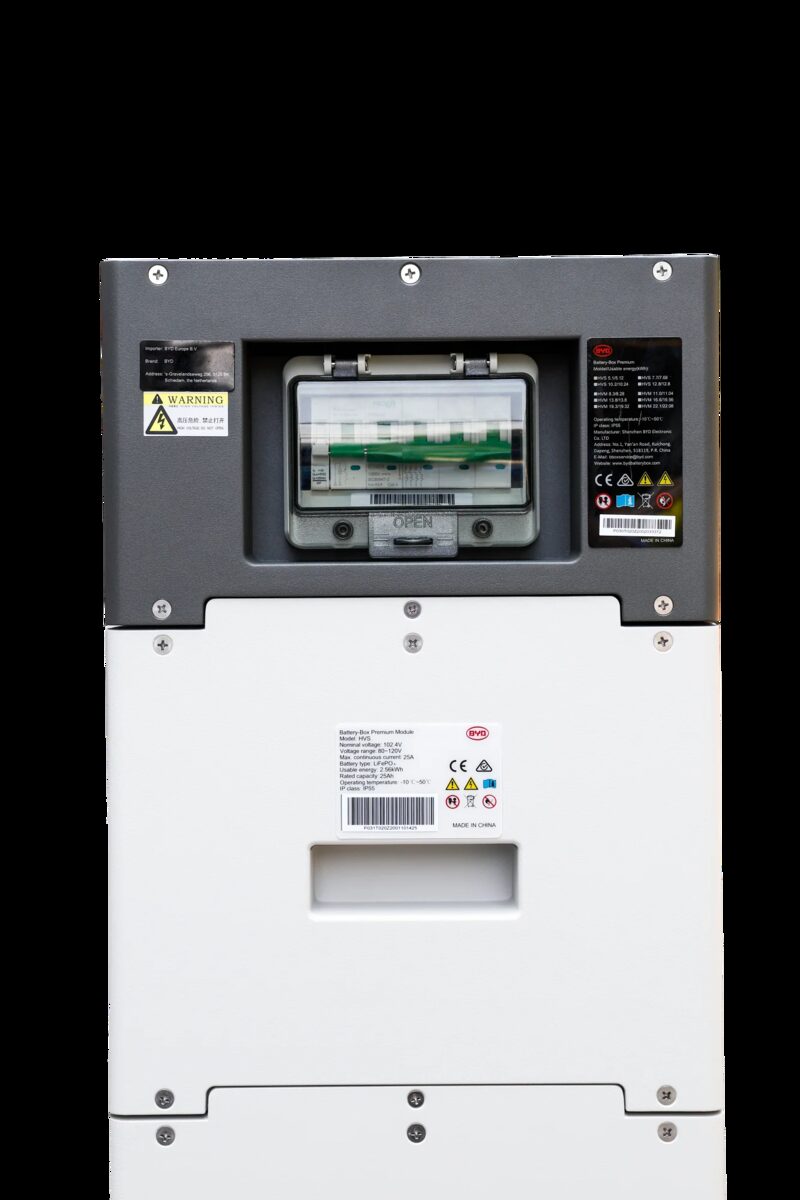
Most of the range carries an IP55 enclosure rating, which protects against dust ingress and water jets from any direction2. The HVE goes further at IP657. The BMU for the LVL and LVS families is available in IP20 and IP55 versions, so the rating depends on the unit specified11. The Premium HVM datasheet lists the environment as indoor or outdoor12.
Physical assembly is designed to be quick. The HVE uses a patented internal plug connection and automatic configuration7. The HVS+ and HVM+ use a tool-less connection9. The HVB accepts additional modules at any state of charge, which removes the need to discharge the stack before expansion10.
Commissioning is not a household task. BYD states that commissioning the battery requires a device capable of running the BYD Be Connect app, available for the Apple App Store and Google Play Store, and the same requirement appears on the LVS, HVS, HVM and LVL pages2. The installer uses the app to configure the system at handover. On the HVE paired with Power-Box inverters, monitoring and support run through the BYD app on an intuitive interface22.
Ownership carries dependencies worth naming. The battery needs an external inverter, so the household depends on that inverter's manufacturer for firmware and support. Commissioning and configuration depend on a smartphone app. The warranty depends on using a certified inverter and on meeting the installation deadline. And the system remains connected to the grid for charging and for the export and import that make most domestic tariffs work. What the Battery-Box changes is when grid electricity is bought, not whether it is bought. The independence question is examined at home batteries and household energy independence.
Where the range has limits
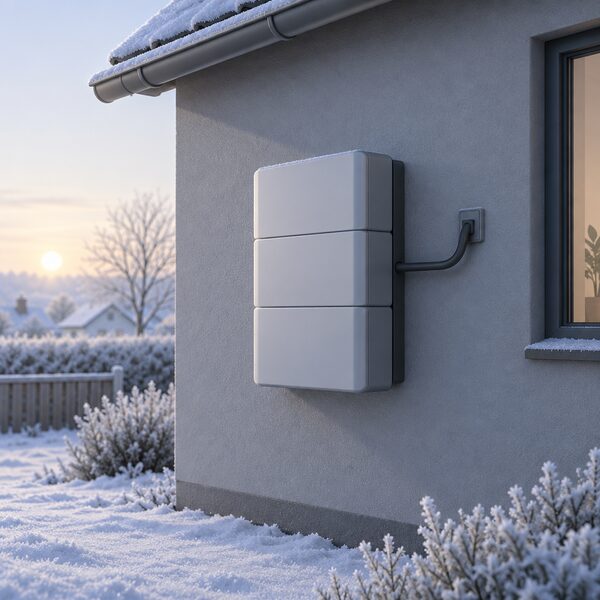
The charge current derates in cold conditions, and the figures differ by family. On the Premium LVS, maximum charge current is 48A between minus 10 and 0 degrees C, 65A between 0 and 5 degrees C, and N of the modules up to 250A per tower between 5 and 50 degrees C2. The Premium HVS is listed at 20A between minus 10 and 0 degrees C and 25A between 0 and 5 degrees C5. The documents do not resolve the difference in presentation between the two families, so both sets of figures stand as published.
That derating matters in an unheated garage or on a north-facing external wall. A battery that charges slowly on a cold morning absorbs less of the early solar generation, and the shortfall is imported later or lost. Independent guidance on battery lifespan suggests a maximum possible calendar life of 12 to 20 years at 60 to 80% daily depth of discharge, which is a goal rather than a promise and sits beyond the ten-year warranty term27.
Off-grid use is supported in principle. BYD lists the Battery-Box for backup and off-grid applications, and the HVB is described as suitable for on-grid, backup and off-grid use1. The B-Box is listed for emergency backup and off-grid applications13. Independent guidance notes that off-grid system batteries need replacing every six to 10 years28. Whether a home keeps power during a cut depends on the inverter and a changeover arrangement rather than the battery alone, which is covered at battery backup in a power cut.
Sources28 cited
- BYD Battery-Box product range, BYD
- BYD Battery-Box Premium LVS, Wind & Sun, 2026-09-20
- Premium LVS Lite datasheet V1.2, BYD, 2026-09-17
- Battery-Box LV Flex datasheet V1.4, BYD, 2026-09-17
- BYD Battery-Box Premium HVS and HVM, Wind & Sun, 2026-09-20
- BYD Battery-Box Premium LVL, Wind & Sun, 2026-09-20
- BYD Battery-Box HVE, Wind & Sun, 2026-09-20
- Battery-Box Premium HVS and HVM limited warranty, Europe, BYD, 2026-09-17
- BYD Battery-Box HVS+ and HVM+, Wind & Sun, 2026-09-20
- BYD Battery-Box HVB, Wind & Sun, 2026-09-20
- BYD Battery-Box Premium LVL and LVS BMU, Wind & Sun, 2026-09-20
- Battery-Box HVM datasheet V1.4, BYD, 2026-09-17
- BYD battery range, Wind & Sun, 2026-09-20
- BYD Power-Box TH5/6/8/10/12/15K, Wind & Sun, 2026-09-20
- Energy Performance Validation Scheme, EPVS, 2026-01-12
- Compatible batteries for GEN24 inverters, Fronius
- BYD B-Box warranty terms, Solarwatt, 2026-09-17
- Solar panel battery storage, Which?, 2026-05-14
- BYD Battery-Box Premium HVL compatible inverter list V1.4, BYD, 2024-02-19
- Battery-Box Premium LVL compatible inverter list V2.5_V2.5_EN-6a5596ba77b8d-6a5dd7df95e49.pdf), BYD, 2025-05-16
- BYD Battery-Box HVE and Power-Box hybrid inverters, Wind & Sun, 2026-09-20
- Introducing BYD HVE batteries and Power-Box hybrid inverters, Wind & Sun, 2025-12-18
- Victron ESS package, Wind & Sun, 2026-09-20
- Featured products, Wind & Sun, 2026-09-20
- Solar panel costs, Which?, 2026-08-03
- BYD Power-Box SH single phase hybrid inverter, Wind & Sun, 2026-09-20
- Depth of discharge, SolaX, 2026-02-04
- Small wind turbines, MCS Certified, 2026-08-18
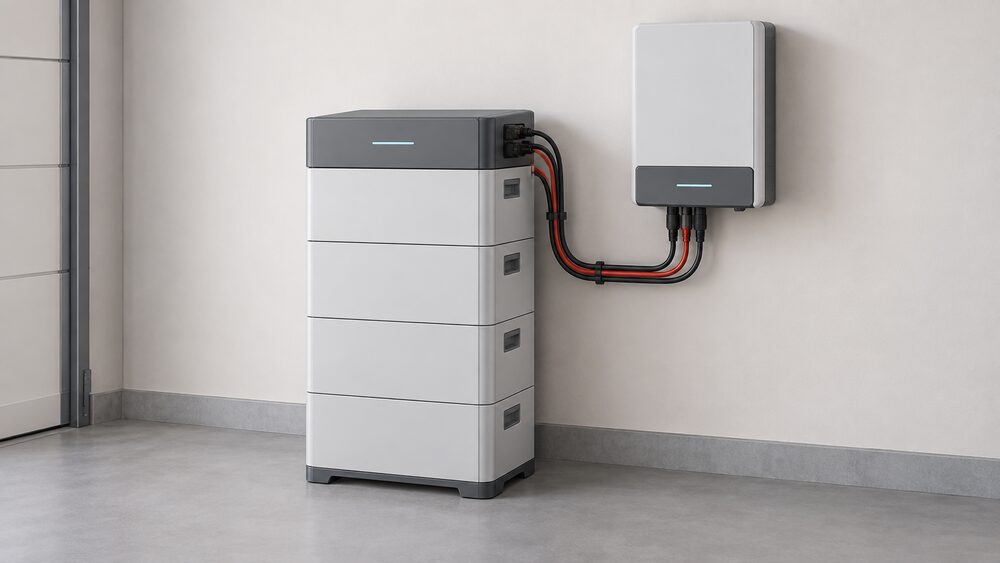 BYD Battery-Box PremiumThinking about a BYD home battery?