In this guide
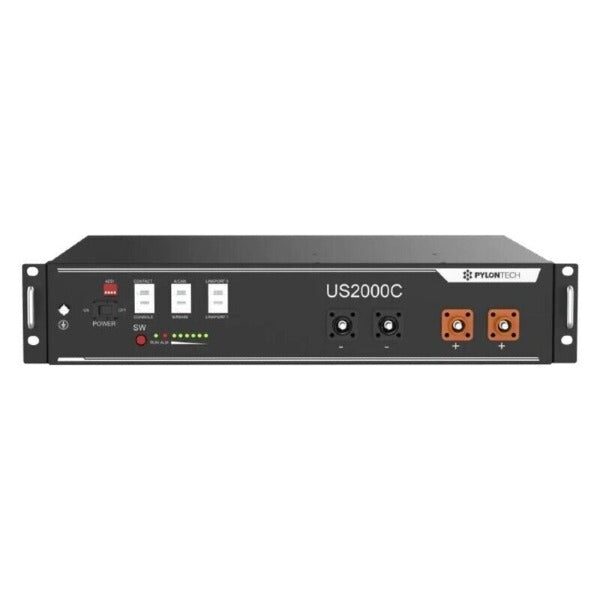
Pylontech is a Chinese energy storage manufacturer whose lithium iron phosphate (LFP) cell and module products sit inside a large number of UK home battery installations, usually without the household ever seeing the name. The company does not sell a finished domestic battery system in the way that a consumer brand does. It supplies modules that an inverter maker, an assembler or an installer integrates into a complete system, which is why the Pylontech name tends to appear on a datasheet or a battery management system compatibility list rather than on the front of a unit in a garage.
The evidence for the company's standing is recent and specific. Pylontech reports consecutive recognition on the BloombergNEF Energy Storage Tier 1 List, dated 3 August 2026, and recognition as a Grade A BESS integrator by Wood Mackenzie, dated 17 July 20261. It also reports commissioning a 7.5 MW/15 MWh energy storage project in Yangzhou on 31 July 20261. Those are utility-scale and market-position facts. They say something about the supplier's scale and its standing with financiers, and nothing directly about how a module will behave in a UK semi-detached house.
What a household can act on is narrower. The published warranty for the Force H1 and H2 modules is 7 years, extended by 3 more at no cost if the product is registered on the Pylontech website, giving 10 years2. Compatibility with third-party battery management systems is documented: Morningstar's ReadyBMS states that it supports two-way closed-loop communication and operation with PylonTech LiFePO4 batteries3. That closed-loop link is the mechanism that makes a Pylontech module usable in a domestic system, and it is the thing to check before assuming any given inverter will work with one.
Who Pylontech are, and what they actually sell
Pylontech's position in the market is as a cell and module specialist rather than a consumer brand. The Force H1 and H2 are the products that appear in the documentation available for the UK, described as using Li-ion (LFP) cell technology2. LFP, lithium iron phosphate, is the chemistry that has come to dominate stationary home storage because it trades energy density for thermal stability and cycle life, which suits a unit that sits on a wall and is expected to last a decade.
The company's own activity reporting is dominated by grid-scale work. The Yangzhou project commissioned on 31 July 2026 is a 7.5 MW/15 MWh installation1. For scale, that is a power rating in megawatts and an energy capacity in megawatt hours, several orders of magnitude above a single-home battery. It demonstrates that Pylontech manufactures and delivers at volume, and that its engineering effort is spread across utility, commercial and residential segments rather than focused on the domestic product alone.
That matters for a householder because it shapes what support looks like. A company whose revenue is weighted towards large projects has less reason to run a consumer-facing service operation in the UK. There is no evidence in the available material of a Pylontech-run domestic installer network, a UK service plan or a direct consumer support line. The relationship a household has is with whoever assembled and fitted the system, and the module warranty is claimed through that route.
Company standing: Tier 1 recognition and Grade A integrator status
Two dated recognitions sit behind Pylontech's current market position. The first is consecutive listing on the BloombergNEF Energy Storage Tier 1 List, reported on 3 August 20261. The second is recognition as a Grade A BESS integrator by Wood Mackenzie, reported on 17 July 20261. Both are third-party assessments, and both are about the company rather than about a product.
Tier 1 lists of this kind are compiled from criteria that bear on bankability: deployment volume, the willingness of financiers to lend against projects using the supplier's equipment, and the supplier's record of delivery. They are not product certifications. A Tier 1 listing does not mean a module has passed a particular safety test, and it does not mean an installer can fit it without checking the applicable standards. It means the supplier is regarded as a safe counterparty at project scale.
Grade A BESS integrator status is a similar kind of statement. BESS stands for battery energy storage system, and the grading relates to a company's role in assembling and delivering complete systems rather than supplying cells alone. Wood Mackenzie's assessment places Pylontech in the top band of that activity1. For a household, the practical translation is limited but not zero: a supplier that integrators and financiers treat as established is less likely to disappear mid-warranty than an unknown one, though nothing in the material guarantees that.
The distinction matters because the two things get conflated in sales material. A household weighing a battery should treat the Tier 1 listing as evidence about the supplier's durability, and look separately for evidence about the specific module, its certification and its compatibility with the chosen inverter.
What the company's ESS experience means for householders
Energy storage system experience at utility scale transfers to a home installation in some ways and not others. What transfers is manufacturing discipline: a company that builds megawatt-hour systems has production processes, cell sourcing and quality control that a small assembler may not. What does not transfer is the service model. Utility projects are maintained under long-term contracts by the developer, not by the equipment maker's consumer arm.
The consumer side of the market has its own expectations. BSI reports that over 80% of UK consumers have increased confidence in products displaying the BSI Kitemark4. That figure describes certification marks generally rather than batteries specifically, but it points at the thing a household actually relies on: an independent mark or listing, not a manufacturer's own grading. A Tier 1 listing and a Kitemark answer different questions.
There is also a documented failure mode in this product category that households should know about. LG ESS Home Batteries, lithium-ion storage batteries installed as part of a residential solar panel system, are the subject of a recall in which LGESS are replacing all potentially affected ESS Home Batteries, with the affected model listed as RESU7H_Type R5. That recall is not about Pylontech products. It is the reason the category is regulated as it is, and the reason a household should check the recall register for any battery model before and after installation.
Recent projects and activity: the Yangzhou commissioning
Pylontech reports commissioning a 7.5 MW/15 MWh energy storage project in Yangzhou on 31 July 20261. The figure is worth reading carefully. 7.5 MW is the power rating, the rate at which the system can charge or discharge. 15 MWh is the energy capacity, the total it can hold. The two-hour ratio between them is typical of grid support and shifting applications.
That project sits in a policy context that has been moving quickly in the UK too. The government's clean flexibility roadmap sets out cap and floor investment support schemes for 7.6GW of new Long Duration Electricity Storage projects, dated 26 June 20266. Long duration storage is a different problem from home storage: it is about shifting energy across days and seasons rather than across an evening. A supplier with utility-scale delivery experience is positioned for that market.
Domestic-scale storage appears in UK policy in a different form. The UK Solar Roadmap, published by DESNZ, is the government's own framing of solar deployment7. At the devolved level, the Welsh government describes a development where every highly energy efficient home is powered by photovoltaic panels and batteries8, and the Scottish government's low carbon infrastructure transition programme covers related ground9. These are deployment programmes rather than product specifications, and none of them names a battery supplier.
The honest reading of Pylontech's recent activity is that it demonstrates capacity and delivery at scale, in a market segment a household will never buy from. It is a signal about the company, not about the product in a UK house.
Pylontech in UK home battery systems: where the modules fit
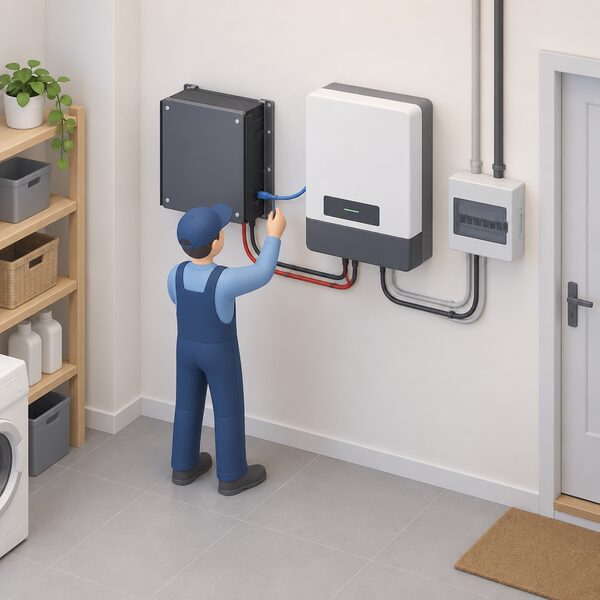
Pylontech modules reach UK homes through integration rather than through a Pylontech-branded domestic product. The clearest documented example is battery management system compatibility. Morningstar's ReadyBMS states that it currently supports two-way closed-loop or Tier 2 communication and operation with Discover and PylonTech LiFePO4 batteries3. Closed-loop communication means the battery management system and the inverter exchange data continuously, so the inverter knows the module's state of charge, temperature and limits rather than inferring them from voltage.
That is the technical condition for a third-party module to work well in a home system. Without it, an inverter treats the battery as a dumb DC source, which usually means conservative limits and less accurate state of charge reporting. With it, the pair behaves more like a matched system.
The wider UK context for home storage is one of active deployment. SSEN reports giving 20,000 home battery packs to customers who need the most support, dated 24 February 2026, and states that the capacity of the battery packs now being provided has been increased by one third compared with those used during the trial10. That is a distribution network operator running storage as a network and consumer benefit, not a manufacturer selling a product, and it shows how far domestic storage has moved into mainstream network planning.
Plug-in solar is the other route by which small storage reaches households. Independent guidance notes that batteries for plug-in solar are already being developed for the UK market11. That is a developing category rather than an established one, and it points to a future in which small LFP modules are bought as appliances rather than installed as part of a designed system.
| Layer | Who provides it | What the household sees |
|---|---|---|
| Cell and module | Pylontech (LFP)2 | A datasheet name, not a badge on the wall |
| Battery management | Third-party BMS, e.g. Morningstar ReadyBMS3 | Compatibility list entry |
| Inverter and controls | Inverter brand | The app and the monitoring |
| Installation and warranty route | Installer or system brand | The point of contact for a claim |
What owning Pylontech modules means for household energy independence
A home battery changes the terms on which a household buys electricity, and it does not remove the connection. The module stores energy that was generated on the property or drawn from the grid at a cheaper time, and releases it later. The household remains connected to the distribution network, remains a customer of a supplier, and remains dependent on the grid for whatever the battery and any generation cannot cover.
Time-of-use tariffs are the commercial mechanism that makes this worthwhile. Independent guidance notes that several providers offer smart storage battery tariffs, including British Gas, E.ON Next and EDF Energy, dated 23 April 202612. Those tariffs price electricity differently by time of day, which is what allows a battery to charge cheaply and discharge when power is expensive. Without such a tariff, a battery's financial case rests on self-consumption of on-site generation alone.
The dependence that remains is worth stating plainly. A Pylontech module in a UK home depends on the inverter that controls it, on the battery management system that communicates with that inverter, on the installer or system brand that carries the warranty route, and on the grid and a supplier for whatever the system cannot cover. It also depends on the manufacturer's continued existence for the module warranty term, which is why the 7 year term extended to 10 on registration is worth registering2.
Consumer research points at where these systems succeed and fail. Energy Systems Catapult reports a Living Lab of more than 5,000 UK homes trialling new technologies, dated 12 February 202613. The finding that matters for storage is that household engagement with energy management is uneven, and a system that requires constant attention tends not to get it. A battery that runs on a schedule and a tariff, with the household checking it occasionally, is the pattern that fits how people actually behave.
For comparison, Powervault states that it has been assembling its energy storage batteries in a UK factory for over 10 years14. That is a different kind of claim from a Tier 1 listing: it is about where the product is made and for how long. Neither claim establishes which product performs better in a given house, and the two are not substitutes for each other.
The independence a Pylontech-based system delivers is therefore partial and conditional. It reduces the amount of electricity bought at peak prices and increases the share of on-site generation used on site. It does not disconnect the home, and it adds a new set of dependencies: on an inverter brand, a battery management system, an installer and a manufacturer's warranty administration. Households weighing the trade-off against other options can compare the field in home battery storage manufacturers and the wider equipment picture in home energy equipment manufacturers.
Sources14 cited
- Pylontech corporate site, Pylontech, 2026
- Eaton xStorage Home brochure, Eaton, 2022
- Morningstar ReadyBMS, Wind & Sun, 2026
- BSI Kitemark certification for EV chargers, BSI, 2026
- LG ESS battery recall, Electrical Safety First, 2026
- Clean Flexibility Roadmap, July 2026 update, GOV.UK, 2026
- UK Solar Roadmap, DESNZ, 2025
- UK's largest net zero housing development to be delivered in Wales, Welsh Government, 2025
- Low Carbon Infrastructure Transition Programme, Scottish Government, 2024
- SSEN gives 20,000 home battery packs to customers who need the most support, SSEN, 2026
- Plug-in solar explained, Low Carbon Hub, 2026
- Time of use tariffs explained, Which?, 2026
- Making home energy management work for consumers, Energy Systems Catapult, 2026
- Powervault P5, Powervault, 2026
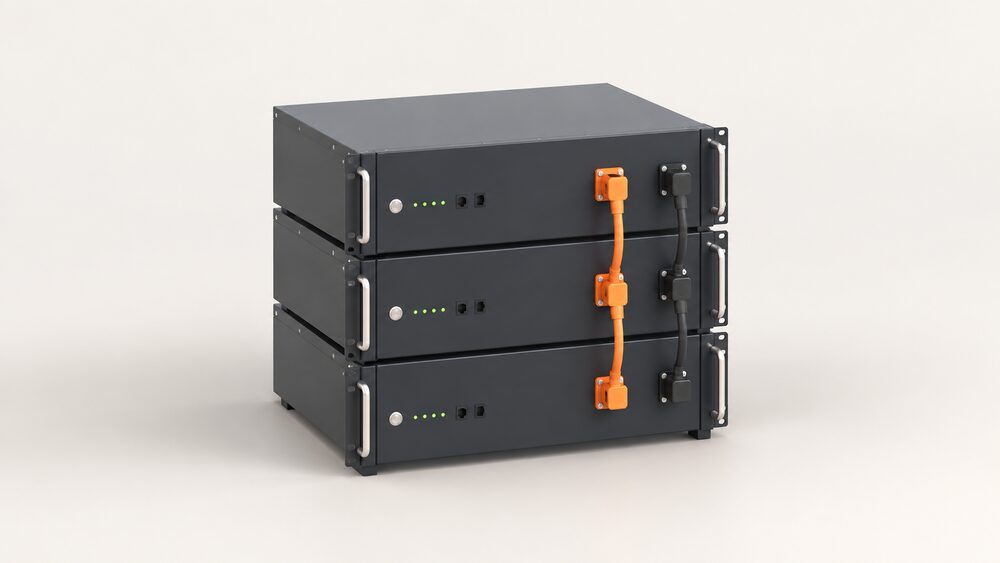 Pylontech Home BatteriesPylontech batteries are already in a huge number of UK homes, so plenty of people meet the name on a quote or a compatibility list.