
In this guide
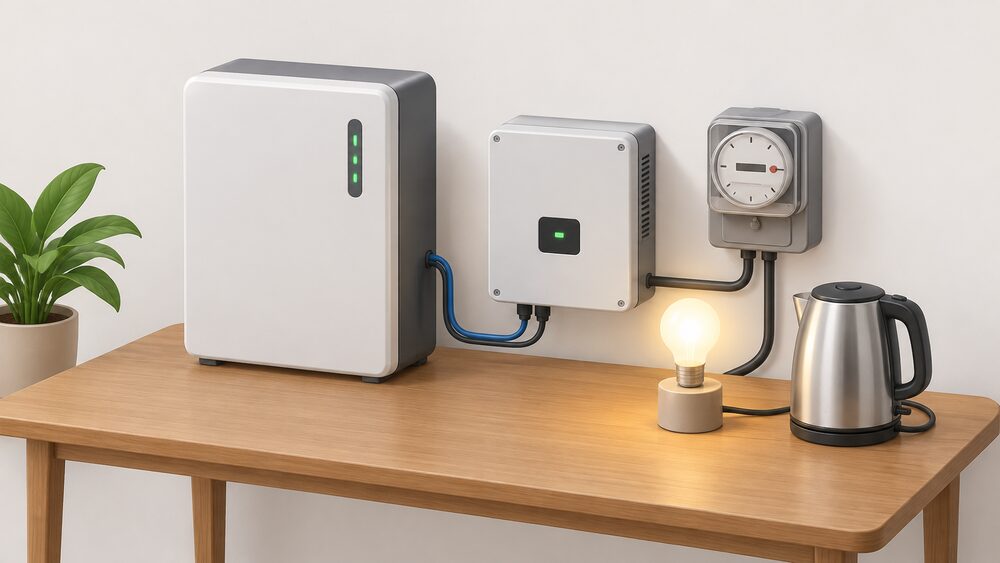
A home battery carries two numbers that are easy to confuse. Capacity is stored energy, measured in kilowatt hours: a typical home system might hold 10 kWh1. Power is the rate at which that energy can move in or out, measured in kilowatts, where 1,000 watts make one kilowatt2. One kWh is enough energy to power a 100-watt lightbulb for ten hours3, so a 10 kWh battery delivering power at a low rate lasts a long time, and the same battery delivering power at a high rate empties quickly. Electricity meters count energy in kilowatt hours, not power4.
The C-rate is the link between the two. It expresses charge or discharge power as a multiple of the battery's capacity: a battery discharging at 1C empties its nominal capacity in about an hour, and at 0.5C in about two. Manufacturers use it because a cell's safe current depends on its size, so a single figure travels across a product range. For a household the practical questions it answers are whether the battery can carry the whole house when the shower, oven and kettle are running together, and whether it can fill within a cheap overnight rate window. Round-trip losses mean neither direction is free: batteries are not 100% efficient, so not all the energy put in comes back out5.
Power ratings come in two forms: a continuous rating the unit can hold indefinitely, and a peak or surge rating held for seconds to start a motor. Neither is set by the battery alone. The inverter, the battery management system, cell temperature, the state of charge and the network operator's connection terms all impose their own ceilings, and the system runs to whichever is lowest at that moment.
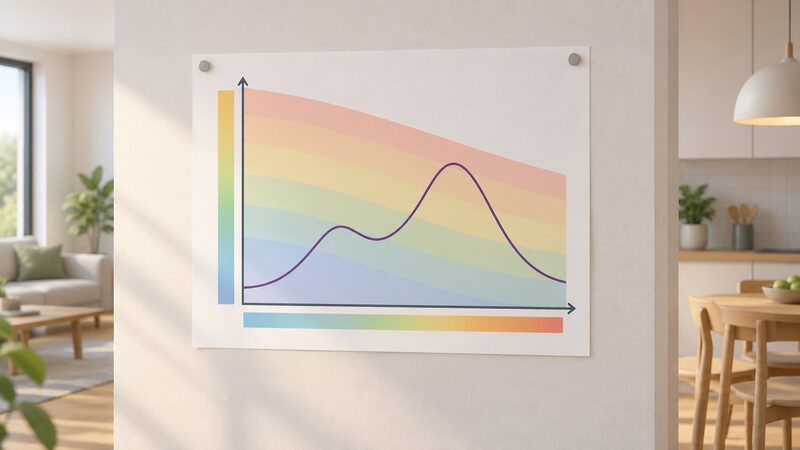
kW is a rate, kWh is a quantity
The distinction matters most when a quote lists only one of the two. A 10 kWh battery with a 3 kW output and a 10 kWh battery with a 5 kW output store the same energy and behave very differently. The first can supply a 3 kW immersion heater and nothing else; the second can supply the same heater plus a fair part of the rest of the house. Capacity decides how long the store lasts; power decides what it can carry.
Household appliances make the point concrete. Electric vehicle charging is the largest routine single load in most homes that have it: the standard power rating for a home charge point is 7 kW7, and units delivering up to 22 kW can be installed at home but require a three-phase electricity supply, which most houses do not have8. A battery rated at 3 kW output cannot cover a 7 kW charge point from storage alone; the shortfall is imported. In the other direction, the same arithmetic governs charging: a battery limited to 3 kW charging takes longer to fill from a cheap-rate window than one limited to 5 kW, and if the window is short the household simply does not get the full store bought at the low price.
Energy is what the meter records and what the bill charges for, in kilowatt hours4, and kWh is also the unit used for measuring charge delivered to an electric vehicle9. Power is what the fuse, the cable and the inverter are sized for. A battery cannot make the supply bigger than the household's cut-out rating allows; it shifts when energy is drawn, not how much the incoming supply can carry at one instant.
Charge and discharge limits: what actually caps the rate
Four things set the current a battery will accept or deliver at any moment.
- The cell and its C-rate. The chemistry sets a safe continuous current. Lithium-ion and lead-acid are the main types in domestic use, with lithium-ion the main type for domestic installations10; the two behave very differently under high current, which is one reason home battery chemistries affects power rating and not just capacity.
- The battery management system. The BMS enforces the cell limits and reports them to the inverter, derating charge or discharge when cells are cold, hot, very full or very empty. Improper charging or discharging is among the causes of thermal instability identified in safety work on lithium batteries, alongside poor quality and substandard components, flawed design and physical abuse11.
- The inverter. Its own continuous rating is often the binding constraint in an AC-coupled or DC-coupled system, and it is the rating quoted in kW on most product literature.
- The state of charge floor. When the battery reaches a set level, maybe 20% of total storage capacity, the system stops discharging1. That reserve is not available power, whatever the nameplate says.
In practice the delivered figure drifts below the headline. Available power falls near both ends of the state of charge range, losses are taken in both directions5, and a battery with no solar attached will simply stop charging when full and begin discharging when the next cheap tariff period ends, doing so automatically1. Usable energy and nameplate energy are treated separately on battery capacity and usable capacity, and the losses in each direction on round-trip efficiency.
For independence, the effect is blunt: a low power rating means the grid still carries the peaks even when the battery is full. Capacity buys hours, power buys the ability to be the sole supply during those hours.
Voltage windows: the limits the system must respect
Every battery has an upper and a lower voltage limit, and the system will refuse to operate outside them. With a lithium battery the limits arrive over the data link. With lead-acid they do not: the maker of one storage inverter states that in lead-acid mode the upper and lower limits of the battery voltage need to be set12, and if the measured voltage falls outside them the unit raises a battery voltage low or battery voltage high fault.
There is a second voltage window on the AC side. Where mains voltage or frequency exceeds the rated range under the set safety regulations, the inverter raises an AC voltage or AC frequency outrange fault, and the stated check is whether the mains voltage or frequency is above the upper limit or below the lower limit of the rated range12. This is grid behaviour, not battery failure. Other grid-connected equipment responds the same way: an EV charger will not function and displays a red ring or an error when voltage goes beyond the acceptable range13.
The dwelling standard for battery installations, PAS 63100:2024, draws its own line: it excludes battery systems with nominal voltages on the AC or DC side exceeding low voltage as defined in BS 767114. Domestic systems sit inside that boundary, which is why they fall under the standard set out on battery installation standards.
"In lead-acid mode, the upper and lower limits of the battery voltage need to be set."
The BMS link: why a data cable decides how much power flows
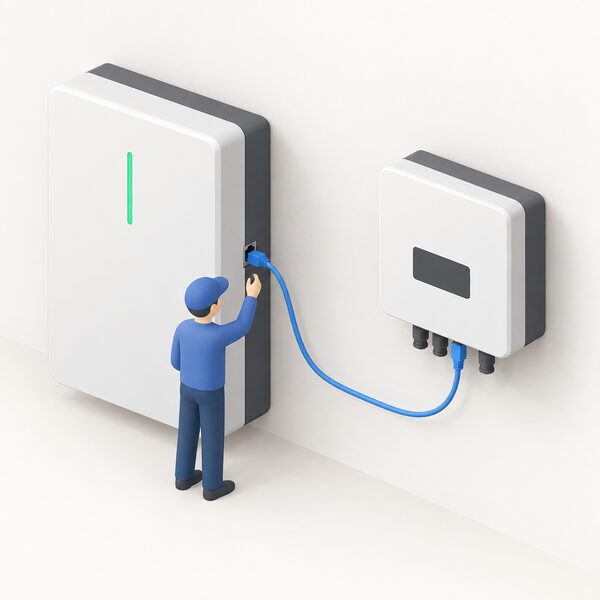
In lithium battery mode the inverter needs to communicate with the battery through the network cable12. That cable is not an accessory. When battery-to-battery communication fails the machine displays BMS COM Fault, and the check called for is whether the wiring between the energy storage machine and the battery is normal12.
Households with stacked packs feel this more than those with a single unit, because each added module extends the communication chain. What a BMS does, and why its reported limits differ from the nameplate, is set out on battery management systems and the faults it raises on home battery maintenance, alarms and common faults.
Firmware is part of the same dependence. One maker states that where the firmware programmed by the machine does not match, an error is raised, and that the check is whether the software of the energy storage machine is the correct version, with the correct code burned if it is not12. A household that cannot update firmware without the manufacturer or installer retains a dependence that has nothing to do with the grid.
Meter connection and what the network operator allows
A storage system that manages import and export needs to see the meter. One maker states that under some safety regulations units need to be connected to the electricity meter when they work normally, that a meter warning occurs when the electricity meter is not connected, and that the check is whether the meter is connected and whether communication between the meter and the energy storage machine is normal12.
Separately, network operators set the power thresholds that decide whether a connection can simply be notified or must be applied for. These are power limits in kW and amps, and a battery's output rating counts towards them.
| Threshold | Figure | Source type |
|---|---|---|
| Post-installation notification for EV charge points and heat pumps, existing properties where connection adequacy is known | maximum demand of the premises including the new load at or below 60 A per phase6 | network industry guidance |
| Heat pump connect-and-notify test, whole current metered properties (Electricity North West) | total electrical energy used in the property, including the heat pump, must not exceed 13.8 kW / 60 A per phase15 | distribution operator |
| Supply capacity confirmation (SSEN), residential | required where maximum demand exceeds the cut-out rating or new maximum demand is above 60 A, 13.8 kVA single phase16 | distribution operator |
| CT metering (Electricity North West) | generally used for three-phase supplies with power usage greater than 69 kW17 | distribution operator |
| Unmetered connections (Electricity North West) | load must be predictable and less than 500 W18 | distribution operator |
| SCADA facilities (NIE Networks, Northern Ireland) | mandatory on all generation connections above 200 kW capacity19 | distribution operator |
Rules differ across the four nations in who administers them rather than in the physics: NIE Networks sets the Northern Ireland generation connection terms, including the 200 kW SCADA threshold19, while the Great Britain operators publish their own thresholds as above. The notification route for storage itself is covered on G98 and G99.
Export revenue depends on the same metering chain. Under the Smart Export Guarantee, 443.1 GWh of low carbon electricity was exported during 2024 to 202520. Suppliers set their own rates, with the average around 12p/kWh as at October 202521. Storage reduces export: installing battery storage lowers the amount exported and so reduces export payments, though the overall saving is reported as greater than relying on export payments alone22.
Reading the meter, and reading the battery
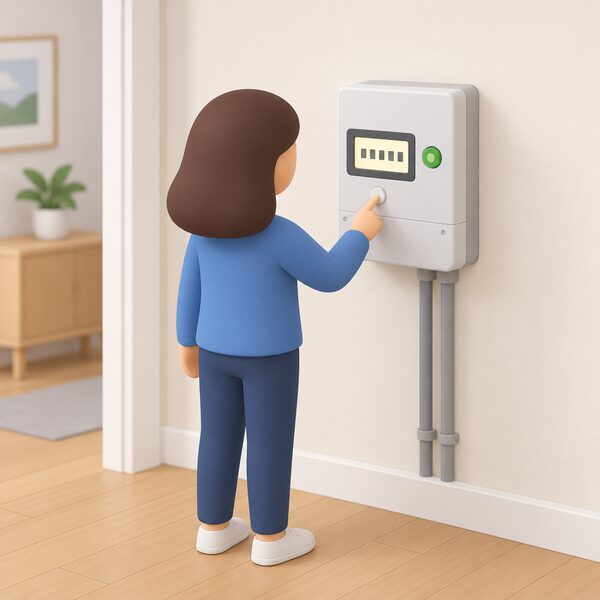
Where a system reports a meter problem, the household's own reading of the meter is a useful cross-check. On a smart meter with a green A button to the right of the screen and a white B button below, the white B button lights the screen; after waiting for "meter boost", pressing A to select "no" shows the reading followed by KWH. On a meter with two buttons to the right of the screen, one marked reconnect, the display or display select button is pressed repeatedly until numbers followed by KWH appear23. A blank in-home display may simply have run out of battery, in which case it is plugged in, charged for a few moments and turned back on24.
Logged data has its own trap. Where a kWh reading resets on a power cycle, a Wh or kWh accumulator process joins across missing values with a straight line and removes the reset, continuing from the value prior to the reset25. Without that, an inverter or meter restart appears in the record as a large negative or a false spike, which is worth knowing before drawing conclusions about power ratings from monitoring graphs. Monitoring a home battery covers the data side in full.
Lead-acid mode: the extra settings a household system needs
Lead-acid remains one of the two main domestic battery types alongside lithium-ion10, and it demands settings that a lithium pack supplies for itself. Two are specific to power and protection. The upper and lower battery voltage limits must be entered by hand12. And the temperature sensor must be wired: the maker states that in lead-acid mode the energy storage machine needs to be connected to the NTC terminal at the corresponding terminal block, with an NTC OPEN alarm raised otherwise, and the check being whether the NTC terminal is properly connected with the energy storage machine12.
The reason is that lead-acid charge voltage is temperature dependent, so without a working sensor the system cannot set a safe charge ceiling. For households, this is the practical difference from lithium: the safe power and voltage envelope is configured rather than negotiated. Comparisons of the two are covered on lead-acid, AGM and gel batteries and lithium-ion vs lead-acid solar batteries.
Fault codes that point to power and connection problems
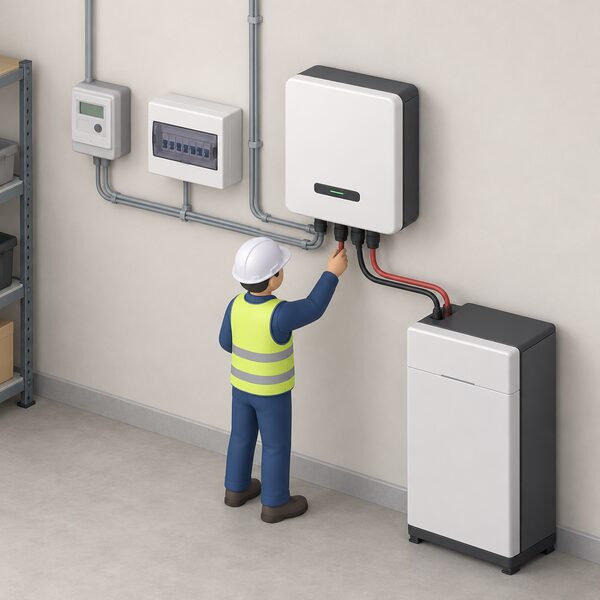
The following are as stated by one storage inverter maker for its own products. They are grouped here because each one is, at root, a power path or a data path that is not where the machine expects it to be.
| Fault | Stated cause | Stated check |
|---|---|---|
| Error 302, No AC Connection | The machine has no mains connection | Whether the wiring between the mains and the machine is correct, and whether the wiring itself is reliable |
| Error 300 / 304, AC V or AC F Outrange | Connected mains voltage or frequency exceeds the rated range under the set safety regulations | Whether mains voltage or frequency is above the upper limit or below the lower limit of the rated range |
| Error 418 | The firmware programmed by the machine does not match | Whether the software is the correct version; burn the correct code if not |
| Error 500, BMS COM Fault | Battery-to-battery communication fails | Whether the wiring between the energy storage machine and the battery is normal |
| Error 502 / 503, Bat Voltage Low / High | In lead-acid mode, upper and lower battery voltage limits need to be set | The configured voltage limits |
| Error 505, Battery Reversed | Battery positive and negative terminals do not correspond to the terminals marked on the machine | Whether the positive and negative terminals are reversed |
| Warning 401 | The electricity meter is not connected | Whether the meter is connected and communication with the machine is normal |
| NTC OPEN | In lead-acid mode the machine must be connected to the NTC terminal at the corresponding terminal block | Whether the NTC terminal is properly connected |
All figures in the table are the maker's own statements for its storage inverters12.
Recalls reach whole battery ranges too: the RESU7H Type R was among the models subject to replacement of all potentially affected ESS home batteries28, an episode covered on home battery recalls and safety notices.
Loss of mains: what witnessed testing shows
A grid-tied battery must stop energising the network when the mains disappears, which is why an ordinary installation goes dead in a power cut unless it has a backup interface. Testing is witnessed against a standard: one domestic-scale generating unit was tested for loss of mains according to BS EN 6211629.
The recorded run-on time in that document is 351 ms for test 1, but a figure of 357 ms also appears and the two disagree; both are within the same report and neither has been reconciled29. Either way, the disconnection happens in well under a second. The same unit used an electromechanical relay to disconnect from the grid, with no solid-state switching device available, and no reconnection occurred at the tested limits of 1.16 pu, 0.78 pu, 47.4 Hz and 52.1 Hz29.
The report also records the remote control path. A logic interface input port is provided and can be used to shut down the module, with the signal described as AC to a maximum of 240 V or DC to a maximum of 110 V, a relay close status of 1, and active power output ceasing within 5 s following an instruction being received29. The manufacturer's declaration of compliance with the cyber security requirements is provided29.
For the household, this is where independence has a hard edge. Fast disconnection protects network staff and is not optional, so battery backup in a power cut requires separate changeover equipment. The remote shutdown path is equally real: a system that can be instructed to cease active power within 5 s is a system whose operation can be influenced from outside the house.
What power rating means for independence
Power rating sets the share of the household's own demand a battery can actually serve. Domestic battery systems can store as much electricity as a household typically uses in a day, enabling a PV system to provide up to 70% of a household's annual electricity demand30. That upper figure assumes the battery can meet the instantaneous loads as well as the daily total, which is a power question, not a capacity one.
Aggregated, the same ratings matter to the network. Millions of homes with batteries could release stored power onto the grid when needed to help balance supply and demand across the country31. Individual participation has thresholds: in one operator's flexibility case study, the maximum volume of flexibility a homeowner could offer was below 10 kW, which was the minimum capacity required32. That is the shape of the trade explored on virtual power plants and flexibility services and on home batteries and household energy independence.
What remains dependent is worth stating plainly. The inverter needs a healthy mains connection to work in its normal mode, and says so when it does not12. It needs a working meter link under some safety regulations12. It needs current firmware from its maker12. It disconnects from the grid in a fraction of a second when the mains is lost29 and can be instructed to cease active power within 5 s29. And the incoming supply, not the battery, sets the household's maximum demand, tested by the network operator against thresholds such as 60 A per phase6.
Sources32 cited
- Battery storage advice, Energy Saving Trust, 2026-08-19
- Energy generation in Wales 2023, Welsh Government, 2025-03
- How to read a British Gas energy bill, Uswitch, 2025-09-25
- Reading your gas or electricity meter, Centre for Sustainable Energy, 2026-08
- Storage and the distribution network, Electricity North West, 2026-09-19
- Connecting to the networks: frequently asked questions, Energy Networks Association, 2026-09-17
- Home charging guide, Zapmap, 2025-06-19
- Electric car charging guide, Carwow, 2025-07-16
- EV charging glossary, Uswitch, 2024-11-26
- Electrical energy storage systems, Flexi-Orb, 2025-04-22
- Battery safety campaign, Electrical Safety First, 2026-09-17
- Storage inverter FAQ, Growatt, 2026-09-17
- Voltage changes in your home or business, UK Power Networks, 2026-09-17
- PAS 63100:2024 specification, BSI, 2024-03-20
- Heat pump connections, Electricity North West, 2026-09-19
- Heat pump connection process, SSEN, 2026-09-17
- Single EV connections, Electricity North West, 2026-09-20
- Connections FAQs, Electricity North West, 2026-09-20
- Generation connection FAQs, NIE Networks, 2026-09-19
- Smart Export Guarantee annual report year 5, Ofgem, 2025-12
- Battery storage advice, Centre for Sustainable Energy, 2025-10
- Battery storage, Home Energy Scotland, 2026-09-20
- How to read a smart meter, Smart Energy GB, 2026-08-17
- Troubleshooting smart meter issues, Smart Energy GB, 2026-04-01
- Daily kWh processing, OpenEnergyMonitor, 2026-09-17
- Solar battery storage guide, The IAA, 2026-09-20
- Lithium battery charger recall, Electrical Safety First, 2026-09-17
- LG ESS home battery recall, Electrical Safety First, 2026-09-17
- Power generating unit type test report, Energy Networks Association, 2023-03-23
- Making the most of your solar PV panels, Centre for Sustainable Energy, 2026-08
- Batteries in the home, Solar Energy UK, 2026-09-17
- Flexibility case study: homeowner, Electricity North West, 2026-09-19
 Capacity and Usable CapacityA battery sold as ten kilowatt hours rarely gives you all ten to use.
 Home Battery WarrantiesHow long does a home battery warranty really last, and what does it actually promise?
 What Size Battery?How much electricity does your home use in a day, and how much of that falls in the hours when power is cheap or your solar panels are generating?
 Heat Batteries with Heat PumpsCan a heat battery replace a hot water cylinder if you have no space for one?
 Cycle Life and DegradationHow long will a home battery actually last, and what decides that?
 Home Battery CostA home battery usually costs between one and a half and ten thousand pounds fitted, depending on size.