

On this page
A home battery only earns its keep if the tariff around it lets it buy electricity cheaply and, where there is solar, sell surplus at a decent rate. The tariffs that matter are time-of-use and overnight tariffs, which charge less for electricity at night, and export tariffs such as the Smart Export Guarantee, which pay for electricity sent back to the grid. Several suppliers offer tariffs designed around storage, including British Gas, E.ON Next and EDF Energy1.
The size of the prize is well documented. Fuel-poor households in Coventry combining a home battery with a time-of-use tariff have saved more than £250 a year on average2. Energy UK reports that a combination of a heat pump, solar and a battery can save households £810 more per year when operated flexibly on a time-of-use tariff than the same assets on a single-rate tariff3. Against that, a battery charged purely from the grid at 12p per kWh, with no solar, costs £420 a year in electricity, so the tariff choice determines whether the battery saves money or simply moves it around4.
Overnight tariffs: filling a battery on cheap-rate electricity
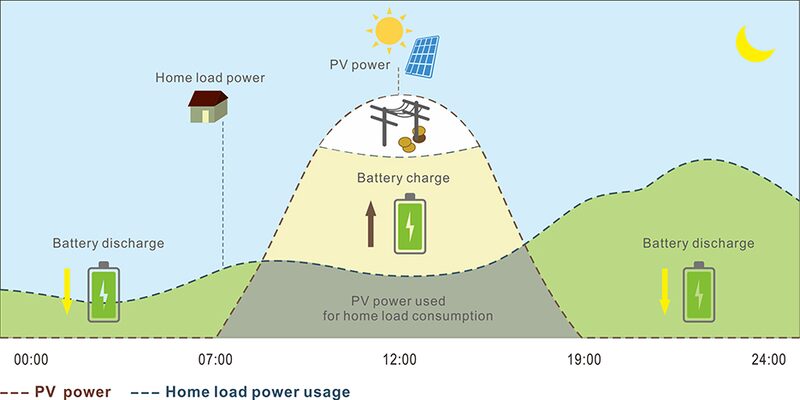
The core tariff for a battery owner is a time-of-use arrangement: a two-rate tariff with cheaper electricity overnight, or an add-on to an existing tariff that discounts certain hours. Which? describes the structure plainly: cheaper overnight electricity on a two-rate tariff, "so you can also use the cheap power for other appliances"1. For a battery owner that sentence is the whole point. The battery charges itself during the cheap window and discharges through the day, so the household effectively pays the overnight rate for electricity it uses in the evening.
This is not a theoretical pattern. Energy Systems Catapult, examining homes in its Living Lab, found that battery-equipped homes show strong overnight charging peaks across autumn, winter and spring, consistent with energy arbitrage behaviour on time-of-use tariffs7. In other words, real households with real batteries are doing exactly this: buying at the bottom of the price curve and consuming at the top.
A case study from the Energy Saving Trust shows the habit in daily life. A household with solar panels, a battery and an electric vehicle uses its cheaper off-peak electricity tariff at night to charge both the car and the battery8. The battery then carries that cheap electricity into the morning and afternoon.
The Centre for Sustainable Energy gives a worked example of the cost: a battery charged at 12p per kWh, assuming no solar PV installed, results in an annual electricity cost of £4204. That figure is the baseline a household should keep in mind. If the daytime rate is materially higher than 12p, the battery pays for the arbitrage; if the gap between the overnight and daytime rates is small, it does not. This is why the shape of the tariff matters more than any single headline rate, and why the pages on battery payback and savings and stacking a battery with smart tariffs work through the arithmetic in detail.
Solar and a battery together: how overnight charging works alongside generation
Add solar panels and the battery has two charging sources instead of one. The Consumer Protection Association describes the benefit: with a home battery, surplus solar energy is captured and held for when the household actually needs it, including overnight EV charging, whereas without a battery the unused solar electricity is wasted or exported to the grid, often at a relatively low rate9. The battery lets a home keep its own generation rather than selling it cheap and buying back dear.
The scale of that shift is significant. A parliamentary research briefing notes that Solar Energy UK suggests combining rooftop solar with a battery could enable 80% of a household's annual electricity to come from low-carbon sources10. A maker's guidance puts the self-consumption effect in similar terms, stating that adding batteries can boost a household's self-consumption rate to over 70%11. The two figures come from different bodies and describe slightly different things, but they point the same way: storage converts daytime generation into evening supply.
The tariff interaction then works in both directions. Ivie's guidance on solar notes that a household can store daytime generation for evening use, that battery storage opens up special export tariffs, and that an overnight EV tariff lowers charging costs12. Which? found the same pattern among real installers: households that installed storage batteries alongside their solar panels could also take advantage of newer energy tariffs to buy grid electricity at cheaper rates overnight as well as charging from the panels13.
So the solar-and-battery household runs a daily cycle with two cheap inputs: free generation through the middle of the day, and cheap grid electricity overnight. An MCS case study from the West Midlands captures the ambition, with owners Stephen and Zoe looking forward to tariffs that let them "sell more power when prices are high and charge the battery when electricity rates are lower"14. The battery is the piece of equipment that makes that timing possible.
Switching tariffs: why a home's export arrangement can be affected
Switching import tariff is not a neutral act for a home that exports electricity. The Smart Export Guarantee (SEG), the scheme that pays households for exported power, is separate from the import supply, and the two interact. Uswitch's guidance for solar households states the position: "In theory, you can move to another supplier without moving your SEG tariff, but you may find yourself moved to a less generous export rate by your old supplier"15. That is the risk in one sentence. The import switch is allowed; the export rate may quietly worsen.
There is also a pull in the opposite direction. In an Energy Saving Trust case study, householder Brian Horne took a fixed Smart Export Guarantee from the same company as his import tariff, "because you get a better rate if you use the same company for both"16. Some suppliers reward customers who hold both accounts with them, which means the best export deal may depend on where the import tariff sits. A household that splits the two across different suppliers should check both rates, not just one.
The general switching checks apply with extra force here. British Gas Energy Trust advises households to review their energy tariff regularly to ensure they are on the best deal, and to be aware of any exit fees17. Its switching guide adds: "If there is an exit fee, compare it with the savings you could make by switching"18. The same organisation's guidance repeats the warning about exit fees and notes that some suppliers offer cheaper energy at certain times of day, as well as variable or fixed tariffs19, and its energy bills support page advises: "Before changing, make sure you understand any exit fees, fixed-term conditions or other charges that might apply"20.
Two further cautions are worth weighing. Citizens Advice, responding to Ofgem's work on a zero standing charge cap variant, warned that poor choices on tariffs could mean consumers are worse off, with limited means of rectifying this if a ban on switching is also implemented21. And whether a battery can exploit flexible export tariffs at all depends on the type of battery installed and the energy company offering the tariff22. A household that switches onto a tariff structure it has not understood, and then cannot leave, has traded flexibility for a headline rate.
Charging outside the cheap window: what it costs
Every battery loses some energy in charging and discharging, and every kWh bought at the wrong rate is bought at the wrong price.
The bigger cost is structural: electricity bought outside any cheap window is charged at the standard rate, which is where the official price cap benchmarks give a sense of scale. Ofgem's cap levels for 1 July to 30 September 2026 show, for example, a Southern region benchmark maximum annual electricity bill of £801.74 at 2,500 kWh on a single-rate meter, and £973.28 at 3,400 kWh on a multi-rate arrangement23. Earlier benchmark documents show the same pattern across regions and payment methods: the 12b benchmark for North West prepayment single-rate metering stood at £821.95 at 3,100 kWh24, and the 14a benchmark for South East single-rate metering at £959.5225.
| Ofgem benchmark | Region | Metering | Annual figure |
|---|---|---|---|
| Cap levels, 1 Jul to 30 Sep 2026 | Southern | 2,500 kWh single-rate | £801.7423 |
| Cap levels, 1 Jul to 30 Sep 2026 | Southern | 3,400 kWh multi-rate | £973.2823 |
| Charge restriction period 12b | North West, prepayment | 3,100 kWh single-rate | £821.9524 |
| Charge restriction period 14a | South East | single-rate | £959.5225 |
The lesson for a battery owner is that the multi-rate and single-rate worlds are priced differently, and a battery only exploits the difference if its charging actually lands inside the cheap window.
VAT: the 0% rate on battery storage has a scheduled end

The installation side of the equation carries a deadline. The UK government charges 0% VAT on the installation of solar panels and smart batteries in residential homes, including standalone battery installations11. The relief for domestic battery storage systems has applied since February 202426.
On a typical installed cost of £2,500 to £10,000 for a domestic system of 4kWh to 10kWh5, the difference between 0% and 5% is a real sum, and it is a reason the installation date matters as much as the tariff that follows it. The full detail is on the home battery VAT rate page.
Checking an export arrangement before you switch
Before any tariff move, a household with export payments has a short list of things to establish. First, what happens to the SEG rate if the import account moves: the old supplier may move the household to a less generous export rate15. Second, whether the new supplier pays a better export rate to customers who hold both accounts with them, as some do16. Third, the exit fees and fixed-term conditions on the current tariff, which should be compared against the expected savings before moving18.
Fourth, the mechanics: whether the new tariff requires a smart meter or a particular metering arrangement, since the official benchmarks show single-rate and multi-rate arrangements are priced differently23. Fifth, whether the tariff expects the battery to respond automatically to price signals, since the £810 annual figure for flexible operation depends on the assets actually responding to the tariff3. A household that confirms those five points before switching protects both sides of its arrangement, the import rate and the export rate.
What a battery-friendly tariff means for household energy independence
The honest picture is that a battery with a smart tariff increases a home's independence from peak prices without ending its dependence on the grid or a supplier. Energy Saving Trust's smart homes guidance is blunt about the precondition: "To benefit properly from smart appliances, electric vehicles and home batteries you need to be on a smart tariff"27. The battery shifts a home's purchases to the cheapest hours, but it still buys. The household remains a customer, with a meter, a supplier and a bill.
The dependence has a commercial edge too. E3G notes that electric heating tariffs of the kind battery and heat pump homes want are only available to a small number of households and are sometimes offered at a loss by the supplier28. Tariffs that good can be withdrawn or closed to new customers, and a household's savings plan should not assume today's rates persist for the life of the battery. The history of tariff churn is a warning: End Fuel Poverty tracked a period in which households on 210 tariffs protected by the Energy Price Guarantee saw bill increases when the protection level rose29.
There are also structural questions about who pays for what. Carbon Brief's analysis of a policy option on rebalancing levies reports savings of up to £400 a year to households using electric heating, while guaranteeing that no households see an increase in cost30. Meanwhile ivie's guidance on low standing charge tariffs notes that these are best suited to small households, single occupancy, energy efficient homes and part-time occupancy properties, and least suited to energy-intensive homes31. A battery home that uses little at the standing-charge margin and much at the unit-rate margin sits in a particular place in that debate, and tariff structures will keep changing around it.
What the battery does deliver is control over timing, and the evidence says that control is worth money: more than £250 a year for Coventry's fuel-poor battery households on time-of-use tariffs2, and £810 a year more for a heat pump, solar and battery home operated flexibly rather than passively3. The independence gained is the ability to choose when to buy, when to store and when to sell. The dependence that remains is the supplier's tariff design, the export rate on offer and the grid connection itself. A household that understands both sides of that bargain, and checks its export arrangement before every switch, is the one that keeps the value it installed the battery to capture.
Sources31 sources
- Time-of-use tariffs explained, Which?, 2026-04-23
- Warm Homes Loan Scheme factsheet, GOV.UK, 2026-10-27
- Clean heat: supporting low income households, Energy UK, 2026-06-11
- Battery storage advice, Centre for Sustainable Energy
- Everything you need to know about battery storage, Plymouth Energy Community, 2026-09-20
- Battery storage for solar: residential economics, Spirit Energy
- Grid impacts of heat pumps, EVs and solar revealed, Energy Systems Catapult, 2025-08-18
- Beth Martin story: solar panels and electric vehicle, Energy Saving Trust, 2025-03-03
- Can solar panels charge electric cars?, The Consumer Protection Association, 2026-04-15
- POST research briefing on household energy, Parliamentary Office of Science and Technology
- Solar power for your home, Jackery, 2026-06-11
- How to decide if solar panels are right for your home, ivie, 2026-09-20
- Should you get solar panels?, Which?, 2024-07-03
- Solar success in the West Midlands, MCS
- Can I switch energy supplier if I have solar panels?, Uswitch, 2026-06-04
- Integrated electric home case study, Energy Saving Trust, 2026-08-12
- Best energy saving tips for UK households, British Gas Energy Trust, 2026-04-21
- How to check your energy tariff and switch, British Gas Energy Trust, 2026-07-30
- Energy savings tips, British Gas Energy Trust, 2026-02-27
- Energy bills support, British Gas Energy Trust, 2026-08-11
- Response to Ofgem's introducing a zero standing charge energy cap, Citizens Advice, 2025-04-04
- Do I need battery storage?, Spirit Energy, 2026
- Energy price cap levels, 1 July to 30 September 2026, Ofgem, 2026
- Benchmark maximum charges for charge restriction period 12b, Ofgem, 2024-05
- Benchmark maximum charges for charge restriction period 14a, Ofgem, 2025-02
- Balancing investment in clean heat and energy efficiency in Scottish housing retrofit, ClimateXChange, 2024
- Smart homes, lower carbon footprint, Energy Saving Trust, 2026-01-21
- The UK needs more affordable electric heating tariffs, E3G, 2025-07-04
- Tariff Watch, End Fuel Poverty, 2026-09-20
- Factcheck: why expensive gas, not net zero, is keeping UK electricity prices so high, Carbon Brief, 2025-05
- Low standing charge tariffs: who are they for?, ivie, 2026-09-20