

In this comparison
A standing charge is a fixed daily amount added to a gas or electricity bill whether or not any energy is used that day. A no standing charge tariff removes that daily amount and recovers the same cost through higher unit rates instead. The two are not different products so much as two ways of collecting the same money, and the choice between them turns on how much energy a household actually uses.
The trade-off is explicit in the guidance. No standing charge tariffs typically charge higher unit rates for gas and electricity, which could result in higher energy bills1, and a supplier usually offsets the lost daily charge with a higher unit rate for fuel used2. Some go further and apply a much higher rate to the first two units of gas and electricity each day, then a lower, more normal rate for everything after that3. For a typical user, the overall price works out roughly similar to a standard price capped tariff3.
That means the comparison is not "free versus paid". It is a question of whether a household's consumption sits below the point at which the higher unit rates overtake the daily charge saved. Low-income households often spend less on energy, so a higher proportion of what they pay goes towards standing charges3, which is the group the design of these tariffs is aimed at. The choice is also narrow: as of April 2026 there were just two suppliers offering no standing charge electricity and gas tariffs, and none of the big six offered one1.
What a standing charge is and what it pays for
The standing charge is a fee paid each day, even if no energy is used on that day6. It is a daily charge that energy customers have to pay even if they use no energy7, and it is not something a household can opt out of or reduce8. It appears on the bill alongside the unit rate, which is the price per kilowatt hour of gas or electricity actually consumed.
The charge covers a range of services, from maintenance to support services8. In practice that means the fixed cost of keeping a property connected and metered, plus the network and policy costs that suppliers recover through the daily charge rather than through consumption. Because it is fixed, it falls hardest on households that use the least: a low-user household pays the same daily amount as a high-user one, so a larger share of its bill is made up of a charge it cannot influence by turning anything down.
The amount is not uniform. The specific amount of the standing charge can vary depending on the supplier and the tariff3, and it also varies by region and by payment method under the cap. For VAT, the treatment is unusual: where a standing charge is made by a local authority or other third party, it does not form part of the supply of gas or electricity and is standard-rated, regardless of who the customer is9. That is a different position from the supply itself, which is charged at the domestic rate.
For a household's energy independence, the standing charge is the clearest example of a cost that cannot be managed by behaviour. Usage can be shifted, reduced or timed; the daily charge accrues regardless. That is the structural complaint behind the reform debate, and it is why the tariffs discussed below are aimed at low users rather than at households generally.
No standing charge tariffs: how they work and the trade-off of higher unit rates
A no standing charge tariff, also called a zero standing charge tariff, is a gas, electricity or dual fuel energy deal that does not include standing charges1. The daily charge disappears from the bill. The cost it recovered does not.
Instead, the supplier recovers it through the rate. A supplier usually offsets this cost with a higher unit rate for fuel used2, and these tariffs typically charge higher unit rates for gas and electricity, which could result in higher energy bills1. The structure is sometimes more specific than a flat higher rate: some tariffs charge a much higher unit rate for the first two units of gas and electricity used each day, then a lower, more normal rate for all other usage after that3. That design concentrates the recovered cost on the first sliver of daily consumption, which is the part every household uses whatever its total.
The result is a genuine trade-off rather than a straightforward saving. For a typical user, the price works out roughly similar to a standard price capped tariff3. A household using very little energy pays less in total because it never consumes enough units to trigger the higher rates in a meaningful way. A household using more than a small amount pays more, because the higher unit rate applies to consumption that would otherwise have been billed at the standard rate.
| Feature | Standard tariff | No standing charge tariff |
|---|---|---|
| Daily charge | Payable every day, even with no energy used6 | None1 |
| Unit rate | Standard rate | Typically higher1 |
| First units of the day | Standard rate | Often a much higher rate for the first two units, then a lower rate3 |
| Typical user outcome | Baseline | Roughly similar to a standard price capped tariff3 |
| Availability | Wide | Two suppliers as of April 2026; none of the big six1 |
The same structure exists for business energy tariffs, where zero standing charges are also available and work in the same way as domestic tariffs that do not include a standing charge1. For a household, the practical question is whether its own annual consumption sits below the crossover point, which depends on the specific unit rates on offer rather than on any general rule.
Ofgem's standing charge review and the consultation on low or no standing charge tariffs
Ofgem has been examining standing charges as a distinct policy question, separate from the level of the cap itself. Its consumer research has indicated that most customers feel that standing charges are unfair, and that they should be lower than they are currently10. That finding underpins the consultation on requiring suppliers to offer lower standing charge tariffs11.
The consultation rests on domestic consumer research and an online behavioural experiment to understand consumers' attitudes towards standing charges11. The policy question is not whether standing charges should exist but whether suppliers should be obliged to offer an alternative structure alongside their existing tariffs, so that low-usage households have a product designed around their pattern of consumption.
Ofgem has also run a split part standing charge tariff trial, which forms part of its longer-term evidence-gathering programme on cost recovery and demand flexibility12. The trial design period ran from July 2025 to September 202512. That work sits in parallel with the shorter-term policy work on low or zero standing charge tariffs, and it suggests the regulator is testing how partial standing charges behave before deciding whether to mandate anything broader.
"Our consumer research has indicated that most customers feel that standing charges are unfair, and that they should be lower than they are currently"
The direction of travel is therefore towards choice rather than abolition. Ofgem has consulted on a requirement to offer lower standing charge tariffs, and it has separately decided not to move a further £20 to £100 of costs from the standing charges to unit rates13. That decision matters for the comparison on this page: shifting cost from the daily charge to the unit rate would make low-usage households better off and high-usage households worse off, and Ofgem has declined to do it at that scale.
How the price cap treats standing charges and unit rates
The price cap applies to default tariffs, regardless of payment method, and does not cover fixed, green or time of use tariffs14. These default tariffs are the standard variable tariffs that most households sit on when a fixed deal ends15. The cap limits both components of the bill: the standing charge and the unit rate are each capped, so the cap is a cap on rates rather than on the total amount a household pays.
That distinction is important for anyone comparing a no standing charge tariff with a capped one. A revision to the typical domestic consumption values will not impact the price cap or EPG values, as both schemes are in effect caps on standing charges and unit rates, not the bill amount16. The published cap figures are therefore rates, and a household's actual bill depends on how much it uses.
The capped standing charge figures move with each cap period. For 1 October to 31 December 2025, the daily electricity standing charge was 53.68 pence per day on a standard variable tariff paid by Direct Debit, averaged across England, Scotland and Wales and including VAT4. Independent statistics tracking the cap show a gas standing charge of 29.68 pence per day from 1 October 2026, an electricity standing charge change of down 2.36 pence per day over 1 July 2026 to 1 October 2026, and a gas standing charge change of up 2.2% over the same period5. The same source records a gas standing charge change of down 4.35 pence per day across 1 October 2025 to 1 October 20265.
The cap has not always treated standing charges identically across schemes. Under the Energy Price Guarantee, average standing charges for customers on default tariffs remained capped in line with the levels set in Great Britain by Ofgem between April and June 202317. The Energy Price Guarantee is now closed, but it illustrates that standing charges have been a capped element of support schemes as well as of the cap itself.
| Cap element | Figure | Period | Source |
|---|---|---|---|
| Electricity standing charge | 53.68 pence per day, Direct Debit, average across England, Scotland and Wales, including VAT | 1 October to 31 December 2025 | 4 |
| Gas standing charge | 29.68 pence per day | From 1 October 2026 | 5 |
| Electricity standing charge change | Down 2.36 pence per day | 1 July 2026 to 1 October 2026 | 5 |
| Gas standing charge change | Up 2.2% | 1 July 2026 to 1 October 2026 | 5 |
| Gas standing charge change | Down 4.35 pence per day | 1 October 2025 to 1 October 2026 | 5 |
The price cap limits the unit rate and standing charge, not the total bill, and it applies to default tariffs regardless of how bills are paid, not to fixed, green or time of use tariffs1. Fixed tariffs are not impacted, and a fixed rate tariff means unit rates and standing charges are exempt from the cap while in contract3. On price-capped variable tariffs the standing charge counts as part of the price-capped amount5. One official figure gives the electricity standing charge as 53.68 pence per day for a standard variable tariff on Direct Debit, averaged across England, Scotland and Wales and including VAT6, while independent guidance gives 54.83 pence per day as the average standing charge for the cap running from 1 October to 31 December 20267. The two figures differ and the conflict is unresolved. Ofgem has also decided not to move a further £20 to £100 of costs from standing charges to unit rates, leaving the balance between the two to the ongoing standing charge review8. Households comparing tariffs are best served by the rates on the specific offer rather than any single published average.
Why suppliers charge a standing charge at all
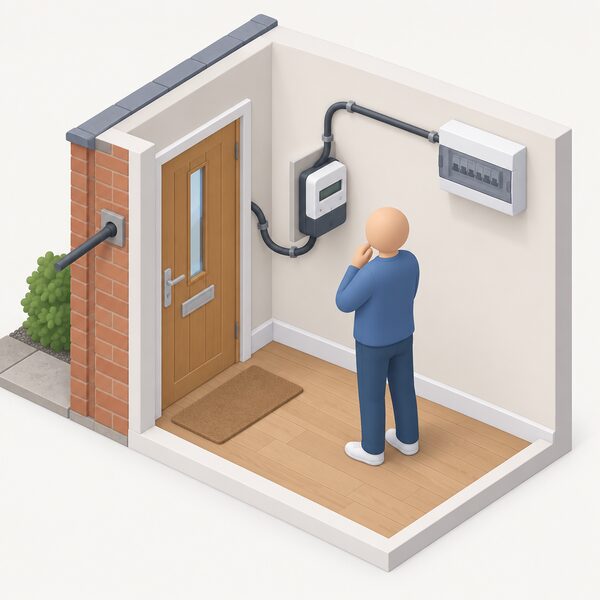
The standing charge exists because a supply connection carries costs that do not vary with consumption. Keeping a property connected, metering it, maintaining the network and funding support services all cost money whether the household uses one kilowatt hour or a thousand8. Recovering that through the daily charge means the cost is shared evenly across connected properties rather than loaded onto heavy users.
Suppliers that advertise no visible standing charge are not avoiding that cost. They charge a higher rate on the first few units of energy used to cover this cost3. The money is collected either way; only the mechanism differs. That is why the comparison between a no standing charge tariff and a standard one is a comparison of structures, not of underlying cost.
The market has not moved far towards zero standing charge products. As of April 2026 there were just two suppliers offering no standing charge electricity and gas tariffs1, and none of the big six currently offers zero standing charge tariffs1. The regulator has not required a specific level either: Ofgem does not require a specific level of standing charge and any standing charge can be zero18. That position, set out in the Retail Market Review consultation, means a zero standing charge tariff has always been permissible; the constraint has been commercial rather than regulatory.
For a household, this explains why the choice is thin. A supplier offering a zero standing charge tariff takes on more risk, because its revenue depends on consumption rather than on a fixed daily amount, and it must set unit rates high enough to cover the fixed costs of every customer including the very low users it attracts. That is the commercial reason the products cluster around prepayment customers and low users rather than being offered universally.
Prepayment, gas and dual fuel: where these tariffs are available
Zero standing charge tariffs currently only exist for prepayment customers and are geared very much towards those who use little electricity and gas1. That is the historical shape of the market, and it reflects the fact that prepayment customers are more likely to be low users managing a tight budget.
The mechanics of switching are not restricted, however. A household with a prepayment meter can switch to a no standing charge tariff just as anyone else would2. The tariff is a normal supply contract; the meter type does not bar a household from it. What differs is the range of products on offer and the unit rates attached to them.
On fuel type, a no standing charge tariff can cover gas, electricity or both as a dual fuel deal1. A household looking for a gas tariff with no standing charge is therefore looking for a dual fuel or gas-only version of the same structure, and the trade-off of higher unit rates applies to the gas rate in the same way it applies to electricity. Because gas standing charges are lower than electricity standing charges under the cap, the amount saved by removing the daily charge is smaller on the gas side, while the higher unit rate applies to a fuel that most households use in larger volumes.
The regional picture matters less here than on some bill questions, because the cap figures cited above are averages across England, Scotland and Wales4. Northern Ireland operates a separate market with its own supplier arrangements, so the capped standing charge figures for Great Britain do not apply there. A household in Northern Ireland comparing a no standing charge offer with a standard one is comparing products in a different regulatory frame.
What a no standing charge tariff means for household energy independence
A no standing charge tariff changes the shape of a household's exposure rather than removing it. The daily charge is the part of a bill that accrues whether or not anything is used, so removing it means a household that uses nothing pays nothing for that period. That is a real gain in control: consumption decisions translate directly into cost, with no fixed floor underneath them.
The dependence that remains is the same as on any grid supply. The household is still connected to a network, still supplied by a company, still exposed to wholesale prices through the unit rate, and still subject to the cap and to policy costs recovered through bills. A no standing charge tariff does not reduce any of that. It moves the recovery of fixed costs from a daily charge into the unit rate, which means the household's bill becomes more sensitive to consumption and less sensitive to the passage of time.
There is a second dependence worth naming: the supplier's continued existence and its pricing decisions. The choice of no standing charge products is narrow, with two suppliers offering them as of April 2026 and none of the big six1. A household that builds its budget around a zero standing charge structure is relying on a small number of companies continuing to offer it, and on the unit rates attached to it staying competitive against the capped alternative. For a typical user, the price works out roughly similar to a standard price capped tariff3, so the financial case rests on being below typical consumption rather than on the structure itself.
The policy direction offers no guarantee either way. Ofgem has consulted on requiring suppliers to offer lower standing charge tariffs11, which would widen choice, but it has also decided not to move a further £20 to £100 of costs from standing charges to unit rates13, which limits how far the rebalancing goes. Its consumer research found most customers consider standing charges unfair and think they should be lower10, but the regulator has not proposed abolishing them. A household weighing the two structures is therefore choosing between two ways of paying for the same connection, and should read the actual unit rates on the offer rather than the headline absence of a daily charge.
Sources18 cited
- Should I get a no standing charge tariff?, Uswitch, 2026-08-26
- Your guide to standing charge energy tariffs, Energy Helpline, 2026-09-20
- Standing charges, National Energy Action, 2026-04-28
- Changes to the energy price cap between 1 October and 31 December 2025, Ofgem, 2025
- Ofgem price cap, End Fuel Poverty Coalition, 2026
- Understand your electricity and gas bills, Ofgem, 2026
- Standing charges, House of Commons Library, 2026-09-17
- How to understand your electricity and gas bills, Energy Ombudsman, 2025-04-24
- VAT on fuel and power (Notice 701/19), GOV.UK, 2016-04-28
- Mandating lower or zero standing charge tariffs: technical working paper, Ofgem, 2025-09-24
- Requirement to offer lower standing charge tariffs, Ofgem, 2025-09-24
- Split standing charge tariff trial, Ofgem, 2025-06-20
- Energy price cap operating cost and debt allowances consultation, Ofgem, 2024-12-12
- Energy price cap explained, Welsh Government, 2026-03-04
- Energy price cap, Ofgem, 2026-09-17
- TDCV 2023 call for input, Ofgem, 2023-02
- Energy Price Guarantee up until 30 June 2023, GOV.UK, 2026-09-17
- Retail Market Review: statutory consultation on RMR domestic proposals, Ofgem, 2013-06-20
 Standing Charge ReformPeople on low usage ask why they pay a daily charge at all, and whether a zero standing charge tariff is really coming.
 Fixed and Variable TariffsCompares capped standard variable tariffs with fixed deals, including exit fees, contract end and rollover.
 Standing ChargesWhy is there a daily charge on a gas or electricity bill even when nothing is used, and what does it actually pay for?
 The Full Tariffs GuideWhich energy tariff suits how you live, and will switching really save you money?
 Time-of-Use Tariffs ExplainedCan you pay less for electricity by using it at different times of day?
 Tariffs and Energy IndependenceA tariff decides what you pay for power from the grid and what you get paid for sending solar back.