

In this answer
Short answer
Doing nothing when a fixed energy deal ends is a decision with a default outcome: the supplier moves the household onto its standard variable tariff. That happens automatically, without a signature or a phone call, and the unit price changes from the fixed rate to whatever the supplier's default rate is at that moment1. Independent guidance is consistent that this is the usual path, and that the standard variable tariff tends to be the most expensive plan a supplier offers3.
The timing is set by rules, not by the household. Suppliers must contact a customer 42 to 49 days before a fixed-term tariff ends, so the reminder arrives roughly six to seven weeks ahead of the change4. That window is the practical deadline: it is long enough to compare tariffs and start a switch, and it closes whether or not the household acts.
The cost of inaction is not fixed. A standard variable tariff cannot be priced above the energy price cap, which is reviewed every three months, so the ceiling moves6. Fixed deals can sit below that ceiling: one analysis put a number of fixed tariffs more than £200 below the predicted cap for the average home, and another estimated savings of up to 19% against standard rates8. The same evidence shows fixed tariffs can also be priced above the cap, so fixing is not automatically cheaper10.
You are moved onto your supplier's standard variable tariff
The move is automatic. When a fixed deal ends, the supplier places the household on its standard variable tariff, and the fixed rate contract terminates at that point1. Independent guidance describes the same mechanism in slightly different words: a fixed-rate customer rolls onto the provider's standard variable rate when the tariff ends, and suppliers will probably move a household to the standard variable tariff when a fixed plan finishes3. The Energy Ombudsman states that when a fixed rate has expired the supplier moves the customer to the standard variable tariff, which is typically higher than fixed rates15.
There is no gap and no renegotiation. The supply continues, the meter keeps recording, and the billing simply continues at a different unit rate. A household that has never switched, has not switched for a year or more, or holds a tariff whose name includes words like "Simpler", "Flex", "Basic", "Standard" or "Variable" is likely already on a standard variable tariff, which is the same destination16.
One variation matters. If a supplier fails and Ofgem appoints a Supplier of Last Resort, the fixed rate contract ends at the moment of the transfer and the customer is placed on a standard variable tariff with no early exit fee17. That is a different route to the same tariff type, and it removes the exit fee question entirely.
For a household's energy independence, this is the point where control is weakest. The tariff is set by the supplier within a cap, the price changes on the cap's three-monthly cycle, and the household holds no fixed term and no fixed price. The only lever is the choice to move, which remains open.

What the standard variable tariff costs: the price cap sets the ceiling

The standard variable tariff is capped, but capped is not the same as cheap. Ofgem's price cap applies to default tariffs, which are the standard variable tariffs, and it applies regardless of how bills are paid, whether by direct debit or prepayment6. The cap is the tariff type affected by the energy price cap, and it changes every three months18. A standard variable tariff cannot be higher than the price cap19.
What the cap does not do is set a floor or guarantee a good price. Independent guidance describes the standard variable tariff as typically the most expensive type of plan, subject to price rises, and as the tariff that tends to be the most expensive a supplier offers3. The cap limits how far the default rate can rise; it does not make it competitive with the cheapest fixed deals on the market.
The relationship between fixed deals and the cap runs both ways, and the evidence shows both directions. The average fixed tariff offered in May 2026 was above the price cap, reflecting supplier expectations that the cap would increase in the future10. Against that, a number of fixed tariffs undercut the predicted cap, some by over £200 for the average home, and switching to a cheap fixed tariff was estimated to make bills up to 19% cheaper than standard rates once a reduction took effect8. A household comparing the two should treat the cap as a ceiling on the default rate, not as a benchmark that fixed deals always beat.
The cap does not apply to fixed-term tariffs with a fixed end date and an agreed per unit price, nor to green or time-of-use tariffs7. That is the structural difference: a fixed tariff is a contract price, and the cap is a regulatory limit on the default price.
What your supplier should tell you before and when the deal ends
Suppliers carry a notification duty. A supplier is required to contact a customer 42 to 49 days before the end date of a fixed-term tariff, informing them the tariff is ending4. Another source states the same obligation as 49 to 42 days before the end5. The reminder should tell the household the contract is about to end, and it is the trigger for comparing options1.
The bill itself is the identification tool. If a bill says the contract has an end date, the household is on a fixed tariff1. A bill also shows the tariff name, whether it is fixed or variable, any exit fees, and the unit rates and standing charges, which is where the end date and the current terms are visible in one place21.
Exit fees are the other thing the reminder period affects. A supplier should not charge a fee to switch supplier if the contract ends in the next seven weeks22. Outside that window, most fixed tariffs include exit fees for each fuel, payable if a customer switches to a different deal before the contract ends, and the amount varies by supplier13. Some fixed-rate tariffs charge a fee if the customer leaves before the contract ends23.
Your options at the end of a fixed deal: stay, switch or re-fix
Three routes exist, and all three remain open after the deal ends. Staying means accepting the standard variable tariff, which carries no contract tie and no exit fees if the household later changes supplier11. Switching means moving to another supplier or another tariff, and a fixed tariff that has already ended does not prevent this: a household can still switch supplier or tariff after the fixed term has finished2. Re-fixing means taking a new fixed deal, either with the current supplier or a different one.
The lock-in during a fixed term is financial rather than contractual. Fixed deals lock in the price of energy for the length of the contract, typically 12 months, and a fixed rate tariff normally runs for a minimum of 12 months12. Fixed energy tariffs usually run 12 to 24 months13. Leaving early is possible, but most fixed tariffs carry exit fees for each fuel18. One piece of official research found that 57% net of consumers could identify that exit fees may still apply to a fixed contract even when moving to another deal with the same supplier25.
A practical point from official guidance is that a tariff with low or no exit fees leaves room to cancel early if circumstances change26. That is a term to read before signing, not after.
For independence, the choice at deal end is the household's main lever over price. A fixed tariff fixes the unit price for a set period; a standard variable tariff does not. Neither removes dependence on the grid or on a supplier, and neither changes the standing charge, but the fixed term is the difference between a known unit rate and a rate that moves with the cap.

Standing charges and other costs that still apply on a variable tariff
Changing tariff type does not remove the standing charge. A standing charge is fixed if the household is on a fixed deal and variable if not, but it is capped by the price cap in either case27. The standing charge varies by supplier, tariff and region, and the specific amount can vary depending on the supplier and the tariff28. That means the daily charge on a standard variable tariff is set by the supplier within the cap, and it can differ from the fixed deal's charge.
Some tariff types handle standing charges differently. On tracker tariffs, standing charges usually stay fixed for a set period, usually 12 months18. That is a structural difference from the standard variable tariff, where the standing charge is variable.
The direct debit is the other cost that moves. A fixed tariff fixes the unit price for a period of time, but it does not protect the household from the direct debit amount increasing or decreasing13. When the unit rate changes at the end of a fixed deal, the direct debit is normally reassessed, so the monthly payment can change even if usage is unchanged.
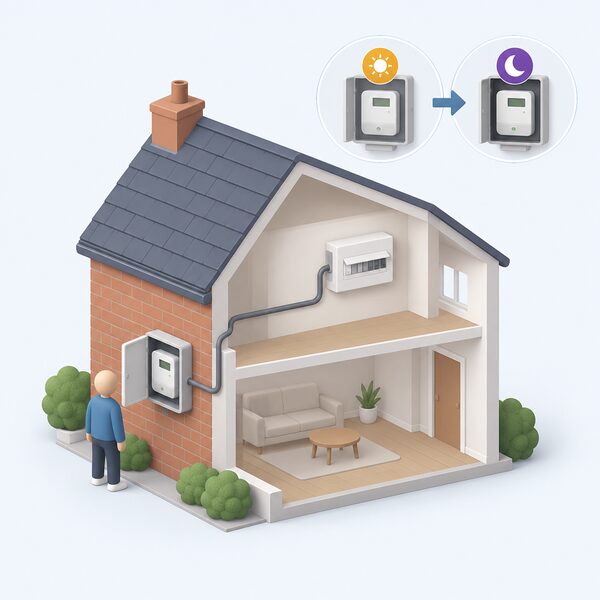
Two further points bear on the end of a deal. A smart meter is compatible with Economy 7 tariffs and fixed rate tariffs, and can support newer time-of-use tariffs, allowing a tariff change without changing the meter31. A meter that has lost smart mode may work in smart mode again after a tariff or supplier change32. And except by switching, a household does not control the tariff the supplier sets, though it can change how much energy it uses33.
"Except by switching, you don't control the tariff your energy supplier sets, but you can change how much energy you use."
Sources33 cited
- Your gas or electricity supplier has put up its prices, Citizens Advice, 2026-09-17
- Fixed energy, Uswitch, 2026-09-07
- Dual fuel, Uswitch, 2026-09-18
- How to complain about your electricity, gas or energy bill, Which?, 2026-07-30
- How do I avoid exit fees when switching energy, Energy Helpline, 2026-09-20
- Energy price cap, Ofgem, 2026-09-17
- Energy price cap explained, Welsh Government Climate Action, 2026-03-04
- Uswitch comments on Cornwall Insight's final price cap prediction for July, Uswitch, 2026-05-18
- Uswitch responds to April energy price cap announcement, Uswitch, 2026-04
- Research briefing CBP-10958, House of Commons Library, 2026
- Switching your energy supplier, Energy Saving Trust, 2026-06-26
- How to switch energy supplier, Confused.com, 2025-12-15
- How to save on your energy bill, Which?, 2026-05-15
- Understanding energy bills, StepChange, 2026-09-20
- How to understand your electricity and gas bills, Energy Ombudsman, 2025-04-24
- Standard rate tariffs, Uswitch, 2026-08-26
- Energy supplier out of business, Uswitch, 2026-05-29
- Energy tariffs explained, Uswitch, 2026-02-17
- What is the energy price cap, Energy Saving Trust, 2026-09-07
- When is the best time to switch my energy deal, Uswitch, 2026-08-26
- How do I read my E.ON Energy bill, Uswitch, 2025-09-10
- Your gas or electricity supplier has put up its prices (Wales), Citizens Advice Wales, 2026-09-17
- How to check your energy tariff and switch if you find a better deal, British Gas Energy Trust, 2026-07-30
- Fixed rate energy tariffs, Confused.com, 2026
- Understanding consumers' energy tariff choices, Ofgem, 2025-07
- Five top tips from Which? to cut your energy bills, Welsh Government Climate Action, 2026-03-18
- Energy standing charges, Uswitch, 2026-08-26
- Gas and electricity standing charges, Confused.com, 2026-07-06
- Standing charges, National Energy Action, 2026-04-28
- Get prepared, National Energy Action, 2026-06-02
- What is Economy 7, Smart Energy GB, 2026-04-07
- What happens if your energy supplier goes out of business, Ofgem, 2026
- How do smart meters save energy, Smart DCC, 2026
 Supplier Licensing and FailureWhat happens when your energy supplier goes bust?
 Fixed-Rate Energy TariffsWhat a fixed energy tariff fixes and what it does not, the contract lengths sold in the UK, exit fees and the 49-day window, how fixed rates compare with the price cap, and what happens when the term ends.
 Switching SupplierHow long does switching energy supplier actually take, and what happens if you owe money?
 The Full Tariffs GuideWhich energy tariff suits how you live, and will switching really save you money?
 How Tracker Tariffs WorkTracker tariffs move your unit rate with wholesale prices or the Ofgem price cap, so what you pay can change daily.
 Fixed and Variable TariffsCompares capped standard variable tariffs with fixed deals, including exit fees, contract end and rollover.