
In this guide
The energy price cap, properly called the default tariff cap, limits how much a supplier may charge for each unit of gas and electricity and how much it may charge as a daily standing charge. It does not limit the total bill. The more energy a household uses, the higher that bill will be1. Separate caps are set for gas and for electricity, and a separate level is set for each of the 14 energy supply regions of Great Britain3.
Ofgem sets a new level every three months2. The wholesale element is built from a 12 month forward view of gas and electricity prices, and the cap has been set quarterly since summer 2022, having previously moved every six months4. For 1 October to 31 December 2025 the level for a typical household using electricity and gas and paying by Direct Debit was £1,755 a year, a rise of £2.93 a month or £35.14 a year for that typical household5. For 1 January to 31 March 2026 the figure for a dual-fuel home with typical usage paying by direct debit was given as around £1,758, and Ofgem confirmed the cap for 1 April to June 2026 would fall by 7%6.
Those annual figures are illustrations, not ceilings. The cap is quoted as a yearly bill for a typical household only to make it easier to understand, and an actual bill will differ7. Typical consumption is assumed to be 2,500 kWh for electricity and 9,500 kWh for gas8.
What the cap limits, and what it leaves open
The cap is a limit on price per unit, not on spend. Ofgem's own description is that the level is the maximum a supplier can charge for a unit of energy and standing charge together, and that it does not limit the cost of a total bill2. From the first public guidance in 2018 the point was made plainly: the limit is not on the total bill, which varies depending on how many units are used in a billing period13. When the caps first took effect the regulator described them as a cap on a unit of gas and electricity, with standing charges taken into account, and not a cap on overall bills14.
This matters for anyone trying to read a headline figure as a budget. A household with high consumption, a poorly insulated fabric or electric heating can pay far more than the quoted typical figure while its supplier stays fully within the cap. A household that uses very little still pays the standing charge every day. The limit is on the rate card, and the household still carries the consumption risk.
For energy independence, the lesson is direct: the cap constrains the price of imported energy, it does not reduce the volume a home imports. The only lever the cap does not touch is demand, and that is the one a household controls through fabric, efficiency and on-site generation.
Who is protected: standard variable and default tariffs
The cap covers households on standard variable and default tariffs, the tariffs a customer ends up on without actively choosing a fixed deal15. On a standard variable tariff the price can go up or down based on things like the cost of buying energy on the open market, and people on this type of tariff are protected by the cap16.
Payment method does not affect eligibility. The cap applies to default tariffs whether the household pays by standard credit, Direct Debit, prepayment meter or through an Economy 7 meter5. A household put onto a deemed contract, for instance after a supplier fails, is still covered17.
Published counts of protected customers differ with the date of the document, and the figures are not reconciled between them:
| Source and date | Customers covered |
|---|---|
| Ofgem, 2025 operating cost decision | 22 million default and standard variable tariff customers9 |
| Ofgem, 2024 operating cost consultation | 29 million customers18 |
| Commons Library, July 2024 | around 28 million customers in Great Britain19 |
| Ofgem, 2022 | 23 million households20 |
Around four million of those households use a prepayment meter21. The cap includes a levelisation allowance whose stated purpose is making sure prepayment and Direct Debit customers pay the same standing charge2.
Standard credit is the outlier. Around 16% of customers pay this way, and research suggests up to 43% do not realise it is the most expensive way to pay, with a £135 price premium specifically due to the costs of debt. Standard credit also becomes the default payment method where a direct debit fails, or where prepayment is not appropriate for a customer22. Related protections are set out in the page on prepayment meters and vulnerable customer protections.
Where the cap stops: fixed deals, business, heat networks and oil
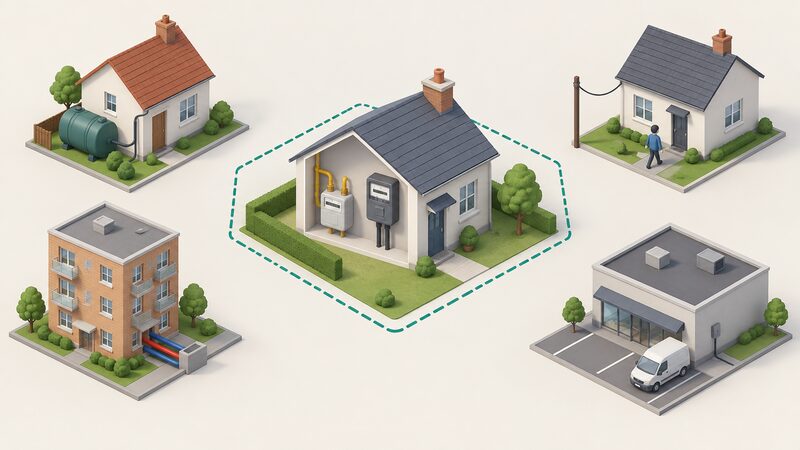
A household that has chosen a fixed-term tariff is outside the cap. The cap applies where a customer has not signed up for a fixed-term contract with their supplier3, and prices on a chosen fixed-term tariff are not protected21.
Several other forms of household energy fall outside it entirely:
- Business energy contracts are not protected by the cap12.
- Heat networks are not covered by the cap or by the former Energy Price Guarantee, being classed as commercial supplies24. Parliament's account is the same: the cap does not cover district heating systems or the energy costs of businesses25. The rules that do apply are covered in heat network regulation.
- Heating oil is not regulated by Ofgem and is not covered by the cap26. Trading Standards has put the consequence bluntly.
"heating oil is not covered by Ofgem's energy price cap, leaving consumers fully exposed to sudden market increases"
Which? makes the same point for households off the gas grid: unlike gas and electricity, heating oil prices are not covered by the cap28.
Northern Ireland sits outside the scheme altogether. The cap sets maximum unit prices and standing charges for customers in each energy supply region of Great Britain3, and during the Energy Price Guarantee period energy prices were not capped in Northern Ireland, where suppliers have the flexibility to set their tariffs independently to reflect their costs of operating29. Domestic tariff oversight there rests with the Utility Regulator.
How Ofgem sets the level each quarter
The cap was introduced on 1 January 20194, coming into force at the beginning of that year3 and applying across all payment types from that month8. It was set every six months until summer 2022, when Ofgem moved to quarterly setting in response to high and volatile wholesale prices4. The regulator now revises the cap each quarter3 and reviews and sets a level for how much a supplier can charge for each unit of energy and daily standing charge every three months5.
Wholesale prices are the driving input: the cap is calculated according to wholesale energy prices during each price cap assessment period11, and wholesale prices paid by energy firms determine the cap1. Ofgem sets the wholesale index on a 12 month forward view of gas and electricity prices4. The published levels are exclusive of VAT, which suppliers apply to consumers' bills31.
Announcements come roughly six weeks before the new level takes effect11. That gives households time to compare a fixed offer before the change lands. The April 2026 reduction, for example, was confirmed in Parliament ahead of the cap reducing on 1 April32.
The underlying cost evidence is not guesswork. Ofgem's 2023 wholesale costs review drew on data collected from 11 suppliers representing 96% of the retail market, and noted that any resulting changes would at the earliest be made in the July to September 2024 cap period33. Methodology changes move slowly, by consultation, a process set out in how energy policy is made. Ofgem also states that it monitors compliance:
"Ofgem will be closely monitoring supplier compliance and will continue to take firm action against suppliers who fall short of their requirements."
What the cap is made of
The cap is built from cost allowances rather than a single number. The components Ofgem lists are wholesale costs, network costs, policy costs, operating costs, EBIT, headroom, the levelisation allowance, and VAT at 5% on gas2. The stated basis is how much it costs, on average, to get energy to a home35, and the purpose is that customers pay no more than is necessary for an efficient supplier to recover its costs and earn a reasonable level of profit36.
| Component | What it pays for | Share, where stated |
|---|---|---|
| Wholesale costs | Buying energy on the open market2 | A third of the cap, as assessed in 201937 |
| Network costs | Transporting energy across Great Britain5 | Almost 30% of the total3 |
| Policy costs | Government schemes and essential support5 | Cut in April 20263 |
| Operating costs, EBIT, headroom, levelisation | Running the supply business, profit, risk margin, equalising standing charges2 | Not stated |
Network costs are the second most important component, at almost 30% of the total3. The charges themselves are explained in electricity network regulation and the charges on your bill. Policy costs were reduced in April 2026 when the government ended a levy-funded energy efficiency scheme and shifted funding for the largest renewable generation support scheme to general taxation3. That is a transfer rather than a saving: the cost moves from the bill to the tax base.
Wholesale volatility explains the cap's history. Rapid increases in wholesale prices from mid-2021 led to a 54% increase in the cap in April 20228, and a further rise of 30 to 50% was forecast for October 202238. Early in the cap's life, Ofgem noted wholesale costs were 17% higher than when the cap was originally set37.
Cap levels by payment method
For 1 October to 31 December 2025, Ofgem published totals for each payment type, each rising by £35, or 2%, on the previous quarter34:
| Payment method | Previous total | 1 Oct to 31 Dec 2025 | Change |
|---|---|---|---|
| Direct Debit | £1,720 | £1,755 | £35, 2%34 |
| Standard Credit | £1,855 | £1,890 | £35, 2%34 |
| Prepayment | £1,672 | £1,707 | £35, 2%34 |
In monthly terms Ofgem put it as a typical household on a default tariff paying £102 for what then cost £100 per month39. Unit rates and standing charges quoted for 1 January to 31 March 2026 were 27.69p per kWh for electricity with a 54.75p daily standing charge, and 5.93p per kWh for gas with a 35.09p standing charge6.
Earlier moves show the scale of quarterly change. The April 2025 rise added £111 for an average household per year, around £9.25 a month, over the three-month cap period40. The January to March 2024 cap was 5% higher than the previous one19.
What a given home pays varies with where it lives, payment method, fuel type and meter type2. Published caps for individual quarters have been restated in different Ofgem tables using different consumption assumptions, so figures quoted for the same region and quarter do not always agree; where they differ, both the assumption and the source date matter.
Standing charges: a daily fee that cannot be avoided
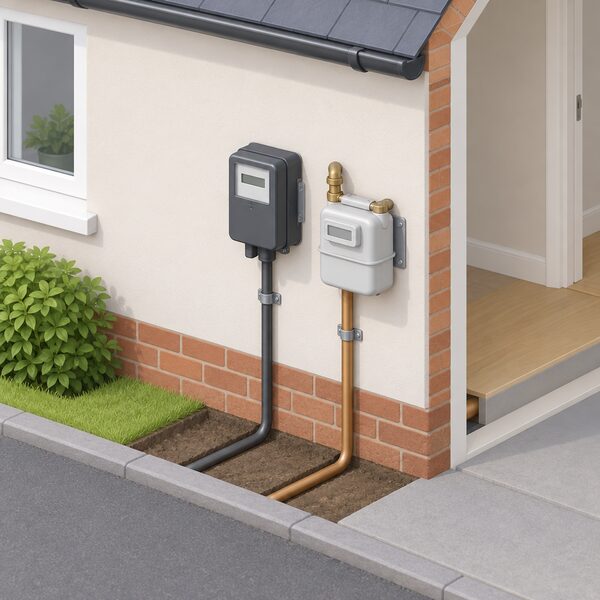
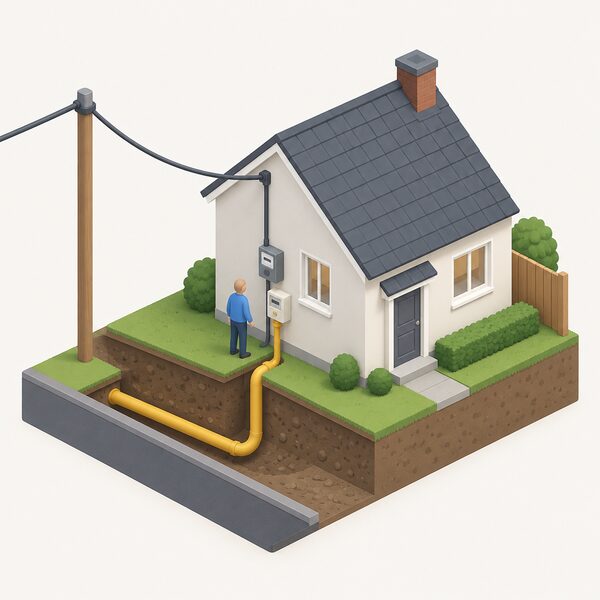
A standing charge is a daily charge that customers pay even if they use no energy41. It is set by the supplier and included in the cap set by Ofgem42, and it cannot be opted out of or reduced43. Suppliers are not, however, required to include a standing charge at all44.
Its stated purpose is to recover the costs required to provide energy company services, including providing and maintaining the wires, pipes and cables that deliver power to a customer's door, through to the staff and buildings required for the energy business to function41. The cap sets a ceiling on how much suppliers can charge for it45, and that ceiling is reviewed quarterly46.
The direction has been upward. Price cap tariff electricity standing charges rose from 22p a day in October 201944; a later reading put the cap at 60.97p a day for electricity and 31.65p a day for gas47. For October to December 2025, standing charges rose by 4% for electricity and 14% for gas39, and an expansion of the Warm Home Discount added a total of 7p a day to standing charges, with electricity balancing costs adding around £1.23 a month to the average household bill39. From April 2025, some households saw an increase in standing charges of up to £20 a year for a typical dual fuel consumer40.
National Energy Action attributes the rise to the cost of maintaining infrastructure and delivering government obligated programmes, to paying for the transfer of customers of failed energy suppliers to new suppliers, and to a conscious decision from Ofgem on how to pay for energy networks46. The cost of supplier failure is explained further in supplier licensing and supplier failure.
Fourteen regions, fourteen different answers
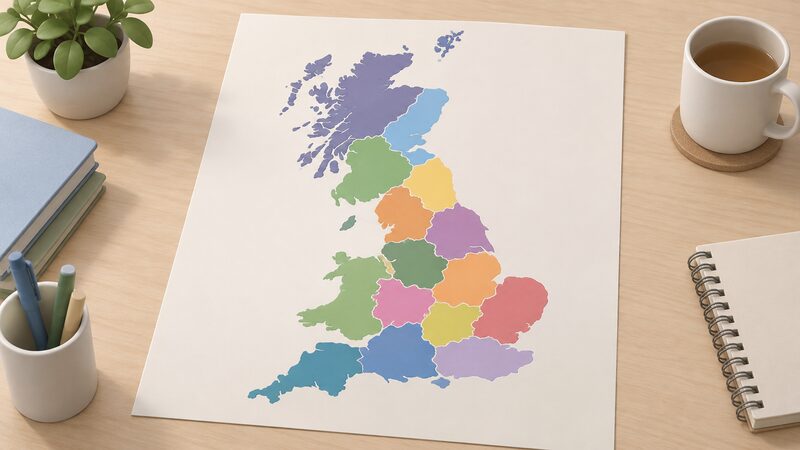
A separate price cap is set for each of the 14 energy supply regions, and it applies throughout that region with no breakdown below regional level3. Regional differences mainly reflect the cost of transporting energy, which is why increases to those costs feed through unevenly5.
Ofgem's benchmark electricity figures for 1 July to 30 September 2026 show the spread48:
| Region | Standing charge, single-rate | Annual bill at 2,500 kWh | Standing charge, multi-rate | Annual bill at 3,400 kWh |
|---|---|---|---|---|
| Northern | £223.48 | £824.03 | £220.70 | £986.44 |
| Southern Western | £201.24 | £829.48 | £202.58 | £1,000.86 |
| Midlands | £207.57 | £810.72 | £206.15 | £977.09 |
| Southern | £172.77 | £801.74 | £172.65 | £973.28 |
An earlier table for 1 October to 31 December 2025, on Other Payment Method, gave Southern electricity at £155.12 at nil consumption and £936.78 at 3,100 kWh single-rate, with £155.67 and £1,169.11 for a multi-register meter at 4,200 kWh; London was £160.10 and £916.85 single-rate, and £159.00 and £1,142.46 multi-register31.
Two households in the same street on the same payment method and the same meter type face the same capped rate. Differences between neighbours therefore come from payment method, meter type, supplier pricing below the cap, or a fixed contract taken at a different time.
Fixed against capped: what the trade-off is
A fixed energy deal locks in the unit rates and standing charges paid over the contract, usually 12 to 24 months49. It sits outside the cap, so a household on a fix gains certainty and loses the protection of the quarterly ceiling21.
Whether that trade is worthwhile depends on where fixed offers sit relative to the cap at the time. In October 2021 many fixed deals cost more than the cap, meaning a premium was being paid for price security50. In September 2026, fixed deals were reported to offer lower savings against the cap than previously49. Meanwhile the cap for April to June 2026 was confirmed to fall by 7%, with estimates suggesting it would stay roughly the same until the end of the year6.
The cap's own design means a capped price is not a frozen one: the level moves every three months with the forward wholesale index4, and Ofgem's stated purpose is protection for people on tariffs where the unit rate can go up or down depending on the energy market2. Neither option removes exposure to wholesale gas. A fix postpones it to the renewal date; the cap passes it through quarterly.
What the cap means for a self-sufficient home
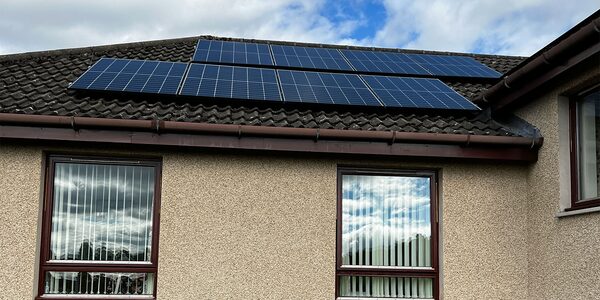
The cap is price regulation, not supply security. It governs what a licensed supplier may charge a household that remains connected, and it leaves untouched the two things that determine a bill: how many units the home imports, and the daily charge for holding the connection. A household reducing dependence on imported energy is working on the first of these, and the cap gives no relief on the second.
Dependencies that remain under the cap are worth stating plainly. The household still depends on a licensed supplier, on the gas and electricity networks whose charges make up almost 30% of the cap3, on government policy costs that can be moved between bills and taxation3, and on wholesale markets set by a 12 month forward view4. Off-grid heating removes the supplier but not the exposure: heating oil sits outside the cap entirely26, and so does heat delivered through a heat network24.
Households seeking to understand the wider framework can read the regulation and policy pillar and the page on Ofgem, which sets the cap and monitors supplier compliance against it34. Where a household disputes how the cap has been applied to its account, the routes are set out in energy complaints and redress.
Sources50 cited
- Get the best deal on your energy, Home Energy Scotland, 2026-09-20
- Energy price cap, Ofgem, 2026-09-17
- Domestic energy prices, House of Commons Library, 2026-09-20
- Energy price cap methodology: backwardation deadband decision, Ofgem, 2025-11-21
- Changes to the energy price cap between 1 October and 31 December 2025, Ofgem, 2025-08-27
- Energy price cap explained, Welsh Government, 2026-03-04
- What is water poverty, National Energy Action, 2026-06-25
- Domestic energy prices briefing, House of Commons Library, 2026-08-28
- Energy price cap operating cost and debt allowances decision overview, Ofgem, 2025-05-23
- How to estimate your energy use, Which?, 2026-08-03
- February 2026 price cap announced this week: what to expect, Uswitch, 2026-02-23
- Alternative homes energy guidance, Ofgem, 2026
- Energy price caps information leaflet, Ofgem, 2018-12
- Higher wholesale costs push default and pre-payment price caps up in April, Ofgem, 2019-02-07
- Energy price cap review of historical debt-related costs, Ofgem, 2026-03-25
- Check if you are owed money on your energy bill, Ofgem, 2026
- What happens if your energy supplier goes out of business, Ofgem, 2026
- Energy price cap operating cost allowances review consultation, Ofgem, 2024-05-14
- Energy prices briefing, House of Commons Library, 2024-07
- Decision on the Contract for Difference allowance methodology in the default tariff cap, Ofgem, 2022-06-23
- Energy bills to fall for millions of people, Turn2us, 2026-09-20
- Debt strategy update: supporting a reduction in energy debt, Ofgem, 2025-11-06
- Energy price caps explained, large print, Ofgem, 2020-12
- Edinburgh Local Heat and Energy Efficiency Strategy, City of Edinburgh Council, 2023-12
- Energy bills support report, UK Parliament, 2022-11-13
- Heating oil prices briefing, House of Commons Library, 2026-09-20
- Cost of living pressures and soaring prices expose gaps in bulk fuel checks, Chartered Trading Standards Institute, 2026-03-16
- Heating oil prices spike with Middle East conflict, Which?, 2026-04-24
- Energy Price Guarantee up until 30 June 2023, GOV.UK, 2026-09-17
- Government announces Energy Price Guarantee for families and businesses, GOV.UK, 2022-09-08
- Energy price cap levels 1 October to 31 December 2025, Ofgem, 2025-08
- Heating oil support debate, Hansard, 2026-03-16
- Energy price cap wholesale costs review, Ofgem, 2023-12-15
- Summary of changes to the energy price cap 1 October to 31 December 2025, Ofgem, 2025-08-27
- Price caps explained, easy read, Ofgem, 2018-12
- Decision on amending the methodology for setting the EBIT allowance, Ofgem, 2023-08-25
- Energy customers could face bigger bills than before the price cap, Which?, 2019-02-07
- Energy prices briefing, House of Commons Library, 2026-09-17
- Energy price cap will rise by 2% in October, Ofgem, 2025-08-27
- Energy price cap will rise by 6.4% in April, Ofgem, 2025-02-25
- Heating oil and standing charges briefing, House of Commons Library, 2026-09-17
- What role does National Grid play in your energy bill, National Grid, 2026-09-17
- How to understand your electricity and gas bills, Energy Ombudsman, 2025-04-24
- Energy UK explains standing charges, Energy UK, 2025-07-09
- Current gas and electricity prices, Centre for Sustainable Energy, 2026-08-27
- Standing charges help, National Energy Action, 2026-04-28
- Your guide to standing charge energy tariffs, Energyhelpline, 2026-09-20
- Energy price cap levels 1 July to 30 September 2026, Ofgem, 2026-05
- Fixed energy tariffs, Uswitch, 2026-09-07
- Energy price rises: what you can do now, Which?, 2021-10-14
 The Full Energy Bills and the Price Cap GuideWondering why your bill went up even when you used less power?
 Typical Household FigureThe energy price cap limits unit rates and daily standing charges, not the total bill.
 Price Cap HistoryThe energy price cap sets the most a supplier can charge you for each unit of gas and electricity, so it shapes what you pay.
 Wholesale Prices and BillsGas prices around the world keep changing, so why do your bills move so slowly, and why does gas still set what you pay for electricity?
 Typical Consumption ValuesOfgem's typical usage figures are what the price cap and most bill comparisons are based on.
 Standing ChargesWhy is there a daily charge on a gas or electricity bill even when nothing is used, and what does it actually pay for?