
In this guide
A supplier in Great Britain can install a prepayment meter without a household's permission only in narrow circumstances: where the customer is building up an energy debt and other ways of recovering that debt have not worked1. Even then the supplier must visit the home to understand the circumstances and check whether a prepayment meter is safe and suitable for that household, must make reasonable efforts to agree another way to repay the debt, and must offer support to a customer struggling to pay1. Where installation does go ahead, by warrant or by remotely switching an existing smart meter into prepayment mode, the supplier must give £30 credit per meter1.
For certain highly vulnerable customers the practice is banned outright. Ofgem has stated that for customers such as those with medical equipment that needs constant power, those with severe mental health problems and those who will struggle to top up their meter, forced installation is banned altogether3. Ofgem also sets a compensation level of £1,000 where a prepayment meter is installed, switched or used inappropriately4.
These rules are licence obligations on suppliers, not something a household arranges for itself. Prepayment leaves a home entirely dependent on a supplier's systems, a top-up network and, for a smart meter, a remote command path: the protections described here limit how that dependence can be imposed, they do not remove it. Ofgem is the independent energy regulator for England, Scotland and Wales5; Northern Ireland has its own regulator and its own supply licences.
What the prepayment meter rules are for
Ofgem's rules protect customers in debt where a supplier wants to install a prepayment meter10. The purpose is not to prevent prepayment as such: many households choose it and manage well on it. The purpose is to stop a meter being imposed on a home where self-disconnection would follow, where nobody can physically top up, or where losing supply would put someone at risk.
The framework sits in several layers. The oldest is legislation: the Electricity (Prepayment Meter) Regulations 2006 set out what sums a prepayment meter may recover, covering gas or electricity supply and meter provision at premises previously owned or occupied by the customer, and gas meter provision or gas supply at the premises where the meter is installed11. Separate gas regulations from 1998 prohibit installing a prepayment meter as a primary meter through which gas passes to a secondary meter12.
Above that sit the supply standard licence conditions. Ofgem modified the electricity and gas supply standard licence conditions covering installation of prepayment meters under warrant in 201713, and in September 2023 confirmed that the Code of Practice for the involuntary installation of prepayment meters would be incorporated into mandatory supply licence conditions14. The code sets out how suppliers should deal with a customer facing an involuntary prepayment meter install15, and it is published by Ofgem as guidance on involuntary prepayment meters16.
Price protection has been a parallel strand. A prepayment price cap, sometimes called a safeguard tariff, applied to households using a prepayment meter to pay for energy17, and the prepayment meter cap was calculated using a methodology chosen by the Competition and Markets Authority18. The wider energy price cap now carries that function, and Ofgem's role across the sector is set out in more detail on the page covering Ofgem.
When a supplier may install a prepayment meter for debt
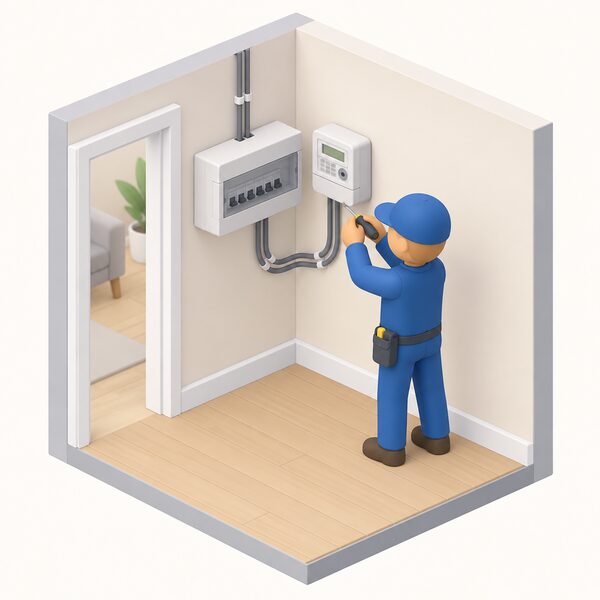
Two conditions must both be met: the customer is building up an energy debt, and other ways of recovering that debt have not worked1. Ofgem's long-standing position is that installing prepayment meters under warrant should be used as a last resort by energy suppliers when consumers get into debt, and that suppliers can only install a prepayment meter where it is safe and reasonably practical for the consumer to use19.
Before going ahead, a supplier must:
- Make reasonable efforts to agree another way for the customer to repay the debt, and offer support if they are struggling to pay2
- Visit the home to understand the circumstances and check whether a prepayment meter is safe and suitable for the household1
- Explain why it has made its decision, say when it plans to install the meter, explain what will happen during the installation, and say how to contact it if circumstances have changed or the decision looks wrong2
Debt does not automatically mean prepayment. Ofgem's consumer standards state that suppliers should offer debt repayment plans at the earliest opportunity and consider offering temporary debt repayment holidays, where appropriate20. A statutory protection also applies during a Debt Respite Scheme moratorium: a creditor or agent must not take steps to install a prepayment meter to take payments in respect of a moratorium debt, or use an already installed prepayment meter to take such payments, unless the debtor consented to installation before the moratorium started21.
Prepayment is also a step before disconnection rather than an alternative to protection. Ofgem's heat networks guidance frames the sequence plainly: any installation of prepayment meters with the explicit consent of the consumer must be explored before disconnection, which should be an absolute last resort22. That principle, and the separate heat network rules, matter for homes on communal heat.
Being on prepayment with a debt does not lock a household to its supplier. A prepayment customer can switch while owing up to £500, with the limit applying separately to gas and electricity meters6. Switching rules generally are covered under supplier licensing.
Forced installations, warrants and the court process
Fitting a meter by force means an energy supplier can enter a house using force to install the meter, after having obtained a court warrant3. The warrant route is the formal, court-supervised end of debt recovery, and it has been used at scale: in 2016, 40,000 gas prepayment meters and 41,000 electricity prepayment meters were installed under warrant8.
Warrant costs were a grievance in themselves, since the charge was added to the debt of a customer who could not pay. Ofgem introduced a £150 cap on charges for installing prepayment meters under warrant for customers in debt23, alongside a proportionality principle covering costs and actions of suppliers, for all customers in the debt recovery process8.
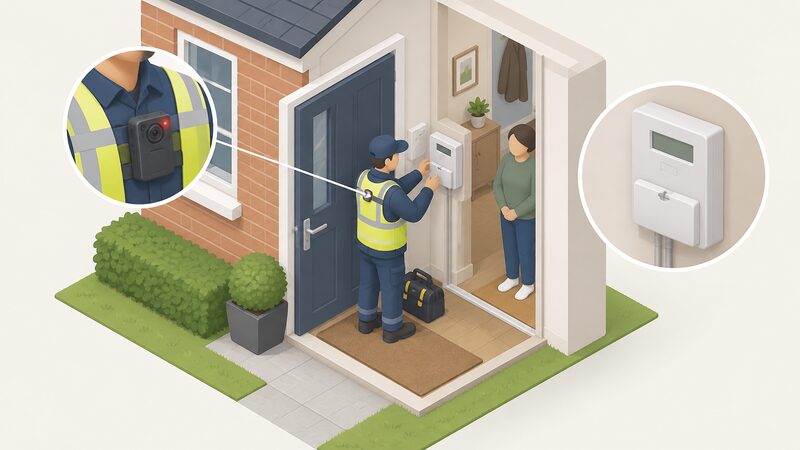
The 2023 rules added evidence requirements around the visit itself. Audio or body cameras must be worn by the lead supplier representative during all warrant installations or site welfare visits, and all audio and video recordings must be available for audit24. A £30 credit per meter applies on all warrant installations and remote switches, described as a short-term measure24. Suppliers must also re-assess the case once a customer has repaid debts owed, contacting the customer to offer an assessment of whether a prepayment meter remains the most suitable and preferred payment method24.
The ban on forced installation, and who it covers
For the most vulnerable customers the answer is not a safeguard but a prohibition. Ofgem has banned suppliers from installing prepayment meters by force entirely for the most vulnerable23, and describes the categories as including those with medical equipment that needs constant power, those with severe mental health problems and those who will struggle to top up their meter3.
Ofgem's consumer guidance sets out the household types where a supplier must not install:
| Protected household | Basis |
|---|---|
| Terminal illness or severe health condition | Supplier must not install2 |
| Dependence on a continuous energy supply for medical equipment | Supplier must not install2 |
| Everyone in the household aged 75 or over with no support | Supplier must not install2 |
| A child under 2 in the household | Supplier must not install2 |
| No one able to top up because of a physical or mental health condition | Supplier must not install2; also listed as a protected category in the 2023 rules24 |
| Temporary circumstances such as pregnancy or bereavement | Supplier must not install2 |
The Code of Practice separates a high risk category, marked "do not install", from a medium risk category that includes temporary situations such as pregnancy and bereavement15. Where a household is not in the expanded vulnerable group list, suppliers must still conduct a vulnerability and affordability assessment before fitting a prepayment meter24. Further assessment is triggered where there are children aged 5 or under in the household, residents have other serious mental, developmental or physical health conditions, or there is a temporary situation that makes residents vulnerable such as pregnancy or a recent bereavement24.
The overarching condition is one a supplier cannot contract out of:
"The supplier must not proceed with the installation of the prepayment meter or switching to a prepayment meter unless they made necessary arrangements to ensure it would be safe and reasonably practicable for a relevant consumer to use a prepayment meter"
Households at risk should note that these lists are not self-executing. A supplier can only apply them if it knows the circumstances: the practical step is telling the supplier, which then checks whether a prepayment meter is suitable10. Vulnerability criteria used in advice guidance include dependence on energy for medical equipment, being over 75 or under five, physical or mental health conditions, and other difficulties in the home10.
Smart meters switched into prepayment mode
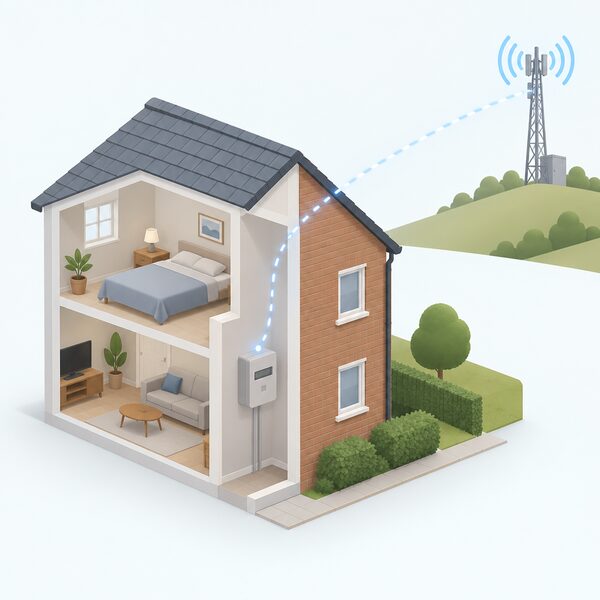
Smart meters can operate in credit or prepayment mode25, and a supplier can remotely switch an existing smart meter to prepayment mode rather than seeking a warrant1. That makes the change cheap, fast and invisible from outside the home, which is precisely why the rules were extended to cover it.
Ofgem has confirmed that references to the installation or removal of an involuntary prepayment meter include the switching of any electricity meter to or from such a mode24. In practice the same protections apply to a remote switch as to a physical installation: the prohibited household categories, the pre-installation assessment, the £30 credit per meter, and the reassessment once debt is repaid24. Government guidance is explicit on the test: a smart meter "should only ever be in prepayment mode if it is safe and works for you to use this payment method"25.
Ofgem's debt work includes trials that focus on proposals to switch existing smart meters into prepayment mode in situations where domestic customers are moving homes27. Moving the other way is generally easier: switching from an existing gas or electricity prepay meter to a smart credit meter is described as straightforward for customers who qualify28. The related question of switching to prepayment without consent and of a supplier changing payment method during debt is covered separately.
For a household weighing energy independence, remote mode-switching is the clearest illustration of how little of a metered supply is under the occupant's control. The meter is the supplier's asset, the communications path is national infrastructure, and the payment mode can change without anyone entering the property. Self-generation reduces consumption but does not remove the metering relationship.
How prepayment bears on vulnerable and fuel-poor households
Prepayment and fuel poverty overlap heavily. In Scotland, 39% of households with a prepayment meter for electricity, gas or both were in fuel poverty in 20249; the equivalent figure recorded for 2021 was 33%, against 17% for other households29. Scottish Government analysis of inefficient homes found fuel poor households more likely to have a prepayment meter than non-fuel poor households, at 29% against 14%30. These are Scottish statistics and the pattern in other nations is addressed under fuel poverty policy.
The mechanism is straightforward: a prepayment household that cannot afford to top up simply goes off supply, with no billing cycle, no arrears letter and no visible trigger for intervention. That is why the protections are framed around whether someone is able to top up rather than whether they are willing to pay.
Crisis support exists alongside the licence rules. The Scottish Government's Fuel Insecurity Fund supports the Fuel Bank Foundation, whose help includes those with prepayment meters and at risk of imminent disconnection31. Wider price support has also had to be delivered differently to prepayment customers: under the Energy Bill Support Scheme, prepayment customers were to receive smart meter credits or payment vouchers where they had a traditional prepay meter, providing top-ups for their meter32.
Prepayment also affects tariff choice. Citizens Advice, responding to Ofgem's consultation on standing charges, argued that prices should not create an unjustified incentive for consumers to choose a payment type that may not be suitable for their needs33.
Debt relief and the proposals now in play
Ofgem's debt strategy has four components: resetting debt through a proposed Debt Relief Scheme; reforming how suppliers manage debt by increasing debt standards; helping to prevent debt from occurring by looking at billing and access to credit; and energy affordability support34. The case for a debt relief scheme was set out in a 2024 Ofgem paper35.
A second strand is levelisation: spreading debt-related costs across payment types so prepayment customers do not carry a disproportionate share. Ofgem's initiative to levelise prepayment debt costs across payment types was paused35. Citizens Advice has said it continues to support some levelisation of payment method cost differentials, that levelising the bad debt element of unit rates for standard credit would be a sensible way to do this, and that the approach should apply to standard credit customers as well as prepayment33. In its 2023 consultation on debt cost recovery, Ofgem proposed that any extra costs would not be passed onto customers who use prepayment meters for their energy20.
There is also an existing protection against charges being loaded onto a meter incorrectly. Ofgem's guidance on Standard Licence Condition 21BA states that consumers paying by prepayment meters are protected by the prohibition where such charges are applied to a prepayment meter, including where a prepayment meter has not been updated with the correct tariff or balance36. How proposals of this kind progress from consultation to licence change is described under energy consultations and the wider regulation and policy guide.
Free help, complaints and the Extra Help Unit
Free, independent help is available before a complaint escalates. Citizens Advice offers information and support on struggling to pay bills, problems with a supplier or supply, saving energy at home and getting a better energy deal37.
| Body | Contact | Coverage |
|---|---|---|
| Citizens Advice consumer service | 0808 223 1133; Welsh language 0808 223 1144; Monday to Friday, 9am to 5pm38 | England and Wales38 |
| Citizens Advice (England) | 0808 144 884439 | England39 |
| Citizens Advice (further published line) | 0808 278 793240 | Free and impartial help and advice40 |
| National Energy Action | 0800 304 7159; a British Sign Language interpreter can be requested41 | England, Wales and Northern Ireland42 |
| Energy Ombudsman | 0330 440 1624, option 3 for heat networks43 | Service disputes, approved by Ofgem43 |
National Energy Action provides free advice about energy bills, keeping warm and safe at home, and can also help with benefits advice and income maximisation41. Local schemes complement this: the Local Energy Advice Programme offers a free telephone advice service to help with benefits, money and bill problems44.
Where a complaint cannot be resolved with the supplier, the Citizens Advice consumer service may refer a case to the Extra Help Unit. Ofgem lists the referral grounds as needing support with a difficult or urgent complaint, being unable to deal with the energy supplier alone due to personal circumstances, being considered vulnerable, or being at risk of being disconnected from an energy supply45. The Energy Ombudsman is approved by Ofgem to handle service disputes in the energy sector43; the full route is set out under energy complaints and redress.
Citizens Advice is the official advocate for heat network consumers in England and Wales46, covers consumers in England and Wales22, and jointly commissions with Ofgem the Energy Consumer Satisfaction Survey of domestic energy consumers in England, Scotland and Wales5.
Where the rules may go next

The Code of Practice was welcomed as needed but incomplete. National Energy Action noted that many still faced uncertainty while the new framework awaited reflection in licence conditions15, which Ofgem confirmed in September 202314.
On the wider consumer protection framework, National Energy Action's response to the government's consultation was built around six key asks47. Its stated positions include that the consumer protection system should not pursue simplicity at the expense of vulnerable households, who need tailored, targeted support; that trusted local advisers and community-based advocates should be embedded within the framework; that the Warm Homes Agency should blend a national framework for advice with local delivery; that success should be measured with outcomes for consumers, not just outcomes in the property, using wellbeing measures alongside EPCs; that a clear, centralised redress system should be established, underpinned by robust first-line guarantee protections backed by a solidarity fund where installers can no longer remediate defective work; and that a single end-to-end system with continuous quality assurance, clear accountability and strong enforcement levers should be created47. It also argues that consistency in protections and installation quality is important to avoid a two-tier market, where outcomes depend on the funding route through which measures are delivered47.
Ofgem's supervision produces enforcement as well as rules: it has found suppliers helping vulnerable customers while others fell short23, and Utilita Energy customers received compensation after Ofgem uncovered an additional support credit failure32. For a household, the practical conclusion is that these protections are enforced after the fact as often as they are observed in advance, and that telling a supplier about vulnerability in writing is what puts the rules into play.
Sources47 cited
- Check if energy suppliers can install prepayment meters without household permission, Ofgem, 2026
- Installing a prepayment meter without your permission, Ofgem, 2026
- Energy regulator outlines next steps on forced prepayment meter installations, Ofgem, 2023-02-21
- Compensation for installing prepayment meters without permission, Ofgem, 2025-05-28
- Customers' satisfaction with their supplier: supplier level findings, Ofgem, 2025-12-02
- Switch your home energy supplier, Ofgem, 2026
- Tackling fuel poverty in Scotland: a strategic approach, Scottish Government, 2021-12-23
- Ofgem caps prepayment meter warrant charges for indebted consumers, Ofgem, 2017-11-10
- Scottish House Condition Survey 2024: key findings, Scottish Government, 2024
- Your home energy checklist, National Energy Action, 2026-05-20
- The Electricity (Prepayment Meter) Regulations 2006, legislation.gov.uk, 2006-07-23
- The Gas Safety (Installation and Use) Regulations 1998, legislation.gov.uk, 1998-10-03
- Decision to modify supply licences on prepayment meters installed under warrant, Ofgem, 2017-11-10
- Tackling fuel poverty: priority actions, Welsh Government, 2023-11-08
- New prepayment meter code of practice is much needed but many still face uncertainty, National Energy Action, 2023-04-18
- Involuntary prepayment meter: energy supplier Code of Practice, Ofgem, 2023-04-18
- Energy price caps information leaflet, Ofgem, 2018-12
- Higher wholesale costs push default and prepayment price caps up in April, Ofgem, 2019-02-07
- Ofgem statement on prepayment meters installed under warrant, Ofgem, 2015-05-26
- Energy regulator sets out proposals to help customers at risk of getting into debt, Ofgem, 2023-12-15
- The Debt Respite Scheme Regulations 2020, regulation 7, legislation.gov.uk, 2020
- Heat networks consumer protection: draft guidance, Ofgem, 2025-09-05
- Some suppliers helping vulnerable customers, others falling short, Ofgem, 2018-06-18
- New protections from forced prepayment meters, Centre for Sustainable Energy, 2023-11-08
- Smart meters: your rights and expectations, GOV.UK, 2025-08-08
- Installing a prepayment meter without your permission, Ofgem, 2026
- Debt strategy update: supporting a reduction in energy debt, Ofgem, 2025-11-06
- How to get a smart meter, Smart DCC, 2026
- Scottish House Condition Survey 2021: fuel poverty, Scottish Government, 2021
- Tackling fuel poverty in Scotland: a strategic approach (full report), Scottish Government, 2021-12
- Boosting the Fuel Insecurity Fund, Scottish Government, 2026-09-17
- 25,000 Utilita Energy customers receive compensation after Ofgem uncovers additional support credit failure, Ofgem, 2022-12-13
- Citizens Advice response to the Ofgem consultation on levelling the cost of standing charges on prepayment meters, Citizens Advice, 2023-10-05
- Consumer Vulnerability Strategy, Ofgem, 2025-04-15
- Resetting the energy debt landscape: the case for a debt relief scheme, Ofgem, 2024
- Open letter on expectations for energy suppliers undertaking charge recovery action, Ofgem, 2020-12-17
- Getting help if you cannot afford your energy bills, Ofgem, 2026-09-17
- Consumer protection rights, GOV.UK, 2026-09-17
- Get help with your home or business energy bills, Ofgem, 2026
- Help with household costs, Isle of Anglesey County Council, 2026-09-20
- Getting help with your energy bills, Birmingham City Council, 2026-06-24
- Worried about your energy bills, Energy Ombudsman, 2026-03-24
- Energy Ombudsman FAQs, Energy Ombudsman, 2026-09-19
- Grants and funding, Tameside Council, 2026-09-17
- Complain about your energy supplier or network operator, Ofgem, 2026
- Heat network customers to be shielded from unfair price hikes, GOV.UK, 2026-01-26
- From home upgrades to better outcomes, National Energy Action, 2026-09-09
 Prepayment Meters and DebtCan your energy supplier force you onto a prepayment meter because you owe them money?
 Disconnection and WarrantsCan your energy supplier force you onto prepayment or cut you off for debt?
 Prepayment Meter DebtHow debt repayment is set on a prepayment meter, the limits on the share of a top-up that can be taken, and how to have a rate reviewed.
 Smart Prepayment MetersHow prepayment mode works on a smart meter, remote switching between credit and prepay, topping up, emergency and friendly credit, the prepayment price cap, the £500 debt limit for switching, and the free help available when a household cannot top up.
 Meters and Energy IndependenceDo smart meters really save you money, and can you still get one fitted for free?
 Smart Meter RulesCan your supplier make you have a smart meter?