
On this page
A smart prepayment meter is an ordinary smart meter that has been set to prepayment mode: instead of paying for gas and electricity after you have used them, you pay in advance, and the meter stops the supply when the credit runs out1. Because the meter is smart, almost everything about prepayment changes for the better. You can top up online, through an app, by text or over the phone, and the credit is sent to the meter over the air, so there is no key to carry to a shop and no card to lose3. The meter itself is free, and the same physical meter can be switched between credit and prepayment mode remotely, without an engineer visit4.
For a household's energy independence, smart pay as you go is a mixed picture. It gives you close control over exactly what you spend, down to the pound, and it removes the risk of running up a bill you cannot pay. But it also ties you to keeping credit in the meter: if the money runs out and the emergency credit is used, the supply stops. The rules recognise this and put limits on when prepayment can be imposed, and obligations on suppliers to help when a household cannot top up.
A smart meter set to prepayment mode
Every smart meter installed in Great Britain can operate in one of two modes: credit, where you pay for what you have used, or prepayment, where you pay before you use it1. Prepayment itself is not new. With a pre-payment meter, you use a smart card, key or token, and sometimes coins, to pay for your gas or electricity as you use it3. What is new is that on a smart meter the prepayment function is a setting, not a piece of hardware. The supplier can change it remotely, and so can you, by asking.
The government's statement of your rights is direct about the limits: a smart meter belongs in prepayment mode only where it is safe and works for the household to use this payment method1. That principle runs through everything else on this page, from the ban on forcing vulnerable households onto prepayment to the duty to offer help when you cannot top up. The meter and its installation are free of charge, for payment-on-account and prepay customers alike4.
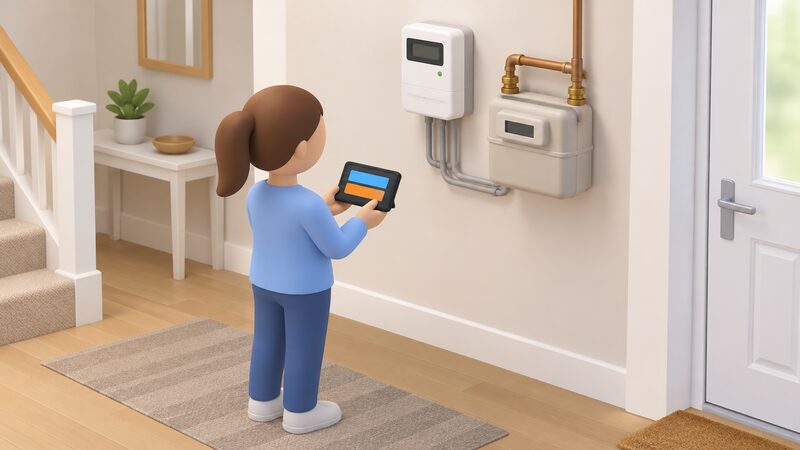
If you are not sure whether your meter is smart, the Citizens Advice website has a checking tool; all you need is your gas and electricity MPANs (meter point administration numbers) and your postcode10.
What changes when the meter is smart
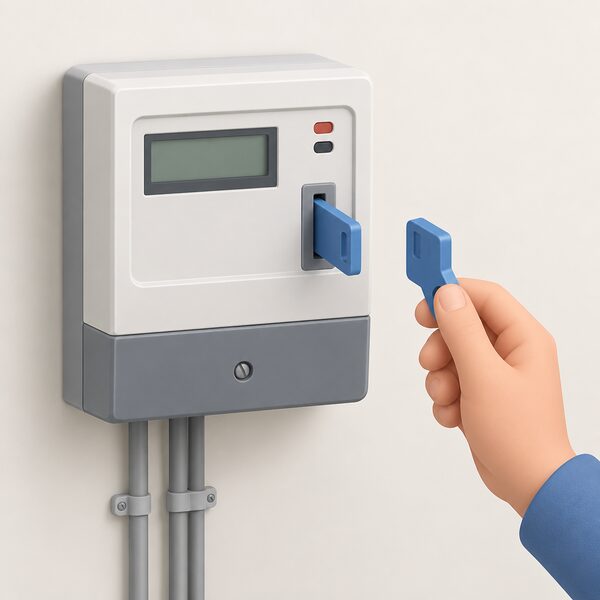
There are three main types of prepayment meter: key meters, smart card meters and smart prepayment meters6. The first two are the traditional kind. Almost all of them use a key or a smart card that you take to an official PayPoint or Payzone outlet, load with money, and carry back to the meter12. Each key or card is unique to a particular meter and will not work with any other, which matters when you move into a home and find a key left by the previous occupant: it belongs to their meter, not yours12.
A smart prepayment meter removes the physical token entirely. The prepayment service runs over the national smart meter network, and allows you to add credit to your meter through an over-the-air top-up5. In practice that means the credit can be added automatically, or at least without a visit to a shop13. The differences that follow are practical and significant:
- No single point of failure in a piece of plastic. A lost key means a replacement and a wait; a smart top-up needs only your account details.
- No travel. Top-ups happen wherever you have a phone or internet connection.
- Remote mode switching. The same meter can move between prepayment and credit without being replaced.
- Better information. The in-home display shows your balance continuously, rather than only what the meter tells you when you insert a key.
The traditional meter is not without its defenders: some households prefer the physical routine of a weekly shop top-up. But the direction of travel is clear, and suppliers can fit a smart meter in place of a non-smart prepay meter at no cost15.
Topping up: app, online, text or phone
On a smart prepayment meter, you can usually complete a top-up online or via an app, and the credit is added remotely, saving you from having to leave the house6. If you have a smart meter, you can top up your credit online, via an app, by text or over the phone15. The government's expectations are explicit: top-up must be possible in the way that best suits the household, in person or remotely1. Ofgem's guidance adds that if you have a smart prepayment meter, you may be able to top up online or using your supplier's mobile app2.
Behind the scenes, the payment travels over the Data Communications Company's network as an over-the-air top-up and reaches the meter without any action at the meter itself5. If a remote top-up does not arrive, treat it as a meter issue: your supplier is expected to promptly investigate any suspected issue with your smart meter and keep you informed while resolving it1.
Households on non-smart prepayment meters top up differently: in person at a local shop or Post Office with a Payzone or PayPoint, using a top-up key or card15. Ofgem describes the same route, at a local PayPoint store or Post Office using your meter's key or card, or a barcode for some smart prepayment arrangements16. If a key or card is lost, contact your supplier for a replacement; in the meantime the supplier should be able to authorise a temporary card from your nearest PayPoint, Payzone or Post Office6. Suppliers will probably replace a lost card for free, but may charge if it happens often12.
What the display shows you
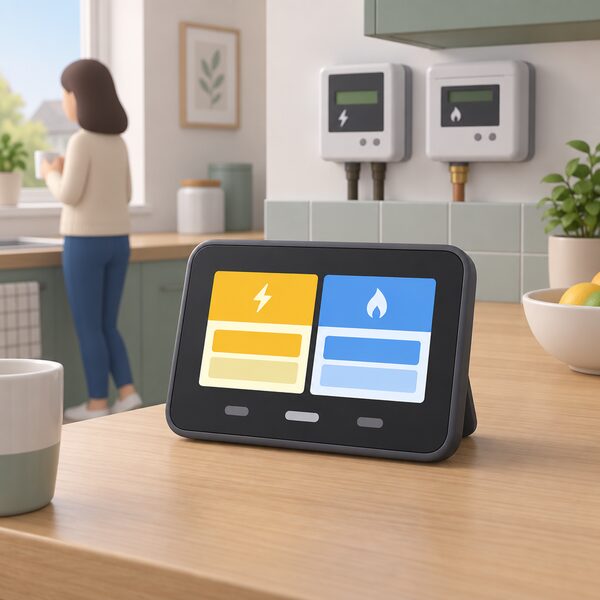
In prepay mode, the in-home display shows your available balance for each fuel and how close you are to your next top-up10. That is a real change from traditional prepayment, where the balance is a number on the meter itself, often in a cupboard or outside, and the first warning of low credit is the meter beeping.
The display is where the household's control actually lives. Knowing the balance for gas and electricity separately, at a glance, lets you pace your spending through the week rather than discovering at the meter that the credit has gone. Low-credit alerts on the display give you time to top up before the supply is at risk, and where debt is being repaid through the meter, the display shows what is being taken, so the deduction is visible rather than buried.
If the display stops working, or shows something that does not match what you expect, contact your supplier. They are responsible for maintenance and will fix or replace your meter as needed9. More detail on the displays themselves is on our page about in-home displays, and on checking your balance in how to check credit on a smart prepayment meter.
Emergency credit, and what happens when it runs out
Prepayment meters give you a small amount of emergency credit, designed to maintain your energy supply after your regular credit runs out; it is reclaimed from your next top-up12. Most prepayment meters have an emergency credit budget you can use, like an overdraft, but it is limited6. Most suppliers provide emergency credit of around £10 in case you are unable to top up for any reason15.
Once the emergency credit is exhausted, the position is blunt: once your credit runs out you will not be able to use any energy until you top up again17. This is the sharpest edge of prepayment, and the reason the safety rules later on this page exist.
Two protections matter here. First, talk to your supplier if you cannot afford to top up your meter: they must offer to help, for example by giving you extra credit in a vulnerable situation16. Second, where a supplier identifies that a prepayment consumer has self-disconnected or is self-rationing while anyone in the household is in a vulnerable situation, the supplier is obliged to offer a reasonable amount of additional support credit in a timely manner18.
What prepayment costs: the cap, unit rates and standing charges
Prepayment customers are protected by a price cap of their own, separate from the cap for direct debit and credit customers. Ofgem updates the cap levels periodically, and figures of £1,707 and £1,803 a year for typical use both appear in official guidance, published at different times16. The current figure is the one that matters for any comparison. For historical context, when the cap mechanism was younger, Ofgem set it at £1,156 a year including VAT for 4 million pre-payment meter customers from 1 April 202119.
The components of the cap are the unit rate and the standing charge. For July to September 2026, published figures include a standing charge of 57.19p per day for electricity, with a unit rate of 25.32p per kWh; the corresponding gas figures published alongside them are 29.04p per day and 7.07p per kWh6. Since 1 October 2023, households on prepayment meters have been paying lower standing charges than those on other payment methods20. The prepayment cap has a built-in end date of sorts: the price cap for prepayment meters only applies until the smart meter roll out is complete, on the Scottish Government's reading of the policy21.
Two cost points are worth stating plainly. The meter itself costs nothing: smart meters are free to use and available for payment-on-account or prepay customers4, and installation is free of charge and typically takes about 90 minutes9. And prepayment has historically been the more expensive way to pay per unit, which is what the separate cap exists to limit. Our page on smart meter costs covers the credit side in more detail.
The households prepayment fits, and those it does not
Prepayment suits particular households well. Ofgem's own guidance says it can be helpful if you are on a tight budget and do not want to pay for what you use all at once, or want more control, or are struggling with debt16. Paying in advance means no bill shocks and no arrears building in the background, and for a household managing week to week, that control is worth having.
The limits are just as clearly drawn. You can ask to switch away from prepayment if it is not safe or practical for you, for example if you cannot physically access the meter to top it up, are disabled or have a health condition, live with young children, are 75 or over, or cannot afford to top up15. Moving from prepayment to a credit meter usually requires your account to be debt-free and, in some cases, a credit check or a refundable deposit6; some suppliers install the new meter for free, and private tenants who pay the bills have the right to change payment method12. Switching from an existing gas or electricity prepay meter to a smart credit meter is straightforward for customers who qualify22. There is no credit check to move in the other direction, to prepayment15.
The independence trade-off deserves stating: prepayment gives you exact control over spending, but it removes the option of using energy first and settling up later, which is precisely the flexibility some households need in a hard month.
Forced switches: the rules suppliers must follow
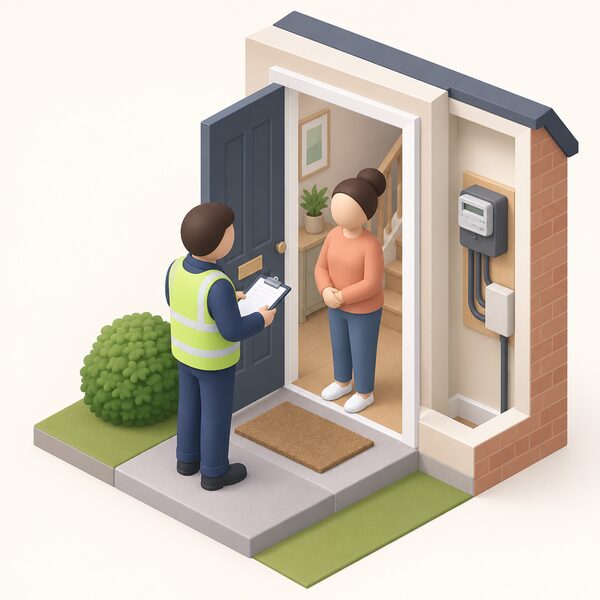
Yes, within strict limits, a supplier can move a household onto prepayment. Your supplier can get a warrant to enter your property and install a prepayment meter, or remotely switch your existing smart meter to prepayment mode23. Before that, the supplier must visit your home to understand your circumstances and check whether a prepayment meter is safe and suitable for your household7. The supplier must not proceed unless they have made the necessary arrangements to ensure it would be safe and reasonably practicable for the consumer to use a prepayment meter18.
The supplier must not install one if there are any vulnerable people in your household. Ofgem's list covers terminal illness or a severe health condition, dependence on a continuous energy supply for medical equipment, a household where everyone is 75 or over with no support, a child under 2, no one able to top up due to a physical or mental health condition, and temporary circumstances such as pregnancy or bereavement23. A code of practice signed by suppliers goes further for involuntary installations, refraining from them entirely for the highest risk customers, including people over 85 with no other support in the house24. Underpinning all of this, Ofgem's licence review concluded that prepayment functionality, including smart prepayment meters, is to be used only when safe and reasonably practicable in all the circumstances25.
If your meter is switched to prepayment without your consent, the supplier must ensure you receive prepayment meter credit, unless that is technically infeasible18. Where the switch is involuntary, the supplier must give you £30 of credit once the meter is installed or your existing meter is switched7. Compensation is available if you were forced to have a prepayment meter between 1 January 2022 and 21 January 2023 and your supplier did not follow the rules properly23. Our page on forced prepayment meter rules covers the process in detail.
Switching supplier, and the £500 debt limit
Being on a prepayment meter does not prevent you from switching tariff or supplier; prepayment customers can switch on the same process as credit meter customers, and tenants responsible for paying bills have the right to switch provider12. The one material difference is debt. You can switch supplier if you have a prepayment meter and owe your current supplier up to £5008; the debt transfers with you to the new supplier15. If you owe more than £500, you cannot switch until the debt is below that line.
When you switch, your smart meter goes with you. The simplest way to check what will happen to it is the smart meter checking tool on the Citizens Advice website11. Our page on what happens to my smart meter when I change supplier explains the SMETS1 and SMETS2 history behind that.
Two protections apply around switching. If a smart meter installation fails due to a fault within the energy supplier's control, the consumer will receive compensation under the guaranteed standards26. And where a supplier fails a standard relating to smart meters not operating in smart mode, the six-month period before further remedies commence runs from the date the supplier failed the original standard, not from day one27. Ofgem intends to review the outcomes of the guaranteed standards in the first quarter of 202726.
If your supplier goes out of business
Supplier failure is the scenario prepayment households worry about most, because the worry is concrete: will the meter still accept top-ups? The answer is that your supply does not stop. A new supplier is appointed for the failed supplier's customers, and the new supplier will give you information on how to get new key cards and tokens28.
What to do, in order:
- Take a meter reading and note your credit balance when you hear the news.
- Wait for the new supplier to contact you before switching; Ofgem advises against switching until the new supplier has been in touch28.
- Follow the new supplier's instructions on topping up. Old keys and cards issued by the failed supplier are replaced, and the new supplier will tell you how28.
- Claim any credit you are owed. Money you had loaded onto the meter is protected and is repaid through the process, via the new supplier or the failed supplier's administrator.
If your smart meter stops working at any point, contact your supplier; they are responsible for maintenance and will fix or replace your meter as needed9. The wider picture of supplier failure, including credit customers, is on Ofgem's guidance28.
Where to get free help
Prepayment households have several layers of free, independent help, and using them early is the difference between a difficult week and a self-disconnection.
- Citizens Advice provides free, independent advice on energy bills across Great Britain, and its website hosts the smart meter checking tool11. In Wales, the published advice line is 0808 223 114420; a second published number, 0800 702 2020, also appears in council guidance for the advice service29, so use whichever route your local listing confirms.
- National Energy Action provides free advice about energy bills and keeping warm and safe in your home, and can also help with benefits advice and income maximisation29.
- Your local council may run a free telephone advice service to help with benefits, money and bill problems30.
- Your supplier must offer help if you cannot afford to top up, for example extra credit in a vulnerable situation16.
Help is also built into some schemes: under the ECO4 and Great British Insulation Scheme proposals, advice on the benefits of using a smart meter must be provided to the household before completion of the first measure31. Government support payments have treated the two meter types differently: smart prepayment meter customers see the discount credited directly to their meters each month, while traditional prepayment customers receive vouchers by SMS, email or post, redeemable at a top-up point32. People who use prepayment meters may be required to redeem their vouchers at their local top-up point33, which is one more argument for the smart version.
Sources33 sources
- Smart meters: your rights and expectations, GOV.UK
- Get help with your prepayment meter, Ofgem
- Overdue utility bills, nidirect
- How do you know if you have a smart meter?, Smart DCC
- How do smart meters send readings?, Smart DCC
- Prepayment meters guide, Uswitch
- Can energy suppliers install prepayment meters without household permission?, Ofgem
- Switch your home energy supplier, Ofgem
- Smart meters: green energy choices, Climate Action Wales
- How do smart meters save energy?, Smart DCC
- What happens to my smart meter when I change supplier?, Smart DCC
- Prepayment meters advice, Centre for Sustainable Energy
- Get help with your smart meter, Ofgem, 2026-09-17
- Get help with your smart meter, Ofgem
- Change prepayment meter to credit meter, Confused.com
- Get help with your prepayment meter, Ofgem
- Prepayment meters consumer guidance, Ofgem
- Heat networks consumer protection draft guidance, Ofgem, 2025-09-05
- Energy price cap increase April 2021, Ofgem, 2021-04-01
- Tackling fuel poverty: priority actions, Welsh Government
- A Scotland without fuel poverty, Scottish Government
- How to get a smart meter, Smart DCC
- Installing a prepayment meter without your permission, Ofgem
- Energy suppliers sign new code of practice on involuntary prepayment installations, Ofgem, 2023-04-18
- Ofgem completes review of how suppliers support customers in vulnerable situations, Ofgem, 2022-11-22
- Final decision on smart meter Guaranteed Standards of Performance, Ofgem, 2026-01-30
- Smart Meter Guaranteed Standard statutory consultation, Ofgem, 2025-08-08
- What happens if your energy supplier goes out of business, Ofgem
- Getting help with your energy bills, Birmingham City Council
- Energy saving: grants and funding, Tameside Council, 2026-09-17
- ECO4 and GBIS mid-scheme changes consultation, GOV.UK, 2024-11-14
- Energy bills support factsheet, House of Commons Library, 2026-09-20
- West Midlands residents urged not to miss out on energy bill support, West Midlands Combined Authority, 2023-02-22