
In this comparison
A prepayment meter is a way of paying for energy in advance rather than after use. Ofgem defines it as a meter where a customer must pay in advance by topping up with a smart card, key or cash token1. A smart meter is a different thing entirely: it is the metering and communications hardware, and it can operate in credit mode or prepayment mode2. The two are often compared as if they were alternatives, but the real choice is between payment methods, and a smart meter can serve either one.
That distinction matters because it changes what a household is deciding. Moving from prepay to credit on a smart meter does not require different hardware, and Ofgem describes switching from an existing gas or electricity prepay meter to a smart credit meter as straightforward for customers who want it3. The meter stays; the mode changes.
The cost picture has shifted too. The Spring Budget 2023 set out plans to align charges for comparable direct debit and prepayment customers4, and independent guidance noted that as of April 2024 those on prepayment meters would pay slightly less for their energy than those on credit meters5. Older official statements described prepayment tariffs as more expensive than standard credit meters6, so the direction of travel has been towards alignment rather than a permanent premium.
What each meter is: pay in advance versus pay after use
A prepayment meter requires payment before consumption. Ofgem's definition is that a customer must pay in advance for their energy by topping up a meter with a smart card, key or cash token1. The Northern Ireland guidance describes the same mechanism: a smart card, key or token, or sometimes coins, is used to pay for gas or electricity as it is used10. A parliamentary briefing from December 2022 put it plainly: prepayment meters require customers to pay for their electricity or gas before they use it, on a pay-as-you-go basis11.
A credit meter, by contrast, bills after use. Consumption is recorded, a bill is issued, and payment follows, usually by direct debit, on receipt of a bill, or on a payment plan. The meter itself does not restrict supply when the account falls behind; the supplier pursues the debt through billing and, in the last resort, through the rules on prepayment installation.
The confusion in the phrase "smart meter vs prepayment meter" is that these are not two points on one scale. A smart meter is a meter with communications and remote functionality. A prepayment meter is a payment arrangement. A traditional prepayment meter is a prepayment meter without smart functionality, topped up with a key or card at a shop. A smart prepayment meter is a smart meter running in prepayment mode. Ofgem's consumer guidance covers prepayment meters as a category in their own right12, and the three main types are key meters, smart card meters and smart prepayment meters5.
For a household's energy independence, the difference is about control of cash flow rather than control of supply. Prepay means no debt can build up, but it also means supply can be interrupted when credit runs out. Credit means supply continues while a bill is disputed or a payment plan is arranged, but the account can fall into arrears. Neither arrangement reduces dependence on the grid or on a supplier; both are ways of settling an account with a company that remains the source of the energy.
A smart meter can run in either prepay or credit mode
The single most useful fact in this comparison is that the mode is a setting, not a separate device. Government guidance states that smart meters can operate in credit or prepayment mode2. That means a household with a smart meter already installed has the hardware for either payment method, and the change between them is made in the meter's configuration and the supplier's systems.
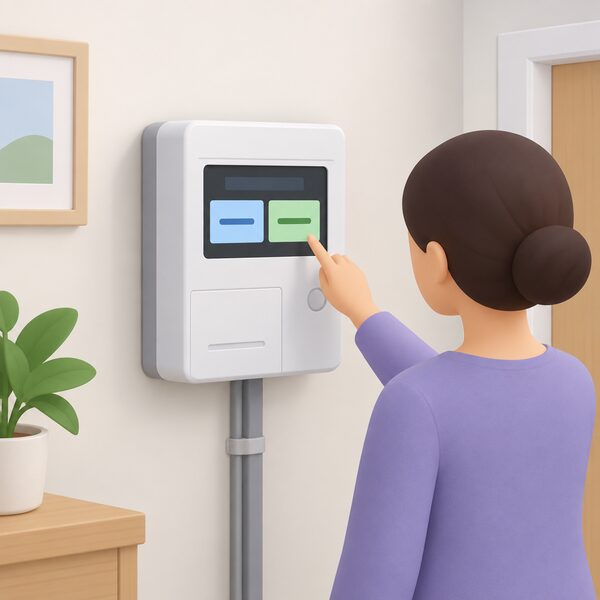
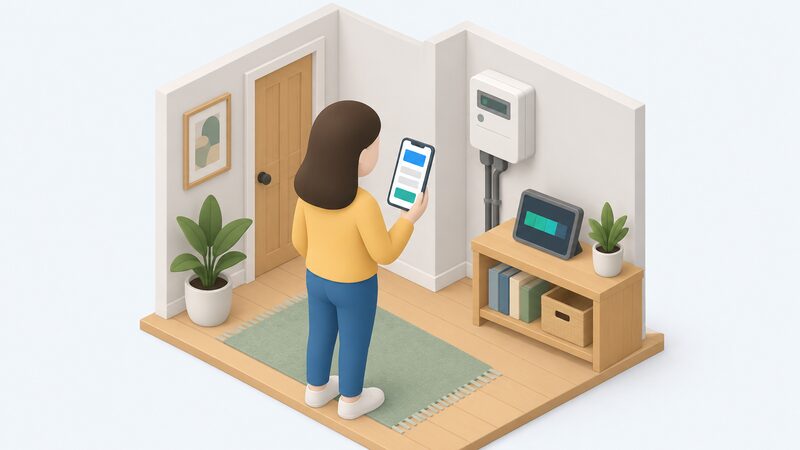
In prepayment mode, a smart meter adds functionality that a traditional prepay meter cannot match. Ofgem's guidance notes that a smart meter in prepayment mode can add credit automatically or without having to visit a shop13. Top-up can be done online or through the supplier's mobile app14, and the credit is delivered remotely over the smart meter network15. The same guidance is clear that top-up should suit the household: in person or remotely, whichever works2.
"Smart meters can operate in credit or prepayment mode."
There is a safeguard attached to the mode. Government guidance states that a smart meter should only ever be in prepayment mode if it is safe and works for the consumer to use that payment method2. That is a condition on the supplier as much as a statement of principle, and it sits alongside the rules on when a prepayment meter may be installed without permission.
For independence, remote mode switching cuts both ways. It removes the need for a visit and a physical meter change, which is convenient and less disruptive. It also means the payment mode can be changed without anyone entering the property, which is why the rules around remote switching are set out separately and why the conditions on installation without permission matter to any household that might be affected.
Smart prepay versus traditional key meters: what changes for you
The practical difference between a smart prepayment meter and a traditional key or card meter is where the top-up happens and how quickly it lands. With a traditional meter, the household takes a key or card to a Paypoint store or Post Office and the credit is loaded onto the device, then carried back to the meter14. With a smart prepayment meter, top-up can usually be completed online or through an app, and the credit is added remotely, so no journey is needed5. The DCC describes this as an over-the-air top-up over its network15.
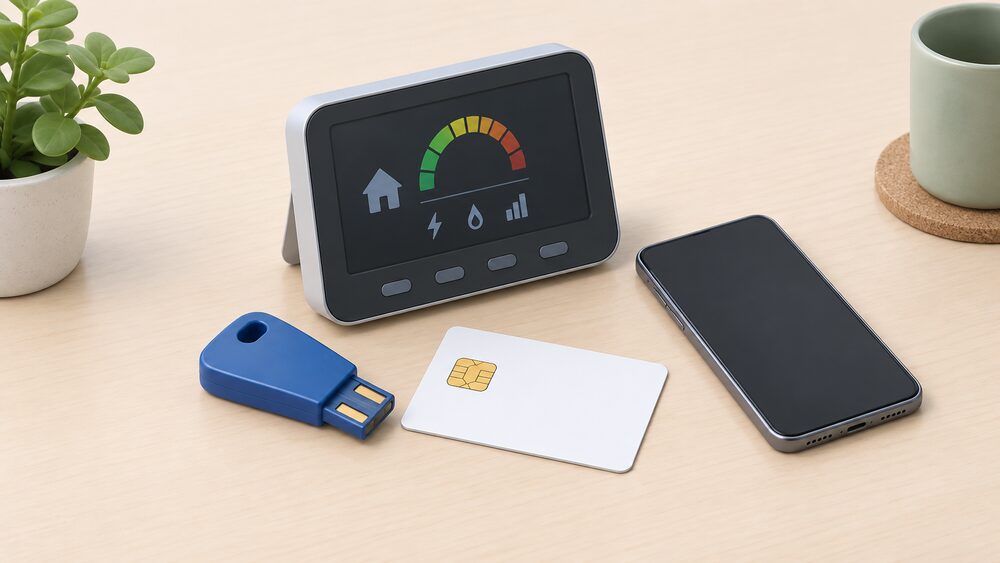
Smart prepayment meters also carry the same functionality as standard smart meters, allowing usage information to be viewed at any time on the in-home display5. That is a genuine change for a prepay household: consumption and remaining credit can be seen without pressing buttons through a menu on a small meter screen, and the display shows what has been used and what is left.
The three types sit alongside each other in the market. Key meters and smart card meters are the older forms; smart prepayment meters are the newer form that combines prepay payment with smart communications5. A household on a traditional prepay meter that wants the remote top-up and display features is looking at a meter change, not a mode change, because the old device has no communications.
Cost: does prepayment cost more than direct debit?
The answer has changed over time, and the sources reflect that. Older official statements described prepayment as the more expensive option: a Welsh Government written statement from June 2022 said those reliant on pre-payment meters pay a more expensive tariff compared to standard credit meters6. The Spring Budget 2023 then set out plans to align charges for comparable direct debit and prepayment customers4, which is the policy direction that has shaped tariffs since.
Independent guidance published in 2024 recorded the result: as of April 2024, those on prepayment meters would pay slightly less for their energy than those on credit meters5. That is a reversal of the older position, and it reflects the removal of the prepayment premium rather than any discount specific to prepay.
The default tariff cap treatment reinforces the point. The 2018 consultation on the cap set out that customers with smart prepayment meters will be treated as direct debit customers16. That matters because the cap level for direct debit customers has historically been the lowest of the cap variants, so smart prepay customers being placed in that group is a structural change rather than a temporary one.
Satisfaction data adds a counterintuitive finding. Ofgem's July 2025 report on what drives consumer satisfaction found that prepayment customers show higher satisfaction than those on direct debit, once other variables are controlled for17. That does not mean prepayment is cheaper in every case, and it does not mean it suits every household. It does mean the assumption that prepay customers are uniformly worse off in their experience of supply is not supported by the survey evidence.
For independence, the cost question is about exposure. A prepay household pays in advance and holds credit with the supplier; a credit household pays after use and holds a debt or a balance. Neither arrangement changes the underlying price of energy, which is set by the tariff and the cap. What changes is the cash-flow position and the risk of disconnection when credit runs out.
Who can get one, including renters
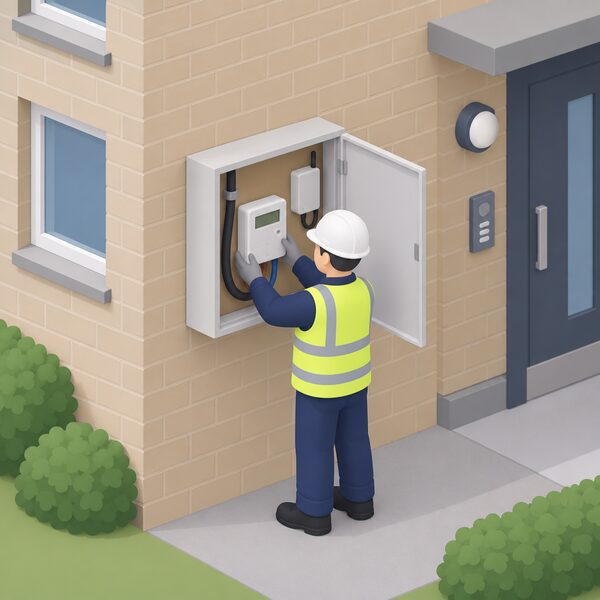
Eligibility for a smart meter is broad, and prepay status or renting does not exclude a household. Welsh Government guidance states that whether on a pre-payment plan or renting, a household can benefit from a smart meter18. The Energy Ombudsman's guidance is more specific for private renters: if the energy bills are in their name or they prepay for their energy, they can choose to have a smart meter, after checking the tenancy agreement and letting the landlord know19. The DCC adds that a household can apply if renting, if a prepay customer, or if the meter is located outside the property, as in flats with communal meter boxes3.
That last point matters for flats and for any property where the meter is not inside the home. A meter in a communal cupboard or an external box is not a barrier to a smart meter, though it can affect how the installation is arranged and how the communications hub reaches the network.
Uptake has not been even across the population. Public Accounts Committee evidence from October 2023 found that consumers who are older, on higher incomes, male, and homeowners are more likely to have smart meters, while consumers who are young, female, on low salaries, and private renters are less likely20. That pattern is a rollout issue rather than an eligibility rule, but it bears on which households are still waiting and which are most likely to be on older prepay hardware.
There is also a data condition specific to prepayment. Electricity supply licence condition 47 provides that where the meter is a prepayment meter, consumption data may be obtained for a single period corresponding to the period since the previous advance payment made through that meter21. In other words, the data granularity for a prepay meter is tied to the top-up cycle rather than to half-hourly or daily reads. That is a limit on what a prepay household's data can show, and it is set in the licence rather than chosen by the supplier.
How switching between modes works without a new meter
Because a smart meter can operate in either mode2, moving between prepay and credit is a configuration change rather than a hardware swap. Ofgem guidance describes switching from an existing gas or electricity prepay meter to a smart credit meter as straightforward for customers who want it3. The meter that is already on the wall is the meter that continues to be used.
The default tariff cap consultation confirms the treatment that follows: customers with smart prepayment meters will be treated as direct debit customers16. So the move from prepay to credit on a smart meter is not just a change of payment method; it also places the account in the direct debit group for cap purposes.
Research in Scotland on the lived experience of fuel poverty found that those who had switched from prepayment meters to direct debit described having saved money as a result, while prepayment users were concerned that direct debit would make it harder to manage their money22. That is the trade-off in the household's own terms: a saving on one side, a loss of the pay-as-you-go discipline on the other. The same research records the concern rather than resolving it, and it is a fair summary of why some households stay on prepay even when credit is available.
The reverse move is also possible, and it is the one that carries the most sensitivity. Ofgem guidance states that a supplier can get a warrant to enter a property and install a prepayment meter, or remotely switch an existing smart meter to prepayment mode23. The same wording appears in the guidance on installing a prepayment meter without permission24. Remote switching is therefore one of the two routes a supplier has, and the conditions on when it may be used are set out in the rules on installation without household permission.
Where prepayment still falls short
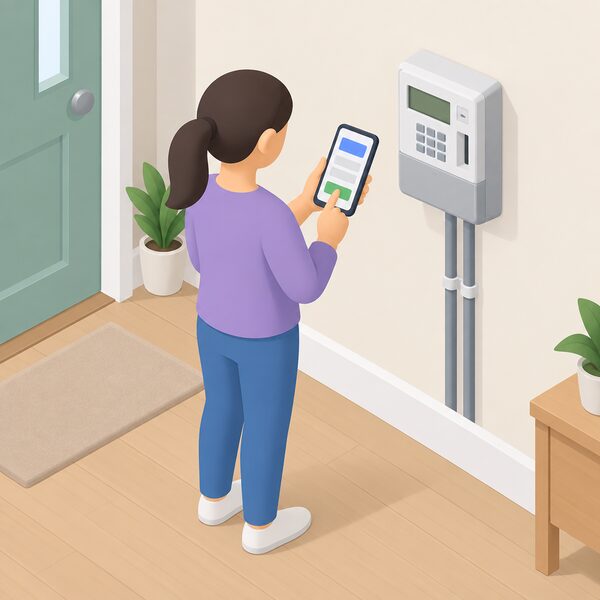
The most concrete shortfall in the evidence is the rate of problems experienced. Ofgem's Energy Consumer Satisfaction Survey for August and September 2023 found that issues were more prevalent among prepayment meter customers, at 46%26. That is a measure of reported problems with the meter or the supply, and it is markedly higher than the rate for other payment groups in the same survey.
The price cap position for prepayment has also been described as time-limited. Scottish Government analysis from October 2016 stated that the price cap for prepayment meters only applies until the smart meter roll out is complete27. That is an old statement, made before the current cap arrangements and before the alignment policy, and it should be read in that context. It does, however, illustrate that the protection for prepay customers has been framed as transitional rather than permanent.
The structural shortfall is the one that no meter design removes: prepay supply can be interrupted when credit runs out. A smart meter makes topping up easier and can add credit automatically13, but it does not change the underlying arrangement that energy is paid for before it is used. A household that values continuity of supply above cash-flow control is choosing between two different risks, not between a good option and a bad one.
There is also the data granularity limit noted above. Where the meter is a prepayment meter, consumption data may be obtained for a single period corresponding to the period since the previous advance payment21. A prepay household that wants detailed consumption data for sizing solar, a battery or a heat pump may find the prepay data stream less useful than a credit meter's, and may need a separate monitoring route. Pages on using energy data to size a system and consumer access devices cover what is available.
The rollout and what it means for prepay households
The rollout is a replacement programme that includes prepayment versions. The DCC states that the roll-out is part of a national government programme to replace all old meters with new smart meters, including prepayment versions28. The scale of the prepay population has been significant for a long time: a 2016 CMA press release referred to the 4 million households on prepayment meters12.
The current target is that suppliers take all reasonable steps to install smart meters in all remaining domestic premises by the end of 20307. That is the deadline that determines when a household still on a traditional prepay meter can expect the offer of a smart replacement, and it is the point at which the older key and card meters are expected to be phased out.
The network transition is the other dated change that affects prepay households directly. The 2G and 3G networks are due to be switched off by 2033, and the smart meter network is transitioning to 4G9. Second-generation smart meters that rely on 2G or 3G will require a replacement communications hub in order to communicate with 4G networks9. Any remaining first-generation SMETS1 smart meters that have not been upgraded to SMETS2 will need to be physically replaced prior to 2033, because they were designed with an integrated 2G communications hub9. The Public Accounts Committee recorded that an estimated seven million communications hubs will need to be replaced because they will lose functionality when the 2G and 3G networks close20. Government news in March 2026 stated that suppliers must replace all smart meters still connected to 2G and 3G before the services are switched off by 20338.
For a prepay household, that means the meter in the home may be replaced more than once: first when the traditional prepay meter is swapped for a smart meter, and again if the communications hub or the meter itself is a 2G or 3G device that cannot be upgraded in place. The National Audit Office has reported on the costs of additional home visits to replace communications hubs ahead of the closure of the 2G and 3G networks by 203329. The practical expectation is that the supplier arranges the replacement, and that the household does not pay for it directly.
Ofgem's debt strategy work has also touched on prepayment, including trials focused on proposals to switch existing smart meters into prepayment mode in situations of domestic customers moving homes30. That is a live policy area rather than a settled rule, and it sits alongside the compensation case in which Utilita Energy customers received compensation after Ofgem uncovered an additional support credit failure31. The lesson from that case is that the support credit arrangements attached to prepay accounts are enforceable, and that suppliers can be held to them.
For energy independence, the honest summary is that a smart meter improves the mechanics of prepayment without changing its nature. It removes the shop trip, adds remote top-up and gives a display that shows usage and credit. It does not remove dependence on the grid, on a supplier, or on the communications network that carries the top-up. A household that wants to reduce that dependence is looking at generation and storage rather than at the meter, and the pillar guide sets out where metering sits in that wider picture. Pages on smart prepayment meters and switching from prepayment to credit go further into the mechanics and the costs of each move.
Sources31 cited
- Get help with your prepayment meter, Ofgem, 2026
- Smart meters: your rights and expectations, UK Government, 2025
- How to get a smart meter, Smart DCC, 2026
- Spring Budget 2023, UK Government, 2023
- Prepayment meters guide, Uswitch, 2026
- Written statement: Welsh Government fuel voucher scheme, Welsh Government, 2022
- Smart metering policy framework post-2025: government response, UK Government, 2025
- Tough new rules force suppliers to fix faulty smart meters, UK Government, 2026
- Do smart meters use 3G?, Smart DCC, 2024
- Overdue utility bills, nidirect, 2026
- Prepayment meters, House of Commons Library, 2022
- CMA publishes final energy market reforms, UK Government, 2016
- Get help with your smart meter, Ofgem, 2026
- Prepayment meters consumer guidance, Ofgem, 2026
- How do smart meters send readings?, Smart DCC, 2026
- Default tariff cap: policy consultation overview, Ofgem, 2018
- What drives consumer satisfaction with energy suppliers, Ofgem, 2025
- Smart meters, Welsh Government, 2026
- Smart meters, Energy Ombudsman, 2026
- Delayed smart meter programme fails to hit targets, Public Accounts Committee, 2023
- Data privacy: final proposals and standard conditions, Ofgem, 2014
- Research on the lived experience of fuel poverty in Scotland, Scottish Government, 2020
- Check if energy suppliers can install prepayment meters without household permission, Ofgem, 2026
- Installing a prepayment meter without your permission, Ofgem, 2026
- Installing a prepayment meter without your permission, Ofgem, 2026
- Energy Consumer Satisfaction Survey findings, Ofgem, 2024
- Scotland without fuel poverty, Scottish Government, 2016
- What happens to my smart meter when I change supplier?, Smart DCC, 2023
- Update on the rollout of smart meters, National Audit Office, 2023
- Debt strategy update: supporting reduction in energy debt, Ofgem, 2025
- 25,000 Utilita Energy customers receive compensation, Ofgem, 2025
 Smart Prepayment MetersHow prepayment mode works on a smart meter, remote switching between credit and prepay, topping up, emergency and friendly credit, the prepayment price cap, the £500 debt limit for switching, and the free help available when a household cannot top up.
 What Does a Smart Meter Cost?There is no upfront charge for a smart meter or a standard installation: the cost is recovered indirectly through energy bills.
 Prepayment Meter DebtHow debt repayment is set on a prepayment meter, the limits on the share of a top-up that can be taken, and how to have a rate reviewed.
 The Full Smart Meters GuideDo smart meters really save you money, and how do you use one to cut your bills?
 SMETS1 and SMETS2 MetersIs your smart meter an old first generation model or a newer one, and does it matter?
 Meters and Energy IndependenceDo smart meters really save you money, and can you still get one fitted for free?