
In this answer
Short answer
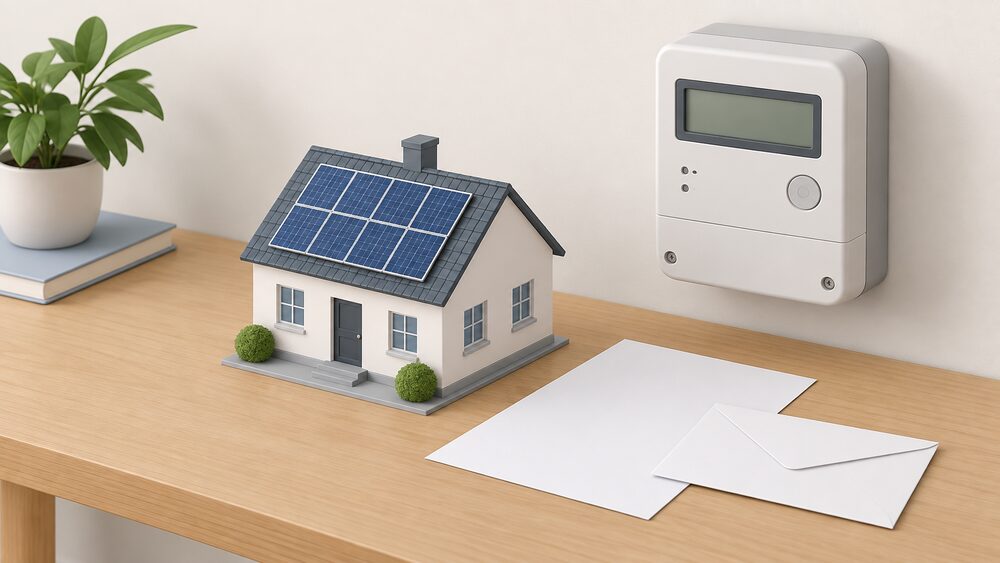
For most households, yes: an export payment under the Smart Export Guarantee needs a meter that records what you send to the grid, and in practice that means a registered smart meter. Generators must have a smart meter to monitor exports, and the scheme is built around a meter capable of taking measurements at half-hourly intervals1. The Energy Saving Trust puts it plainly: you need a registered smart meter that records your exported electricity, even if you are not signing up to a smart tariff2.
The second requirement is administrative. Your export needs its own meter point administration number, the export MPAN, which identifies the generating equipment rather than the supply you buy in3. For a domestic solar installation the supplier arranges that export MPAN as part of the application4.
What follows is the rule, why older smart meters often fail it, how the export MPAN works, and what changes for a household already receiving deemed export payments.
What the Smart Export Guarantee rules say about metering
The Smart Export Guarantee is a support mechanism that ensures people who generate their own electricity are paid for electricity they export to the grid2. It came into force on 1 January 2020 under the Smart Export Guarantee Order 2019, and it is governed by that Order together with Conditions 57 and 58 of the Standard Conditions of the Electricity Supply Licence7. From 1 January 2020, electricity suppliers have been required to offer a tariff for small-scale low-carbon generation exported to the grid9.
The metering condition sits inside that framework. Generators must have a smart meter to monitor exports, and the scheme requires an export or smart meter capable of taking measurements at half-hourly intervals1. Suppliers can set their own SEG tariff rates, provided they offer more than £0 per unit of metered exported power, so the rate is a commercial decision rather than a regulated one, but the metering requirement is not negotiable10.
Eligibility also depends on how the system was installed. Your system must be installed by an MCS certified installer using certified products, and the installation must be MCS certified for the SEG11. The metering rule and the certification rule work together: the certificate establishes that the generation is eligible, and the meter establishes how much of it left the property.
For a household, the practical consequence is that the smart meter is not an add-on to an export tariff but the gateway to it. Without half-hourly export data there is nothing for a supplier to bill against, which is why the application process asks about the meter before it asks about the tariff.
Why first generation smart meters often cannot record exports
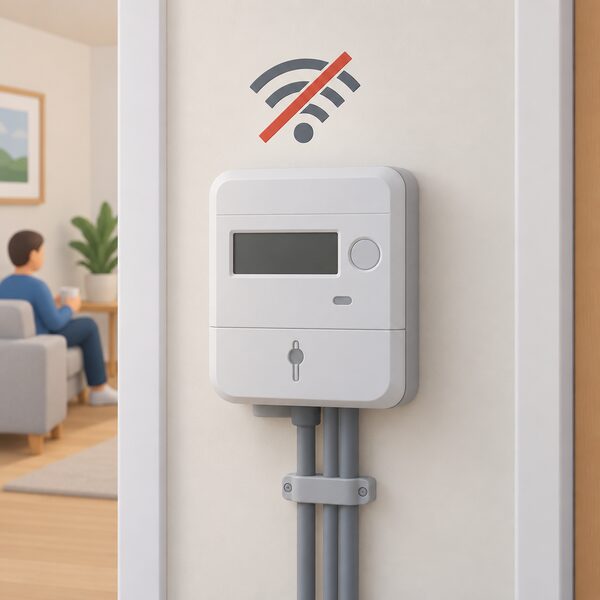
The difficulty is not smart meters in general but the first generation of them. All first-generation smart meters use a third-party communications network to send metering information to the energy supplier13. That design has two consequences that matter for export payments.
First, SMETS1 meters do not always allow the consumer to change energy supplier without losing the ability to send meter readings automatically14. They can temporarily lose smart functionality when switching suppliers and may stop sending data to the new supplier, requiring manual meter readings instead15. Some first generation smart meters cannot connect to supplier systems at all16. An early first-generation meter might not have been connected to the communications network at all and may have lost its smart functions early17.
Second, a meter that has fallen back to manual readings cannot deliver the half-hourly export data the scheme expects. The requirement is a meter that can give half-hourly readings, generally a smart meter, to sign up to a tariff that pays for exporting solar electricity18.
The distinction between the two generations is covered in more detail in SMETS1 and SMETS2 smart meters explained, and the switching problem specifically in will my SMETS1 meter stop working if I switch supplier.
The export MPAN and how your export is measured
An export MPAN is the meter point administration number for equipment that exports excess electricity back to the network, and it is mostly used with solar panel installations3. It is a separate identifier from the import MPAN, which is required for each new standard electricity meter to measure consumption and allow individual billing3. The two are not interchangeable: a lookup tool for export MPANs will not show details of your incoming electricity supply or who you pay your bills to, because that requires the import MPAN20.
Who arranges it depends on the size of the generation.
| Generation size | Who provides the export MPAN |
|---|---|
| Domestic-scale distributed generation | Your supplier arranges it4 |
| Larger installations | The network operator's design engineer can provide it21 |
| Larger installations | The network operator's account manager provides it22 |
For a typical domestic rooftop array, the first row applies. The application process also asks for information about the control equipment alongside the MPAN3. Where an address cannot be found in connection tools, the Meter Point Administration Number is the piece of information that resolves it23.
MPANs matter beyond the paperwork. They are the numbers suppliers use as reference points for getting meters installed, so the export MPAN is what allows the right meter to be associated with the right generating equipment3. A household that has solar installed but no export MPAN has generation that the settlement system cannot see.
Deemed export payments: what happens when you get a smart meter
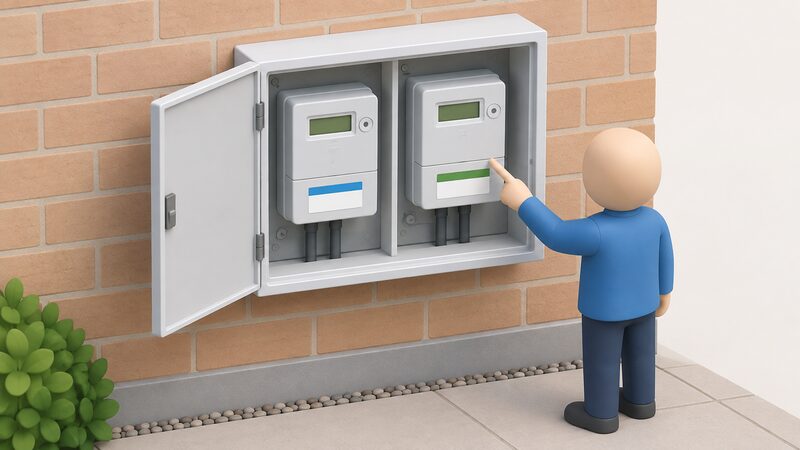
Deemed export is the arrangement where a household is paid on an estimate rather than on measured export. It exists mainly in the Feed-in Tariff world, where export payments can be made based on export meter readings as opposed to deemed export24. The change on moving to a smart meter is explicit: if you currently receive deemed export payments, these will stop and you will instead receive export payments for the amount of electricity recorded by the meter as exported to the grid6.
That is a shift from an assumption to a measurement, and it can move the payment either way. SEG payments are calculated by using export meter readings, and payments are exclusively an export tariff, based solely on how much electricity you export back to the grid as recorded by your smart meter25. A household that exports a great deal may do better on metered payments; one that exports little may do worse than the deemed estimate it previously received.
There is one structural point worth knowing for households with more than one installation. You can receive SEG payments for an installation when you already receive FIT export payments for a different installation, as long as the installations are completely separate with distinct import and export meters and different import and export MPANs27. Where pro-rating applies and the shared meter is an export meter, the electricity exported can be accurately measured, which means deemed export payments are not available in that situation27.
"If you currently receive 'deemed export payments', then these will stop and you will instead receive export payments for the amount of electricity recorded by the meter exported to the grid"
Alternatives and edge cases: generation meters, trials and non-smart routes
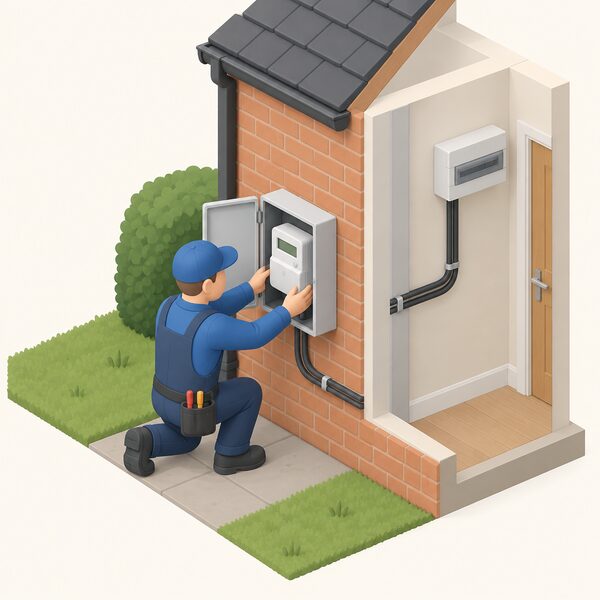
A generation meter is not a substitute for export metering. It records what the panels produce, not what crosses the boundary to the network, and the SEG is calculated on export meter readings25. The export MPAN and the export meter are what capture the flow out, which is why the application process centres on them rather than on the generation meter.
For larger installations the route differs. For distributed generation the network operator's design engineer can provide the export MPAN, while for domestic-scale distributed generation the supplier arranges it21. The network operator's account manager provides it for larger installations22. These routes mean a domestic array and a small commercial array go through different administrative doors even though the metering principle is the same.
Smart meters also enable a greater range of two-way metering of electricity, import and export, and time-of-use tariffs, which is the technical reason the export requirement can be met at all28. That two-way capability is what a generation meter alone cannot provide.
On the flexibility side, participation in household flexibility schemes needs a smart meter in most cases, plus being on a smart tariff, with suppliers able to arrange free installation29. A smart meter is also what you need to access the full benefits of flexible schemes and smart tariffs30. The metering requirement for export payments and the metering requirement for flexibility rewards therefore point at the same device.
Getting the meter itself is straightforward. Contact your supplier to get a smart meter for free5. The roll-out is being implemented by energy suppliers across the country, who are installing millions each year32. If you are unsure whether the meter already installed is smart, the check needs your gas and electricity MPANs and your postcode33.
For households weighing up what the meter enables beyond export payments, smart meters and time-of-use tariffs and export metering and export limitation devices cover the adjacent ground, and the pillar page Smart Meters and Home Energy Management sets the whole picture.
Sources33 cited
- Feed-in Tariffs: scheme closure, Ofgem, 2026
- Smart Export Guarantee, Energy Saving Trust, 2026
- MPAN only, UK Power Networks, 2026
- Installations up to 3.68kW per phase at a single premises, SSEN Distribution, 2026
- Getting a smart meter, Ofgem, 2026
- Feed-in Tariffs: guidance for generators, Ofgem, 2026
- Smart Export Guarantee Annual Report Year 5, Ofgem, December 2025
- Smart Export Guarantee: electricity suppliers, Ofgem, 2026
- Smart Export Guarantee, House of Commons Library, 2026
- Smart Export Guarantee, House of Commons Library, 2026
- Smart Export Guarantee, Electricity North West, 2026
- Smart Export Guarantee, MCS Certified, 2026
- Smart meters, Energy Ombudsman, 2026
- How to get a smart meter, Smart DCC, 2026
- Smart meters explained, Uswitch, 2026
- Smart meter connection, Uswitch, 2026
- How to solve 6 common energy supplier problems, Which?, 2024
- Smart meter problems and solutions, Which?, 2026
- Smart Energy GB FAQs, Smart Energy GB, 2025
- Export payments, UK Power Networks, 2026
- G99 fast track process, Electricity North West, 2026
- Installations of up to 3.68kW per phase at more than one property, SSEN Distribution, 2026
- Connect Direct, Energy Networks Association, 2026
- Key terms explained: Feed-in Tariffs, Ofgem, 2026
- Smart Export Guarantee, Ofgem, 2026
- Can I switch energy supplier if I have solar panels?, Uswitch, 2026
- Guidance for FIT generators, Ofgem, September 2024
- Storage, Electricity North West, 2026
- For homes, FlexAssure, 2026
- How smart meters work with heat pumps, Smart Energy GB, 2026
- Electricity only, Confused.com, 2026
- Do you have to have a smart meter by law?, Smart DCC, 2026
- How do you know if you have a smart meter?, Smart DCC, 2026
 SMETS1 and SMETS2 MetersIs your smart meter an old first generation model or a newer one, and does it matter?
 Meters and Time-of-Use TariffsDo you need a smart meter for a time-of-use tariff, and does it have to send readings every half an hour?
 Export Tariff EligibilityTo get paid for solar power you send to the grid, you need a certified installer, your network operator told about the connection, and a meter that records what you export.
 Meters and Energy IndependenceDo smart meters really save you money, and can you still get one fitted for free?
 The Full Smart Meters GuideDo smart meters really save you money, and how do you use one to cut your bills?
 Solar Export PaymentsIf you have solar panels, how do you actually get paid for the electricity you send back to the grid?