In this guide
The protocol a home energy device speaks decides three things: whether it keeps working when the broadband fails, whether it can be controlled from the app you already use, and whether it will still be supported in ten years. Zigbee is the incumbent. It is a self-organising, self-healing mesh, fully backward compatible with over a billion Zigbee devices already deployed worldwide, and it is the mesh the UK Government selected for connected devices in the home linking to the utility network1. Matter is the newer arrival: a universal, open-source and secure connectivity standard that runs over Wi-Fi, Ethernet and Thread rather than relying on lots of separate control hubs3.
The two are not rivals in the way the search phrase "zigbee vs matter vs thread" suggests. Zigbee and Matter are different technologies that share a similar underlying data model, and they are expected to co-exist, with bridging specified in Matter1. Thread is the low-power mesh that Matter commonly runs over, noted for its stability, speed and range, and connecting devices directly to one another without the cloud4. KNX sits apart again: a wired bus system that also appears in radio frequency and KNX-RF variants, and which some gateways list alongside Zigbee as a supported bus5.
For a household, the practical question is not which protocol is best in the abstract but what each one does for energy independence. A local mesh keeps working when the internet is down and does not require communication to the cloud1. A cloud-dependent device does not. That distinction matters more for a smart plug switching a tumble dryer than for a light bulb, because the load it controls is the household's own consumption.
Zigbee, Matter and Thread at a glance
Zigbee is a full-stack, secure and market-proven solution used by a majority of large smart home ecosystem providers, including Amazon's Echo Plus, Samsung SmartThings and Signify (Philips Hue)2. It operates in unlicensed bands worldwide at 2.4GHz (global), 915MHz (Americas) and 868MHz (Europe), and its physical layer supports both the 2.4 and Sub-GHz bands to cover the widest variety of setups1. A Zigbee device is typically a small radio with a microcontroller, and the network is coordinated by a hub or gateway.
Matter is a connection standard for smart home devices from a range of manufacturers, described by the Connectivity Standards Alliance's successor body as the new universal communication standard for smart homes designed to end interoperability challenges6. It was developed by leading providers including Apple, Google, Amazon, Samsung SmartThings and the Zigbee Alliance, who came together as the Connectivity Standards Alliance, formerly the Zigbee Alliance6. Matter-compatible devices usually carry the Matter logo on the packaging6.
Thread is a low-power wireless communication protocol noted for its stability, speed and range, and it connects multiple devices in a mesh allowing them to talk directly to one another without the cloud4. It is IP-based, which is why Matter can run over it alongside Wi-Fi and Ethernet3. A Thread border router is the piece of hardware that joins a Thread mesh to the rest of the home network, and a Matter controller is needed to commission devices onto it7.
| Protocol | Medium | Topology | Typical role in energy devices |
|---|---|---|---|
| Zigbee | 2.4GHz and Sub-GHz radio | Self-organising, self-healing mesh | Plugs, sensors, TRVs, meter HAN |
| Thread | 2.4GHz radio, IP-based | Mesh, no cloud required | Matter devices, thermostats |
| Matter | Runs over Wi-Fi, Ethernet, Thread | Application standard, not a radio | Cross-brand control layer |
| KNX | Wired bus, plus KNX-RF | Wired bus with RF variants | Whole-home control and energy |
Zigbee: a self-healing mesh with over a billion chipsets deployed
Zigbee's headline number is scale. The Connectivity Standards Alliance describes it as an IoT wireless protocol market leader and a complete solution with over 1 billion chipsets sold worldwide, and separately as a globally-adopted, open-standard solution with more than a half-a-billion chipsets deployed worldwide1. The two figures measure different things, chipsets sold against chipsets deployed, and both appear in the Alliance's own material. Hundreds of companies build and deploy Zigbee products2.
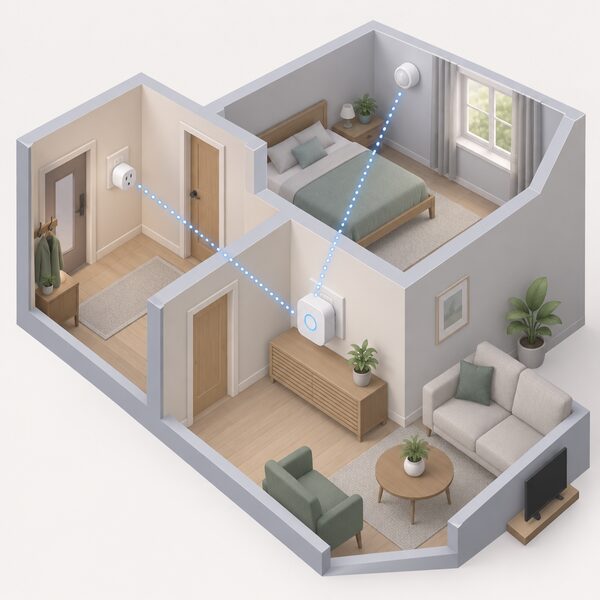
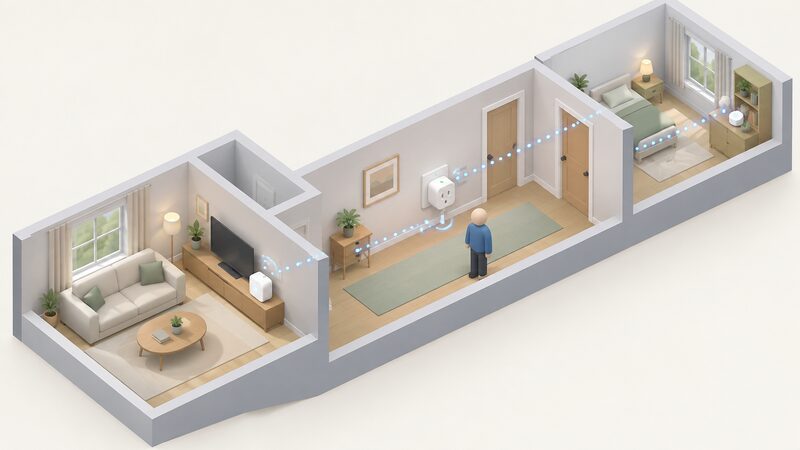
The network topology is what makes it useful in a house with thick walls and awkward corners. Zigbee uses a self-organising, self-healing mesh topology scalable to thousands of nodes, proven by nearly a decade of deployment2. In a mesh, every mains-powered device can relay traffic for its neighbours, so a plug in a hallway extends the reach of a sensor in a back bedroom. That is why the placement of mains-powered devices matters more than the placement of the hub.
Addressing is generous. Zigbee's addressing scheme is capable of supporting hundreds of nodes per network, and multiple network coordinators can be linked to support extremely large networks1. In domestic products the limits are set by the gateway rather than the protocol: one Zigbee wireless hub is listed as supporting up to 50 Zigbee devices, while a Legrand Arteor gateway with Netatmo lists a maximum of 100 devices per channel8.
Backward compatibility is the long-term argument. Zigbee is fully backward compatible, providing continuity and interoperability with over a billion Zigbee devices already deployed worldwide, and the Alliance states that Zigbee was developed to be backwards and forward compatible2. A device bought in 2016 and a device bought in 2026 can sit on the same network.
Zigbee range and throughput: 250kbit/s at 2.4GHz, 1km or more on Sub-GHz
Zigbee's radio performance is modest by Wi-Fi standards and entirely adequate for energy control. Raw data throughput rates of 250Kbs can be achieved at 2.4GHz across 16 channels, 500kbs at 915 to 921MHz across 27 channels, and 100kbs at 868MHz across 63 channels1. Zigbee products have access to 16 separate 5MHz channels in the 2.4GHz band1. A smart plug sending a power reading every few seconds uses a tiny fraction of that.
Range depends on the band and the environment. Transmission distances range from 10 to 100 metres depending on power output and environmental characteristics, while 1 km or more can be attained with the North American or European and UK Sub-GHz radios1. The Sub-GHz bands travel further and penetrate walls better, which is why they suit meters and outdoor equipment; the 2.4GHz band is global and carries more channels.
For a household, the practical consequence is that a single hub in a living room will usually reach the whole of a typical house through the mesh, but a detached outbuilding, a garage or a meter cupboard at the far end of a garden may need a mains-powered Zigbee device between it and the hub to relay traffic. Zigbee PRO 2023 added security enhancements, coexistence of Zigbee and Zigbee Smart Energy devices, SubGHz support for North American and EU markets, and device onboarding and control via Bluetooth Low Energy1.
Matter: the universal standard that runs over Wi-Fi, Ethernet and Thread
Matter's promise is interoperability without a pile of hubs. It ensures interoperability using Wi-Fi, Ethernet and Thread, rather than relying on lots of separate control hubs, and it allows products from different brands such as Apple, Google, Amazon and Samsung to communicate seamlessly3. The standard is described as universal, open-source and secure3.
The radio question is settled by what Matter runs over. Thread is a mesh network where the range and density of the wireless network increases with each Thread device added, and WLAN is the alternative; a bridge can translate signals from a manufacturer standard such as Zigbee into the Matter IP standard6. That bridging route is how Zigbee devices reach Matter ecosystems in practice.
Bosch's [+M] devices illustrate the dual-mode approach. If the device is paired with a Bosch Smart Home Controller, the Zigbee wireless standard is used; if it is operated via a Matter controller or Thread border router, Thread is used7. A Matter system requires a Thread Border Router and a Matter controller7. The same device therefore speaks one protocol or the other depending on what it is paired with.
Matter's scope is deliberately narrow. It defines common basic functions for each device category, such as on and off, while advanced functions such as special time programmes or proprietary services are not covered and require the system providers' own apps6. That is the single most important limitation for energy management, because scheduling is exactly what a household wants from a heating or appliance control.
| Matter transport | What it needs | Where it suits |
|---|---|---|
| Thread | Thread border router and Matter controller | Low-power sensors, TRVs, battery devices |
| Wi-Fi | Existing home network | Mains-powered plugs and appliances |
| Ethernet | Wired connection | Controllers and fixed infrastructure |
| Bridge | A hub translating Zigbee to Matter | Existing Zigbee devices in Matter apps |
Local control: how each protocol behaves when the internet is down
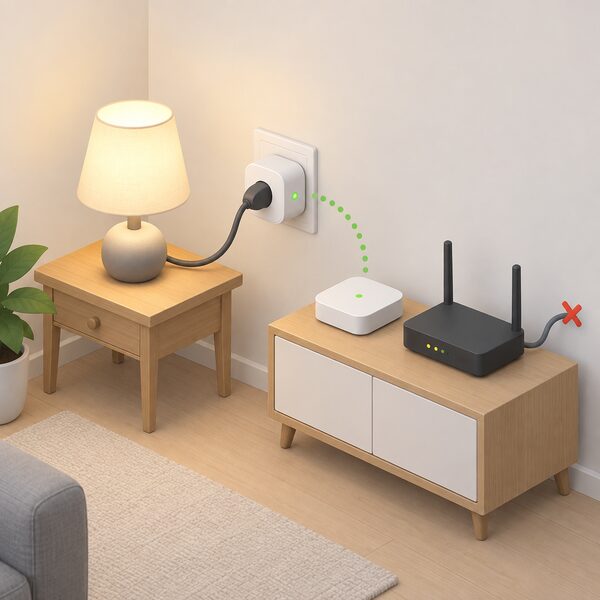
Local operation is the dividing line for energy independence. Zigbee's consistent and responsive local connectivity still works if the internet is down and does not require connection with or communication to the cloud1. Matter follows the same principle: communication between Matter-capable smart home devices takes place locally, not via a cloud6. Thread connects devices in a mesh allowing them to talk directly to one another without the cloud4.
The caveats are specific and worth knowing before relying on a schedule. A Zigbee smart plug's timer does not work if the device disconnects from the Zigbee gateway, but still works if the gateway itself loses internet access10. In other words, the failure mode is the local link, not the broadband. The same plug is described as offering reliable operation even when the internet is down, with local processing for privacy and security10.
Remote control is a different matter. Wi-Fi is needed for remote control outside the home, while Bluetooth and Thread serve at-home control13. A household that wants to switch a load from another city needs an internet path; a household that wants a schedule to run while the broadband is out does not, provided the hub and the mesh stay up.
Interference and reliability: channels, CSMA-CA and mesh routing
Zigbee shares the 2.4GHz band with Wi-Fi, Bluetooth and microwave ovens, and it is designed with that in mind. Zigbee incorporates an IEEE 802.15.4 defined CSMA-CA protocol that reduces the probability of interfering with other users1. Carrier sense multiple access with collision avoidance means a device listens before it transmits and backs off if the channel is busy, rather than talking over whatever else is on the air.
The 16 separate 5MHz channels in the 2.4GHz band give room to move1. Wi-Fi in the UK commonly occupies wide channels in the same band, so a Zigbee network that shares a channel with a busy router will retry more often. Mesh routing is the second defence: with multiple mains-powered routers in the network, traffic can take a different path around a congested or failed node.
Repeater capacity is a product specification rather than a protocol limit. A Zigbee smart plug functioning as a repeater can support up to 64 end devices, enhancing network stability11. That is a substantial fan-out for a single plug, and it explains why a handful of well-placed mains devices transforms the reliability of a network that was previously thin.
For energy monitoring specifically, reliability matters because the data is the point. A plug that drops readings leaves gaps in the record a household might use to size a solar or battery system. Zigbee's local operation means those readings can be kept in the home rather than passing through a cloud service, which is the same principle behind local data access approaches such as Modbus and local APIs.
KNX and whole-home energy management, including EV charging
KNX is the wired option, and it appears in UK product catalogues alongside the wireless standards rather than instead of them. A Legrand Arteor gateway with Netatmo lists bus systems including KNX, KNX-RF (radio frequency), radio frequency, LON, Powernet and Zigbee, with radio frequency bidirectional support5. The same gateway operates on a 2.4G Wi-Fi network and Zigbee9. In other words, a wired bus and a wireless mesh can sit in one installation, each doing what it does best.
The case for a wired bus is stability and determinism. A cable does not suffer interference, does not need a repeater and does not depend on a battery. The case against is installation: KNX is a building project, suited to new build and deep retrofit rather than a plug-in addition. For a household that is already opening walls, it is a route to whole-home control that does not compete for the 2.4GHz band.
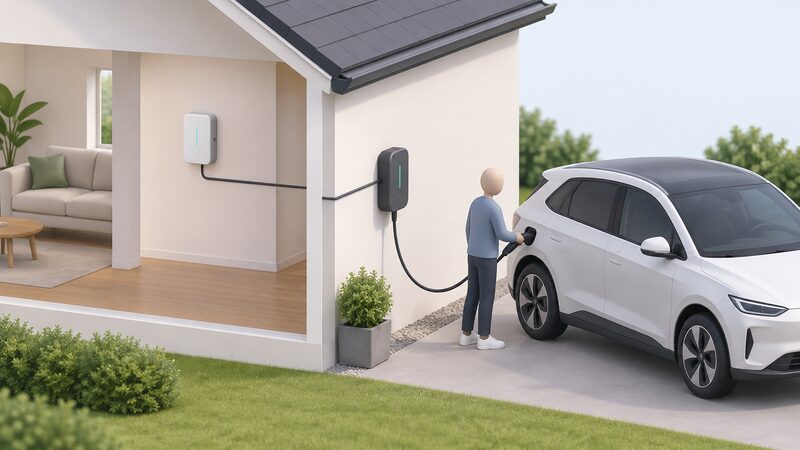
EV charging is where whole-home energy management meets a large single load. Zapmap and DfT charging statistics changed their leading metric in February 2026 to EV chargers (EVSE) to more closely reflect the number of EVs that can be charged14. For households on a keypad meter, Northern Ireland Networks advises that if you have an electric vehicle, try charging it at a time when there are fewer electricity devices in use in the home16.
Smart charging logic takes that further. One charger's smart charging logic automatically targets the cheapest, greenest electricity tariffs and shifts demand away from peak times, and it requires no change to your energy provider17. That is a control-layer function, not a protocol one, but it depends on the charger being able to receive a signal and act on it locally or through a cloud service.
How the protocols work together: bridging, co-existence and Zigbee Direct
Bridging is the mechanism that makes a mixed home work. While Zigbee and Matter both use a similar underlying data model, Zigbee and Matter are different technologies, expected to co-exist, with bridging specified in Matter1. A bridge is a hub that presents Zigbee devices to a Matter controller as if they were Matter devices, which is how a Zigbee plug ends up controllable from an Apple Home app.
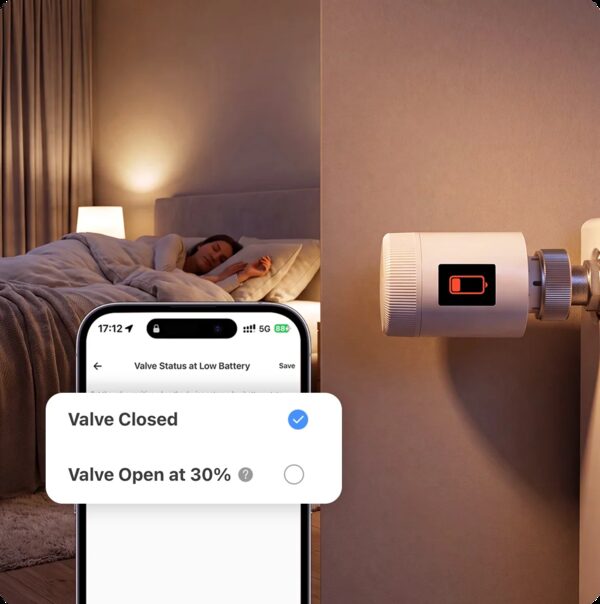
That pattern is common in shipping products. A Zigbee thermostatic radiator valve works with Apple Home via a Matter bridge, using a bridge, a Zigbee gateway, an iHost or a Cube OS setup with a Zigbee dongle18. A Zigbee smart plug works with Apple Home via a Matter bridge using a gateway or an eWeLink CUBE11. A Zigbee temperature and humidity sensor works with Apple Home via a Matter bridge19. The Zigbee device itself is unchanged; the bridge does the translation.
Zigbee Direct is the other route to simpler control. It is a feature of Zigbee that brings together two market-proven technologies, Zigbee and Bluetooth Low Energy, to simplify the user experience, and it allows users to interact with their Zigbee networks using a smartphone, tablet or other Bluetooth enabled device1. That removes the need for a separate gateway for some commissioning and control tasks.
Compatibility across generations is handled at the device level. A Zigbee sensor supports Zigbee gateways that use the Zigbee 3.0 protocol and is compatible with most hubs19. A Zigbee smart button uses Zigbee 3.020. A Zigbee TRV is built on the Zigbee 3.0 standard and IEEE 802.15.418. Zigbee 3.0 is the common denominator that makes a mixed-brand mesh viable.
Choosing between them for household energy independence
The choice is less about picking a winner than about knowing what each protocol leaves the household dependent on. Zigbee keeps working when the internet is down and does not require the cloud, but it depends on a gateway that needs power and, in most homes, a manufacturer's app for setup1. Matter keeps communication local and encrypted, but its scope stops at basic functions, so scheduling and advanced energy logic live in the provider's app6. Thread removes the cloud from the mesh but needs a border router and a controller4. KNX removes the radio problem entirely at the cost of a wired installation5.
Energy flexibility is the reason this matters. Shifting appliance timing, running a dishwasher, washing machine or tumble dryer at times when demand on the grid is lower, is a behaviour a household can automate, and the automation runs on one of these protocols20. The Centre for Sustainable Energy's free Energy Choices Tool guides users through practical solutions based on their home, lifestyle and budget, with no sales pressure or specific brand recommendations21. Which?'s home energy planning service, powered by Snugg, is also free and offers personalised advice22.
What the protocols cannot do is guarantee a saving. Actual savings vary by property type, size and location, existing insulation levels, heating system, occupancy patterns, energy tariffs, installation quality and how people use their home after improvements23. A protocol is the plumbing, not the outcome. For homes off the electricity grid, the Consumer Council notes that hydropower systems might be a cheaper option, which is a reminder that the energy source, not the control layer, sets the ceiling24.
The dependence that remains is worth stating plainly. A Zigbee or Thread mesh still needs a hub, and that hub is usually a manufacturer's product with a manufacturer's app and a manufacturer's update policy. Matter reduces the risk of a single brand locking a household in, because products from different brands communicate seamlessly3. It does not remove the hub, the app or the cloud account that most ecosystems still require for setup and remote access.
Sources24 cited
- Zigbee FAQ, Connectivity Standards Alliance, 2026
- Zigbee, Connectivity Standards Alliance, 2026
- Making home energy management work for consumers, Energy Systems Catapult, 2026-02-12
- Matter smart home devices, tado°, 2026
- Arteor with Netatmo Zigbee/Wi-Fi Gateway and Home/Away Wireless Master Switch Magnesium, Legrand, 2026-09-17
- Matter standard, Bosch Smart Home, 2026-09-20
- Plug Compact M help, Bosch Smart Home, 2026-09-20
- Mycond Zigbee Wireless HUB, Mycond, 2026-09-17
- Arteor with Netatmo Zigbee/Wi-Fi Gateway and Home/Away Wireless Master Switch White, Legrand, 2026-09-17
- SONOFF iPlug Zigbee Smart Plug S60 series, SONOFF, 2026-09-20
- SONOFF iPlug Zigbee Smart Plug S60 series, SONOFF, 2026-09-20
- SONOFF iPlug Zigbee Smart Plug S60 series, SONOFF, 2026-09-20
- Smart plugs, Centre for Sustainable Energy, 2025-10
- EV charger counts and power bands explained, Zapmap, 2026-02
- Arteor with Netatmo Zigbee/Wi-Fi Gateway and Home/Away Wireless Master Switch Soft Alu, Legrand, 2026-09-17
- Temporary power outages for keypad customers, Northern Ireland Networks, 2026-09-19
- Smart charging, Zapmap, 2026
- SONOFF TRV Gen2 Zigbee Thermostatic Radiator Valve, SONOFF, 2026-09-20
- SONOFF SNZB-02D Zigbee LCD Smart Temperature Humidity Sensor, SONOFF, 2026-09-20
- What is flexibility, Flex Assure, 2026-09-19
- New Energy Choices Tool helps navigate smart energy options, Centre for Sustainable Energy, 2025-10-17
- Use our home energy planning service, Which?, 2026-06-18
- Our data, Energy Saving Trust, 2026-09-01
- Renewable energy, Consumer Council, 2026
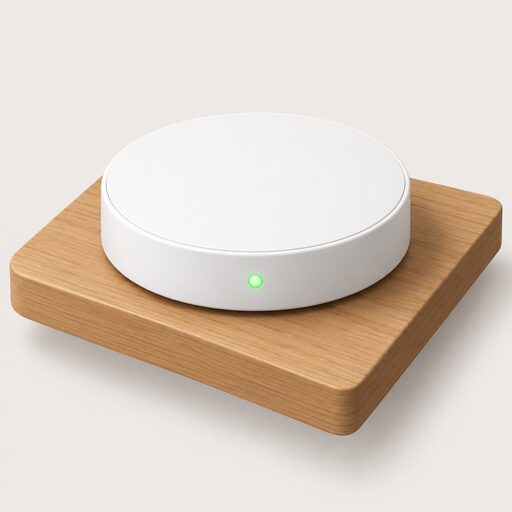 Zigbee, Matter, KNX and Wi-FiWill your smart thermostat and radiator valves keep working if the broadband goes down, and can gear from different brands talk to each other?
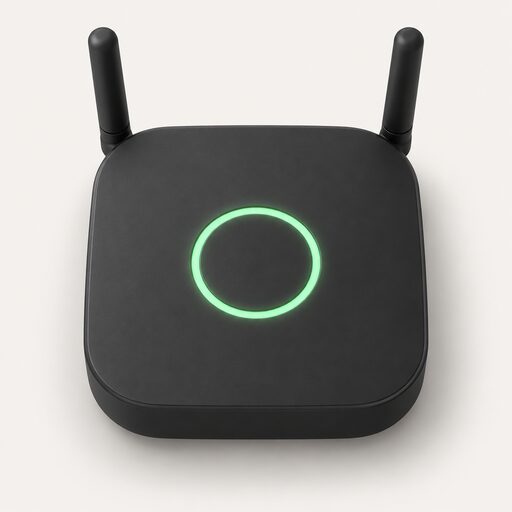 Smart Home Hubs for EnergyHow a smart home hub joins Zigbee, Thread and Matter devices, runs schedules and automations, and whether it keeps working without internet access.
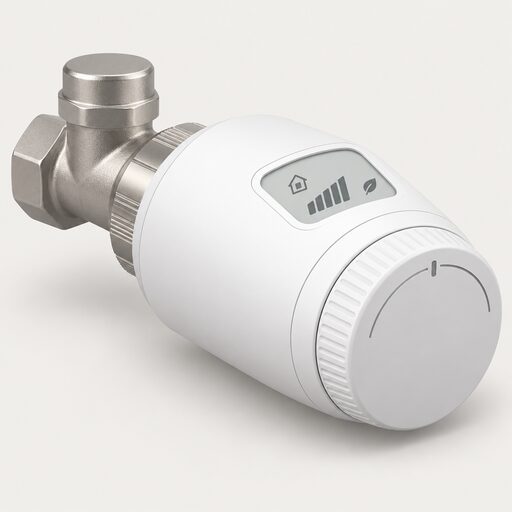 Controls and Energy IndependenceIf the broadband goes down, will your heating still come on?
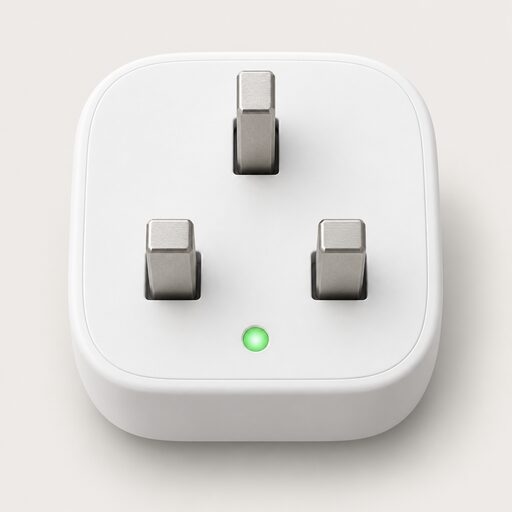 Smart Plugs and MonitoringWhich appliances are worth putting a smart plug on, and will it really show you what each one costs to run?
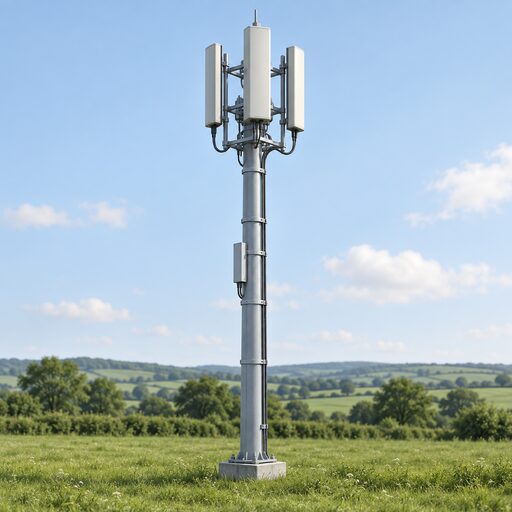 How Smart Meters CommunicateSmart meters send readings without using your home wifi or broadband, so they still work if your internet goes down.
 What a HEMS DoesWhat does a home energy management system actually do, and is it worth having one?