
In this answer
Short answer
Consent for smart meter data is not a single yes or no. Smart meter data is classified as personal data, owned by the consumer, and the consumer is the source of consent for any onward data-sharing1. In practice that means a household controls who can access its energy use data, how often and for what purposes, except where access is required for regulated purposes such as billing2.
The choice most households actually make is about granularity: how often the meter sends readings to the supplier. Monthly is the minimum, while daily and half-hourly are optional3. Half-hourly readings are what time-of-use tariffs and flexibility services are built on, so they carry both the greatest benefit and the greatest detail about life inside the home.
What consent means for smart meter data
Consent here is the mechanism that turns a metering device into a service. The data provided by a smart meter puts a household in control of its energy usage, meaning it can take energy-saving steps to reduce CO2 emissions2. Through the DCC network, smart meter data can be shared securely between authorised users, helping to support smart energy services and innovation across the energy sector4. Consent is what decides which of those authorised users is which.
The baseline is that the bill payer decides. It is the bill-payer's decision whether to get a smart meter6. That principle runs through the data rules as well: meter readings can only be shared with energy suppliers, and they cannot share this without the permission of the energy bill payer7.
Above that baseline sit the choices that are genuinely optional. Suppliers may offer new products and services, for example new tariffs, if permission has been given for this to happen8. Marketing use is therefore permissioned rather than assumed. The Consumer Consent Solution, a piece of consent infrastructure being built for the market, was designed with the original aim of providing consumers information about who is accessing their smart meter data and giving them the ability to make choices about that access where possible9. Its initial data scope is smart meter consumption data, expanding to other datasets as the Delivery Body's resource and priorities allow10.
For a household's energy independence, consent is the control point. The meter and the network do the measuring and the transmitting; consent decides how much of that detail leaves the home and what it can be used for. What it does not change is the underlying dependence: readings still travel over the DCC's network to a supplier, and the household remains connected to the grid and to a billing relationship.
Who can access your readings, and on what basis
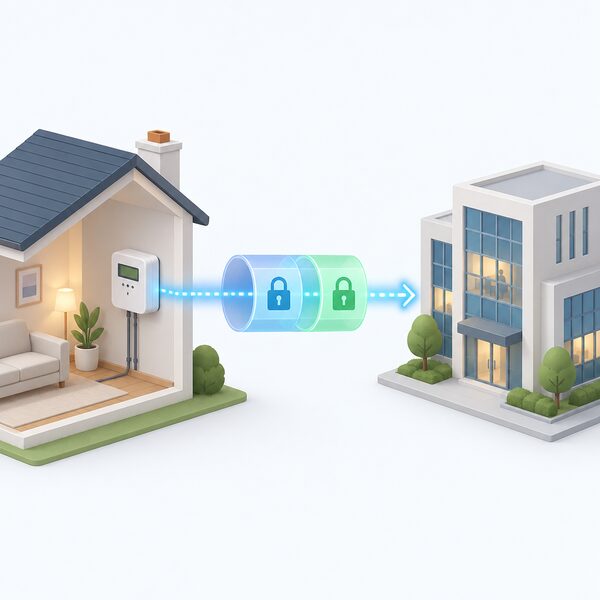
Access is narrower than many households assume. Only your supplier, or third parties when given explicit permission from the consumer, can see how much energy you are using and when4. Only your energy supplier can receive your meter readings, and only at intervals arranged between you and them6. When a smart meter is installed, all the readings are automatically sent via the DCC's secure network to your energy supplier11.
Distribution Network Operators are a separate case. They can access smart meter data for regulated purposes only, and before doing so they must agree a privacy plan with Ofgem1. That is a permissioned, purpose-limited route rather than an open one.
Third parties that are signatories to the Smart Energy Code face a stricter test again. They can access smart meter data of any granularity, but via opt-in consent only, with regular reminders of that consent, and based on confirmation that the request for the third party service comes from the individual1. If a supplier needs to share smart meter data with a third party, the household is notified and can opt out6.
| Who | What they can see | On what basis |
|---|---|---|
| Energy supplier | Readings, at intervals arranged with the household | Regulated billing purpose6 |
| Third party (SEC signatory) | Data of any granularity | Opt-in consent, regular reminders, request confirmed from the individual1 |
| Distribution Network Operator | Data for regulated purposes | Privacy plan agreed with Ofgem first1 |
| Anyone else | Nothing | Explicit permission required4 |
The security underneath this is not left to the supplier alone. The DCC network wraps smart meter data within two layers of encryption before sending it over a dedicated communications system, backed by the National Cyber Security Centre and in line with governance and data protection standards12. Smart meters are also covered by strict UK product safety laws, ensuring the same high quality and safety standards regardless of supplier13.
Granularity: half-hourly readings and what they reveal
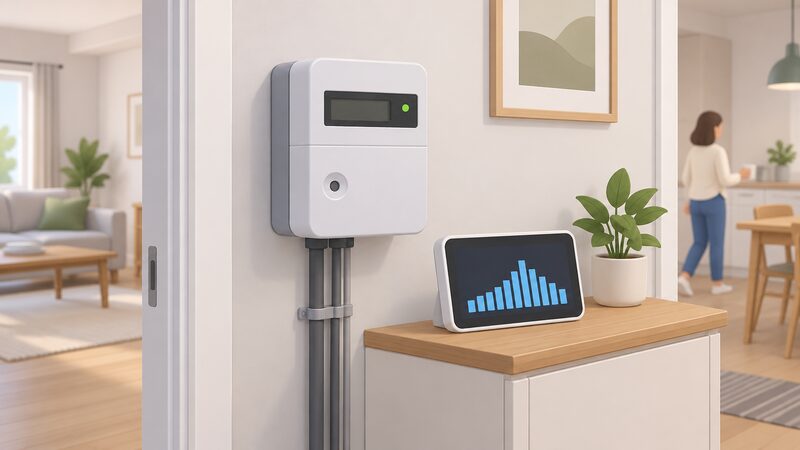
Granularity is the consent decision with the most visible consequences. Half hourly meter readings mean that a smart meter will send a meter reading to the supplier every 30 minutes14. Gas is recorded at the same interval: a smart meter records electricity use in near-real time, and every half hour for gas3.
That detail is what makes half-hourly data useful and what makes it sensitive. Researchers have mapped half-hourly gas and electricity consumption data into features that identify similar groups of households, which shows how much can be inferred from the pattern alone15. At the extreme end of what the metering system can record, parliamentary briefing material describes smart meter data recorded at half a second intervals16, far finer than anything a domestic tariff requires.
Households can see their own data at this resolution. If a smart meter has been in place for a while, half-hourly usage data can usually be downloaded from the supplier or an online account17. That is the same dataset a third party would need consent to reach.
The practical trade is straightforward. Monthly readings support accurate billing with minimal disclosure. Half-hourly readings support time-of-use tariffs, demand response and any service that needs to know when energy was used rather than how much. Smart meters also support demand response initiatives, where users can shift consumption to off-peak times18, and they enable participation in flexibility and demand response services19. None of that works on monthly data.
Consent for specific services: smart charging and demand-side offers
Some services cannot be delivered without a specific consent package, and it is worth knowing what each one asks for before agreeing.
The Demand Flexibility Service is the clearest example. To accurately measure energy usage in the home during a Demand Flexibility Service event, and to create a baseline measure, a smart meter capable of sending half-hourly readings is required, plus a baseline measure of the last 60 days of electricity usage and marketing consent20. Three separate things are being asked for: the meter capability, the historical data and permission to contact the household. Consumer action is required to take part21.
Time-of-use tariffs have a similar dependency. Smart time of use tariffs need a smart meter that communicates with your supplier every half hour17. A household that has chosen monthly readings is effectively choosing not to be eligible for that tariff shape.
Smart charging and flexibility offers sit in the same family. Smart meters enable participation in flexibility and demand response services19, and the consent model for these services is opt-in with the household confirming the request. The pattern across all of them is that the service provider needs a data feed the household would not otherwise send, and consent is the gate.
For energy independence, these services are the point at which a household stops being a passive consumer. Shifting load to off-peak times, or being paid for reducing use during an event, is a form of control over when energy is bought. The dependence that remains is on the supplier or aggregator running the scheme, on the meter communicating reliably, and on the household continuing to hold the consent that makes participation possible.
Withdrawing or changing your consent
Consent is not permanent. Because the household is the source of consent for onward data-sharing1, it can be changed, and the granularity setting is the most common thing to change. Moving from half-hourly to daily or monthly readings is a choice about how often the meter sends data to the supplier, with monthly as the minimum3.
There is a limit worth stating plainly. Refusing a smart meter altogether is a right, but it is not costless: while it is your right to refuse the installation of a smart meter, if a traditional meter needs to be replaced due to fault or safety, replacement options may be limited22. Consent choices about data are separate from the decision to have the meter at all.
Consent records themselves have rules. In the prepayment context, consent may be given in writing or verbally, but it must still be recorded with the consumer's knowledge and not given under duress23. That standard, knowledge and no duress, is a useful test for any consent a household is asked to give.
Checking what has already been agreed starts with the supplier. For meter migration specifically, the DCC worked with Citizens Advice to provide a tool that allows a household to check if a smart meter has been migrated onto the DCC network12. That matters because a meter that has not migrated may not be able to deliver the service the consent was given for.
Where consent rules come from and who enforces them
The consent framework is assembled from several layers rather than one statute. Smart meter data is treated as personal data owned by the consumer, with the consumer as the source of consent for onward sharing1. The Smart Energy Code sets the terms for third-party access, including the opt-in and reminder requirements1. Ofgem regulates suppliers and the metering arrangements, and the guaranteed standards for smart meters reference the Electricity and Gas Acts, which respondents to consultation asked be updated to clarify the standards apply only to SMETS meters24.
The network layer is operated by the Data Communications Company. Smart meters use a secure data network, managed by the Data Communications Company (DCC), to automatically and wirelessly send readings5. The DCC's own description of its role covers secure sharing between authorised users4 and the encryption and governance standards that sit behind it12.
Enforcement and redress run through the usual channels. The Energy Ombudsman handles smart meter disputes22, and supplier failure is covered separately: if an energy supplier goes out of business, a household's meter may not work in smart mode when it moves to the new supplier, and readings may need to be taken manually and submitted instead25. That is a reminder that consent arrangements are only as durable as the supplier relationship behind them.
For a household, the independence question has two halves. Consent gives real control over who sees energy data and at what resolution, and it is the gate to tariffs and flexibility services that reward shifting load. What it does not remove is dependence on a supplier, on the DCC network, and on the meter continuing to communicate. A household that wants to keep its data local has options outside the supplier route, including consumer access devices and local data access, and the wider picture is set out in Smart Meters and Home Energy Management.
Sources25 cited
- Data protection and smart meter data, Open Energy
- Smart meters and decarbonisation, Smart DCC
- What is a smart meter, Smart Energy GB, 2026-08-10
- Protecting data on the smart meter network, Smart DCC
- Smart meters vs home energy monitors, Smart Energy GB, 2026-08-17
- Data access and privacy, Smart Energy GB, 2026-03-16
- Smart meters for landlords, Smart Energy GB, 2026-03-16
- Get help with your smart meter, Ofgem, 2026
- Citizens Advice response to RECCo's Consumer Consent Solution design consultation, Citizens Advice, 2026-05-05
- Consumer Consent Decision, Ofgem, 2025-04-29
- How do smart meters save energy, Smart DCC, 2026
- Upgrading Britain's first generation smart meters, Smart DCC, 2026
- Myth busting smart meter problems, Smart Energy GB, 2026-09-17
- Time of use tariffs: the benefits, Smart Energy GB, 2026-04-24
- Identifying similar groups, Nesta, 2025-08-06
- POST note 0655, UK Parliament, 2026-09-17
- Should I switch to a time of use tariff, Energy Saving Trust, 2026-01-23
- How do smart meters reduce my bills, Smart DCC, 2025
- Smart meters, MCS Certified, 2026-07-24
- Understanding the Demand Flexibility Service scheme, Smart Energy GB, 2026-03-16
- How to get a smart meter, Smart DCC, 2026-06-10
- Smart meters, Energy Ombudsman, 2026-09-20
- Heat networks regulation: consumer protection guidance decision, Ofgem, 2026-01-13
- Final decision: smart meter GSOPs, Ofgem, 2026-01-30
- What happens if your energy supplier goes out of business, Ofgem, 2026
 Smart Meter Data and Who Sees ItWhat does your smart meter actually record, and who gets to see it?
 Who Owns Your Home Energy DataYour smart meter records how much gas and electricity you use, and that information belongs to you, not your supplier.
 Take a Meter ReadingWhich numbers do you actually read on a gas or electricity meter, and which ones do you ignore?
 Meters and Time-of-Use TariffsDo you need a smart meter for a time-of-use tariff, and does it have to send readings every half an hour?
 The Full Smart Meters GuideDo smart meters really save you money, and how do you use one to cut your bills?
 Get a Reading From a Smart MeterHow to bring up a meter reading on a smart electricity or gas meter when a manual reading is still needed, and the difference between the meter itself and the in-home display.