
In this answer
Short answer
Smart meters are not compulsory in the UK. No household is under any legal obligation to have one, and there are no plans for smart meters to become compulsory1. What is compulsory sits on the other side of the relationship: energy suppliers are obliged to offer every household a smart meter, and households are free to decline2.
The distinction matters because the two halves of the rollout are so often run together. Suppliers work to government-set targets and licence conditions that require them to take all reasonable steps to install a smart meter where a meter is fitted for the first time or a traditional meter needs replacing because of a fault3. That is a duty on the company, not a power over the resident. Parliament's own research on the Energy Bill [HL] 2022-23 records that there are no provisions in the Bill that would allow anyone to enter a property by force to install a smart meter, and that consumers retain the right to refuse installation4.
In practice, refusal is straightforward but not always costless. Where a traditional meter is faulty or unsafe, replacement options may be limited, and a supplier may fit a non-smart meter instead3. Where a radio teleswitch (RTS) meter is being retired, the choice narrows further, because smart meters are the technical replacement for RTS meters and can be programmed to deliver a similar service5.
Are smart meters compulsory? The short answer is no
The legal position is settled and consistent across official, independent and supplier-facing guidance. Smart meters are not compulsory; it is entirely your choice whether you accept one2. The Energy Saving Trust states the same in plainer terms: it is not compulsory to have a smart meter installed, and if your energy supplier offers you one, you can refuse8. The gas distribution network SGN, which has no interest in the electricity metering market, puts it as bluntly: you do not have to have a smart meter if you do not want one9.
The Welsh Government's climate action guidance frames the same fact from the household's side: smart meters are optional, but without one, a household misses out on easier billing and innovative tariff options10. That is the honest shape of the trade-off. Nothing in the rules compels acceptance, and nothing in the rules obliges a supplier to keep a household on the same metering arrangement indefinitely if the existing meter has reached the end of its life.
There is also no legal obligation on individuals in the UK to have a smart meter installed at home; installation is voluntary11. The Data Communications Company, which operates the national smart metering network, states the position for households directly: you are not under any legal obligation to have a smart meter12.
What follows from that is a household's energy independence in the narrow sense: the meter on the wall is not something that can be imposed. What does not follow is independence from the grid or from a supplier. A household that refuses a smart meter still buys electricity and gas from a licensed supplier, still receives bills, and still depends on the same wires and pipes. Refusal preserves a choice about metering; it does not change where the energy comes from.
Your rights when a supplier offers you a smart meter
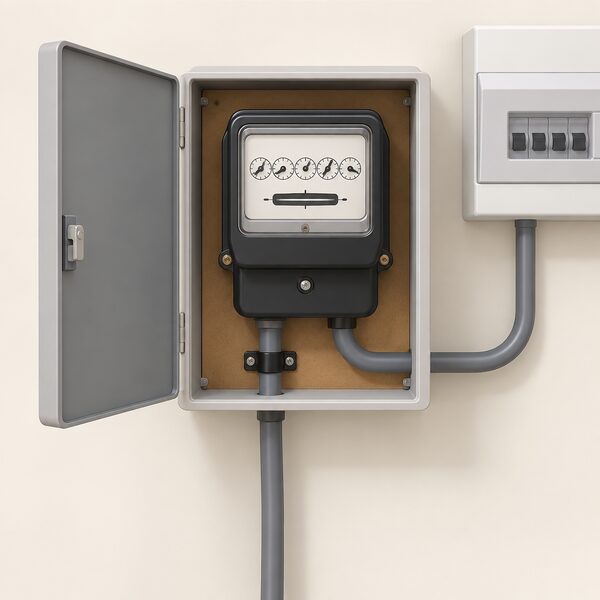
An offer from a supplier is an offer, not a notice. The right to refuse is explicit: you do have the right to refuse a smart meter if you do not want one13. The Energy Ombudsman, which handles disputes between households and suppliers, confirms the same right while noting the practical limit: while it is your right to refuse the installation of a smart meter, if your traditional meter needs to be replaced due to a fault or safety concern, replacement options may be limited3.
The government publishes a guide setting out the standards energy suppliers should follow at each stage of the customer's smart meter journey, covering the offer, the appointment and what happens afterwards14. Two obligations sit alongside it that households can rely on. All energy suppliers are legally obliged to give you an in-home display when your smart meter is first installed15. And under their licence conditions, suppliers are required to take all reasonable steps to install a smart meter where a meter is fitted for the first time or a traditional meter needs replacing due to a fault3.
There is a gap worth knowing about. There is currently no requirement for suppliers to install a smart meter on request, though a household that wants one can contact the supplier to ask3. So the entitlement runs one way: a supplier must offer, and a household may accept or decline, but a household cannot compel a visit on its own timetable. Consumer action is required to start the process, and the practical route is to ask the supplier directly16.
"While it is your right to refuse the installation of a smart meter, if your traditional meter needs to be replaced due to a fault or safety concern, replacement options may be limited."
For renters the position is more layered. Private renters whose energy bills are in their own name, or who prepay for energy, can choose to have a smart meter after checking the tenancy agreement and letting the landlord know3. Tenants who pay the bills in their rental property are entitled to ask for a smart meter, and Ofgem recommends telling the landlord before getting one2. Citizens Advice has warned that one in eight renters is at risk of missing out on vital support with energy bills, which is a reminder that the practical barriers for renters are often administrative rather than legal17. More on the rented sector sits in smart meters and monitoring in flats and rented homes.
Why suppliers are obliged to offer one to every household
The obligation on suppliers is the mirror image of the household's freedom. Energy suppliers are obliged to offer everyone in Britain a smart meter at no extra cost18. The government has set targets for energy suppliers to install smart meters in homes and businesses, and suppliers must offer all customers a smart meter before the end of the rollout under those targets1. All energy suppliers are obliged to offer their customers a smart meter before the end of the smart meter rollout19.
The dates attached to that duty have moved. Guidance states that the government requires energy suppliers to offer smart meters to all homes and small businesses across Great Britain by the end of 202520. Age UK's guidance states that energy suppliers are required to offer a smart meter to all households by the end of 20307. The two figures reflect different stages of the same programme: an earlier end-of-2025 milestone for the offer, and a later end-of-2030 deadline for completing installations in remaining domestic premises. Where documents disagree on the date, both should be read as the published position at the time each was written.
The mechanism behind the duty is regulatory rather than contractual. Energy suppliers were required to meet binding annual targets for installing smart and advanced meters21. Those targets are set by Ofgem and reported against, which is why suppliers chase appointments and why a household may receive repeated offers. The pressure is on the company's numbers, not on the household's consent.
The scope is Great Britain. Northern Ireland runs a separate metering market, and the supplier obligation described here applies to England, Scotland and Wales. Households in Scotland can read more in smart meters in Scotland, in Wales in smart meters in Wales, and in Northern Ireland in smart meters in Northern Ireland.
| Question | Position |
|---|---|
| Must a household accept a smart meter? | No, acceptance is the householder's choice2 |
| Must a supplier offer one? | Yes, to every household in Great Britain18 |
| Must a supplier install one on request? | No current requirement to install on request3 |
| Must a supplier install one at a meter replacement? | Yes, all reasonable steps where a meter is fitted or a faulty traditional meter is replaced3 |
| Is there a legal obligation on the household? | No12 |
Where smart meters are the only option: replacing RTS metering
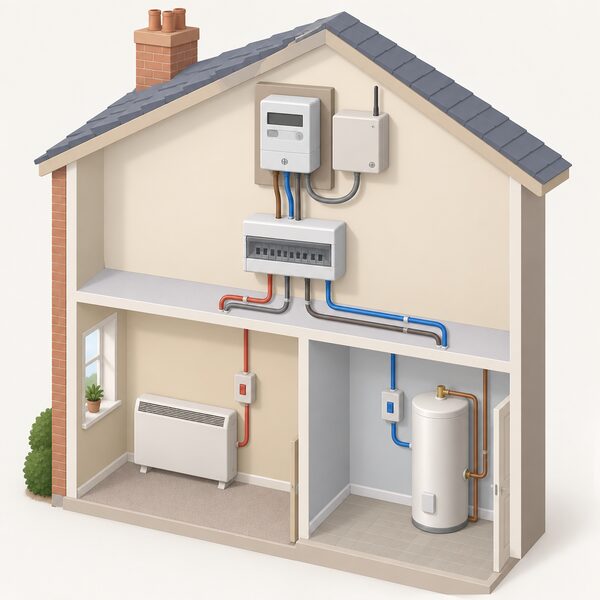
The clearest case where a household's choice narrows is the retirement of the radio teleswitch service. RTS meters, used widely with Economy 7 and Economy 10 tariffs, depend on a long-wave radio signal to switch between peak and off-peak rates. As that service is withdrawn, the meters that rely on it must be replaced. Smart meters are the only replacement, and residents must contact their energy supplier to arrange an upgrade22.
The technical reason is that a smart meter can do the same job. Smart meters are a technical replacement for RTS meters because they can be programmed to deliver a similar service5. Where a smart meter cannot be installed, the obligation does not disappear: the supplier still has to replace the RTS meter with a suitable alternative23. In practice that may mean a smart meter, a non-smart meter on request, or a non-communicating smart meter preset to switch between tariffs where there is no signal24.
For a household on an Economy 7 or Economy 10 tariff, the practical consequence of refusing a smart meter at an RTS replacement is that heating and hot water may be affected if the old meter stops switching correctly. The Welsh Government's advice to residents is direct: contact your supplier to arrange to have a new smart meter installed25. Home Energy Scotland gives the same instruction for households north of the border26.
This is the point at which the "not compulsory" answer needs its qualification. A household is never legally obliged to accept a smart meter. But where the existing meter is an RTS unit, or a faulty traditional meter, the alternative to a smart meter is another meter, not the status quo. The full picture of the switch-off is in Radio Teleswitch Service switch-off: what it means for you.
Safety: how smart meters are regulated in the UK
Smart meters are covered by strict UK product safety laws, which ensures that all smart meters have the same high quality and safety standards regardless of supplier2. The regime is not self-certified by manufacturers. Smart meters used across Britain have undergone one of the most rigorous smart safety testing regimes in the world and are installed by trained professionals27.
The technical basis is product safety legislation. All smart meters installed as part of the national rollout follow UK and EU product safety legislation, which covers the correct use of radio equipment and emissions28. They are covered by strict UK and EU product safety laws29. Every smart meter installed as part of the national rollout must meet a common set of technical standards, so different suppliers may install different makes and models while the safety baseline stays the same30.
Two further points are worth separating. First, the meters must have undergone checks to ensure they meet UK and EU safety standards27. Second, installation is carried out by trained professionals, and the rollout is being delivered across the UK under these rules31. The standards work is described in more detail in smart meter standards and accuracy, and the security of the wider system in can a smart meter be hacked?.
What this means for independence is limited but real. A household cannot inspect or verify a meter's compliance itself; it relies on the certification regime and on the installer. That is a dependence on regulation and on the supplier's engineer, and it does not go away with refusal. What a household does control is consent to the visit, and the choice of whether to accept the offer when it comes.
Sources31 cited
- Do I have to get a smart meter?, Smart Energy GB, 2026-04-01
- Myth-busting smart meter problems, Smart Energy GB, 2026-09-17
- Smart meters, Energy Ombudsman, 2026-09-20
- [Energy Bill [HL] 2022-23 research briefing](https://commonslibrary.parliament.uk/research-briefings/cbp-9865/), House of Commons Library, 2026-09-20
- Radio Teleswitch Service switch-off, National Energy Action, 2026-07-29
- How to get a smart meter, Smart DCC, 2026
- Energy advice, Age UK, 2026-08-24
- Guide to smart meters, Energy Saving Trust, 2026-07-15
- Smart meters, SGN, 2026
- Smart meters, Welsh Government, 2026
- How to bleed a radiator, Uswitch, 2026-09-04
- Do you have to have a smart meter by law?, Smart DCC, 2026
- Do I have to accept a smart meter?, Which?, 2026-05-12
- Smart meters: your rights and expectations, GOV.UK, 2025-08-08
- In-home displays and smart meters: 6 myths busted, ivie, 2024-02-14
- Get a smart meter, Smart Energy GB, 2026-06-10
- One in eight renters at risk of missing out on vital support with energy bills, Citizens Advice, 2022-06-10
- Smart meter costs: are smart meters free?, Smart Energy GB, 2026-03-16
- Can I get a smart meter?, Smart Energy GB, 2026-03-16
- Smart Energy GB FAQs, Smart Energy GB, 2025-12
- Supplier smart metering installation targets, Ofgem, 2026-09-17
- Act now: RTS switch-off could affect heating and hot water, Rent Smart Wales, 2026-06-15
- RTS meter switch-off, Energy Saving Trust, 2026-05-08
- Important reminder for Economy 7 and 10 meters, Centre for Sustainable Energy, 2026-06
- Get help with your smart meter, Ofgem, 2026
- RTS switch-off, Home Energy Scotland, 2026-09-20
- Smart meters and health, Smart Energy GB, 2026-03-16
- Does a smart meter need WiFi?, Smart Energy GB, 2026-03-16
- Safety and security, Smart Energy GB, 2026-03-16
- The installation process, Smart Energy GB, 2026-04-01
- Smart meters, MCS Certified, 2026-07-24
 The Full Smart Meters GuideDo smart meters really save you money, and how do you use one to cut your bills?
 Smart Meter RulesCan your supplier make you have a smart meter?
 Meters and Energy IndependenceDo smart meters really save you money, and can you still get one fitted for free?
 What Does a Smart Meter Cost?There is no upfront charge for a smart meter or a standard installation: the cost is recovered indirectly through energy bills.
 Meter Standards and AccuracyHow UK smart meters are certified for accuracy, how their readings become a bill, what happens when a meter stops communicating, and how a metering or billing dispute is escalated to a supplier and then to the Energy Ombudsman.
 Smart Meter InstallationCan your supplier make you have a smart meter, and how long should you wait for an appointment?