In this guide
Samsung EHS is the company's air to water heat pump line for homes, sold in the UK as monobloc units in both single phase and three phase versions. The current family is the EHS Mono HT, with a Quiet Mark certified variant, the Mono HT Quiet, sitting alongside it. Every model listed for the UK market is an air to water heat pump, meaning it heats radiators, underfloor loops or a cylinder rather than blowing warm air1.
The appeal for a household is straightforward: a heat pump runs on electricity rather than gas, so it moves a home off the gas grid and off a gas supplier. What it does not do is move a home off the electricity grid. The unit still draws power, and the amount it draws depends on how well the house holds heat and how the system is set up. Independent guidance states that heat pumps are suitable for most houses in the UK, and official guidance goes further, noting that studies suggest 90% of UK homes already have enough insulation to run one2.
Samsung is one of the larger players in this market. There are at least 33 manufacturers supplying air source heat pumps in the UK, with Mitsubishi Electric, Vaillant, Daikin and Samsung accounting for nearly two thirds of total annual UK sales4. That scale matters for spare parts and installer familiarity, though it says nothing about how any individual unit will perform in a particular house.
The range: Mono HT and Mono HT Quiet
Samsung's UK heat pump line is built around the EHS Mono HT, a monobloc air to water unit. The Mono HT Quiet is the same family with noise reduction as its headline feature, described by Samsung as a high temperature, low noise heat pump ideal for Europe's residential renovation market7. That framing points at the household it is aimed at: an older property with radiators sized for a boiler, where a higher flow temperature keeps the existing emitters in play.
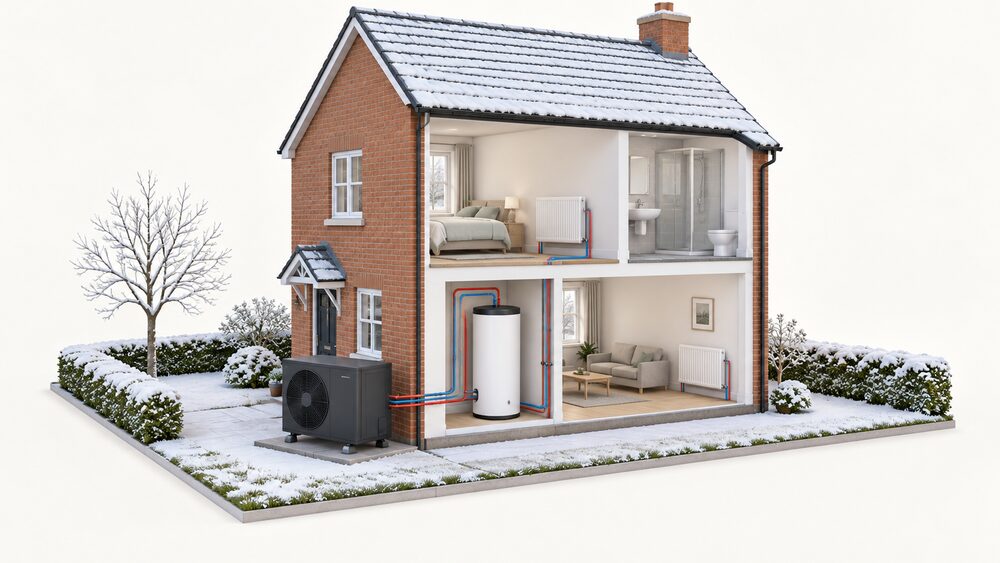
The monobloc design is the important structural fact. In a monobloc, the entire refrigeration circuit sits in the outdoor unit and the connection to the house is water pipework only. A split system separates the two, running refrigerant lines into the building. Government analysis of the heat pump stock expects monobloc units to dominate heavily, at 87% against 13% split by 2050, and notes that installations in new homes from 2025 are all monoblocs8. For a household, the practical difference is that a monobloc keeps refrigerant work outside the building, which simplifies installation and servicing.
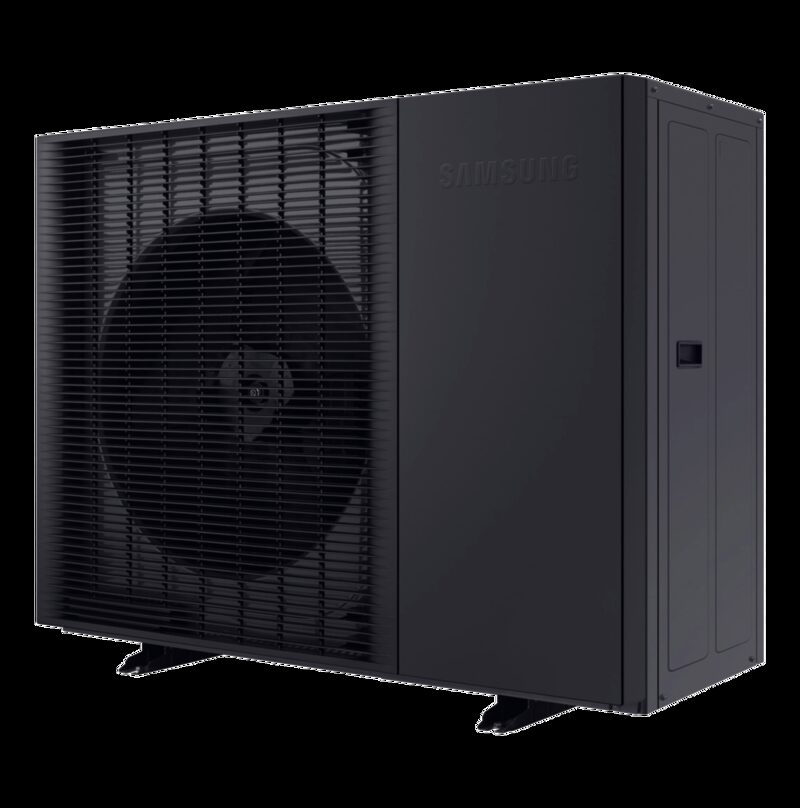
Samsung lists the Mono HT Quiet as a heat pump (air to water) with a premium dark colour intended to blend into a building, and easy side panel access for setup and maintenance9. Six Mono HT models carry Quiet Mark certification: the AE080BXYDEG, AE120BXYDEG and AE140BXYDEG in single phase, and the AE080BXYDGG, AE120BXYDGG and AE140BXYDGG in three phase1. Quiet Mark is an independent certification, so the noise claim is not solely the maker's.
Sizes and output: single and three phase
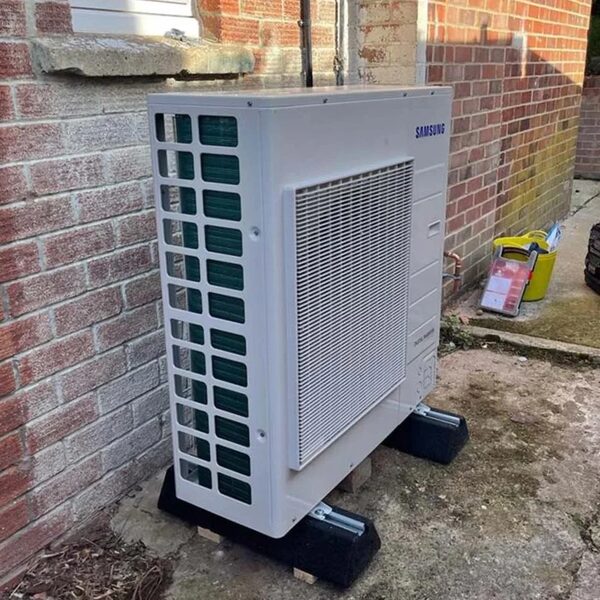
Samsung's UK listings cover single phase and three phase versions of the Mono HT, with model numbers that encode the output. The AE080 units are the smallest in the certified set, the AE120 units sit in the middle, and the AE140 units are the largest1. The naming runs across both the standard Mono HT and the Quiet variant, so a householder comparing quotes will see the same output offered in either form.
Phase matters more than many buyers expect. A single phase unit runs from the standard domestic electricity supply. A three phase unit needs a three phase connection, which most UK homes do not have, so specifying one usually means a supply upgrade. Samsung lists both, and the Quiet Mark certification covers both, but the choice is determined by what the property already has rather than by preference1.
Output sizing itself is not something a householder can settle from a product page. The right figure depends on the heat loss of the building, the radiators or underfloor loops already fitted, and the domestic hot water demand. Official statistics count hydronic heat pumps with a capacity up to 45kW, which is the range that covers domestic installations10. Above that, a unit stops being a domestic product.
Key specifications households weigh before choosing
The specification that Samsung leads on is cold weather performance. The Mono HT is described as capable of reliably providing 100% heating performance even in extremely cold weather, at temperatures as low as -25°C, and the product pages repeat the claim as 100% heating capacity at -25°C1. The test basis is stated: internal testing under lab conditions based on EN 145111. That is a manufacturer's test to a recognised standard, not an independent field trial, and it describes capacity rather than efficiency. A unit can hold its rated output at low temperature while drawing more electricity to do it.
Noise is the second specification. The Mono HT Quiet is described as powered by a combination of innovative noise reducing technologies, and the six certified models carry Quiet Mark listing1. Noise matters because of planning: permitted development rights for air source heat pumps are devolved, and the Planning Portal's guidance relates to the planning regime for England, noting that policy in Wales may differ12. A Welsh Government report on air source heat pump noise and permitted development rights exists precisely because the rules are not uniform13. A householder in Scotland, Wales or Northern Ireland is working to a different set of conditions from one in England.
Installation access is the third. Samsung describes the units as simple to set up and maintain with easy side panel access, and the Mono HT Quiet as easy and hassle-free to install and maintain1. That is a maker's claim about servicing convenience, and it matters most at the point when a unit needs attention rather than when it is new.
| Model | Phase | Certified | Key claim |
|---|---|---|---|
| Mono HT AE080BXYDEG | Single | Quiet Mark1 | 100% heating capacity at -25°C1 |
| Mono HT AE120BXYDEG | Single | Quiet Mark1 | Air to water, premium dark finish7 |
| Mono HT AE140BXYDEG | Single | Quiet Mark1 | EN 14511 test basis1 |
| Mono HT AE080BXYDGG | Three | Quiet Mark1 | Easy side panel access1 |
| Mono HT AE120BXYDGG | Three | Quiet Mark1 | Low noise sound level9 |
| Mono HT AE140BXYDGG | Three | Quiet Mark1 | 100% heating capacity at -25°C5 |
Buying in the UK: direct from Samsung
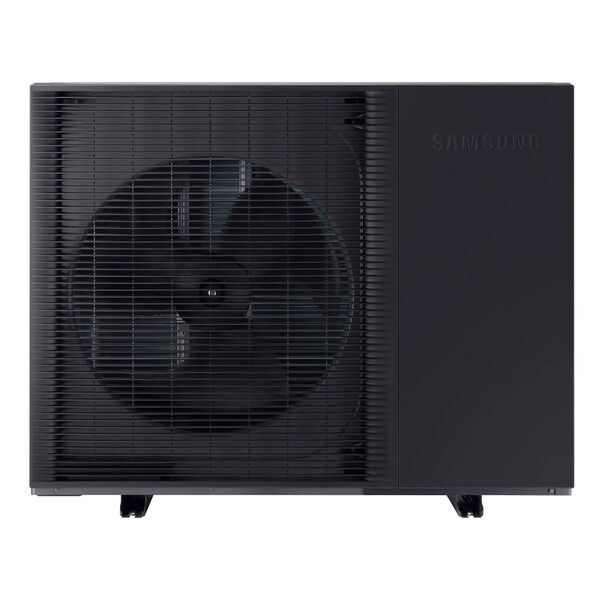
Samsung sells its EHS range through its own Climate Solutions GB site rather than through a published retail price list. Each product page carries a link to buy at Samsung, pointing to the GB section of samsung-climatesolutions.com1. There is no manufacturer list price for a supplied and fitted system in the material available, so the cost of an installed Samsung heat pump is installer-quoted after a survey of the property.
The wider market context is worth knowing. There were over 98,000 heat pump sales in the UK in 2024, and Samsung sits in the group of four brands accounting for nearly two thirds of annual UK sales4. The UK's domestic manufacturing sector is smaller than its market: it meets just over 30% of UK demand, so most units sold here are imported4. That has a bearing on lead times and on where spare parts come from.
Availability is the practical caveat. Samsung states that these products may only be available in specific regions1. A model listed on the UK site is therefore not a guarantee that it can be supplied and supported in a given postcode. The route to a firm answer is an enquiry through Samsung Climate Solutions or through an installer who already works with the brand.
For households weighing brands against each other, the heat pump manufacturers supplying UK homes page sets out how the main names compare, and Mitsubishi vs Daikin air source heat pumps covers two of the other high-volume brands.
SmartThings integration and connected home control
Samsung's connected home platform is SmartThings, and the company announced a new SmartThings Hub and supporting devices in September 2018 as part of opening up the connected home16. The platform is not limited to Samsung's own hardware: Heatmiser announced in May 2026 that its neo range integrates with Samsung SmartThings17. That pattern, a heating control maker joining a broader smart home platform, is how most households will meet SmartThings in a heating context.
Independent guidance describes the general benefit plainly: smart controls let a householder take control of the heating from wherever they are18. That is a real convenience, and it is also the clearest new dependence a connected heat pump creates. Remote scheduling, monitoring and diagnostics rely on a working broadband connection, the manufacturer's servers and an app that the manufacturer supports. Local control at the unit and at a wired programmer continues without any of that, but the remote layer does not.
For a household thinking about energy independence, this is worth separating from the fuel question. A heat pump changes where the heat comes from. A smart home platform changes who can see and adjust the system, and it adds a company to the list of parties the household depends on. The firmware updates and product support life page covers how long that support tends to last, and heating control manufacturers covers the controls market more broadly.
Service and support: what Samsung offers and what it does not
Samsung's best known at-home service is Doorstep Repair, launched in the UK in April 2018 for mobile phones and tablets in collaboration with WeFix, with a progressive 2018 rollout of seven-day in-home support for televisions and kitchen appliances19. It is a consumer electronics service. Nothing in the material available extends it to heat pumps, so a householder should not read a heat pump warranty or service promise into it.
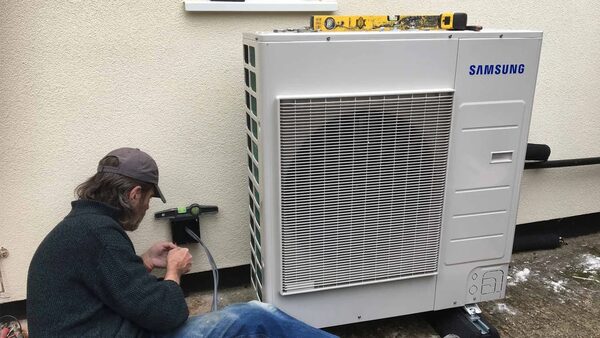
Heat pump support runs through a different route. Samsung's EHS product pages direct buyers to its Climate Solutions GB site, which is where product, installer and technical enquiries belong1. Beyond the manufacturer, there is public support for the sector: the Heat Pump Ready Programme supported the development of tools, technologies and processes to overcome specific barriers to domestic heat pump deployment, and support is available for installers and manufacturers to expand supply chains20. That is programme-level support for the industry rather than a service to an individual household, but it explains why installer capacity has been a focus of policy.
The practical position for a household is that the installer who fitted the unit is the first point of contact for a fault, and the manufacturer's technical support and spare parts route follows from there. The manufacturer technical support and spare parts page explains how those routes generally work, and manufacturer service and maintenance plans covers what a plan typically includes.
What owning a Samsung EHS means for household energy independence
A Samsung EHS heat pump changes the fuel a home runs on. It removes gas from the heating system, which means no gas standing charge, no gas supplier for heat, and no exposure to gas price movements for the largest energy use in most homes. That is the substantive independence gain, and it is the same gain any air source heat pump offers.
What remains is electricity. The unit draws power from the grid, so the household still depends on an electricity supplier and on the network. The scale of that dependence depends on the building: official guidance states that 90% of UK homes have sufficient insulation and electrical capacity to operate a heat pump, and a parliamentary briefing repeats the same figure3. Where a home falls outside that, the electrical capacity is the constraint that has to be resolved before a heat pump is viable.
Adoption is still low. Around 2 to 3% of UK households heat their homes using a heat pump, and England has around 9 heat pumps per 1,000 households on a cumulative basis22. A Which? survey of 1,004 UK homeowners who had considered heat pumps but were undecided or had decided against found that 50% of UK homeowners think there is too much conflicting information about the technology22. That is a confidence problem rather than a technical one, and it is worth naming because it shapes what a householder will be told when getting quotes.
The remaining dependencies are specific and worth listing plainly. The household depends on the electricity grid and a supplier. It depends on the installer who commissioned the system, since correct setup determines whether the unit runs efficiently. If smart controls are used, it depends on broadband and on Samsung's app and servers. And it depends on Samsung continuing to support the product line in the UK, which is a different question from whether the hardware works. The manufacturers and household energy independence page sets out how those dependencies compare across the sector, and the heat pump manufacturers supplying UK homes page covers the brands selling here.
Sources23 cited
- Samsung EHS Mono HT AE140BXYDEG Single Phase Heat Pump, Quiet Mark, 2026
- Heat pumps, Energy Saving Trust, 2026
- Heat pump guidance, UK Government, 2026
- Energy in non-domestic buildings and heat: 2025, Department for Energy Security and Net Zero, 2025
- Samsung EHS Mono HT AE140BXYDGG Three Phase Heat Pump, Quiet Mark, 2026
- Heat pumps and the transition to low carbon heating: committee report, House of Commons Environmental Audit Committee, 2025
- Samsung EHS Mono HT AE120BXYDEG Single Phase Heat Pump, Quiet Mark, 2026
- HFC phasedown reform de minimis assessment, Department for Environment, Food and Rural Affairs, 2025
- Samsung EHS Mono HT AE120BXYDGG Three Phase Heat Pump, Quiet Mark, 2026
- Heat pump deployment statistics: June 2026, Department for Energy Security and Net Zero, 2026
- Heat pump deployment statistics: March 2026, Department for Energy Security and Net Zero, 2026
- Heat pumps and planning, Planning Portal, 2026
- Air source heat pump noise and permitted development rights in Wales: phase 1 report, Welsh Government, 2024
- Samsung EHS Mono HT AE080BXYDGG Three Phase Quiet Heat Pump, Quiet Mark, 2026
- What the UK needs from the Warm Homes Plan, Energy Saving Trust, 2025
- Samsung announces new SmartThings Hub and supporting devices, Samsung, 2018
- Heatmiser central wiring centres, Heatmiser, 2026
- Level up your lifestyle with a heat pump, Plymouth Energy Community, 2026
- Samsung announces launch of new Doorstep Repair service, Samsung, 2018
- Heat Pump Ready Programme, UK Government, 2021
- Information about the Heat Pump Ready Programme, UK Government, 2026
- Beyond affordability: why heat pumps feel like a gamble, Which?, 2026
- Heat pumps used in central heating, England and Wales, Office for National Statistics, 2025
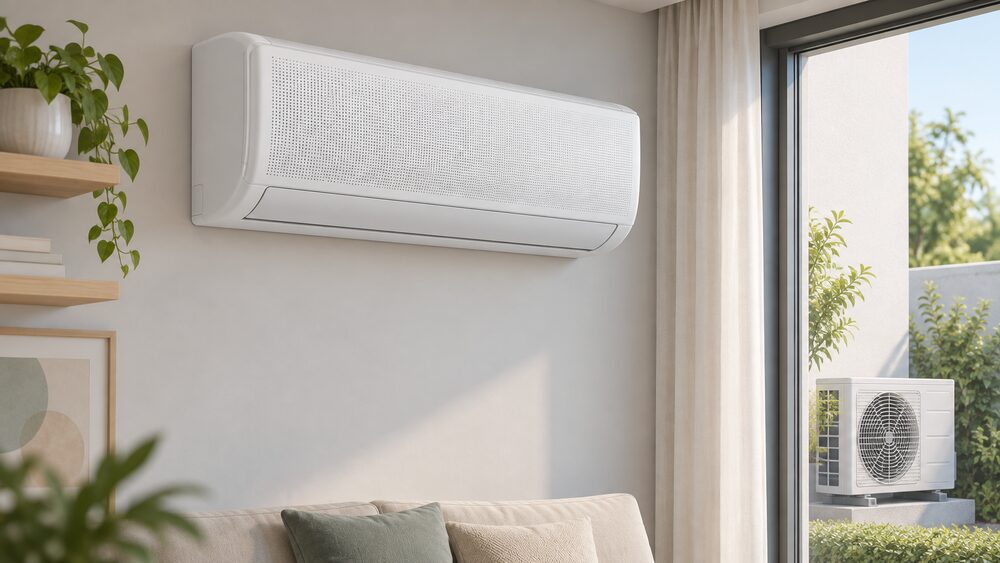 Samsung air conditioning and WindFree systemsSamsung air conditioning comes in wall, floor and ceiling units, and the WindFree models cool a room gently through thousands of tiny holes instead of blowing cold air straight at you.