
In this guide
Heatmiser is a British thermostat brand, now trading as IMI Heatmiser, whose controls are best known for underfloor heating and multi-zone systems. The company sits inside IMI and its dedicated Climate Control sector, and the same team in Blackburn continues to run product development, installer support and the smart heating range1. The brand was renamed in June 2025, and the maker states the change will not affect availability, compatibility or technical support1.
On price, independent guidance puts Heatmiser in the region of £200 depending on what you need, against £100 to £200 for most smart thermostats2. That is a guide rather than a published list price, and it moves with the number of zones and the type of wiring centre the installation needs.
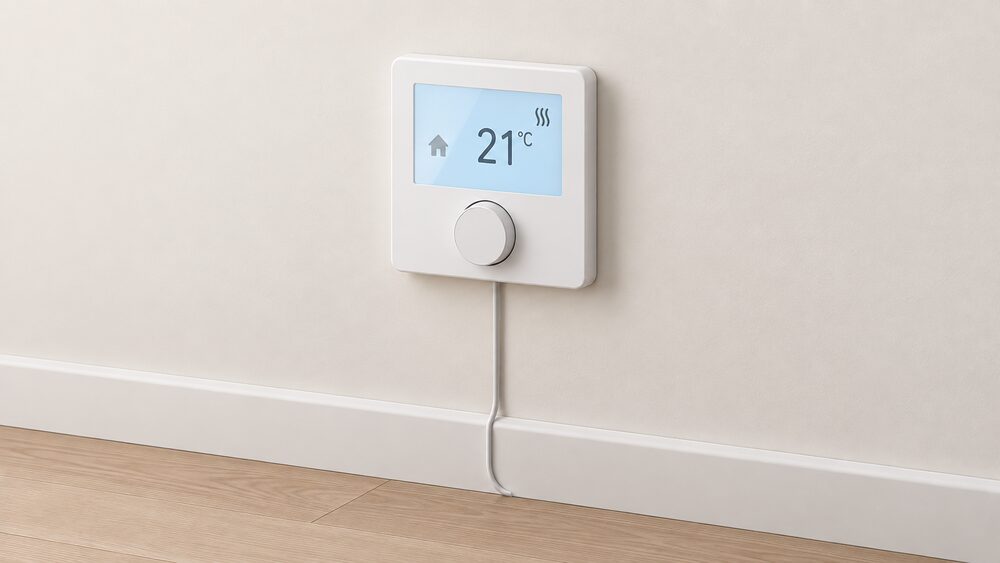
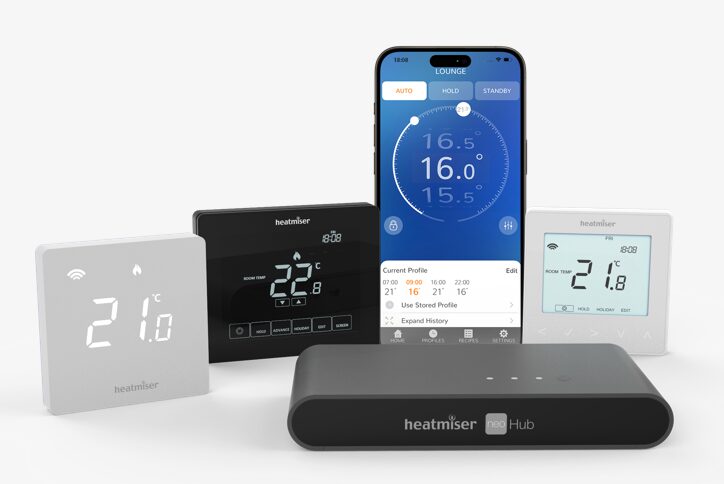
What a Heatmiser thermostat does is straightforward: it holds a room at a chosen temperature, calling for heat until the set point is reached and then switching off3. The neo range extends that across multiple zones and most heating systems, including radiators, electric underfloor heating and water underfloor heating4. The controls are made for zoning, and the wiring centres that sit behind them are the part most households never see.
Who makes Heatmiser: IMI Heatmiser and the Blackburn team
Heatmiser is part of IMI and its dedicated Climate Control sector, a relationship the company made explicit when it renamed itself IMI Heatmiser in June 20251. The maker describes the change as a refreshed brand identity that brings the business closer to its parent company, and states plainly that the rebrand will not impact availability, compatibility or technical support1. For anyone holding an existing Heatmiser system, that is the load-bearing sentence: the products, the app and the support arrangements continue.
The operational centre stays in the north west of England. The same team in Blackburn continues to drive product innovation, support the installer community and deliver the smart heating solutions the brand is known for1. That matters for a household weighing independence, because a UK-based support and installer network is a shorter chain than a brand with no domestic presence. It does not remove the dependence: the neo system's remote features run through a Heatmiser account and the maker's servers, so the company's continued operation is part of how the controls work.
The wider corporate picture is worth separating from the product. Heatmiser is not an independent company, and has not been since it became part of IMI. The brand name changed, the ownership did not. Independent guidance describes Heatmiser as launching in 2014 with a build-your-own approach to smart thermostats and home heating systems, which is a fair description of a range assembled from thermostats, hubs, wiring centres and receivers rather than sold as one sealed kit2.
Market position: leaders in underfloor heating thermostats
Heatmiser's reputation rests on underfloor heating and zoning rather than on the mass-market smart thermostat shelf. The company's own product pages describe the neo system as multi zone smart thermostat control for most heating systems, including radiators, electric and water underfloor heating4. That breadth is the point: the same control family can run a wet underfloor manifold, a set of electric mats and a radiator circuit.
Underfloor heating is a market where controls are not optional. BEAMA, the trade body, publishes homeowner guidance on underfloor heating as a distinct category7, and Warmup, which describes itself as the world's best-selling floor heating brand, notes that underfloor heating under carpet is controlled by using a thermostat8. Which? separates electric from water underfloor heating on installation cost, with electric lower9. In all three cases the thermostat is the interface between the floor and the household's energy use.
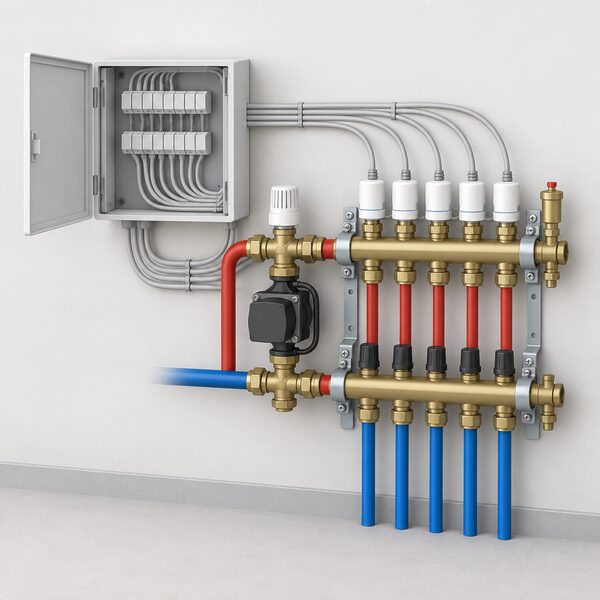
That is where Heatmiser's wiring centres come in. The UH6 is a 6 zone underfloor heating wiring centre designed to work with the maker's 230v thermostats10. The UH8 and UH4 can be used in conjunction with the mains thermostats, the UH8-N is designed for the 12v thermostats, and the UH8-RF v2 is designed for the wireless thermostats10. A household choosing Heatmiser is therefore choosing a control architecture as much as a wall unit, and the wiring centre determines which thermostats will work with it.
For a wider view of how manifolds, wiring centres and zone controls fit together, see underfloor heating controls and heating zoning.
The range and what a Heatmiser thermostat does
A room thermostat keeps a home at a steady temperature, turning the heating on until it reaches the chosen temperature and then switching it off3. A hot water thermostat does the equivalent job for a cylinder, stopping it becoming hotter than it needs to be and turning off the heat supply from the boiler once the water reaches the set temperature3. Heatmiser's range covers both ends of that, plus the switching gear in between.
The DS1 family is the basic wired end. The DS1 Basic, DS1 v2, DS1-L v2 and DS-SB v3 all carry a temperature range of 05-35C, and the DS1-L v2 incorporates an LCD that displays the actual room temperature5. The DS1 v2, DS1-L v2 and DS-SB v3 accept a remote sensor allowing temperature to be measured up to 20m from the thermostat location, which is useful where the control position is not representative of the floor or room5.
The RF Switch v2 handles a different job: it can cater for 2 heating zones and the hot water cylinder, and runs on a 230v AC supply11. The wiring centres run on 230v AC as well10. The neo range is the smart layer, and it is the part that carries the app, the integrations and the zoning.
| Product | Role | Key figure |
|---|---|---|
| DS1 Basic, DS1 v2, DS1-L v2, DS-SB v3 | Wired room thermostats | 05-35C range5 |
| DS1 v2, DS1-L v2, DS-SB v3 | Remote sensor support | up to 20m from thermostat location5 |
| RF Switch v2 | Zoning and hot water switching | 2 heating zones and the hot water cylinder, 230v AC11 |
| UH6 | Underfloor wiring centre | 6 zone, works with 230v thermostats10 |
| UH8, UH4 | Underfloor wiring centre | works with mains thermostats, 230v AC10 |
| UH8-N | Underfloor wiring centre | designed for 12v thermostats, 230v AC10 |
| UH8-RF v2 | Underfloor wiring centre | designed for wireless thermostats10 |
The practical question for a household is which of these the existing system needs. A single-room electric mat needs a thermostat and a floor sensor. A multi-zone wet system needs a wiring centre, one thermostat per zone and a manifold with actuators. The neo range adds the hub and app on top. For the wiring side, heating control wiring sets out how zone valves and wiring centres are arranged.
Price: in the region of £200 depending on what you need
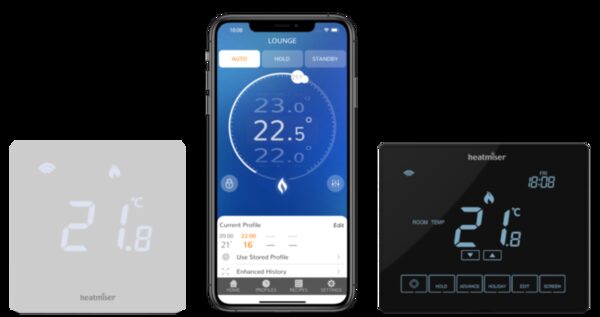
Independent guidance puts Heatmiser in the region of £200 depending on what you need2. The same source gives the market context: most smart thermostats cost between £100 and £200, but some will have add-ons such as installation which push the total higher2. Heatmiser sits at the top of that band rather than below it, which is consistent with a system built from several parts rather than a single replacement unit.
Comparisons in the same market show how wide the spread is. Drayton Wiser prices for the Wiser Kit 1 range from £195 to just under £470 plus installation costs if required2. A Worcester Bosch EasyControl Smart Thermostat is listed at £17012. Nesta puts a customer's outlay for a smart thermostat as low as £10013. None of these is a Heatmiser figure, and none should be read as one, but they show what a household is choosing between.
Three things move a Heatmiser quote. The first is the number of zones: a wiring centre and a thermostat per zone multiply the parts. The second is whether the system is wired or wireless, since the UH8-RF v2 is designed for wireless thermostats while the UH6 works with 230v thermostats10. The third is installation, which is quoted separately and depends on whether the work is a like-for-like replacement or a new zoning scheme.
For the wider cost picture across brands, how much do heating controls cost covers the market.
Smart integrations: IFTTT triggers and actions
Heatmiser's IFTTT channel is the maker's route to connecting the neo system to other apps and devices. IFTTT is described by the maker as an online platform that enables you to connect your Heatmiser Neo System to your favourite Apps and Devices14. The channel allows Applets that consist of a single trigger and multiple actions, so one event can set off several responses at once15.
The triggers are Temperature rises above, Temperature drops below, neoHub enters Home Mode and neoHub enters Away Mode15. The actions are Set Temperature Hold, Cancel Temperature Hold, Turn on neoPlug, Turn off neoPlug, Set Temperature, Boost Timer, Set Away Mode, Set Home Mode, Set Standby Mode, Cancel Standby Mode and Run Profile15. The neoPlug action is the one that lets a non-heating device be switched, which is how a fan or another appliance can be brought into a temperature rule.
Setup runs through the Heatmiser account. A household searches Heatmiser on IFTTT, goes into the Heatmiser Channel, presses Connect and logs in using the Heatmiser Neo Account username and password15. Connecting the two accounts gives IFTTT permission to control the Heatmiser system15. If the details are not recognised, the maker advises a password reset in the Heatmiser App, noting that this will change the details needed to log in through the app15.
The channel has been extended over time. In April 2021 the maker added Run a Profile and Cancel a Temperature Hold as new actions, with one more to follow, and listed Run a Recipe as coming soon14. That history is worth knowing because it shows the integration is maintained rather than fixed at launch.
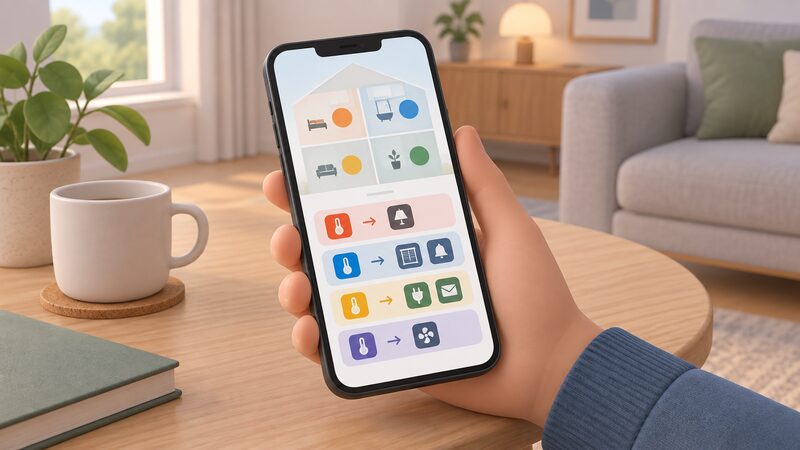
Samsung SmartThings support for the neo range
On 11 May 2026, IMI Heatmiser announced that its neo smart control system is now integrated with SmartThings by Samsung Electronics6. With the integration, neo can sit alongside a wider range of connected devices within the SmartThings ecosystem, and users can manage their heating from smart thermostats, connected controls and the neoApp6. The maker states the integration was requested by a wide range of customers, including large-scale housing developers and end users6.
The neo range itself is designed to offer multi zone smart thermostat control for most heating systems, including radiators, electric and water underfloor heating4. Alexa support runs alongside it: the Alexa Smart Home Skill makes the Neo system compatible with other Alexa Smart Home compatible devices and allows Neo devices to be added to Alexa Smart Home Routines, with the skill currently supporting English (U.S., U.K)4.
This is the clearest statement of what the integrations buy a household. A smart thermostat connects to Wi-Fi, which allows it to form part of a more connected home heating system16, and independent guidance notes that smart heating thermostats may interpret inputs such as preferred room temperature, learn from what you do and react to other data like weather forecasts17. Heatmiser's own route into that world is the neo hub, the account and the third-party platforms it supports.
The dependence is worth stating as plainly as the benefit. SmartThings, Alexa and IFTTT are third-party services. The rules a household builds live in those platforms, not in the thermostat, and they run only while the account, the broadband connection and the platform itself are working. Local control at the thermostat continues without them. For the wider picture, see smart home protocols for heating and smart heating control security and data.
Temperature alerts and what they can trigger
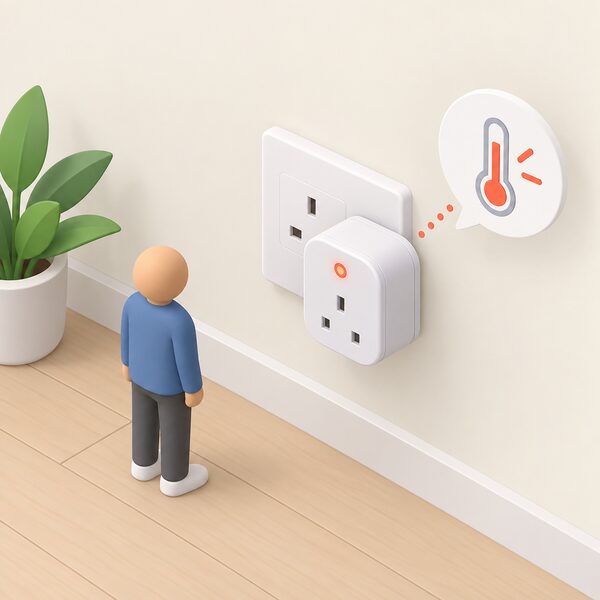
Heatmiser's alerting is built on the IFTTT channel rather than on a separate notification service. The Temperature rises above and Temperature drops below triggers are the two that matter for alerts, and each can be paired with actions including Turn on neoPlug, Turn off neoPlug and Set Temperature15. A household wanting a warning rather than an action would pair the trigger with a notification service inside IFTTT.
The low-temperature case is the one with the clearest independent guidance. For homes without frost protection, the heating will only come on if the temperature inside drops below 10 degrees C, so it will only use a small amount of energy18. That is the behaviour of a heating thermostat without frost protection, and it sets the threshold a household might want to watch. Home Energy Scotland publishes separate guidance on protecting pipes in winter18.
The high-temperature case has a limit worth knowing. Independent guidance states that if the room temperature is above 35 degrees C, a fan will likely heat you up rather than cool you down19. A rule that switches a fan on when a room passes a threshold is therefore useful in ordinary summer conditions and counterproductive in extreme heat. The same guidance source covers keeping a home cool in hot weather19.
Email notification exists in the wider thermostat market rather than as a stated Heatmiser feature. The Salus VS10BRF Wireless Digital Thermostat 230V is listed with free email notification available20. For Heatmiser, the equivalent route is an IFTTT action. On the safety side, Northern Ireland legislation describes a heat alarm containing a thermistor set to respond to temperatures above 58 degrees C by sounding an alarm21, which is a different device class from a room thermostat and is not a substitute for one.
What owning a Heatmiser thermostat means for energy independence
Heating controls let a household set and maintain the temperature in the home, keeping it warm for the times of day people are there and switched off to save electricity when they are not22. That is the benefit side, and it is real: a zoned system with a thermostat per area can avoid heating rooms nobody is using, and the neo range is built for exactly that4.
The limits are equally clear. Independent guidance on smart thermostats states the energy-saving benefit may be limited if heating is already well controlled, the home is poorly insulated, the thermostat is not set up correctly, features are unused, or heating habits stay the same16. A Heatmiser system is subject to all five conditions. It also shares a limitation common to the category: smart thermostats such as Hive and Nest can be expensive and have an installation cost, and having one means you are only tracking your heating, so you cannot keep an eye on your electricity and gas usage23.
On switching, the position is straightforward. The thermostat helps to control how much energy you use, but will not be a barrier to switching your actual energy deal2. A Heatmiser system does not tie a household to a supplier.
The dependence that remains is the cloud. Remote control, IFTTT rules, SmartThings scenes and Alexa routines all run through a Heatmiser account, a broadband connection and third-party platforms. Local control at the thermostat and the wiring centre continues without them. The company itself is part of IMI, so the brand's future sits with a larger parent rather than with an independent maker1. For a household weighing this up, heating controls and energy independence sets out the local-versus-cloud trade-off in full, and do heating controls save money covers the evidence on savings.
Sources23 cited
- Say hello to IMI Heatmiser, Heatmiser, 2025-06-24
- What are smart thermostats?, Uswitch, 2026-02-05
- Thermostats and heating controls, Energy Saving Trust, 2026-02-10
- Alexa thermostat, Heatmiser, 2026-01-06
- Room thermostats, Heatmiser, 2025-06-20
- IMI Heatmiser neo now integrated with SmartThings by Samsung, Heatmiser, 2026-05-11
- Underfloor heating: information for homeowners, BEAMA, 2026-09-19
- Underfloor heating under carpet, Warmup, 2026-09-20
- Electric vs water underfloor heating, Which?, 2026-05-27
- Central wiring centres, Heatmiser, 2024-06-20
- RF receiver repeater, Heatmiser, 2025-09-30
- How to buy the best smart thermostat, Which?, 2026-09-17
- HeatFlex: the untapped potential of automated heat pump flexibility, Nesta, 2024-11-19
- Heatmiser adds all new triggers and actions to IFTTT channel, Heatmiser, 2021-04-28
- Heatmiser IFTTT channel, Heatmiser, 2025-06-20
- What is a smart thermostat?, Smart Energy GB, 2026-08-19
- Smart homes, lower carbon footprint, Energy Saving Trust, 2026-01-21
- Protect pipes in winter, Home Energy Scotland, 2025-12
- How to keep your home cool in hot weather, Centre for Sustainable Energy, 2026-07
- VS10BRF wireless digital thermostat 230V, Salus Controls, 2026-09-20
- Domestic heating regulations (Northern Ireland) 2024, legislation.gov.uk, 2024-05-30
- Make winter feel like summer, Home Energy Scotland, 2026-09-20
- Ultimate energy saving tips guide, Smart Energy GB, 2026-04-24