
In this guide
Warmup describes itself as the world's best-selling floor heating brand, and it is the name most UK householders meet first when they search for electric underfloor heating1. The range covers electric mats, cables and foil heaters, plus water-based systems, and the maker states that its heaters are suitable for use with all floor finishes2. Buying in starts from less than £200 for a system, and Warmup states that a complete solution can be purchased from as little as £3503.
Running costs are the figure most people want. Warmup states that heating an average-sized bathroom with a modern electric underfloor heating system can cost as little as 13p per day, and that a typical bathroom floor costs less than £20 per year to heat4. Those are the maker's figures under suitable conditions, and the same page sets out what moves them: room size, insulation, floor covering, local electricity prices and how the system is programmed5.
What the system does for independence depends on which type is chosen. An electric system runs on mains electricity and needs no boiler, no gas supply and no cylinder, but it keeps the household on the grid and on an electricity tariff. A water system is tied to a boiler or heat pump, so it inherits that appliance's fuel dependence while running at lower flow temperatures than radiators6.
Warmup: the brand and what it sells
Warmup has over 25 years of innovation and expertise behind its thermostat range, and its electric systems are described as usable with almost any floor finish and in every room of the home9. The product families split by floor construction and by fuel. The Foil Heater is designed for installation under wood and laminate flooring or under soft and resilient floor coverings such as carpet, vinyl and other floating floor finishes10. Warmup states that most of its electric and water-based floor heating systems can be used with wooden floor finishes, and that the wood range facilitates an optimum temperature output that never exceeds 27°C11.
On the water side, Warmup sells systems that pump heated water through pipes installed within the floor construction, radiating warmth from the ground up, and states that it offers heating systems for all types of flooring: from carpet to stone, laminate, vinyl, tiles or wood12. Wet systems come designed and supplied with a full set of components and controls ready for installation12.
Quality assurance is stated as running through the ISO 9001 process and the testing requirements of BEAB7. Warmup also runs Warmup Pro, a community of approved installers that underfloor heating installers can join2.
Electric or water underfloor heating: which suits which home

The two technologies are not interchangeable, and Warmup's own guidance draws the line by project type. Electric systems are more popular with renovations and small to medium-sized rooms, while water products are more popular in new builds and large areas13. The maker's product pages put it more bluntly: electric is great for renovations, water is great for new-builds14.
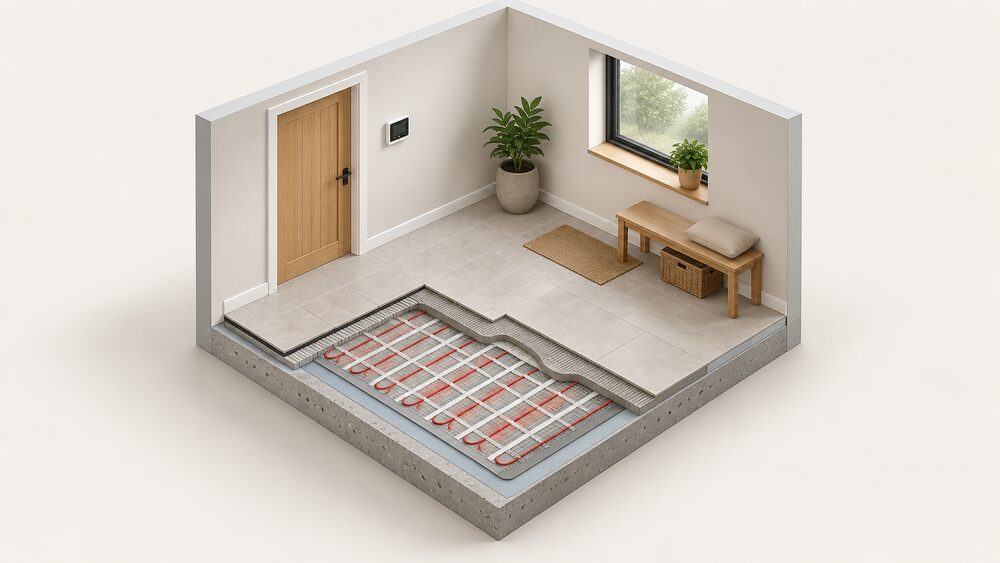
The practical split is zone size. Warmup states that electric systems are ideal for zones less than 25m² and water systems for larger zones over 25m²2. Electric systems suit single rooms, do not alter floor levels and are described as great for renovations; water systems are compatible with existing central heating systems and are described as great for new-builds2.
Water systems run at flow temperatures of 30 to 40 degrees, which is why they pair well with a heat pump or a condensing boiler12. The Energy Saving Trust confirms the principle: with a larger surface area than radiators, a wet underfloor heating system can be run at lower boiler or heat pump flow temperatures than radiators, saving money on energy bills6. The same guidance puts wet system installation at £85 to £110/m²6.
Electric underfloor heating uses electric wires installed beneath or within the floor15. NICEIC, the electrical registration body, divides electric systems into two modes: comfort heating, which takes the chill off the floor on cold days, and space heating, which is intended to warm the room16. NICEIC also notes that electric systems are often used for warming smaller spaces such as toilets, utility rooms or ensuites rather than whole properties, and that wet systems can cost around 25% more per square metre to install and usually require digging up the floor16.
For a household weighing independence, the choice is a fuel choice. Electric systems need no gas connection and no flue, but they draw on the grid. Water systems need a heat source, so the household's independence is only as good as the boiler or heat pump feeding them. The wider comparison of wet and electric systems sits in underfloor heating.
Cost: from under £200 to buy, from 13p a day to run
Warmup states that underfloor heating from the brand starts from less than £200, and that a complete Warmup solution can be purchased from as little as £3504. Those are equipment figures. Installation is separate and is quoted by the installer.
The maker's own guidance on labour is broad and varies by page. Warmup suggests about £200 to £300 per day as a reasonable estimate for a fully-qualified installer, and elsewhere states that labour costs can range from £100 to £300 a day for a qualified UFH installer2. For water systems, the guidance is around £200 to £400 a day for a qualified installer17. For retrofitting, the figure given is £150 to £250 a day for a qualified engineer, varying by location18. Warmup's general estimate for installing an underfloor heating system is about £4003.
Running costs are where the maker's figures are most specific. Warmup states that heating an average-sized bathroom with a modern electric underfloor heating system can cost as little as 13p per day, and that the average running cost after an initial heat-up period is 0.7836 p/m²/h5. The same source states that a typical bathroom floor costs less than £20 per year to heat4.
| Cost item | Figure | Basis |
|---|---|---|
| Entry price | from less than £200 | Warmup system4 |
| Complete solution | from £350 | Warmup system3 |
| Daily running cost | 13p per day | Average-sized bathroom5 |
| Annual running cost | less than £20 per year | Typical bathroom floor4 |
| Running cost rate | 0.7836 p/m²/h | After initial heat-up3 |
| Installer day rate | £100 to £300 | Qualified UFH installer3 |
| Water system installation | £85 to £110/m² | Independent guidance6 |
The variables that move the running figure are listed by Warmup as the size of the room, the insulation level of the property, the floor covering, local electricity prices and how the system is programmed5. Using a programmable thermostat and heating only occupied rooms can further improve energy efficiency and help reduce running costs5. Wider context on electric heating costs is in electric heating running costs.
Thermostats and controls: 4iE, 6iE, 7iE and Smartcare
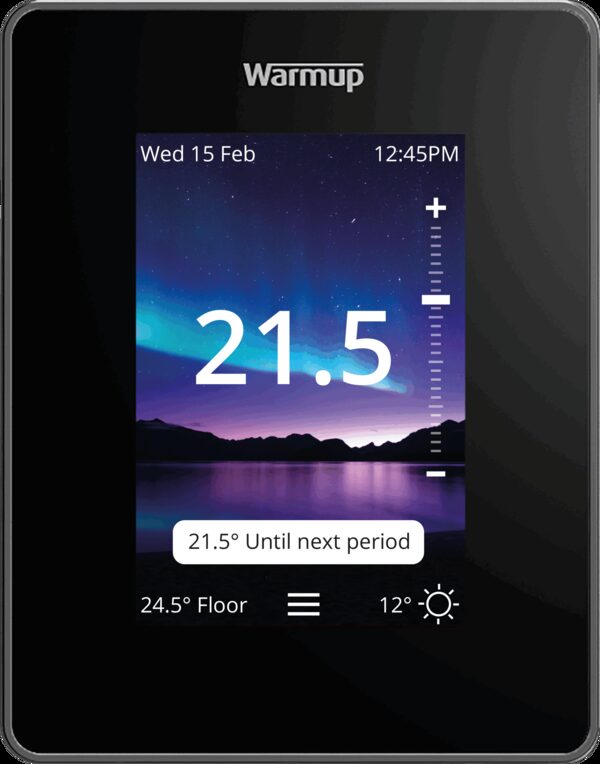
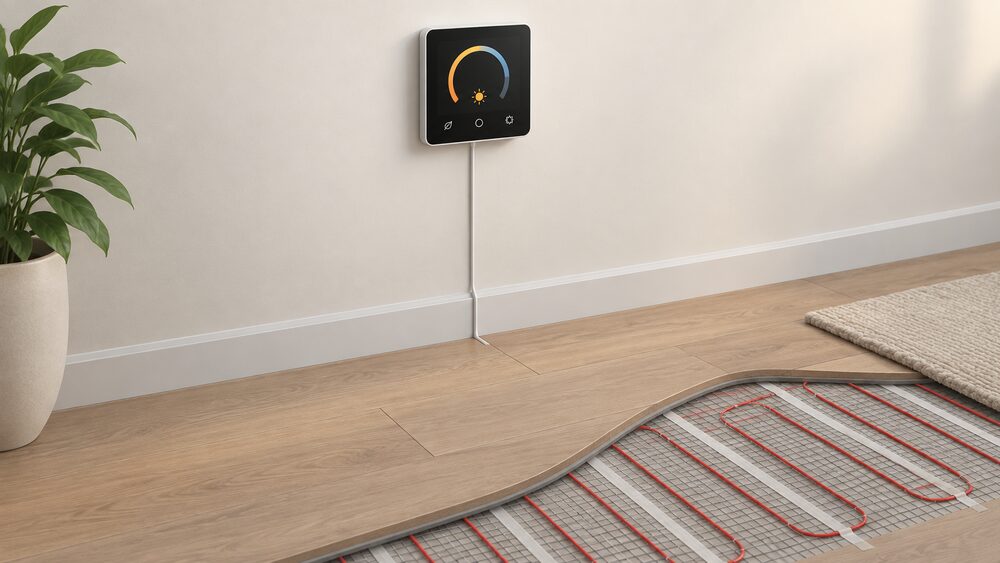
Warmup's smart thermostat range is the 4iE, the 6iE Mini and the 7iE, with the +Kit as an add-on for central heating. The 4iE Smart WiFi Thermostat is for use with both electric and water underfloor heating systems, and is compatible with Alexa for voice control19. The 6iE Mini WiFi Thermostat provides smart control for floor heaters in a compact package20. The 7iE Smart Matter WiFi Thermostat provides multi-zone, energy-saving control for floor heating systems of all scales21.
The +Kit is designed to work with the 4iE to upgrade the thermostat from being a heating controller for underfloor heating systems to one that wirelessly controls central-heating systems22. Warmup notes a condition: a household already using a 4iE to control underfloor heating zones will require a new 4iE to use with the +Kit to control the boiler and central heating in other rooms22.
Smartcare is the service layer. Using the 7iE with a Warmup underfloor heating system provides exclusive access to Warmup's Smartcare heating support, which offers remote diagnostics and instant, expert technical advice to fix most issues the heating system may develop, using data received from the 7iE, while assisting in improving a property's energy performance21. Electric systems carry access to bespoke 24/7 Smartcare10.
Remote control runs through two routes. Warmup's collection of smart thermostats can be connected to the MyWarmup online portal and the MyHeating smartphone app to manage and monitor heating settings and energy usage remotely9. That is the clearest dependence the range creates: the browser portal and the app both rely on a home internet connection and on Warmup's own servers. Local control at the thermostat continues without them, but remote scheduling, monitoring and diagnostics do not. General control options are covered in heating controls and thermostats.
Installation: timescales, installers and electrical requirements
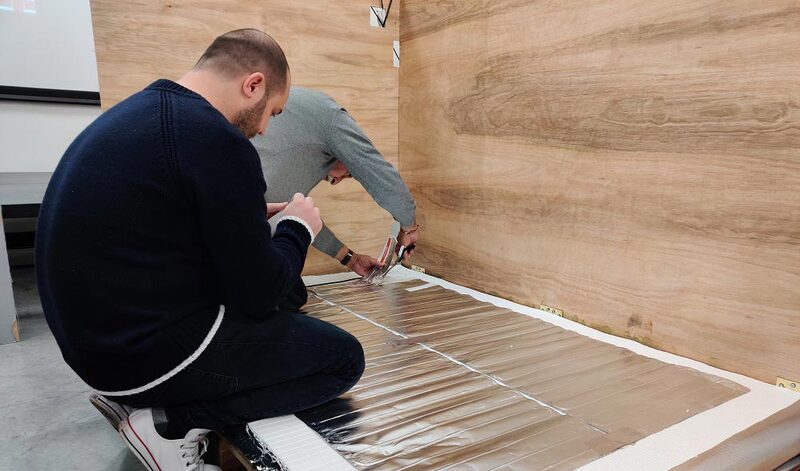
Warmup states that many of its systems can be installed in under a day, and that most systems can be installed within a room, start to finish, in about 1 to 1.5 days1. The maker's general line is that it takes one day to install most floor heating systems in one room2. The systems can be fitted by a competent DIY person, but a professional installer can also be used1.
The electrical side is not a DIY job. Warmup states that all electrical work, including wiring and connecting the thermostat to the heating system, needs to be completed by a part P certified or NICEIC electrician, and that all electrical connections should be completed by a qualified electrician1. All electric systems must be connected to the mains electricity source by a qualified electrician2. NICEIC's own guidance is that electric underfloor heating should use a registered electrician certified with a recognised certification body16.
Before installation, Warmup states that the electrical circuit must be capable of supporting the total current required by the heating system23. Each heating mat or cable must be wired in parallel to ensure the system operates safely and delivers the correct heating output24. Where the total electrical load exceeds the thermostat's rated capacity, a suitable relay or contactor should be installed so the thermostat can safely control the system without carrying the full load; heaters exceeding 16 amps need to be wired via a relay or contactor23. Thermostats can control underfloor heating totalling more than 16 amps if a contactor and RC unit are used in the circuit4.
Water systems are different again: installation should be conducted by a fully qualified floor heating installer17. Independent guidance agrees that these systems can be complex and should be installed by qualified professionals, and that in a wet system the installer needs to connect the pipes to a boiler or heat pump6. Warmup does not offer installation of its underfloor systems outside its Projects department, which handles bespoke heating solutions for new-build projects and larger renovations3.
Warranty: lifetime guarantees and the SafetyNet installation guarantee
Warmup states that many of its electric floor heaters come with lifetime guarantees, and that all its products are warrantied if the item is registered with Warmup within 30 days and installed by a qualified contractor in accordance with building code regulations2. The registration deadline is repeated in the maker's guidance: guarantees should be completed within 30 days of purchase2.
The terms vary by product. The Warmup PEX-a Underfloor Heating Pipe carries a lifetime warranty, and the PE-RT Underfloor Heating Pipe carries a 50 year warranty7. The 7iE thermostat carries 12 years if installed with a Warmup heater and 3 years if installed with a non-Warmup heater7. Warmup states that its heating systems require little to no maintenance and that all products are covered by market-leading warranties12.
The SafetyNet Installation Guarantee is the brand's distinctive term. Warmup states it was the first brand on the market to offer a SafetyNet Installation Guarantee on its heating wires and pipes, and that the guarantee protects against accidental damage caused to a Warmup system during the installation process7. Where a heater is damaged during installation, the guarantee will replace the heater for free, providing another heater of the same make and model, provided the terms and conditions have been met4.
"The SafetyNet™ Installation Guarantee does not cover any other type of damage, misuse, or improper installation due to improper adhesive or subfloor conditions and there is a limit of one free replacement heater per customer or installer."
The limits matter as much as the cover. The guarantee is tied to installation, not to performance afterwards, and it is capped at one free replacement heater per customer or installer7. Registration within 30 days is the condition that makes any of the terms live. General warranty practice is explained in boiler warranties.
Retrofitting an existing home versus specifying for a new build
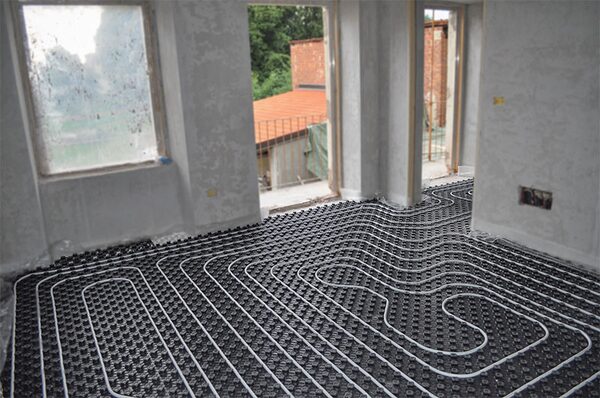
The two routes pull in opposite directions. Warmup recommends one of its low-profile electric systems or its Total-16 hydronic system for retrofitting a heater or where a project has fixed ceiling heights2. For a home being built from the ground up, the maker advises considering a water system during the design stages so its dimensions can be taken into account2. Warmup's product guidance adds that a hydronic system should be specified during the design stage in new-build homes so the deeper system build-up is accounted for14.
Independent guidance is firmer about retrofit. The Centre for Sustainable Energy states that underfloor heating is expensive and disruptive to retrofit, and is usually only a good option if significant building work is already being undertaken26. Uswitch notes that underfloor heating is particularly suitable for new-build properties or when work is already being done on the floor27. The Centre for Sustainable Energy describes solid-floor wet installation as built into concrete or screed, with insulation laid first and pipes set in a specific pattern before the concrete or screed is poured, common for new builds or large refurbishments26.
Insulation level decides whether electric underfloor heating can carry a room on its own. Warmup states that if a house is an older property with lower insulation levels, it is probably best to install an additional source of heat, and that the only way to be completely sure whether an additional heat source is needed is to seek advice from an architect or HVAC specialist who can carry out a heat-loss calculation28. Warmup recommends carrying out a heat-loss calculation before specifying a floor heater, and states that it can be conducted by an architect or a heating engineer and will help in choosing the correct heat output2. For loft installations, the maker states it is important to carry out a heat-loss calculation to work out the exact heating requirements for the space25.
Building regulation also bears on replacement work. Approved Document L states that a different-fuel replacement fixed building service should not produce more CO2 emissions per kWh of heat, or have a higher primary energy demand per kWh of heat, than the appliance being replaced29. The Future Homes and Buildings Standards consultation response records that the wording on floor coverings was modified so the overall design needs to take account of the thermal resistance of the floor covering, rather than setting a specific U-value30. New-build heating rules are set out in the Future Homes Standard.
What owning Warmup means for energy independence
The honest position is that Warmup underfloor heating reduces some dependencies and creates others. On the positive side, an electric system needs no gas connection, no flue and no cylinder, and Warmup states that its water systems need virtually no maintenance17. The maker also states that its heating systems require little to no maintenance and are covered by market-leading warranties12. An independent product page for a different underfloor brand makes the same point about the category: the system is maintenance-free, so no annual servicing costs are needed31.
The dependencies are concrete. An electric system runs on mains electricity, so the household remains on the grid and on a tariff, and the running cost moves with local electricity prices5. A water system is tied to a boiler or heat pump, so it inherits that appliance's fuel and servicing arrangements. Remote control through the MyWarmup portal and the MyHeating app depends on a home internet connection and on Warmup's servers9, and the Smartcare diagnostics service depends on data flowing from the 7iE back to the maker21. The lifetime guarantees depend on registration within 30 days and on installation by a qualified contractor7.
What the system does change is where the heat sits. Underfloor heating warms a home from the ground up by turning the floor into a large radiator, in NICEIC's description16. One householder case study describes the appeal plainly: "It saves space on my walls in a small flat and it's a very comfortable way to heat my home"32. Zoning is the other lever: an Edinburgh renovation uses underfloor heating and radiators zone controlled with individual room temperature controllers integrated into the wall switches33. Warmup's own advice points the same way, that using a programmable thermostat and heating only occupied rooms can improve energy efficiency and reduce running costs5.
For households looking at the wider picture, the Warm Homes Plan offers homeowners access to low and zero-interest loans to cover the costs of installing solar panels, battery storage, heat pumps, smart controls, home insulation and draught proofing34. The strategic view of what heating choice means for a household's independence is set out in heating and energy independence.
Sources34 cited
- Underfloor heating buying guide, Warmup, 2026-09-20
- Underfloor heating installation, Warmup, 2026-09-20
- Underfloor heating cost, Warmup, 2026-09-20
- Underfloor heating FAQs, Warmup, 2026-09-20
- How much does it cost to run Warmup electric underfloor heating, Warmup, 2026-09-20
- Underfloor heating, Energy Saving Trust, 2025-10-02
- Best warranties, Warmup, 2026-09-20
- Where do I connect the earth from the underfloor heating, Warmup, 2026-09-20
- Thermostats buying guide, Warmup, 2026-09-20
- Electric underfloor heating, Warmup, 2026-09-20
- Wood floor coverings, Warmup, 2026-09-20
- Water underfloor heating, Warmup, 2026-09-20
- Laminate floor coverings, Warmup, 2026-09-20
- Underfloor heating for the house, Warmup, 2026-09-20
- Electric heating, Energy Saving Trust, 2026-07-01
- Underfloor heating system, NICEIC, 2026-09-17
- Water underfloor heating buying guide, Warmup, 2026-09-20
- Retrofit underfloor heating, Warmup, 2026-09-20
- 4iE Smart WiFi Thermostat, Warmup, 2026-09-20
- 6iE Mini WiFi Thermostat, Warmup, 2026-09-20
- 7iE Smart Matter WiFi Thermostat, Warmup, 2026-09-20
- +Kit for central heating, Warmup, 2026-09-20
- What are the electrical requirements for my Warmup system, Warmup, 2026-09-20
- Can I connect one Warmup heater to another in series, Warmup, 2026-09-20
- Underfloor heating for the loft, Warmup, 2026-09-20
- Underfloor heating, Centre for Sustainable Energy, 2025-11
- Underfloor heating guide, Uswitch, 2025-12-10
- Can I use Warmup electric floor heating systems as a primary heating source, Warmup, 2026-09-20
- Approved Document L, Conservation of Fuel and Power, Volume 1: Dwellings, HM Government, 2026-09-17
- Future Homes and Buildings Standards Consultation Response, HM Government, 2026-03
- Ezy-Warm underfloor heating, UK Green Building Council, 2024-04-25
- Joanna Oloan: upgrading storage heaters with an air source heat pump, Energy Saving Trust, 2026-02-19
- Luxury home renovation, Edinburgh, KNX Association, 2026
- What the Warm Homes Plan means for you, Energy Saving Trust, 2026-01-23
 Warmup ThermostatsWhich Warmup thermostat works with your heating, and can it handle the size of your floor?