
In this guide
Warmup is a UK underfloor heating brand that also sells the controls for its systems, and its thermostat range splits along the same line as the heating itself. Electric floor heating is controlled by the 7iE, 6iE and Element smart thermostats; water floor heating, radiators and hot water are served by the Wireless range and the 5iE. Warmup states that its Smart range works with both underfloor heating and traditional central heating systems, and that its controls can suit underfloor heating only, central heating only, or in some cases both1.
The practical limits are electrical rather than clever. Most Warmup thermostats are rated to control loads of up to 16 amps, and the Element is listed at 16 A, roughly 3,680 W3. A maximum of two heaters can be wired directly into the back of a thermostat; beyond that a junction box is required5. Where the combined load exceeds the thermostat's rating, a contactor or relay handles the current while the thermostat acts as the control device3.
Warranty is where the brand's own heater range matters most. Warmup states that all thermostats carry a three year warranty, but the 7iE and Element are listed at 12 years when installed with a Warmup heater and 3 years with a non-Warmup heater6. Registration within 30 days of purchase is a condition of cover6.
What a Warmup thermostat does and which systems it suits
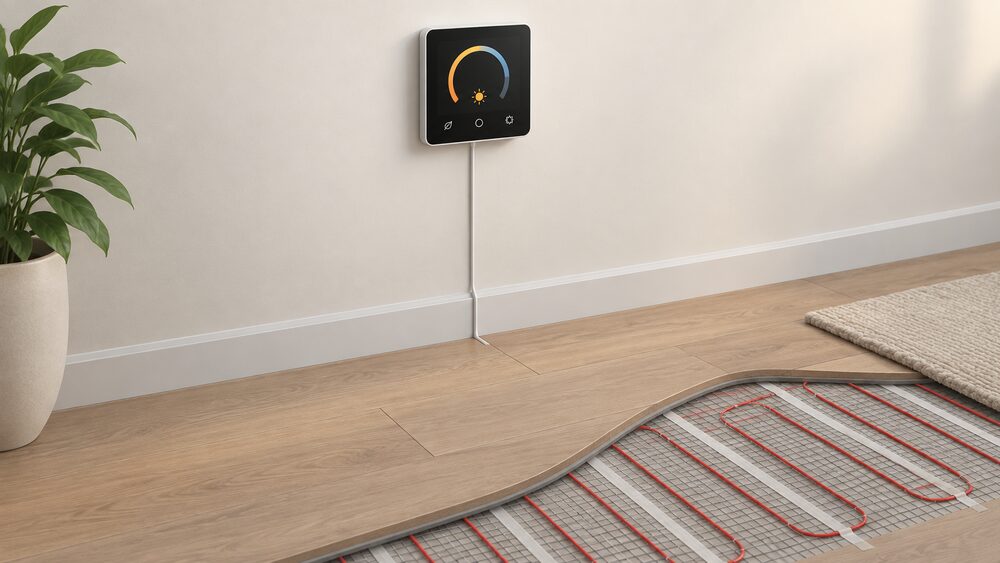
A thermostat measures room temperature and switches the heating to hold a set level9. What it switches depends on the system. In wet underfloor heating, the thermostat controls motorised valves on the manifold, regulating warm water flow; in electric systems it controls the electrical supply to cables or mats beneath the floor9. Warmup's own water systems are described as running automatically when connected to a Warmup thermostat, allowing self-regulation rather than overheating or underheating a space, and the control unit shuts itself down if the primary heating temperature drops below a set level, avoiding circulating cool water and wasting energy10.
The range is not confined to floors. Warmup states that its Smart thermostats work with both underfloor heating and traditional central heating systems1, and that its controls can be suitable for underfloor heating only, central heating only, or in some cases both2. The Wireless Thermostat is made for water underfloor heating, radiators and hot water, and controls heating, hot water, or both depending on how the system is set up11. The 5iE Wireless Smart Thermostat is specifically designed for homeowners with central heating, and is sold only online through the Warmup store12.
For a household, the distinction that matters is what the thermostat is switching. An electric underfloor thermostat is a load controller on a dedicated circuit, and its ceiling is the 16 amp rating. A water system thermostat is a valve controller, and its ceiling is the manifold and zone arrangement. Warmup states that most thermostats are designed to control one or more heating zones, provided the combined electrical load does not exceed the thermostat's maximum rated capacity13. Zoning arrangements are covered in more detail in underfloor heating controls.
The range: 7iE, 6iE, Element, Tempo and the Wireless controls
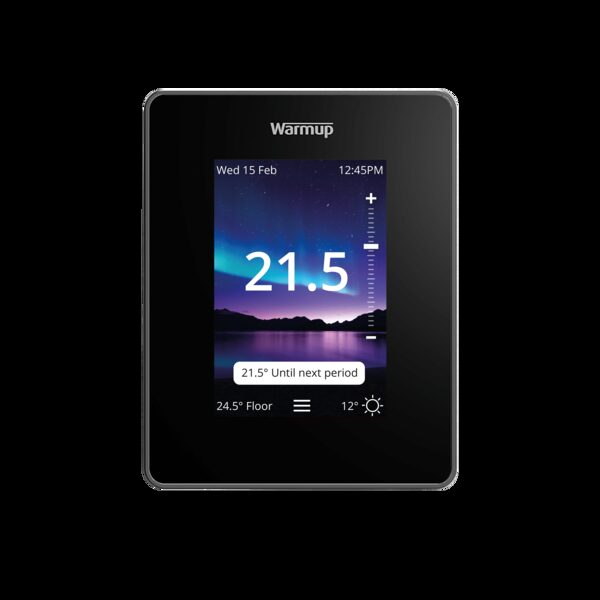
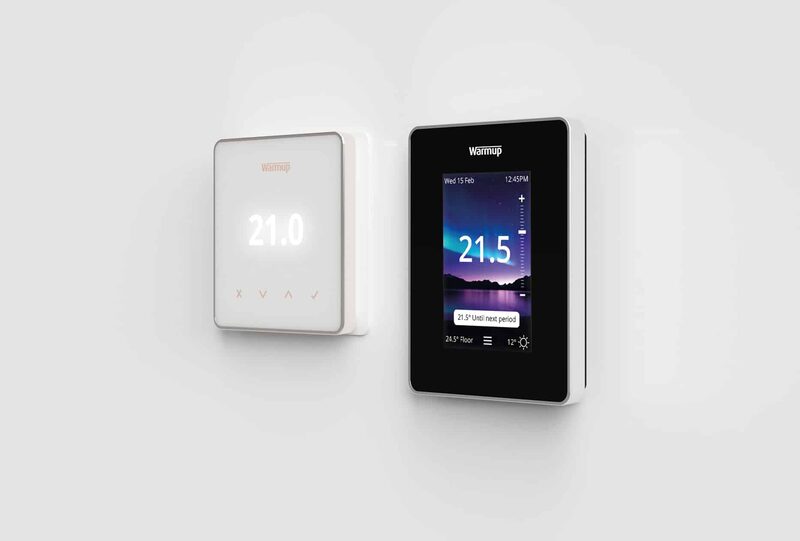
The 7iE Smart Matter WiFi Thermostat is the flagship. It provides multi-zone, energy-saving control for floor heating systems of all scales, uses SmartGeo technology to deliver automatic warmth without a programme being set up, and carries a full-colour touchscreen14. It is Matter compatible and integrates with Apple Home, Google Home and Amazon Alexa, and works with the MyHeating app for remote control14.
The 6iE Smart WiFi Thermostat uses air and floor or ambient sensing, with the sensor capable of being extended to 50m8. The Element Smart Thermostat with Smartcare is the entry point on price and carries the same 16 A rating4. The Tempo and MStat thermostats sit in the simpler part of the range and are listed at 3 years warranty6.
The Wireless range is a different architecture rather than a different thermostat. It consists of a programmable, battery powered wireless thermostat for each room, an 8-zone wireless wiring centre beside the manifold, and an optional hub connecting the system to a phone11. Programming modes are 5/2, 7-day and 24-hour, with four comfort levels a day, and Self-Learning Optimum Start calculates the ideal heat-up time so a room is warm when needed11. For an electric floor heater, Warmup directs buyers to the 7iE or the Element11.
| Model | Suits | Notable specification | Warranty |
|---|---|---|---|
| 7iE Smart Matter WiFi | Electric floor heating, multi-zone | Matter, Apple Home, Google Home, Alexa, SmartGeo14 | 12 years with a Warmup heater, 3 with others6 |
| 6iE Smart WiFi | Underfloor heating | Air and floor/ambient sensing, extendable to 50m8 | 12 years with a Warmup heating system8 |
| Element Smart with Smartcare | Electric floor heating | 16 A (~3680 W)4 | 12 years with a Warmup system, 3 with others4 |
| Wireless Thermostat | Water UFH, radiators, hot water | 5/2, 7-day and 24-hour programming, four comfort levels11 | 3 years6 |
| Tempo | Underfloor heating | Not stated | 3 years6 |
Smart features: voice control, weather updates and personalisation
Warmup lists travel and weather updates, voice control through smart home technologies, personalised background images and information on cheaper energy prices among the enhanced capabilities of its controls2. Its smart thermostats are also described as learning household habits to provide automatic heat functionality1, and remote access runs through the MyHeating app for smartphones or the My Warmup online portal1.
Those features sit within a wider category. Smart thermostats connect to Wi-Fi, which allows them to form part of a more connected home heating system15, and depending on the model may offer app control, voice control, hot water settings, location-based heating, reminders or alerts, open window detection, routine learning and heating-use tracking15. Remote control from a smartphone app, learning capabilities, geofencing, energy insights and integration with Alexa, Google Assistant and Siri are the common set9. Some go further, with multiple programmed settings, air quality monitoring, or acting as smart speakers themselves16.
The independence question here is straightforward. A Warmup thermostat keeps working as a local control if the internet drops: schedules, floor sensing and the boiler or mat switching are all handled at the device. What stops is remote access, weather-based adjustment, cheaper-price information and any voice control routed through a cloud assistant. The 7iE's Matter support means it can be commissioned into a local smart home ecosystem rather than only the maker's app, which is a meaningful difference for a household that wants control to survive a company's decisions. The trade-offs are set out in heating controls and energy independence and smart heating control security and data.
Electrical limits: 16 amps, dual voltage and when a contactor is needed
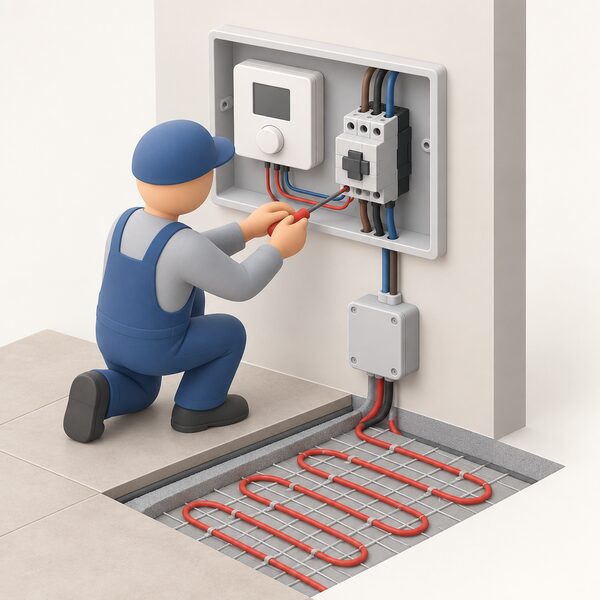
The load ceiling is the single most important number in the range. Most underfloor heating thermostats are designed to control loads of up to 16 amps17, and the Element is listed at 16 A, roughly 3,680 W4. Warmup's guidance is that a single thermostat can still control a system whose total electrical load exceeds 16 amps, provided the installation includes a suitable contactor or relay to handle the additional load3. In that arrangement the thermostat acts as the control device while the contactor switches the higher current the heating system requires3.
There is a second, separate limit on how many heaters can be terminated at the device. A maximum of two heaters can be wired directly into the back of the thermostat, and where more than two are installed the connections should be made via a junction box5. In many installations two heating mats or cables can be connected directly to a single thermostat13. The StickyMat 3D repeats the same rule: a maximum of two heaters per thermostat, then a junction box is required for safe usage18. A single thermostat can control multiple foil heaters provided they are all installed within the same heating zone or room and the total electrical load remains within the thermostat's rated capacity17.
Voltage is the third constraint. For lower voltage or volt-free systems, a contactor must be used, a condition stated on both the 6iE and the Element8. Warmup also notes that its thermostats can only handle up to 15 amps in some guidance, so where multiple heaters are connected at one location a relay and a larger breaker may be needed5. The documents give 15 amps and 16 amps for the same class of device; the 16 amp figure is the one repeated across the product pages and the load guidance, and the 15 amp line appears in a wiring context.
Where to place the thermostat in the room
Placement decides whether the thermostat is measuring the room or measuring an artefact of the room. Warmup's guidance is that the thermostat should be positioned in an area that properly reflects the room's typical temperature, not in a draughty spot or a hotter zone19. Independent guidance agrees that the best place is somewhere the temperature is relatively consistent20, and that a thermostat should sit on an inner wall in a frequently used room, away from draughts, direct sunlight and heat sources, at approximately 1.5 metres height, in a location representative of the whole house9.
The specific things to avoid are consistent across sources: above radiators or near heating vents, near external doors or windows, in kitchens, and near lamps or electronics that generate heat9. It should not be blocked by furniture or curtains, and should be kept away from electric fires or heaters and from draughts such as windows or a front door20. Where a room has additional local heating, the thermostat should not be in that room at all, since it will disrupt control of the rest of the house; a wireless thermostat can simply be moved out21.
For underfloor heating there is a further consideration. Where both a floor and a wall heating system are run from one thermostat, the thermostat must take its reading from the floor sensor18. The Wireless Thermostat offers floor sensing mode with an optional remote probe alongside its built-in air sensor11. Siting and sensor choice are covered further in room thermostats explained and how many room thermostats do I need for underfloor heating.
Electric or water underfloor heating: which the thermostat will control
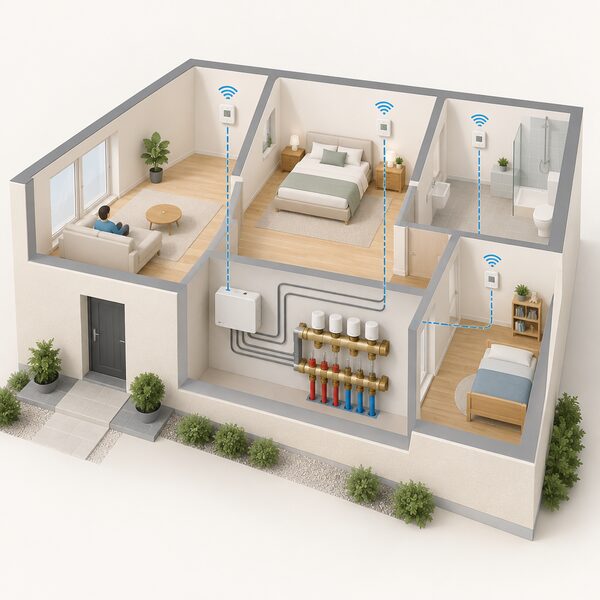
Warmup sells controls for both, and the choice of system is usually made before the thermostat. Warmup's own guidance is that electric systems suit zones of less than 25m² and water systems suit larger zones over 25m²22. Independent comparison puts the trade-offs plainly: electric underfloor heating has lower installation costs and higher running costs, while water underfloor heating has higher installation costs and higher efficiency than electric and radiators because it runs at a lower temperature23. Water systems also stay warmer for longer than electric systems, as the hot water remains in the pipes after the system switches off24.
That maps onto the controls. An electric system needs a thermostat that can switch a resistive load, which is why the 16 amp rating and the contactor rule matter. A water system needs a thermostat that drives motorised valves on the manifold9, which is why the Wireless range is built around a wiring centre and per-room thermostats11. Warmup states that its water systems can run automatically when connected to a Warmup thermostat, self-regulating rather than overheating or underheating a space10.
For a household, the independence picture differs by system. Electric underfloor heating runs on electricity, so it depends on the grid and a supplier but not on gas, and it can be paired with a time-of-use tariff. Water underfloor heating depends on whatever heat source feeds the manifold, typically a gas or heat pump system, so it inherits that fuel dependence. Neither depends on the thermostat maker for basic operation, but both depend on the thermostat for control. The wider comparison is at electric vs water underfloor heating.
Warranty: three years on the thermostat, longer with a Warmup heater
Warmup states that all thermostats carry a three year warranty25. The longer terms are conditional on what the thermostat is connected to. The 7iE is listed at 12 years if installed with a Warmup heater and 3 years if installed with a non-Warmup heater6. The Element carries the same split6, and its product page states 12 years when installed together with a Warmup heating system, 3 years with other systems4. The 6iE is listed at 12 years with a Warmup heating system8. The Tempo and MStat thermostats are listed at 3 years6.
The heater warranties are longer still, which is the point of pairing. Warmup lists a 15 year warranty on the Foil Heater, a lifetime limited warranty on the Sticky Mat system, the Loose Wire system and the Inscreed Heating Cable, a 50 year warranty on the PE-RT underfloor heating pipe, and a 10 year warranty on the manifold6. Pumps and actuators are listed at 2 years6.
Two conditions apply across the range. Warmup states that all products are warrantied if the item is registered with Warmup within 30 days and installed by a qualified contractor in accordance with building code regulations6, and that guarantees must be completed within 30 days of purchase22. The company also runs a SafetyNet Installation Guarantee, which it says it was the first brand on the market to offer on heating wires and pipes: if an electric or water floor heating system is accidentally damaged during installation, Warmup replaces the damaged part free of charge19. Quality assurance is described as running through an ISO 9001 process and BEAB testing requirements6.
Cost, buying in the UK and installation
Warmup publishes guide prices for some thermostats and not others. The Element Smart Thermostat with Smartcare is listed from £92.00 RRP ex. VAT4, and the 6iE Smart WiFi Thermostat from £155.44 RRP ex. VAT8. Both figures are ex-VAT guide prices rather than installed costs. The 5iE Wireless Smart Thermostat is available only to purchase online, through the Warmup e-commerce store12.
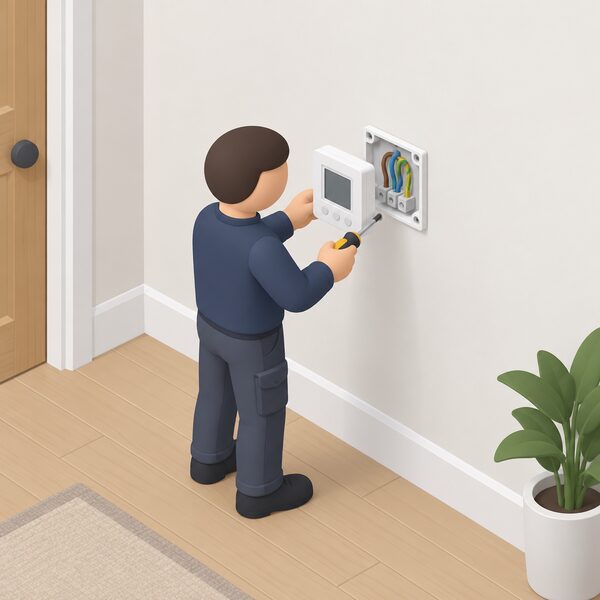
Installation is not something Warmup does for domestic customers. The company states that, outside its Projects department, it does not offer installation of its underfloor systems26. A complete Warmup solution can be purchased from as little as £350, which is a system price rather than a thermostat price26. Warmup's own guidance on whether a thermostat can be installed by the householder is covered in its support material13, and the general position on DIY and warranty is set out in does DIY thermostat installation affect my warranty.
The cost of the control is therefore a small part of the cost of the system, and the system cost is a small part of the decision. What a household is buying with a Warmup thermostat is a control layer that works locally, holds a schedule without a connection, and in the 7iE's case can be commissioned into a Matter ecosystem rather than only the maker's app. What it does not remove is the dependence on electricity for an electric system, on a heat source for a water system, and on the manufacturer for app features, firmware and the extended warranty terms that hinge on which heater the thermostat is attached to.
Sources26 cited
- Warmup Smart Thermostats, Warmup, 2026-09-20
- Thermostat Buying Guide, Warmup, 2026-09-20
- The heaters total more than 16 amps: is it still possible to use one thermostat?, Warmup, 2026-09-20
- Element Smart Thermostat with Smartcare, Warmup, 2026-09-20
- Loose Wire System, Warmup, 2026-09-20
- Warmup Warranties, Warmup, 2026-09-20
- Testing the underfloor heating system: what setting should the multimeter be on to test floor probes?, Warmup, 2026-09-20
- 6iE Smart WiFi Thermostat, Warmup, 2026-09-20
- Heating thermostat, tado°, 2026-08-03
- Water Underfloor Heating Buying Guide, Warmup, 2026-09-20
- Warmup Wireless Thermostat and Heating Controls, Warmup, 2026-09-20
- 5iE Wireless Smart Thermostat Plus Kit for Central Heating, Warmup, 2026-09-20
- Can I install a thermostat myself?, Warmup, 2026-09-20
- 7iE Smart Matter WiFi Thermostat, Warmup, 2026-09-20
- What is a smart thermostat?, Smart Energy GB, 2026-08-19
- Turning down thermostats, Smart Energy GB, 2026-04-22
- Can I use one thermostat to control multiple foil heaters?, Warmup, 2026-09-20
- StickyMat 3D, Warmup, 2026-09-20
- Underfloor Heating Maintenance Tips, Warmup, 2025-08-06
- Heat the whole house or one room?, Uswitch, 2026-08-20
- Energy savings tips, British Gas Energy Trust, 2026-02-27
- Underfloor Heating Installation, Warmup, 2026-09-20
- Electric vs water underfloor heating: installation, efficiency and user reviews compared, Which?, 2026-05-27
- Underfloor heating costs, Which?, 2026-05-27
- My thermostat says the system is on but the floor is not heating up, Warmup, 2026-09-20
- Underfloor Heating Cost, Warmup, 2026-09-20
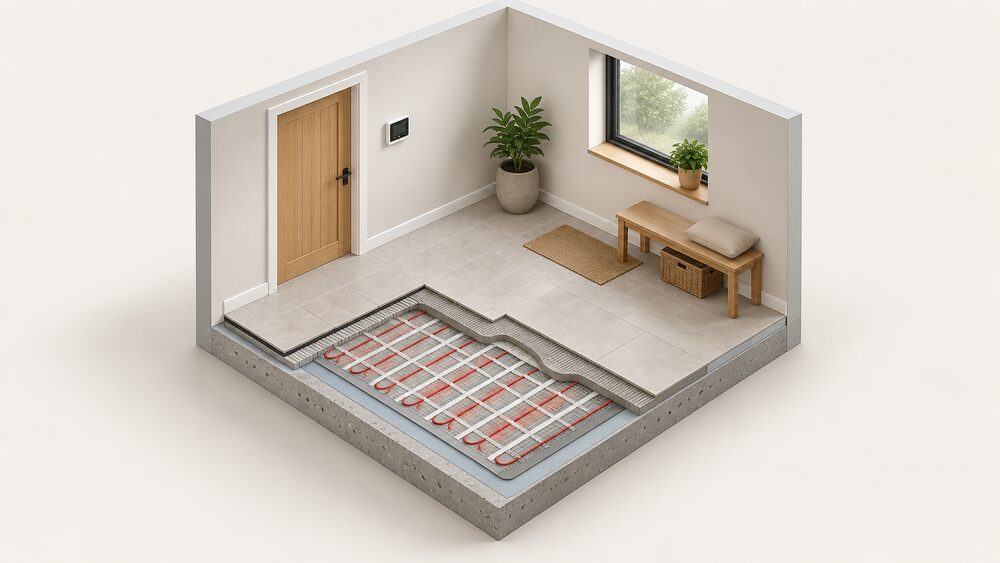 Warmup underfloor heating and thermostatsWarmup underfloor heating costs from under two hundred pounds, and running a bathroom floor can work out at pennies a day.