
In this answer
Short answer
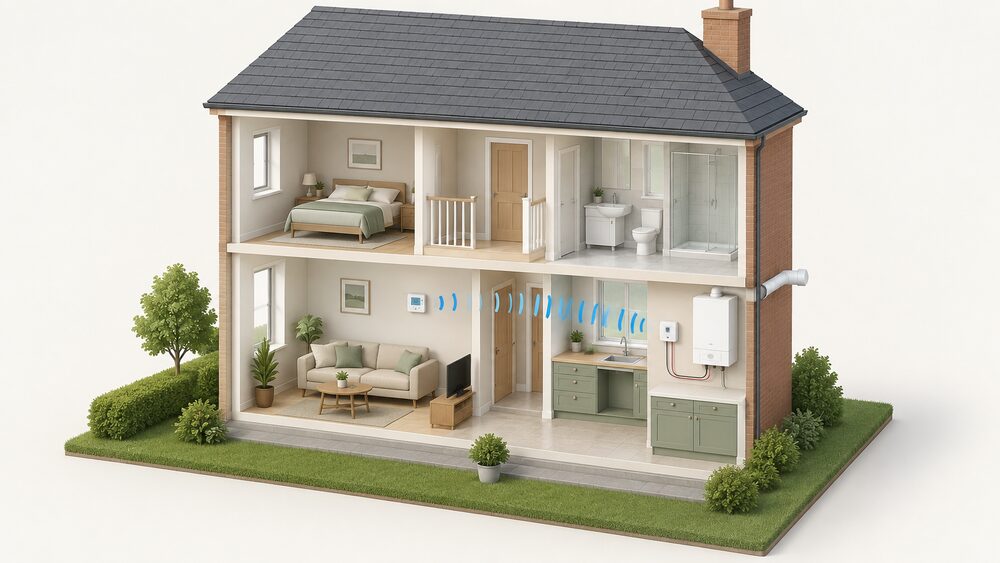
Yes, OpenTherm can be used wirelessly. The protocol itself is defined as a manufacturer-independent system of communication between modulating heating appliances and room thermostats, and it "can also be used as a wireless protocol"1. What changes in a wireless setup is only the link between the thermostat and the boiler: the thermostat sends a radio signal to a receiver, and the receiver is wired to the boiler2.
That distinction matters because it is where most of the confusion sits. A wireless OpenTherm thermostat is not a thermostat that talks to the boiler over the air from end to end. It is a thermostat that talks to a receiver over the air, and a receiver that talks to the boiler over the same two low-voltage wires a wired OpenTherm control would use1. The modulating conversation between control and boiler is preserved; only the last few metres of cable between the room and the boiler are replaced by radio.
The practical consequences are range, placement and power. Published radio ranges for heating controls vary from 30 m to 250 m depending on the product and the conditions, and walls and construction materials reduce all of them3. Wireless thermostats also need recharging or replacement batteries from time to time6.
What wireless OpenTherm is and how it works
OpenTherm is a multi point to point communication protocol for use in HVAC systems, and it is primarily designed to control modulating heating appliances1. It replaced the traditional on/off room thermostat, which the protocol's own documentation describes as inadequately effective in fulfilling the communications needs of modern appliances7. In the heating equipment market the protocol has become widely used8.
A wireless OpenTherm arrangement keeps that protocol and moves the human interface. The thermostat sends a wireless signal to a receiver connected to the boiler, which then tells the boiler when to turn the heating on or off, without a direct wired connection between thermostat and boiler2. The receiver is the fixed part; the thermostat is the part that can be carried from room to room and does not need to be wired into the walls6.
The same communication channel can be used to read appliance settings and other data like error and malfunction codes, available to related systems such as home energy management systems7. A remote control can operate the appliance via the temperature controller and at the same time display other parameters and alarms7. Future expansion possibilities include connecting OpenTherm controllers to other smart energy systems such as HEMS and grid control1.
For a household, this is the independence question in miniature. The control logic and the boiler conversation stay local, in the home, on a two-wire link that does not depend on an internet connection. What a wireless version adds is convenience of siting, and what it introduces is a radio link and, on many products, an app. The OpenTherm protocol page covers the wired side in full.
Wired OpenTherm versus wireless: what changes and what does not
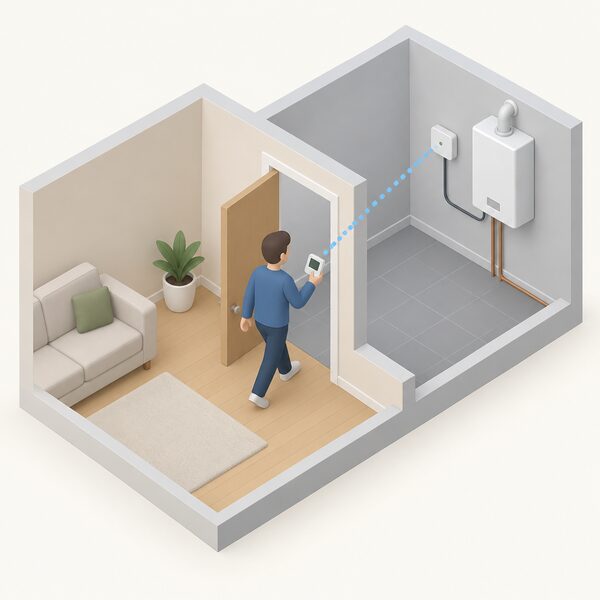
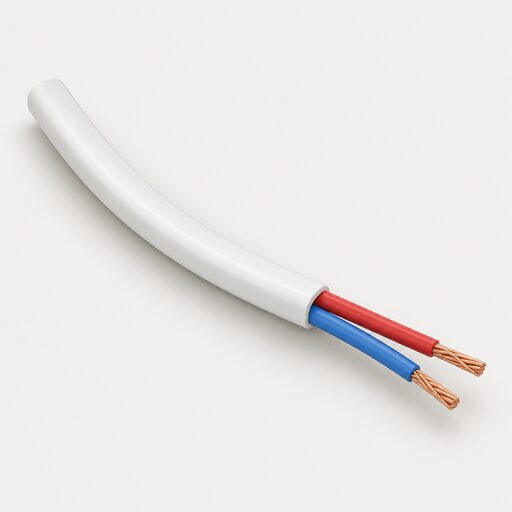
The wired version of OpenTherm is a 2-wire low voltage and polarity-free connection, described as a standard type of connection like in any modern installation practice1. That is the link between the control and the boiler. In a wireless installation, that same link still exists, but it runs from the receiver to the boiler rather than from the room thermostat to the boiler.
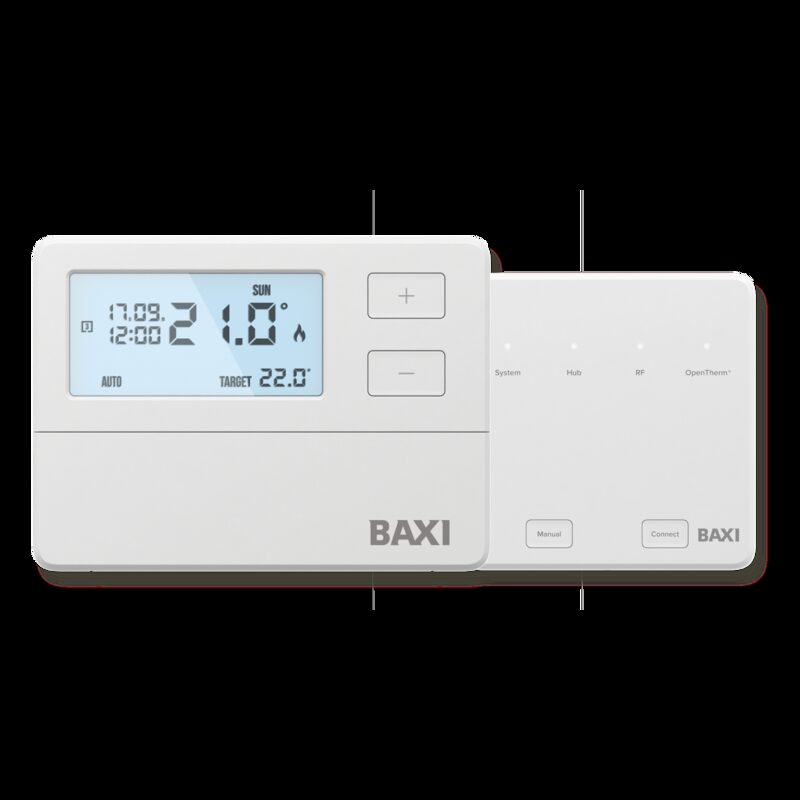
What changes is the room end. Wireless thermostats require no wired installation, so are easier to set up in the home9, and they can be carried from room to room6. A wireless thermostat is not always smart: smart thermostats usually add app control, internet connectivity, automation or other connected features on top of the wireless link2. A non-programmable wireless thermostat has no digital screen or programming options, and offers manual control only via a receiver communicating with the boiler10.
What does not change is the boiler conversation. OpenTherm remains a manufacturer-independent system of communication between modulating appliances and room thermostats1, and the protocol's benefits for modulating appliances, better efficiency, reduced environmental effects and increased comfort, are properties of the protocol rather than of the cable7.
| Wired OpenTherm | Wireless OpenTherm | |
|---|---|---|
| Thermostat to boiler | 2-wire low voltage, polarity-free connection1 | Radio signal to a receiver2 |
| Receiver to boiler | Not applicable | Wired connection, installed by a trained professional2 |
| Thermostat siting | Fixed on the wall | Can be carried from room to room6 |
| Power at the thermostat | Wired | Recharging or replacement batteries from time to time6 |
| Modulation | Preserved | Preserved1 |
The wired versus wireless room thermostats comparison sets out the siting and wiring trade-offs in more detail.
Which boilers and controls support wireless OpenTherm
Support is a property of the control and the boiler together, not of the protocol alone. On the control side, several UK products are listed with both connection types. The Wiser Thermostat Kit 1 2nd Generation is listed with relay and OpenTherm connections11, and the Wiser 1-Channel 2nd Generation HubR with relay and OpenTherm connections12. tado° X is described as compatible with boilers that have a relay or OpenTherm connection, covering the vast majority of models on the market13. The WundaSmart HubSwitch is listed as Open Therm Compatible14, and the Keston RF Electronic Programmable Room Thermostat is described as using wireless communication via an OpenTherm connection15.
On the boiler side, the Intergas Rapid is listed as OpenTherm ready13, and the Intergas Comfort Touch thermostat communicates with the boiler using OpenTherm to automatically adjust its settings to achieve the desired room temperature16. One maker states that its tado° X is compatible with boilers that have a relay or OpenTherm connection, which it says covers the vast majority of models on the market17.
Compatibility is not automatic, and one maker's warranty condition shows why it matters. Johnson and Starley states that installation of any non-OpenTherm control with a WarmCair heat only appliance will invalidate the guarantee18. That is a guarantee condition on one range, not a general rule, but it illustrates that the control and the boiler have to be matched deliberately. The boiler compatibility page covers how to check a specific model.
Range, interference and placement limits in a real home
Published radio ranges for heating and home controls vary by an order of magnitude, and the variation is mostly about what the figure describes. A wall thermostat is listed with a typical open area RF range of 250 m5. A Wiser Underfloor Heating Controller is listed with a radio signal range of 30 m3, and a Wiser Radiator Thermostat with a maximum of 30 m in free air4. A monitor maker describes a range in the order of 50 metres in ideal conditions, compromised depending on factors such as walls and construction materials19. A smart home system is described as working up to 600 m with direct line of sight20, and a motion sensor as approximately 100 m in a typical household environment, with open field tests up to 1 km21.
The pattern is consistent: open-air figures are much longer than in-home figures, and walls are the reason. A basic wall thermostat is listed at 250 m typical open area5, which is a laboratory-style figure rather than a promise about a Victorian terrace.
Placement guidance is thinner than range guidance. Independent guidance says the best place to put a smart thermostat is in a place where the temperature is relatively consistent22. The receiver's position is largely fixed by the boiler, so the variable is where the thermostat sits relative to it. For context on how far a device can be from a fixed point in a room, Northern Ireland legislation for private tenancy dwellings requires a heat alarm in the kitchen to be not more than 7.5 metres from any point in the room23, which gives a sense of domestic room scale rather than radio range.
Installing a wireless OpenTherm thermostat: receiver, wiring and pairing
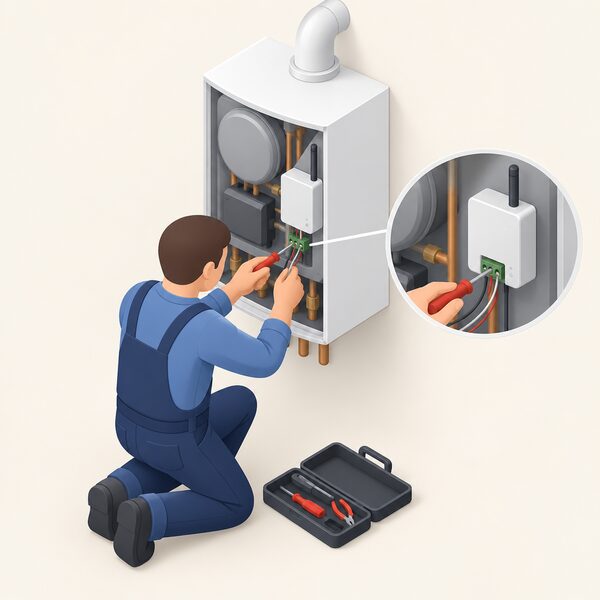
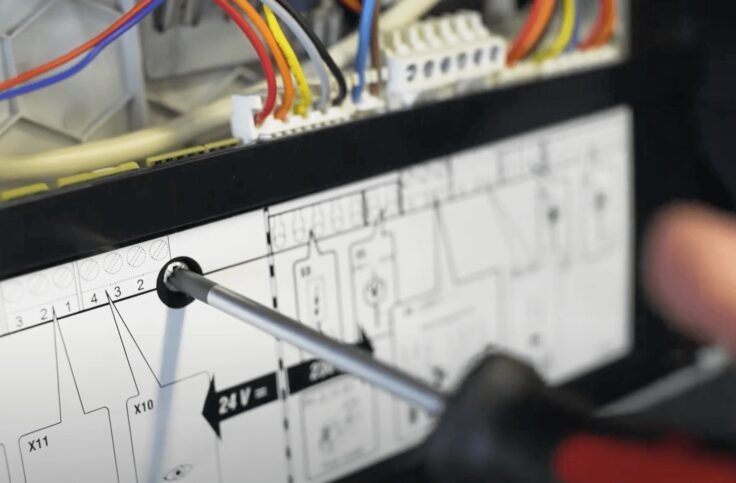
The installation splits into two jobs. The first is the receiver, which is wired to the boiler. A lot of boilers are not Wi-Fi-enabled, so many smart or wireless thermostat systems still include a wired element, and wiring should be done by a trained professional2. Wireless thermostats just need to have their wireless receiver connected up to the home boiler10. The second job is the thermostat, which needs no complex installation and is installed more flexibly than a wired thermostat, but must be linked to its wireless thermostat receiver9.
In order:
- The receiver is wired to the boiler, on the OpenTherm connection where the boiler supports it1.
- The thermostat is sited within radio range of the receiver, in a position where the temperature is relatively consistent22.
- The thermostat is paired to the receiver, and the control is set up for the boiler's connection type9.
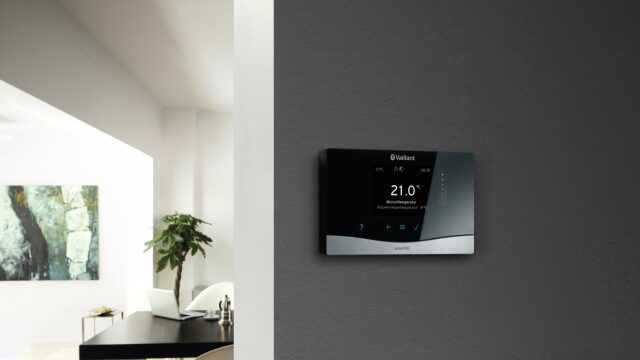
Wireless thermostats communicate with the boiler via signal, and the thermostat itself is either a battery-powered wall unit or plugged into the mains24. Some models can be controlled remotely from a smartphone or tablet25, and a wireless boiler control connects to devices via WiFi so the boiler's temperature and timings can be controlled remotely26. That WiFi link is separate from the OpenTherm link and is the part that depends on the internet.
The installation and replacement page covers the wiring side, and heating control wiring explains how receivers sit alongside existing plans.
What wireless OpenTherm means for modulating control and efficiency
Modulation survives the move to wireless, because modulation is a property of the protocol rather than of the cable. OpenTherm is primarily designed to control modulating heating appliances1, and the protocol enables operation of modulating HVAC appliances, which offer better efficiency, reduced environmental effects and increased comfort7. The traditional on/off controller is described as inadequately effective for the communications needs of these appliances7.
A wireless OpenTherm thermostat therefore still asks the boiler for a flow temperature rather than simply switching it on and off, provided the receiver is wired to the boiler's OpenTherm connection and the control is configured for it. Where a control is wired on the relay connection instead, the modulating conversation is not available, which is why products are listed with both connection types rather than one11.
For a household's energy independence, the picture is mixed and worth stating plainly. The control loop between thermostat, receiver and boiler is local: it runs on a two-wire link and a radio signal, and it does not need a supplier, a cloud service or an internet connection to keep the boiler modulating. What remains dependent is the boiler itself, which runs on gas or oil delivered from outside the home, and the app layer on many products, which does depend on WiFi and on the maker continuing to support it. The energy independence page sets out that split, and load compensation and modulation explains what modulating control does at the boiler.
Sources28 cited
- What is OpenTherm?, OpenTherm Association, 2026-01-26
- What is a smart thermostat?, Smart Energy GB, 2026-08-19
- Wiser Underfloor Heating Controller, Drayton Controls, 2026-02-19
- Wiser Radiator Thermostat, Drayton Controls, 2026-09-08
- Wall thermostat basic, Homematic IP, 2026
- Boiler thermostats: a complete guide, Ideal Heating, 2026-09-17
- Why a communication protocol?, OpenTherm Association, 2026-01-26
- Technical Study Report on Measuring, Remote Monitoring and Remote Controlling for Solar Thermal Systems, Solar Heat Europe, 2015
- Wireless thermostat, Netatmo, 2026-09-20
- Boiler thermostat, Netatmo, 2026-09-20
- Wiser Thermostat Kit 1 2nd Generation, Drayton Controls, 2026-09-08
- Wiser 1-Channel 2nd Generation HubR, Drayton Controls, 2026-08-27
- Rapid, Intergas Heating, 2026-09-17
- WundaSmart HubSwitch, WundaSmart, 2026-09-20
- RF Electronic Programmable Room Thermostat, Keston, 2026-09-20
- Comfort Touch thermostat, Intergas Heating, 2026-09-17
- Best heating systems, tado°, 2026-07-07
- FAQs, Johnson and Starley, 2026-09-20
- FAQs, Eco-eye, 2026-09-20
- Book a smart home consultation, Lightwave, 2026-09-20
- Smart Motion Sensor, Lightwave, 2026-09-20
- What are smart thermostats?, Uswitch, 2026-02-05
- The Private Tenancies (Northern Ireland) Order 2006, Heat Alarm Regulations, legislation.gov.uk, 2024-05-30
- Heating thermostat, tado°, 2026-08-03
- Boiler thermostat, Netatmo, 2026-09-20
- Choosing the best heating control for you and your home, Vaillant, 2026-09-17
- Boiler controls, Ideal Heating, 2026-09-17
- Can smart controls help to save money on energy bills?, Vaillant, 2026
 OpenTherm Protocol ExplainedOpenTherm lets a smart thermostat and a boiler from different makers work together properly, so the boiler can run gently instead of switching on and off.
 Zigbee, Matter, KNX and Wi-FiWill your smart thermostat and radiator valves keep working if the broadband goes down, and can gear from different brands talk to each other?
 Smart Thermostats ExplainedWhat does a smart thermostat actually do, and is it worth it?
 Controls and Energy IndependenceIf the broadband goes down, will your heating still come on?
 Controls and Wi-FiWhich air conditioning controls work without the internet, and which need Wi-Fi?
 Controls, Thermostats and TRVsWhich heating controls actually cut your bills, and what does each one do?