In this guide
Drayton is one of the UK's longest-established heating controls brands, and it is described in independent guidance as one of the country's leading heating control brands1. Its current smart range is Wiser, built around a Wiser Home Hub and Smart Room Thermostat, with Wiser Multi-room Kits offering room-by-room control and Smart Radiator Thermostats giving individual control of each radiator1. The brand sits within Schneider Electric, and its controls are designed for the British market rather than imported under another label.
For a household, Drayton controls do one job well: they decide when the heating runs and how warm each room gets. Independent guidance puts it plainly, that heating controls help control when the heating system operates and the temperature in each room2. The smart end of the range adds internet connectivity and more functionality than conventional controls3, which is where both the convenience and the dependence begin.
The most important thing to know before buying into the Wiser ecosystem is what happened to the previous one. Drayton closed the miGenie cloud service on 31 March 2024, ending app control while the controllers themselves continued to run their set schedules. That is the pattern to plan around: local control survives a service closure, remote control does not.
Drayton: a UK heating controls brand under Schneider Electric
Drayton's position in the market is unusual for a controls maker in that it is both long-established and currently active in the smart segment. Independent guidance describes Wiser as a smart home heating system offered by Drayton, one of the UK's leading heating control brands1. That description matters commercially: it places the brand in the small group of controls makers with a genuine UK installed base rather than a single-product presence.
The ownership question is the one householders ask most often, and it is worth separating brand from parent. Drayton operates within Schneider Electric, the French electrical equipment group. The brand itself is British in origin and in market focus, with a trading history of more than 75 years designing controls for UK heating systems. That combination, a British-designed product line under foreign group ownership, is common across the controls sector and does not by itself change how the products work or how they are supported.
What it does change is where decisions about product support are made. A cloud service, an app and a firmware update programme are all run by the parent company, and the miGenie closure shows that a decision taken at group level can end a feature that householders had come to rely on. For a household weighing independence, the relevant question is not the nationality of the owner but the length of the support commitment and what remains functional if that commitment ends.
Drayton's controls cover the full span of a domestic system: room thermostats, programmers and timers, thermostatic radiator valves, and the Wiser smart range with zoning. The mechanical and wired products have no cloud dependency at all. The smart products do, and that distinction runs through everything below. For the wider picture of how these categories fit together, see heating controls.
What Drayton makes: smart controls run from a phone app
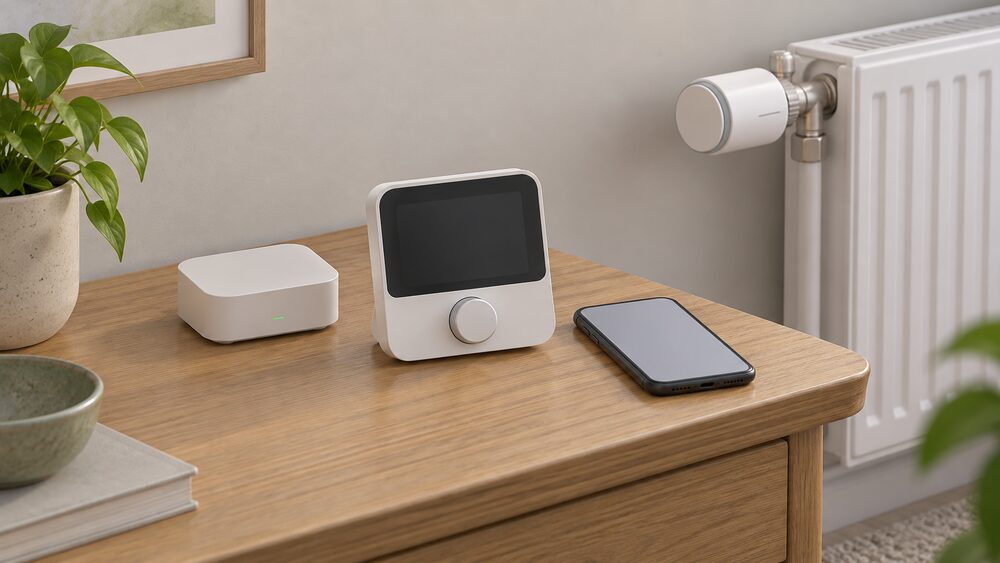
The Wiser system is modular rather than a single box. It is made up of a Wiser Home Hub and Smart Room Thermostat, with the Wiser Multi-room Kits offering room-by-room control, and Smart Radiator Thermostats offering individual control of each radiator1. A household can start with the hub and one thermostat and add radiator thermostats room by room, which is how most zoning installations are built in practice.
The app side is what defines the smart category. Independent guidance notes that smart controls are connected to the internet and offer more functionality than conventional controls3, and that most smart heating controls link to a phone, with heating controllable via smartphone, tablet or laptop, or by telling a smart speaker what is wanted3. Some systems know when the household is away from home, and may adjust the heating accordingly or send a message so the heating can be turned off via an app3. The Energy Saving Trust describes the same capability more simply: access your temperature settings using a mobile app6.
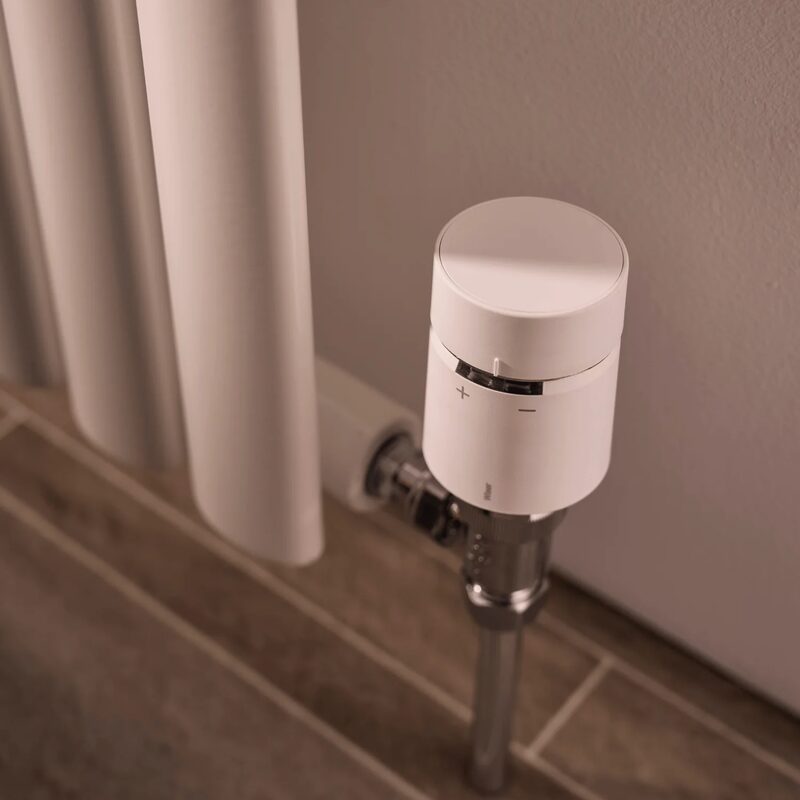
The Wiser Thermostat Kit I carries a feature set typical of the range: professional installation recommended, hot water control, a learning thermostat, programme modes, frost protection, weather responsive operation and a child lock4. The Wiser Smart Radiator Thermostat adds open window detection, frost protection, child lock and on-valve controls5. Those on-valve controls matter more than they look: they mean a radiator can still be adjusted at the radiator itself if the app or the network is unavailable.
| Product | Type | Key features | Source |
|---|---|---|---|
| Wiser Home Hub and Smart Room Thermostat | Hub and thermostat | Base of the Wiser system | 1 |
| Wiser Multi-room Kit | Zoning kit | Room-by-room control | 1 |
| Wiser Thermostat Kit I | Thermostat kit | Hot water control, learning thermostat, programme modes, frost protection, weather responsive, child lock | 4 |
| Wiser Smart Radiator Thermostat | Smart TRV | Open window detection, frost protection, child lock, on-valve controls | 5 |
| Wiser 2nd Generation Radiator Thermostat | Smart TRV | New and improved, launched 27 August 2026 | 7 |
Trading history: over 75 years of designing UK heating controls
Longevity in the controls sector is not a marketing claim so much as a practical one. A brand that has been designing UK heating controls for more than 75 years has accumulated compatibility knowledge across boiler types, wiring conventions and the S-plan and Y-plan arrangements that British homes use. That history is why Drayton products turn up in so many existing installations, and why replacement parts and installer familiarity are relatively easy to find.
The comparison with other long-established heating names is instructive. Glow-worm has been designing and manufacturing heating systems for more than 90 years8, Trianco has a heritage spanning more than 165 years9, and Flue Supplies reports over forty years of direct experience supplying the UK chimney trade10. Longevity of this kind is common in British heating, and it signals a distribution and service network rather than a guarantee about any individual product.
For a household, the practical value of a long trading history is continuity of support and spares. It also means the brand's older products are still in service, which is why the miGenie closure affected real installations rather than a handful of early adopters. When a maker has been in the market for decades, its decisions about retiring a cloud service reach a larger installed base.
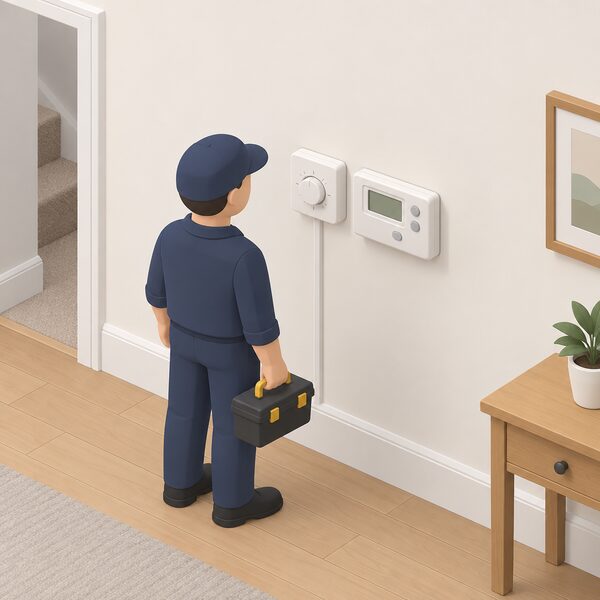
The history also shapes what the current range is designed to replace. Much of Drayton's business is in like-for-like replacement of wired thermostats and programmers, where the wiring already exists and the installer's task is to match the existing control arrangement. That is a different job from a first-time smart installation, and it is where the brand's accumulated knowledge of UK systems pays off. For the wiring conventions involved, see heating control wiring.
Software support: five years of updates from launch
The support window is the single most important number for anyone buying a smart control, and it is not always published clearly. Independent guidance states that Drayton appears to offer five years of update support from launch4, and a separate independent review repeats the same figure: Drayton appears to offer five years of update support from launch5. The word "appears" in both is significant. This is a reported position rather than a formal published policy, and it should be read as an indication rather than a contractual commitment.
Five years is a reasonable window by the standards of the smart heating market, but it is short relative to the working life of the hardware. A thermostat or radiator valve can remain physically functional for far longer than five years, and the question a household faces at the end of the support period is what still works. Local scheduling, on-valve adjustment and wired control typically continue. App features, remote access and any cloud-dependent function may not.
The wider context is that support periods across the sector vary and are often unstated. Some manufacturers publish remote monitoring commitments measured in years, and some of those run considerably longer than five: one heat pump maker's approved innovation measure includes access to 10 years of remote monitoring support11. That is a different product category, but it shows that longer commitments exist where a maker chooses to offer them.
For a household, the sensible reading is that a smart control is a five-to-ten-year purchase with a support tail that may be shorter than the hardware's life. The controls that carry no cloud dependency at all, wired thermostats, programmers and standard TRVs, have no equivalent expiry. More on this balance is at smart heating control security and data.
The miGenie cloud service closure and what it meant for users
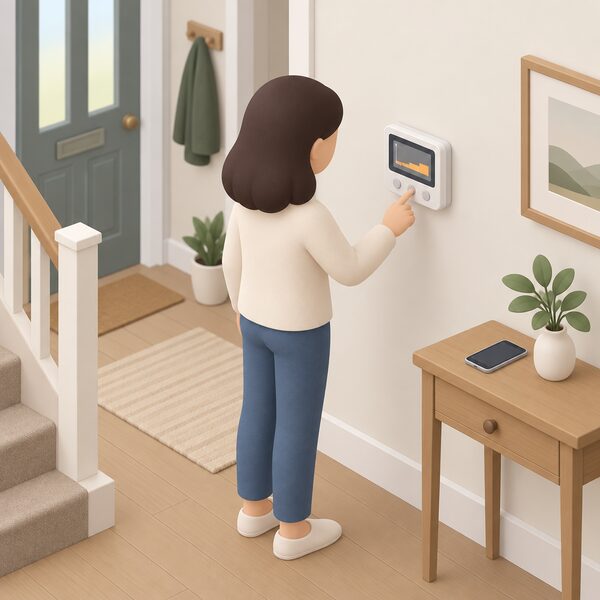
Drayton closed the miGenie cloud service on 31 March 2024. App control ended, while the controllers themselves continued to run the schedules already set on them. This is the clearest worked example in the UK controls market of what a cloud closure actually does, and it is worth being precise about the split.
What survived: the physical controllers, their stored schedules, and local operation at the device. A household with a miGenie controller did not lose heating control. What ended: remote access from a phone, any app-based scheduling changes, and whatever monitoring or reporting the app provided. The hardware kept working; the service layer did not.
That pattern is not unique to Drayton. A maker support article for a different heating brand states that its cloud service is monitored continuously and is highly reliable, and that an interruption is almost always caused by the home broadband connection rather than the service itself12. The same article explains that when an app shows offline status, it means the data path between the appliance and the cloud has been interrupted, not that the appliance has faulted12. Both statements are true and both point the same way: the cloud link is the fragile part of a smart heating system, and it can fail for reasons entirely outside the household's control.
"When you see 'offline' in the app, it means the data path between your heat pump and the cloud has been interrupted."
The lesson for a buyer is to check what a system does without its cloud service before committing to it. A control that keeps its schedule locally and can be adjusted at the device degrades gracefully. A control whose only interface is an app does not. The miGenie case shows that a manufacturer can and will close a service, and that the decision is commercial rather than technical. The wider question of local versus cloud control is covered at heating controls and energy independence.
Wiser 2nd Generation Radiator Thermostat: the newest addition
Drayton launched the new and improved Wiser 2nd Generation Radiator Thermostat on 27 August 2026, expanding the Wiser 2nd Generation range7. It is the most recent addition to the line and sits alongside the Wiser 2 Channel Temperature and Humidity Sensor and Radiator Thermostat Kit, which offers Eco, Comfort and Away modes13.
The kit is the more informative product for understanding where the range is going. It is Boiler Plus compliant and uses a relay connection13. Boiler Plus compliance matters because it ties the control to the standards that apply when a boiler is replaced, and it means the kit is designed to satisfy the control requirements that come with a new installation rather than being an optional extra. The expandability list is broad: additional smart radiator thermostats, smart plugs, electrical heat switches, a smart underfloor heating controller, smart sensors and micro modules13.
That expansion path is what turns a thermostat into a zoning system. A household can begin with a single room thermostat and add radiator thermostats room by room, then extend into underfloor heating or electrical heating circuits. The Eco, Comfort and Away modes give the system a simple three-state logic that covers most daily patterns without requiring a full schedule to be set up.
| Feature | Detail | Source |
|---|---|---|
| Modes | Eco, Comfort and Away | 13 |
| Compliance | Boiler Plus compliant | 13 |
| Connection | Relay connection | 13 |
| Expandable with | Additional smart radiator thermostats, smart plugs, electrical heat switches, smart underfloor heating controller, smart sensors, micro modules | 13 |
| Launch date | 27 August 2026 | 7 |
The regulatory backdrop is worth noting. Approved Document L Volume 1 requires that for heating systems in new dwellings, or when a heat generator such as a boiler is replaced in an existing dwelling, each room should be provided with thermostatic room controls able to separately adapt the heating output in each room served14. That requirement applies in England. Where it applies, a room-by-room system is not a luxury but the standard the installation is measured against. For the full picture across the four nations, see heating controls building regulations.
Where to see the range: InstallerSHOW, stand 5B52
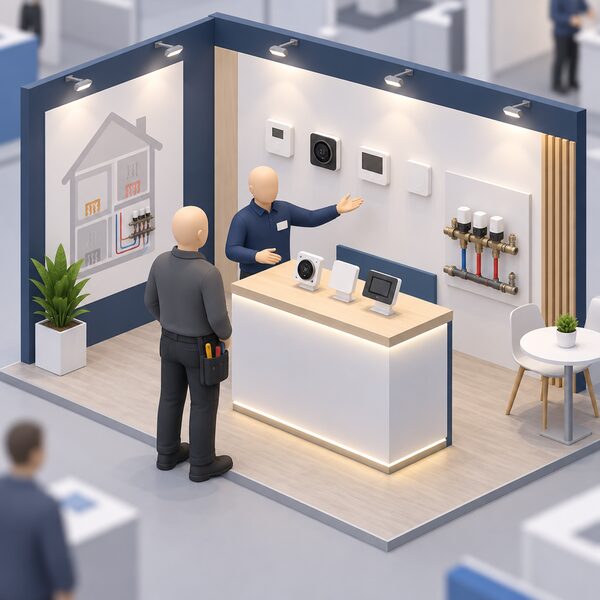
Drayton brought technical training, product demos and installer rewards to InstallerSHOW 2026 on stand 5B527. The show is held at the NEC, Birmingham15, and it is where the controls sector launches products and runs training for the installers who specify them.
The relevance to a household is indirect but real. InstallerSHOW is where installers learn how a system is commissioned and configured, and the quality of that commissioning determines whether a zoning system performs as designed. The 2026 event gave prominence to smart heating, zoning and training16, which reflects how much of the current market is now built around room-by-room control rather than a single thermostat.
For anyone specifying a system, the practical point is that the installer's familiarity with the product matters as much as the product itself. A zoning system that is installed and balanced properly delivers room-by-room control; the same hardware installed without commissioning does not. Drayton's presence at the show, with training attached, is aimed at that gap.
What Drayton controls mean for household energy independence
The independence question for any heating control comes down to what the household can still do when the outside services stop. Drayton's range splits cleanly on this line.
The wired and mechanical products, room thermostats, programmers and timers, and standard thermostatic radiator valves, carry no cloud dependency. They control the heating locally and continue to work regardless of broadband, app stores or manufacturer servers. Independent guidance describes the function of these controls in exactly those terms: heating controls help control when the heating system operates and the temperature in each room2, and room thermostats and heating controls allow a household to set and maintain the temperature and have the heating switched off to save electricity when nobody is home17.
The Wiser smart range adds capability and dependence together. Smart controls are connected to the internet and offer more functionality than conventional controls3, and that connectivity is what enables remote control, away-from-home adjustment and app-based scheduling3. The dependence is on a home broadband connection, the manufacturer's cloud service and the app. The miGenie closure shows what happens when one of those three is withdrawn.
There is a further layer where controls meet tariffs and meters. Smart meters are independent of smart heating controls, but combining the two can enhance the ability to manage a home's heating and energy use remotely18. That combination is useful and it also deepens the reliance on connected services. Official guidance for self-build homes recommends installing smart systems that control lighting, heating and cooling based on occupancy and time of day19, which is a recommendation for the capability rather than for any particular dependency.
The honest summary is that Drayton controls give a household good local control and, in the Wiser range, genuine room-by-room capability. What they do not give is independence from the cloud for the smart features, or a support commitment longer than the reported five years. A household that wants the smart features and the resilience can have both, provided it checks that the system keeps working locally when the app does not. The broader trade-off is set out at heating controls and energy independence, and the alternatives at Wiser smart heating controls and smart TRVs compared.
Sources19 cited
- What are smart thermostats?, Uswitch, 2026-02-05
- Thermostats and heating controls, Energy Saving Trust, 2026-09-20
- Smart homes and lower carbon footprint, Energy Saving Trust, 2026-02-10
- How to buy the best smart thermostat, Which?, 2026-09-17
- Best smart radiator valves, Which?, 2026-09
- Guide to smart meters, Energy Saving Trust, 2026-07-15
- Wiser 2nd Generation Radiator Thermostat launch, Drayton Controls, 2026-08-27
- Glow-worm brand page, Quiet Mark, 2026-09-17
- Trianco brand page, Quiet Mark, 2026-09-17
- Spotlight on Flue Supplies, HETAS, 2026-02-12
- ECO4 innovation approved innovation measures, Ofgem, 2026-02
- Connectivity troubleshooting guide, MasterTherm, 2026-02-18
- Wiser 2 Channel Temperature and Humidity Sensor and Radiator Thermostat Kit, Drayton Controls, 2026-09-20
- Building Regulations Approved Document L Volume 1, Welsh Government, 2026-04
- Viessmann Climate Solutions at InstallerSHOW 2026, CIPHE, 2026-05-14
- Smart heating, zoning and training at InstallerSHOW 2026, CIPHE, 2026-06-09
- Make winter feel summer, Home Energy Scotland, 2026-09-20
- Smart meters in Wales, Welsh Government, 2026
- Self-build homes sustainability, Planning Portal, 2026