
In this guide
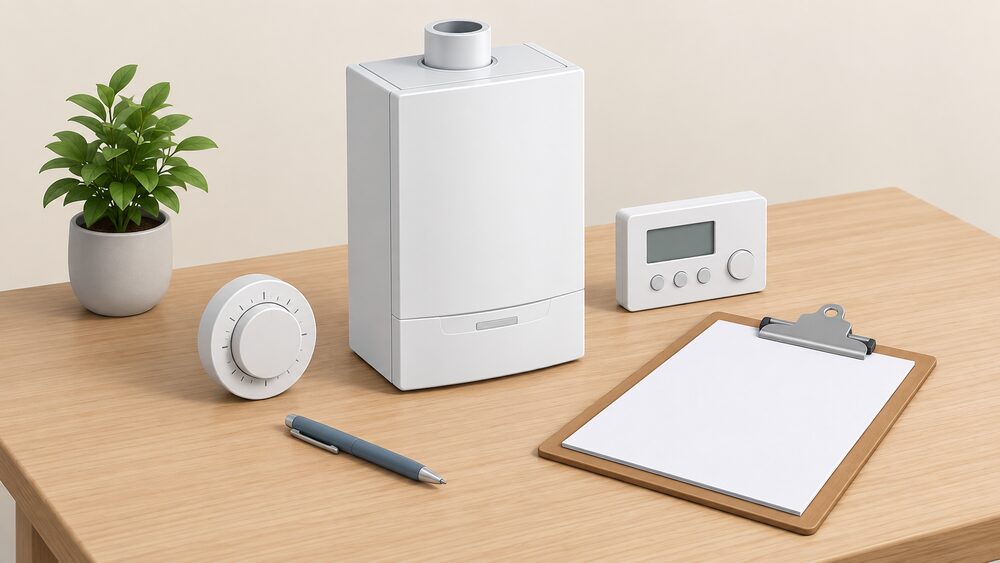
Boiler Plus is the set of minimum standards that applies in England when a gas boiler is installed or replaced. It came into force on 6 April 2018 as a change to Part L of the Building Regulations, and it does three things: it sets a minimum efficiency for the boiler, it requires time and temperature controls on the heating system, and, for gas combination boilers, it requires one further energy efficiency measure chosen from four options1.
The four options for a combi are flue gas heat recovery, weather compensation, load compensation, and a smart thermostat with automation and optimisation2. The minimum efficiency is 92 per cent ErP seasonal efficiency for a gas boiler, and 91 per cent ErP for an oil-fired boiler2. Time and temperature controls are required alongside the boiler, not instead of the additional measure2.
The practical effect is that a like-for-like boiler swap is no longer a like-for-like job. A replacement gas combi now carries a control requirement and a second efficiency measure, and the household pays for both. What follows sets out what each requirement means, how the four combi options differ, how the standard sits inside Part L, what it does to the cost of a replacement, who is exempt, and how to tell whether a proposed control package actually complies.
What Boiler Plus is and when it applies
Boiler Plus is an English policy introduced in 2018. The parliamentary written evidence describes it as "The 2018 Boiler plus policy", and the Northern Ireland consultation document records that "In 2018, England introduced 'Boiler Plus' standards"1. The Welsh Government's consultation on Part L and F is more specific still: "additional minimum standards came into force from April 2018 in England only"4. The Carbon Budget Delivery Plan gives the implementation date simply as 20186.
The trigger is installation. Boiler Plus applies when a gas boiler is newly installed or replaced in an existing dwelling. It is not a standing obligation on a household that already has a boiler, and it is not a periodic check. The requirements attach to the work: the boiler must meet the efficiency threshold, the heating system must have time and temperature controls, and a gas combi must have one additional measure2.
The policy has three components, and the parliamentary evidence lists them together: "increased minimum efficiencies for boilers, required time and temperature controls (surprisingly not present in all installations) and required an additional energy efficiency measure (weather compensation, smart thermostat, flue gas heat recovery, load compensation)"1. That framing matters, because it shows the additional measure is not a substitute for controls. It sits on top of them.
For a household's energy independence, Boiler Plus is a modest but real intervention. It does not remove dependence on the gas grid or on a supplier. What it does is ensure that a new boiler is commissioned with the controls that let it modulate rather than run flat out, which reduces the fuel a household has to buy. The dependence that remains is the same as before: mains gas, a supplier, and a boiler whose efficiency is set at installation and then drifts with servicing and flow temperature settings.
The 92% ErP minimum efficiency standard

The efficiency floor is expressed as ErP seasonal efficiency, the metric used on the energy label. For a gas-fired boiler in an existing dwelling, whether new or a replacement, "the ErP seasonal efficiency of the boiler should be a minimum of 92%"2. For oil-fired boilers the same document sets the minimum seasonal efficiency at 91% ErP2.
Approved Document L, the statutory guidance that sits behind the requirement, states the oil figure in its own tables. For a wet heating system with a regular boiler in an existing dwelling, the minimum is "91% (as defined in ErP)"3. The two documents agree on the number and differ only in how they present it, one as a policy proposal and one as a compliance table.
The distinction between gas and oil is not arbitrary. Oil boilers have historically run at lower seasonal efficiencies than gas, and the threshold reflects what the technology can reach rather than a policy preference. A household off the gas grid replacing an oil boiler is therefore held to a slightly lower bar, and the practical consequence is that fewer oil models are excluded from the market by the standard.
ErP seasonal efficiency is not the same as the efficiency a household experiences. It is a laboratory-derived figure under standard conditions. Real performance depends on flow temperature, how well the system is balanced, whether the controls actually modulate the boiler, and how the property is insulated. A boiler rated at 92% ErP running at a high flow temperature will not deliver 92% in the home. This is precisely why the control requirements exist alongside the efficiency floor: the standard recognises that a compliant boiler with poor controls underperforms a compliant boiler with good ones.
For independence, the efficiency floor is a floor on the fuel a household must buy per unit of heat. It does not change the fuel. It does mean that a replacement boiler cannot be a regression to an older, less efficient design, which protects a household from a poorly specified installation.
Time and temperature controls: the baseline requirement
Every installation covered by Boiler Plus must have time and temperature controls. The Northern Ireland consultation, describing the English standard it was considering, states that "time and temperature control should be installed for the heating system" for a gas-fired boiler in an existing dwelling, whether new or replacement2. For oil-fired boilers installed as a replacement of an existing boiler, "time and temperature controls are applied as a new additional requirement"2.
A time control schedules when the heating runs. A temperature control decides how warm the rooms get and switches the boiler accordingly. Age UK describes the room thermostat function plainly: "It turns your boiler on and off automatically when the room temperature reaches the level you've chosen"8. That is the baseline. It is not sophisticated, and it is not the same as the additional measure a combi needs.
The reason this is a requirement at all is that a significant share of installations historically had no proper controls. The parliamentary evidence notes the controls requirement was needed because time and temperature controls were "surprisingly not present in all installations"1. A boiler without a room thermostat and a programmer runs until someone turns it off, which wastes fuel regardless of how efficient the boiler itself is.
For a household, the baseline requirement is the least visible part of Boiler Plus, because most modern installations already have a programmer and a thermostat. Where it bites is in older properties where a replacement boiler is being fitted to a system that has only a manual valve or a single dial. In that case the controls are a genuine addition to the job, and they are the part of the standard that most directly reduces running cost.
The controls requirement also interacts with the additional measure. A smart thermostat with automation and optimisation is one of the four combi options, and it also satisfies the time and temperature control requirement. A weather or load compensator does not replace the thermostat; it works with it. The baseline is always there.
Combi boilers: the extra measure and the four options
A gas combination boiler carries an extra obligation. The Chartered Institute of Plumbing and Heating Engineering states it directly: "When a gas combination boiler is installed, an additional energy efficiency measure will be required"1. The Northern Ireland consultation lists the four options that satisfy it for a gas-fired combination boiler in an existing dwelling: "i. flue gas heat recovery ... ii. weather compensation ... iii. load compensation ... iv. smart thermostat with automation and optimisation"2.
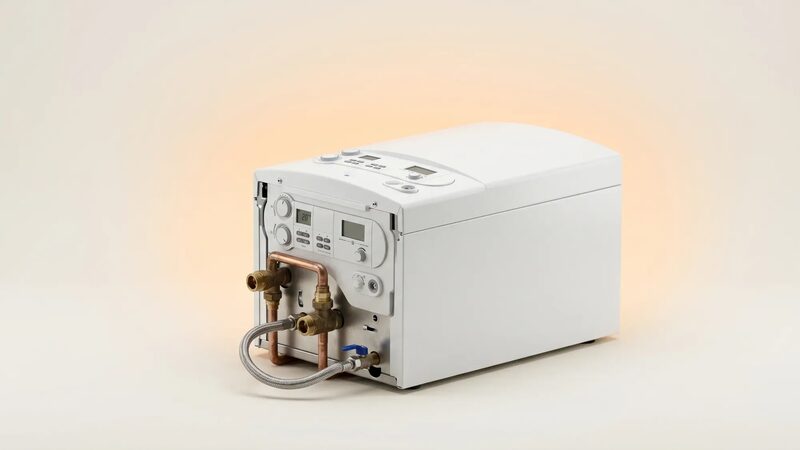
The four are not equivalent in what they do or what they cost. Flue gas heat recovery captures heat from the exhaust gases that would otherwise leave the property, and it is a physical addition to the boiler or flue. Weather compensation and load compensation both adjust the boiler flow temperature, but they take their signal from different places. A smart thermostat with automation and optimisation uses the thermostat's own logic and connectivity to modulate the boiler.
| Option | What it does | Where the signal comes from |
|---|---|---|
| Flue gas heat recovery | Recovers heat from flue gases | The flue or boiler itself |
| Weather compensation | Alters temperature flow from the boiler in relation to the measured outdoor temperature9 | An outdoor sensor |
| Load compensation | Alters the boiler flow temperature and prevents overheating9 | The heating circuit and return temperature |
| Smart thermostat with automation and optimisation | Modulates the boiler using thermostat logic and connectivity | The thermostat and its algorithms |
The combi requirement is the part of Boiler Plus that most changes a replacement job, because a combi is the most common boiler type in English homes and the additional measure is a real cost. It is also the part that most affects a household's future options, because the choice of measure can constrain what is fitted later.
Weather compensation, load compensation, smart controls and flue gas recovery compared

The two compensation options are the ones most often confused, and the difference is the sensor. Weather compensation works by "altering temperature flow from the boiler, in relation to the measured outdoor temperature"9. Load compensation works by "altering the boiler flow temperature and preventing overheating"9. Both reduce flow temperature when demand is low, which is where the efficiency gain comes from, because a condensing boiler recovers more heat at lower return temperatures.
Energy Saving Trust describes the pair together and points to the practical route: "These include load and weather compensation, which adjust the boiler flow temperature to maximise boiler efficiency; a smart thermostat is probably the easiest way to add compensation to an existing system"10. That is a statement about ease of retrofit, not about which performs better, and it is worth reading carefully. A smart thermostat that delivers compensation is doing the same job as a standalone compensator, through different hardware.
A smart thermostat is not automatically a compliant additional measure. The Boiler Plus option is specifically a smart thermostat with automation and optimisation. Smart Energy GB advises checking compatibility before purchase: "Before buying a smart thermostat, check that it's compatible with your boiler and heating system"11. Compatibility is usually stated in the product description or on the thermostat manufacturer's website11.
Flue gas heat recovery is the odd one out. It does not touch the flow temperature and it does not depend on a thermostat. It is a passive recovery device, and it is the option that delivers its gain regardless of how the household operates the controls. For a household that wants the measure to work without changing behaviour, it is the one that does so.
How Boiler Plus fits into Part L of the Building Regulations
Boiler Plus is not free-standing legislation. The Chartered Institute of Plumbing and Heating Engineering records that "Changes to Part L of the Building Regulations came into force in England on Friday 6 th April, in a bid to make home heating more efficient"1. Boiler Plus is that change, applied to domestic heating installations.
Part L is the conservation of fuel and power. The London Assembly guidance notes that "Approved documents L1 and L2 of the Building Regulations relate to the conservation of fuel and power in dwellings and buildings other than dwellings respectively"12. Boiler Plus sits within the dwellings volume, Approved Document L Volume 1, which is where the efficiency tables for wet heating systems appear3.
The Welsh Government has stated that "Part L of the Building Regulations is in general, technology and fuel neutral"13. That principle matters for how Boiler Plus is read: the standard sets an efficiency threshold and a control requirement, and it does not mandate a particular fuel or technology. A household is not being pushed towards or away from gas by the standard itself.
Part L continues to move. The Welsh Government consulted in 2025 on "the impacts of changes to Building Regulations Part L (conservation of fuel and power), including changes to Part F (Ventilation), Part O (Overheating) and associated Approved Document guidance"14. The Carbon Budget Delivery Plan lists Part L 2002 and 2005/6 as implemented6. The 2021 Part L uplift covered gas boilers as a heating appliance category15. Boiler Plus is one layer in a document that is periodically revised, and the requirements a household meets depend on the edition in force at the date of installation.
For independence, Part L is the mechanism through which a household's heating choices are constrained at the point of installation rather than at the point of use. It does not control what a household does afterwards. It controls what can be fitted, and therefore what the household is committed to for the life of the appliance.
What Boiler Plus means for the cost of a boiler replacement
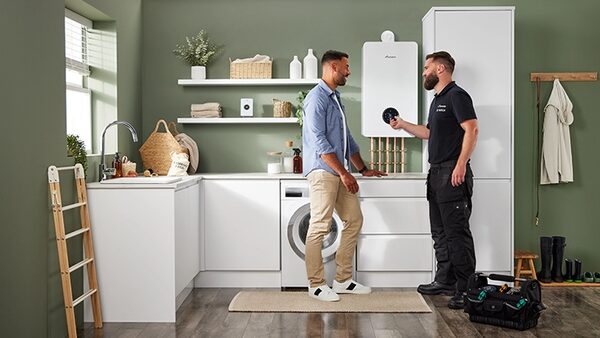
Boiler Plus raises the cost of a replacement, and the sources say so plainly. The Chartered Institute of Plumbing and Heating Engineering answers the question directly: "Yes, because boilers will need to have additional controls and in the case of gas combi boilers, a further energy efficiency measure"1. That is the shape of the cost: controls for every installation, plus a further measure for a combi.
The only published figure in the available material is from the Welsh Government's impact assessment, which put the cost at "£150 to install a load compensator" for combi boiler replacements5. That is a Welsh assessment of a measure equivalent to one of the English options, and it is a single component cost, not a total. It does not include the boiler, the time and temperature controls, labour, or the flue gas heat recovery option.
Beyond that figure, controls and additional measures are installer-quoted. There is no published price range for a compliant smart thermostat or weather compensator fitted under Boiler Plus, and a household should expect the controls to appear as a line in the installation quote rather than as a separate retail price. The cost of the boiler itself is covered on new boiler cost, and the running cost consequences on heating running costs.
The offsetting consideration is that the additional measure is intended to reduce running cost. A load or weather compensator lowers flow temperature, which raises condensing efficiency. A smart thermostat with optimisation reduces run time. Whether the saving repays the capital cost over the life of the boiler depends on the property, the controls and how the household uses them, and no source in the available material quantifies that payback.
For independence, the cost point is the honest one: Boiler Plus makes a household buy controls it might not otherwise have bought, in exchange for a boiler that can be run more efficiently. The household still buys gas from a supplier. What changes is how much of it is needed per degree of warmth.
Who is exempt: existing boilers and new builds
The exemption that matters most is the one for existing installations. Boiler Plus applies to new and replacement installations, not to boilers already in place. A household with a working boiler and basic controls has no obligation to upgrade either, and no enforcement mechanism reaches into a home to require it. The requirement is triggered by the installation event.
New builds are a separate case, and the position is set out in the Boiler Upgrade Scheme guidance rather than in Boiler Plus itself. The scheme states that "New build properties which the developer is still building are not eligible"16, and that "New builds by developers" are not eligible17. The scheme rules confirm that "new-build homes and social housing are not eligible for the Boiler Upgrade Scheme, although self-build properties are eligible"18. The quarterly report repeats the position: "New build properties are not eligible for the scheme except for certain 'self-builds'"19.
Where a self-build is eligible, the criteria are specific. A self-build "must have been built mainly using the labour or resources of the first owner and must never have been owned by a business or organisation"20. The property owner guidance puts it as "certain self-build properties that meet specific criteria"22. A household that moves into a finished new build with a fossil fuel boiler may be able to get a grant for a heat pump under the scheme16.
A property is also excluded if "a previous BUS grant has already been received for installing a heat pump or biomass boiler at the same address"17. And a property that has "already been given government funding or support for a heat pump or biomass boiler" cannot receive a grant16.
Choosing controls that comply: thermostats and OpenTherm
Compliance is decided by what the control does, not by what it is called. A room thermostat on its own satisfies the time and temperature control requirement but not the combi additional measure. A compensator satisfies the additional measure. A smart thermostat satisfies the additional measure only if it provides automation and optimisation.
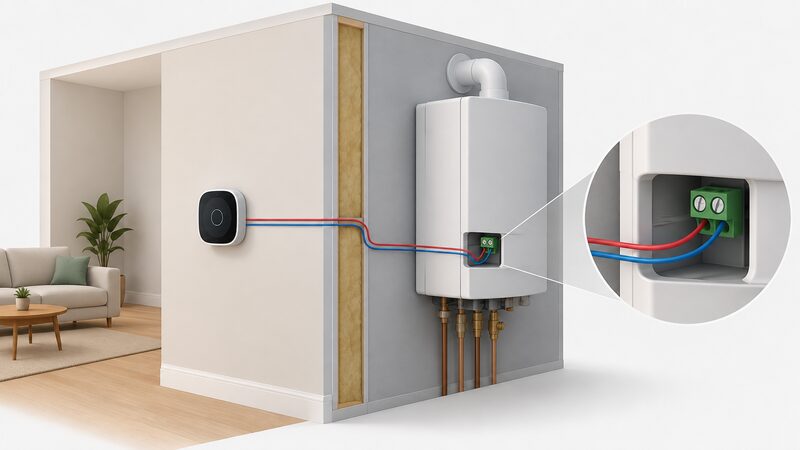
OpenTherm is the common language between compliant controls and boilers. It is "a manufacturer-independent system of communication between modulating HVAC heating appliances and room thermostats", consisting of "a communication protocol and an interface specification"23. It is "primarily designed to control modulating heating appliances", and it uses "a 2-wire low voltage and polarity-free connection"23. It can also be used as a wireless protocol23.
The compatibility point is the one that matters at purchase. OpenTherm's own documentation states that "using OpenTherm guarantees a minimum level of compatibility"23. That is a guarantee of a baseline, not of full functionality: "The way this protocol is implemented, and any extra functionality resulting from the use of OpenTherm, is determined entirely by manufacturers of HVAC appliances and room thermostats"23. Two OpenTherm devices will talk to each other; what they do with the conversation is down to the makers.
That is why the compliance question cannot be answered from the protocol alone. A control that speaks OpenTherm and performs load compensation meets the requirement. A control that speaks OpenTherm and only switches the boiler on and off does not. The specification sheet, not the logo, is what establishes compliance.
How the standard is enforced at installation
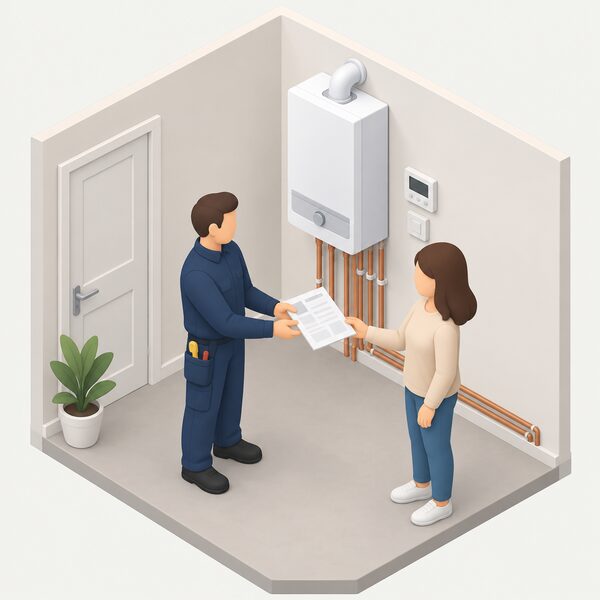
Enforcement runs through building control. The Welsh Government guidance describes the process: "When works have been completed the installer should then produce for you a commissioning certificate such as a Benchmark certificate and notify the local authority building control department either directly, or, if a member of a Competent Person Scheme, via the scheme operator"24. That notification is the point at which compliance is recorded.
The installer is therefore the enforcement interface for a household. A gas installation is carried out by a registered engineer, and the commissioning certificate documents what was fitted. Where the installer belongs to a Competent Person Scheme, the scheme operator notifies building control instead of the household doing so24. Where the installer does not, the notification falls to the household or the installer directly.
Ofgem's role is separate and often confused with enforcement. Ofgem "administers the scheme on behalf of the Gas and Electricity Markets Authority" for the Boiler Upgrade Scheme17, and states "We administer the Boiler Upgrade Scheme on behalf of the Department for Energy Security and Net Zero"15. That is grant administration, not Boiler Plus enforcement. Boiler Plus is a building regulations matter.
For a household, the practical check is the paperwork. A commissioning certificate naming the boiler, the controls and the additional measure is the evidence that the installation met the standard. Without it, there is nothing to show a future buyer or a warranty claim. The wider installation process is set out on boiler installation, and the warranty registration consequences on boiler warranties.
Does Boiler Plus apply in Wales, Scotland or Northern Ireland?
Boiler Plus is an England-only standard. The Welsh Government consultation states that the additional minimum standards "came into force from April 2018 in England only"4. Wales has its own Part L review process, including a 2025 consultation on changes to Part L, Part F and Part O14, and its own guidance on boilers and heating24. The Welsh impact assessment that produced the £150 load compensator figure was assessing measures for Wales, not restating the English standard5.
Northern Ireland has run a separate exercise. The Department of Finance discussion document on building regulations sets out the options, including the 92% ErP gas boiler minimum and the four combi measures, as proposals for Northern Ireland rather than as adopted rules2. Northern Ireland's own consumer guidance on insulation and heating controls sits outside the Boiler Plus framework25.
Scotland sets building standards under its own regime, and the available material does not show a Boiler Plus equivalent. A household in Scotland replacing a boiler should treat the English standard as informative rather than binding, and check the Scottish building standards that apply.
The devolution point has a practical edge for a household near a border or moving between nations. The same boiler installation can carry different control obligations depending on which side of it takes place. The efficiency thresholds and the combi additional measure are English requirements, and the devolved administrations have consulted on their own versions rather than adopting them wholesale.
What Boiler Plus does for a household's energy independence
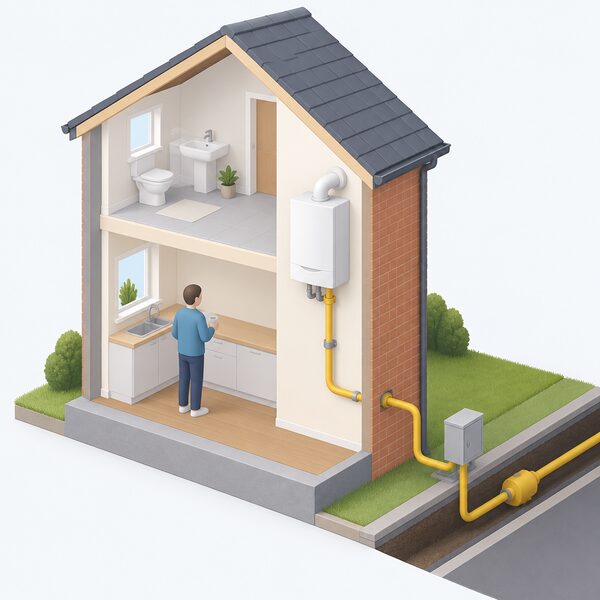
Boiler Plus improves the efficiency of a new installation and requires the controls that let a boiler modulate. That reduces the fuel a household buys for the same warmth, and it prevents a replacement from being a step backwards in efficiency. Those are real gains, and they are the extent of them.
The dependence that remains is substantial. A gas boiler still depends on the gas grid and on a supplier. A combi still depends on mains water pressure. The controls depend on the manufacturer's app and cloud service if they are smart, and on the maker's continued support for that product. Boiler Plus does not change any of that. It sets a floor on efficiency and a requirement for controls at the moment of installation, and then leaves the household with the same fuel and the same supplier as before.
The standard also has a forward-looking dimension that a household should weigh. The four combi options are not equally compatible with a later switch to a heat pump, and the choice made at installation is the one that persists. A household that expects to move to a heat pump should understand what the chosen measure commits it to, and the comparison is set out on heat pumps vs boilers. The wider picture of what a home can and cannot supply for itself is on home heating and energy independence.
Sources26 cited
- What's the deal with Boiler Plus, CIPHE, 2018
- Building Regulations Discussion Document and Pre-Consultation, Northern Ireland Department of Finance, 2023
- Approved Document L Volume 1: Dwellings, UK Government, 2026
- Building Regulations Part L and F Review Stage 2a Consultation, Welsh Government, 2020
- Building Regulations: boilers and heating, Welsh Government, 2026
- Check if you're eligible for the Boiler Upgrade Scheme, UK Government, 2026
- Approved Document L Volume 1: Dwellings, 2021 edition incorporating 2023 amendments, UK Government, 2023
- Insulation, nidirect, 2026
- Smart homes and lower carbon footprint, Energy Saving Trust, 2026
- What is OpenTherm, OpenTherm Association, 2026
- Thermostats and heating controls, Energy Saving Trust, 2026
- Carbon Budget Delivery Plan, UK Government, 2023
- Energy Assessment Guidance, Greater London Authority, 2022
- Annex: Welsh Government response to Preparing Wales for Renewable Energy 2050, Welsh Government, 2024
- Boiler Upgrade Scheme, Ofgem, 2026
- Boiler Upgrade Scheme guidance for property owners V5, Ofgem, 2026
- Boiler Upgrade Scheme, UK Government, 2026
- BUS Quarterly Report Issue 15, Ofgem, 2026
- Boiler Upgrade Scheme Quarterly Report Issue 7, Ofgem, 2024
- BUS Quarterly Report Issue 12, Ofgem, 2025
- Evaluation of the Boiler Upgrade Scheme 2025, UK Government, 2025
- Boiler Upgrade Scheme guidance for installers V5, Ofgem, 2026
- What is a smart thermostat, Smart Energy GB, 2026
- Building Regulations Part L 2025 review, Welsh Government, 2025
- Heating controls guidance, nidirect, 2026
- Home and business grants, schemes and advice, East Herts Council, 2026
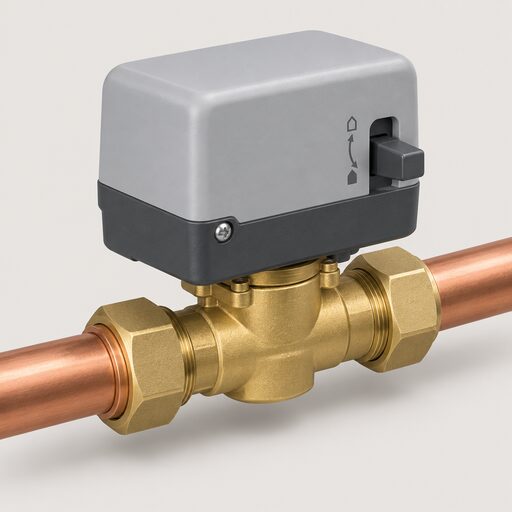 Heating Controls Building RulesWhat heating controls must you fit by law when you replace a boiler?
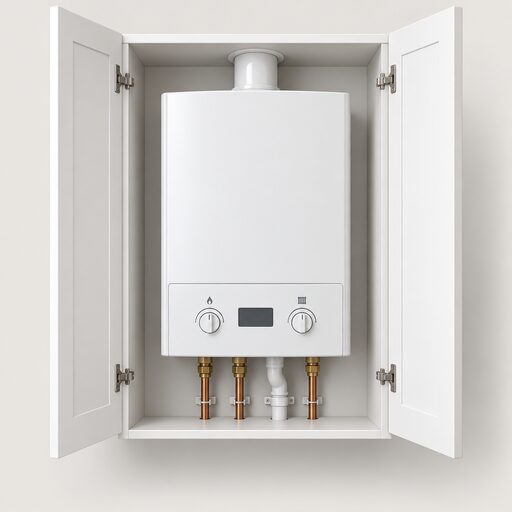 Combi BoilersWhat a combination boiler is, how it produces heating and instantaneous hot water from one unit, and the flow rate and mains pressure it depends on.
 Boiler InstallationGetting a new boiler means following building rules, and the person fitting it must be registered to sign the work off.
 The Full Boilers and Heating GuideWhich boiler suits your home, and when is it worth swapping the old one?
 New Boiler Cost in the UKWhat a replacement boiler costs in the UK by type and fuel, and what drives the installation element: conversions, relocations, flue work and system upgrades.
 Boiler SizingWhat size boiler does your home actually need, and does the number of bedrooms or radiators decide it?