
In this guide
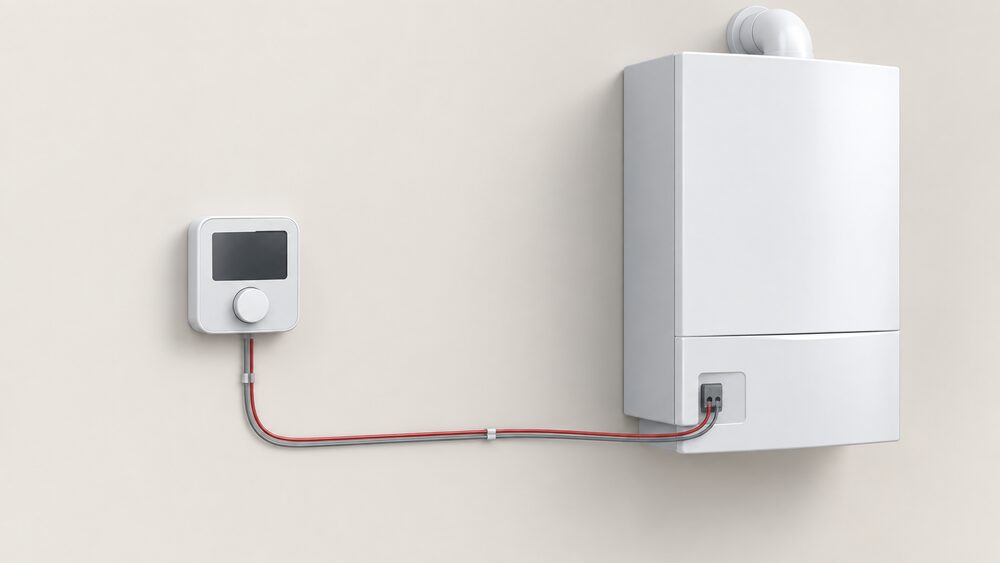
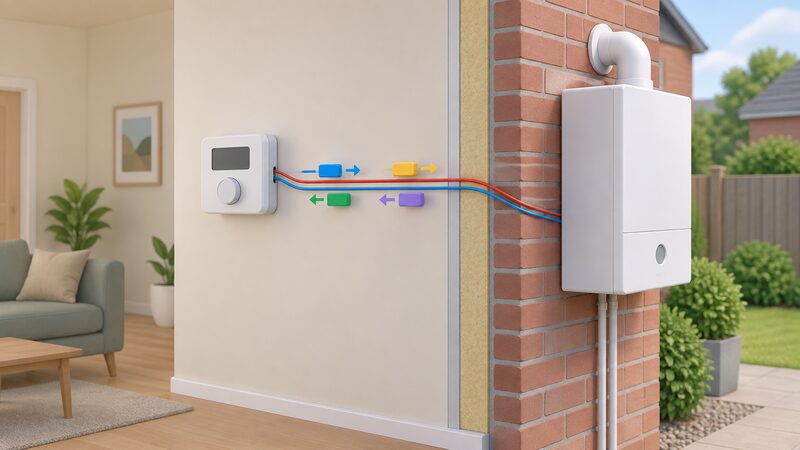
OpenTherm is a manufacturer-independent system of communication between modulating heating appliances and room thermostats. It is a multi point to point communication protocol for use in HVAC systems, and it is primarily designed to control modulating heating appliances rather than simply switch them on and off1. In practice that means a thermostat and a boiler made by different companies can exchange numbers, a target flow temperature, an actual temperature, a modulation level, a fault code, over a single pair of low voltage wires.
It matters because boilers speak different languages. Different boilers use different communication protocols, though the most common is OpenTherm, and it is the one that enables modulation2. The traditional room thermostat's on/off controller is inadequately effective in fulfilling the communications needs of modern appliances, which is the problem the protocol was written to solve3. Open protocols are set, non-proprietary communication standards that allow smart heating controls and boilers to speak to each other regardless of manufacturer4.
For a household, the practical effect is a boiler that runs at a lower, steadier output for longer instead of firing at full power and shutting off. Instead of the boiler simply turning on or off when heat is or is not needed, the system can adjust the boiler's water temperature to a set point based on the temperature predetermined at the thermostat, which gives a much more steady heat output; on that basis OpenTherm is described as much more accurate than regular boiler thermostat connections5. The dependence that remains is real: the standard guarantees a minimum level of compatibility and no more, because the way the protocol is implemented, and any extra functionality resulting from its use, is determined entirely by manufacturers of HVAC appliances and room thermostats1.
A standard protocol, not a product
OpenTherm is a standard communication protocol between HVAC appliances and controllers, replacing the traditional on/off controller3. Nothing is branded OpenTherm in the way a thermostat is branded: it is the language spoken across the terminals, and both ends must speak it.
The standard is maintained by the OpenTherm Association. Its Technical Commission monitors the extra functions that manufacturers add and ensures that standardised functions are added to the Protocol Summary1. That is a useful model to hold in mind: a core set of messages that every compliant device must handle, and a wider fringe of optional and proprietary extensions that individual makers layer on top.
Policy is moving towards it. A control manufacturer reported a proposal to consult on a requirement for new boilers to use open protocols such as OpenTherm, meaning heating systems must be compatible with a wide range of heating controls8. Outside the UK, a heat pump maker describes OpenTherm as the most important open communication protocol in the residential sector for integrating weather compensation, carrying bidirectional transfer of setpoints, actual temperatures, modulation levels and fault codes9. That list of four data types is the clearest short description of what the wire actually carries.
The benefit of an open standard is not only comfort. Open protocol systems can send boiler fault codes to compatible smart controls, simplifying diagnostics for engineers and reducing downtime for occupants10. A household that can see why an appliance has locked out is less dependent on a call-out to find out.
How modulation replaces on/off
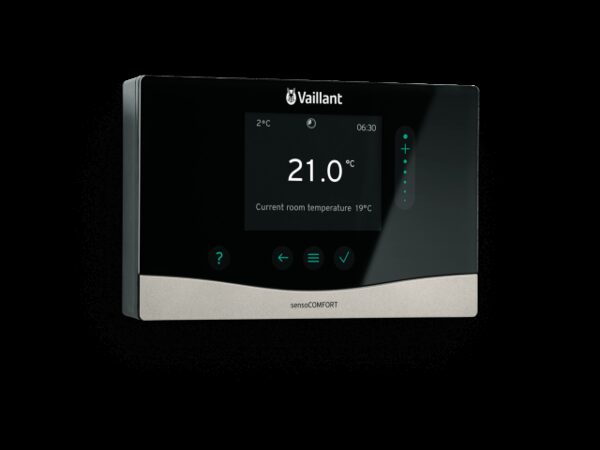
A conventional thermostat is a switch. It closes when the room is cool, the boiler fires at whatever output its own controls choose, and it opens when the room is warm. A compensating control instead interprets the difference between the actual room temperature and the temperature wanted, and sends the boiler a signal of how hard to work rather than a simple ON or OFF, which improves efficiency11.
Two strategies use that signal. Load compensation works by measuring the response of the heating system and controlling the flow temperature dependent upon the required load, adjusting the radiator circulating temperature to be hotter when the house is cold12. Weather compensation instead varies flow temperature against outdoor conditions. Both are covered in more detail under load compensation and boiler modulation and weather compensation.
The consequences of running cooler and longer are physical as well as financial. Low-temperature operation is associated with slower corrosion rates within the system, less thermal shock to the system and components, gentler treatment of expansion vessels, reduced cavitation at pump and fittings, less noise and creaking, increased comfort through a reduced heat gradient in the room and through steady emitter output, and less loss through pipes in unheated areas13. A boiler maker's own framing is narrower and commercial: OpenTherm controls with load compensation help fine tune efficiency further by controlling the output of the boiler to satisfy the requirements of the system, which reduces cycling, helps lower fuel bills and extends the life of the boiler14.
Modulating forms of regulation are becoming more and more common alongside the usual on/off control, including modulation on the basis of room temperature, remote controlled central heating and information readings on the thermostat3. Several control makers state the same function plainly: OpenTherm communication technology enables modulating control15.
Efficiency and comfort: what the numbers do and do not show
Savings figures for OpenTherm come almost entirely from control manufacturers, and they should be read as marketing claims rather than measured outcomes. One control maker states that its programmable room thermostat offers OpenTherm communication which can save up to 15% gas when connected to an OpenTherm compliant boiler, by automatically reducing the flow temperature of the boiler6. Another states that OpenTherm optimises energy usage and can even reduce gas emissions by up to 12%7. The two figures are not measuring the same thing, are not from the same test, and neither is independently verified.
Independent and association sources describe the mechanism instead of a headline percentage. Modulating appliances offer better efficiency and reduced environmental effects, as well as increased comfort3. A boiler manufacturer's guidance lists lower gas consumption as an outcome5. That is as far as the evidence in front of this page goes.
What a household should expect in practice depends on what it is replacing. If the existing control is already a compensating one, or if the boiler is already set to a low flow temperature and the emitters are oversized, the marginal gain is small. If the system has been running at a high fixed flow temperature and short-cycling, the change is larger. The fabric and the radiator sizing set the ceiling, not the protocol. Do smart heating controls actually save money? takes that question further.
Wiring: two wires, low voltage, no polarity
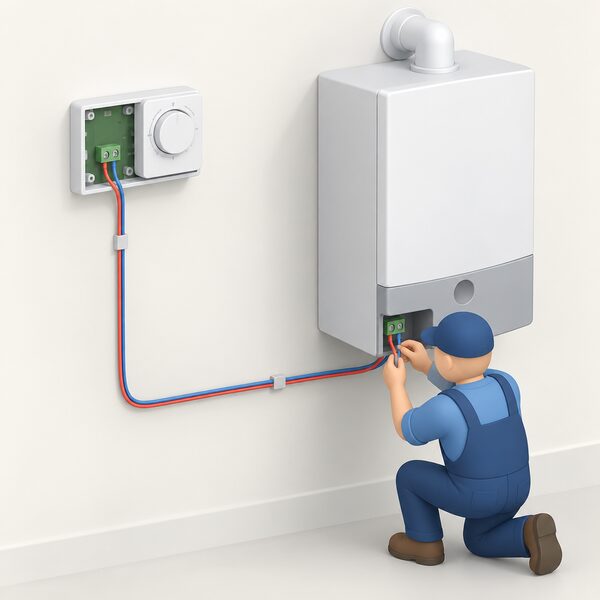
OpenTherm requires a standard type of connection as in any modern installation practice: a 2-wire low voltage and polarity-free connection1. Polarity-free matters on site, because the pair can be connected either way round without damage or malfunction, which removes one common source of error compared with a switched live arrangement.
Physically, the pair runs from the control or its receiver to a dedicated terminal on the appliance. Not every appliance has one. Where a boiler uses a proprietary bus instead, an adapter may exist: one manufacturer sells a converter from its own EMS bus to OpenTherm, IRT or a single channel 230 V on/off connection16. Manufacturer buses such as EMS and eBUS are the alternative family to OpenTherm, and a converter is the usual bridge between them.
Many current UK controls are dual-capable, offering both relay and OpenTherm connections on the same hub so that the installer can use whichever the appliance supports17. That is a pragmatic design: the relay path gives a call for heat to any boiler, and the OpenTherm path adds modulation where the appliance can accept it.
Wiring an OpenTherm pair alongside existing zone valves and a wiring centre raises the usual questions of interlock and zoning; those are dealt with under heating control wiring and boiler interlock.
Wireless links, gateways and app control
OpenTherm can also be used as a wireless protocol1. In UK products that usually means the room unit talks by radio to a receiver or hub which is itself wired to the boiler's OpenTherm terminals. A wireless thermostat sends a signal to a receiver connected to the boiler, which then tells the boiler when to turn the heating on or off, without a direct wired connection between thermostat and boiler18.
Examples across the market show the pattern rather than a ranking. One zoning hub is listed as Open Therm compatible19. A Wi-Fi room thermostat from a boiler maker states OpenTherm compatibility for integration with an existing heating system20. An electric boiler has been made compatible with the universal communication protocol OpenTherm21. A thermostat range states compatibility with most boilers and heat pumps over relay or OpenTherm, in both wired and wireless starter kits, the wireless version suiting a boiler not yet wired to a thermostat22. One widely sold smart thermostat family is listed as OpenTherm enabled for compatible combi boilers only23. The wireless question is treated separately on does OpenTherm work wirelessly?.
Cloud and app features sit on top of, not inside, the protocol. Hot water is a good example of where an OpenTherm link can reach further: with an OpenTherm storage boiler, one modulating thermostat can regulate domestic hot water production via a dedicated schedule, with production activated, deactivated and its temperature adjusted remotely from a smartphone24. That convenience introduces a dependence on the manufacturer's servers and app that the two-wire link by itself does not have. Heating controls and energy independence covers that trade-off.
Home energy management and grid signals

The association's own roadmap points outward. Future expansion possibilities include connecting OpenTherm controllers to other smart energy systems such as HEMS, grid control or other related systems1. The same communication channel can be used to read appliance settings and other data like error and malfunction codes, and that data is available to related systems like a HEMS3.
A home energy management system can integrate EV chargers, heat pumps and PV diverters25. Grid-side signalling uses different standards: OpenADR enables grid signals to be sent to a HEMS or device manufacturer platform, which then translates those requests into instructions for devices26. OpenTherm's place in that chain is the last hop, between the household controller and the heating appliance. It is not a grid protocol and does not replace the smart home layers discussed under Zigbee, Matter, KNX and Wi-Fi for heating controls.
For independence, the distinction is worth holding. A wired OpenTherm thermostat keeps working with no internet connection at all. Once the same control is enrolled in a HEMS or a flexibility service, the household has gained optimisation and lost some autonomy over when the appliance runs.
What the standard guarantees, and what it leaves to manufacturers
Using OpenTherm guarantees a minimum level of compatibility1. That is the honest statement of what buyers get, and it is narrower than "any OpenTherm thermostat works fully with any OpenTherm boiler". The way the protocol is implemented, and any extra functionality resulting from its use, is determined entirely by manufacturers of HVAC appliances and room thermostats1. Two compliant devices will exchange the core messages. Whether the thermostat can also set hot water temperature, read a specific fault code or adjust a compensation curve depends on both makers having implemented the same optional functions.
That is why compatibility must be checked at the model level. Independent guidance is that before buying a smart thermostat, a householder should check that it is compatible with the boiler and heating system, usually in the product description or on the thermostat manufacturer's website18. Manufacturer listings bear this out: one smart thermostat range is OpenTherm enabled for compatible combi boilers only23, and one boiler maker's support guidance for an OpenTherm room thermostat is to check the thermostat's connection to the boiler and contact the installer if in any doubt27.
| Layer | What is fixed by the standard | What the manufacturer decides |
|---|---|---|
| Physical link | 2-wire, low voltage, polarity-free1 | Terminal location, whether a terminal is fitted at all |
| Core messages | Standardised functions added to the Protocol Summary by the Technical Commission1 | Which optional messages are supported |
| Extra features | Nothing | Implementation and any extra functionality, entirely1 |
| App and cloud | Outside the protocol | Gateway, account, server availability |
Weather compensation and Boiler Plus
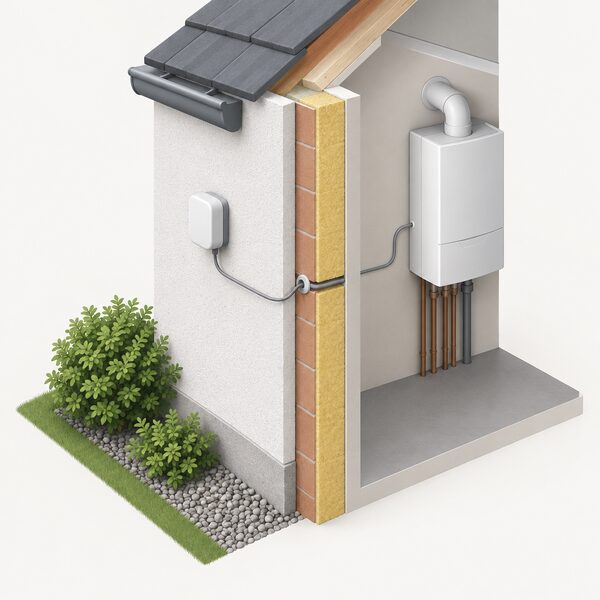
Boiler Plus increased minimum efficiencies for boilers, required time and temperature controls, and required an additional energy efficiency measure chosen from weather compensation, a smart thermostat, flue gas heat recovery or load compensation28. Two of those four options are things an OpenTherm control can deliver, which is a large part of why the protocol became common in the UK gas market.
Weather compensation itself is a strategy, not the protocol. A weather compensator adjusts the boiler temperature in line with the outside temperature, so it uses less fuel when it is warmer outside29. It needs a means for automatically measuring local outdoor temperature. Manufacturer guidance is that weather compensation can be achieved when the boiler is fitted with an optional compatible outdoor sensor30, and kits are sold on that basis and marked Boiler Plus compliant31. One maker requires a weather compensating room thermostat plus an internet gateway to meet Boiler Plus requirements with a combi boiler32; another states that its app's weather compensation abilities and smart control compatibility mean boilers featuring it will achieve Boiler Plus compliance33. The requirements themselves differ between the nations of the UK, and are set out on building regulations for heating controls.
OpenTherm and heat pumps
Heat pumps modulate by nature and run at lower flow temperatures. They can work with radiators or underfloor heating, and some types can work without either34. Varying flow temperature according to the season is standard practice and is called weather compensation, also known as outdoor weather compensation35.
Some control ranges state compatibility with most boilers and heat pumps over relay or OpenTherm22. But a caution belongs here, and it comes from official field work rather than a manufacturer.
"Weather compensation was typically enabled, though in some cases it appeared to be in conflict with third party thermostat control"
Two control layers pulling in different directions is a real failure mode: the appliance's own compensation curve setting one flow temperature while an added thermostat demands another. Where a heat pump manufacturer provides its own controller, adding a third party OpenTherm thermostat is a design decision for the installer, not a plug-in upgrade. Why TRVs are often left off heat pump installations covers the same tension at radiator level.
Where OpenTherm sits in the UK market
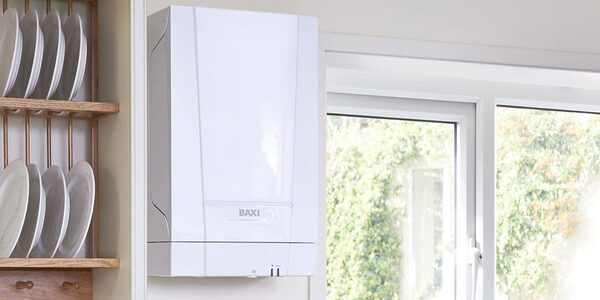
The association states that using OpenTherm gives specific benefits for application in the UK37. The market position is straightforward: it is the most common boiler communication protocol in use, and the one that enables modulation2. It is widely listed across UK-sold appliances and controls, from combi boilers marked OpenTherm ready to zone kits, room thermostats and hub receivers offering both relay and OpenTherm connections17.
Boiler manufacturers list it in their own specifications: one combi upgrade quotes boiler communication by OpenTherm protocol38, and a boiler maker's own room thermostat communicates with the boiler using OpenTherm to automatically adjust its settings to achieve the desired room temperature27. Those are maker statements about their own products, and are reliable for that purpose only.
The remaining dependence is worth stating plainly. An OpenTherm link does not reduce a home's reliance on gas, on a supplier or on the grid. It makes the appliance the household already has burn less fuel for the same comfort, and it frees the choice of control from a single manufacturer's ecosystem. Everything above that, remote control, hot water scheduling, fault reporting to an app, reintroduces a dependence on a manufacturer's servers, a gateway and a broadband connection. The proposal to require open protocols in new boilers, if it becomes a rule, would make the first of those freedoms a default rather than a feature to shop for8.
Sources38 cited
- What is OpenTherm, OpenTherm Association, 2026-01-26
- How to buy the best smart thermostat, Which?, 2026-09-17
- Why a communication protocol, OpenTherm Association, 2026-01-26
- What are open protocols in heating controls, ESI Controls, 2026
- What is OpenTherm, Viessmann, 2022-06-16
- 4 Series wired programmable room thermostat, ESI Controls, 2026
- Hive Thermostat, Hive, 2026-09-17
- The future for smart heating policy, Drayton Controls, 2025-09-25
- Weather compensation in heat pump control, iDM Energiesysteme, 2026-07-09
- Benefits of open protocols for homeowners and landlords, ESI Controls, 2026
- The secret life of boilers, part two, CREDS, 2020-06-29
- Guide to load and weather compensation, HHIC, 2018
- What is boiler modulation and boiler cycling, Heat Geek, 2026-09-17
- Practical advice on cutting energy bills, Intergas Heating, 2022-05-23
- Connectivity and thermoregulation, Ferroli, 2026-09-17
- EasyControl adapter, Worcester Bosch, 2026-09-17
- Wiser 2-Channel 2nd Generation HubR, Drayton Controls, 2026-08-27
- What is a smart thermostat, Smart Energy GB, 2026-08-19
- WundaSmart HubSwitch, WundaSmart, 2026-09-20
- Alpha Touch Wi-Fi thermostat, Alpha Innovation, 2025-08-20
- New Baxi Amptec S electric boiler, CIPHE, 2025-09-04
- Central heating and thermostat guide, tado°, 2026-08-03
- Smart heating range, Hive, 2026-09-17
- Smart thermostat and OpenTherm, Netatmo, 2026-09-20
- Making the most of your solar PV panels, Centre for Sustainable Energy, 2026-08
- Making home energy management work for consumers, Energy Systems Catapult, 2026-02-12
- Comfort Touch thermostat, Intergas Heating, 2026-09-17
- Written evidence on heating policy, UK Parliament, 2026
- Upgrading and replacing your boiler, Centre for Sustainable Energy, 2026-06
- Heating glossary, Ideal Heating, 2026
- Weather compensation kit, Ideal Heating, 2026-09-17
- Controls and frost protection, Vaillant, 2026
- ON AI technology, Navien, 2026
- Heating your home, Energy Saving Trust, 2026-05-19
- Heat pump questions answered, Energy Saving Trust, 2026-05-27
- Heat pump transition report, GOV.UK, 2026-05
- OpenTherm benefits, OpenTherm Association, 2026-01-14
- Halo Combi 2-Zone specification sheet, Ideal Heating, 2026-09-17
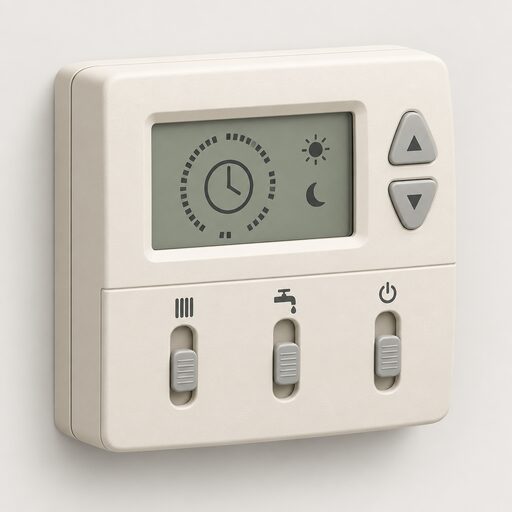 Controls, Thermostats and TRVsWhich heating controls actually cut your bills, and what does each one do?
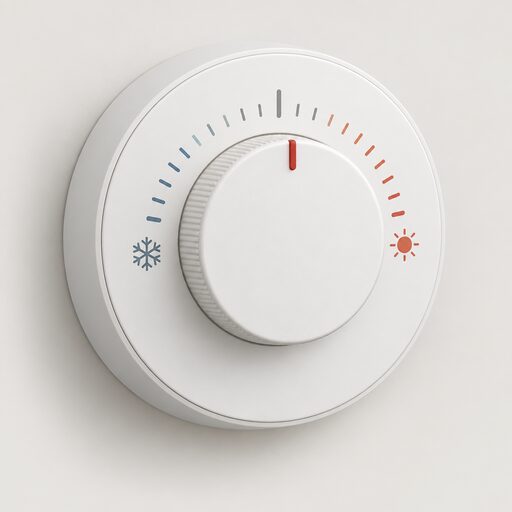 Controls and Smart OperationWhy does a heat pump need different controls from a boiler, and what does weather compensation actually do?
 Smart Thermostats ExplainedWhat does a smart thermostat actually do, and is it worth it?
 Controls and Time-of-Use TariffsCheaper electricity at night only saves money if your heating actually uses it then.
 Installing Heating ControlsSwapping a thermostat or programmer looks simple, but which jobs can you safely do yourself and which need a registered installer?
 System Boilers ExplainedA system boiler heats your radiators and stores hot water in a separate cylinder, so several taps and showers can run at once.