
In this answer
Short answer
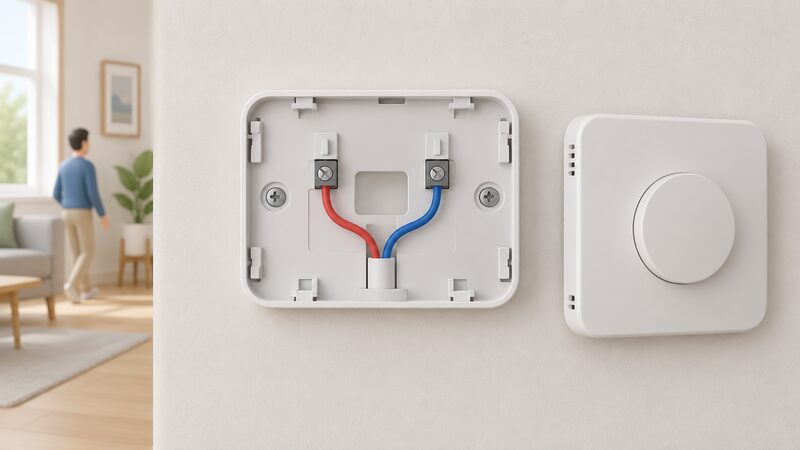
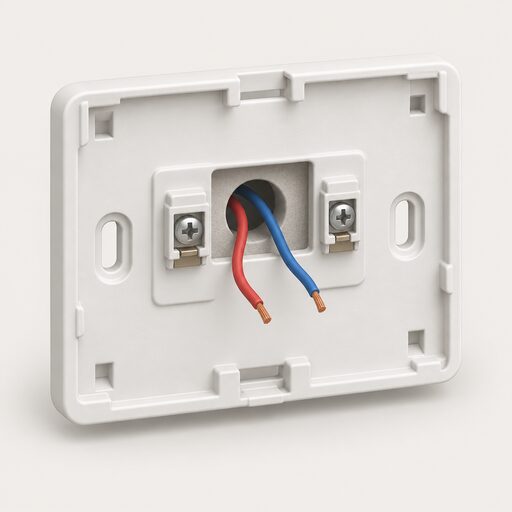
A room thermostat does one job: it turns the boiler on and off automatically when the room temperature reaches the level chosen1. In most UK homes the old thermostat on the wall is connected by two wires, and there is no third terminal to supply it with power. That is the common wire, often labelled C, and its absence is the single most frequent reason a straightforward smart thermostat swap turns into a longer job.
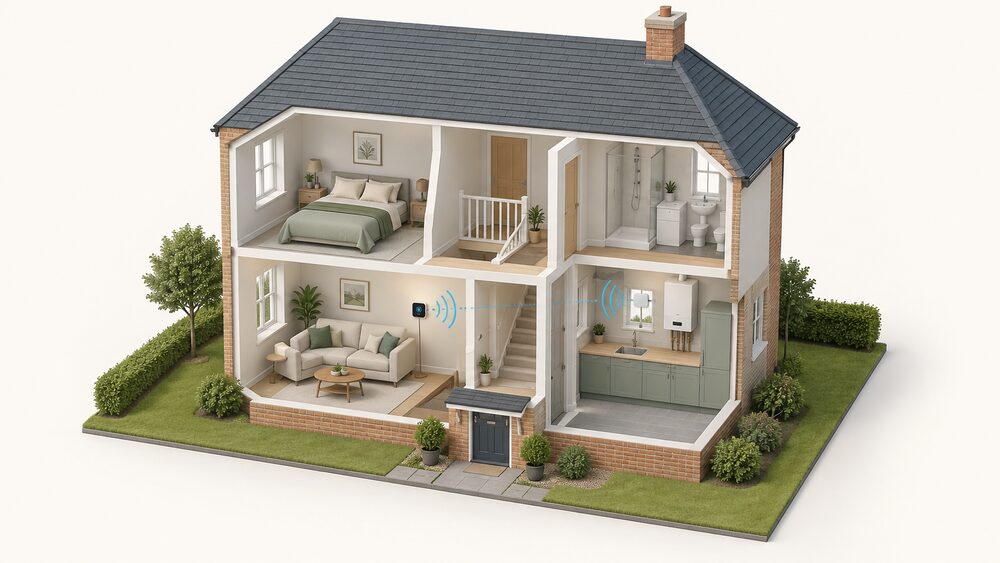
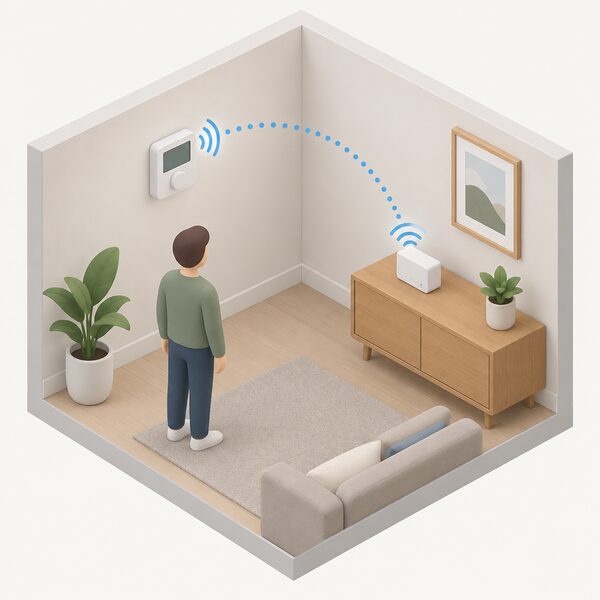
The workaround is well established. A wireless thermostat sends a signal to a receiver connected to the boiler, which then tells the boiler when to turn the heating on2. The thermostat itself sits on a wall or a shelf with no cable to the boiler at all, so the missing common wire stops mattering at the room end. What it does not remove is the wired connection at the boiler: a lot of boilers are not Wi-Fi enabled, so many smart or wireless thermostat systems still include a wired element, and that wiring should be done by a trained professional2.
So the honest answer to the search that brought most readers here is that a missing C wire is rarely a dead end, but it does change what the job involves. The thermostat moves to where it can be powered by batteries or a plug, a receiver goes near the boiler, and the two talk wirelessly.
What a thermostat actually does, and why the wiring matters
A room thermostat is a switch with a thermometer attached. It turns the boiler on and off automatically when the room reaches the temperature chosen1. It does not control how hot the water in the system gets: the thermostat on the boiler controls the temperature of the water flowing through the heating system, not the temperature inside rooms7. Those are two separate settings and confusing them is behind a lot of wasted gas.
The common wire exists because a smart thermostat needs continuous power to run its screen, its Wi-Fi radio and its processor. Older mechanical thermostats did not: they were passive switches that drew nothing. Wired thermostats connect directly to the boiler with physical wires, which gives a reliable connection with no signal interference and no batteries needed, but they require existing wiring or the installation of new wiring8. Where the existing cable has only two cores, there is nothing to power a smart unit, and pulling a new cable through finished walls is the expensive part of the job.
Wireless models sidestep this. A wireless thermostat is not always smart, though: smart thermostats usually add app control, internet connectivity, automation or other connected features on top of the wireless link2. That distinction matters when comparing prices, because a plain wireless programmable thermostat and a smart one can look similar on the shelf.
Wired, wireless, programmable or smart: which fits which home
The choice usually comes down to what is already in the wall and what the household wants from the controls.
Wired thermostats suit homes where a suitable cable already runs from the boiler to a good wall position. They connect directly to the boiler with physical wires, giving a reliable connection with no signal interference, and need no batteries8. If the cable is there, this is the least troublesome route.
Wireless thermostats suit homes with two-wire legacy cabling, solid walls, or a thermostat position that would be awkward to cable. They require no wired installation, so are easier to set up and start using9. The trade-off is batteries or a plug-in power supply, and a radio link that has to reach the receiver.
Smart thermostats add Wi-Fi so they can connect to the home network and be controlled remotely through an app on a phone or tablet6. Most smart heating controls link to a phone, and heating can be controlled via smartphone, tablet or laptop, or by telling a smart speaker what is wanted10. Some makers sell both options: the Netatmo Smart Thermostat is a programmable thermostat that comes in both wired and wireless models11, and its wireless version is described as remotely controllable via digital devices and a smartphone9.
| Type | Power source | Connection to boiler | Best suited to |
|---|---|---|---|
| Wired thermostat | No batteries needed8 | Physical wires to the boiler8 | Homes with existing multi-core cable |
| Wireless thermostat | Batteries or plug | Radio signal to a receiver2 | Two-wire legacy wiring, awkward cable runs |
| Smart thermostat | Batteries, plug or wired | Wi-Fi for app control, plus a receiver or hub wired to the boiler in many systems2 | Households wanting app and voice control |
Prices for the device itself typically sit between £100 and £200, with add-ons such as installation pushing the total higher3. Other published figures put the device at £100 to £20012 and a smart thermostat for boiler heating controls at around £100 to £25013. Prices are installer-quoted in practice, and the figures above are the published ranges rather than a quote for any particular home.
Fitting it safely: power, wiring and the heating circuit
The safe division of labour here is clear. Where a receiver or hub must be wired to the boiler, that wiring should be done by a trained professional2. That is not a formality: the receiver connects into the boiler's control circuit, and getting it wrong can affect how the boiler fires and whether its safety interlocks still work.
Maker guidance on self-installation varies. Hive recommends finding a local tradesperson to install its smart thermostat, describing it as a bit of a task14. Google Nest recommends professional installation of the Nest Learning Thermostat but says self-installation of the Smart Thermostat E should be achievable for most15. The pattern is that the more the unit replaces existing wired controls, the more the job leans towards a professional.
Before buying anything, check compatibility. Not every boiler is compatible, so check with the boiler manufacturer before buying a smart thermostat16. The same check can be made against the product description or the thermostat manufacturer's website2.
For homes without central heating at all, the plug-in type is the relevant one, and it is covered further under electric heating controls.
Where to site the thermostat, and where not to
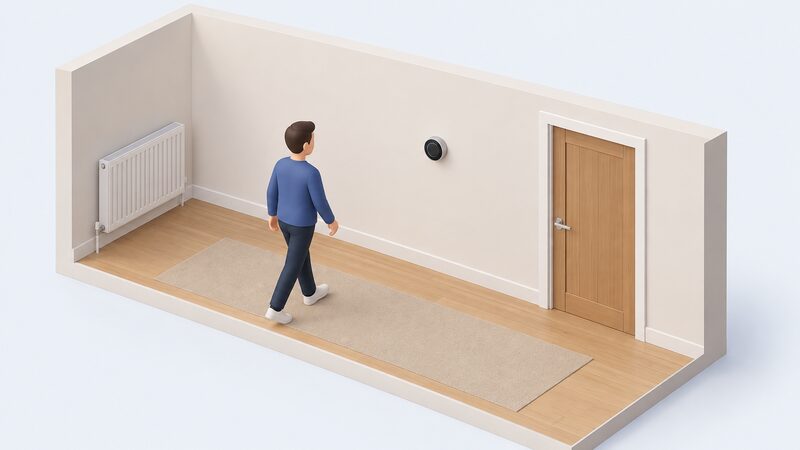
Placement decides whether any thermostat, smart or not, does its job. The best place to put a smart thermostat is somewhere the temperature is relatively consistent3. An internal wall away from windows, doors and radiators usually meets that test.
The exclusions matter as much as the recommendation. A thermostat should not be blocked by furniture or curtains, should be kept away from heat sources such as electric fires or heaters, and should be protected from draughts and placed away from sources of draughts such as windows or the front door17. A thermostat reading the warmth of a lamp, a television or a draught under a door will switch the boiler on and off at the wrong times, and no amount of app control fixes a sensor in the wrong place.
For a wireless unit there is one further constraint: the radio link has to reach the receiver at the boiler. That is a practical limit rather than a documented rule, and it is worth confirming before committing to a position at the far end of the house.
How much a thermostat can save you
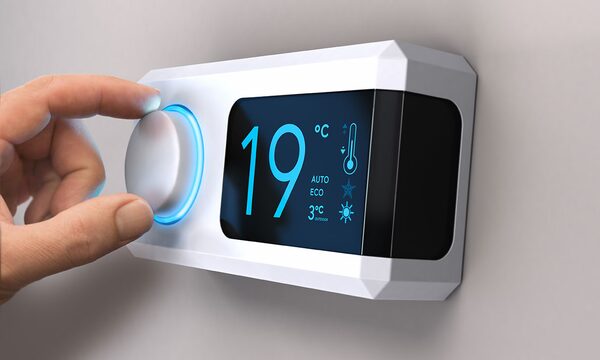
Savings figures for heating controls vary widely, and the variation is the story. Installing a smart thermostat and controls to fine-tune heating is put at up to £110 a year off bills18. Turning the thermostat down by a single degree is put at as much as £90 a year4, £90 off heating costs19, £90 per year20, between £85 and £90 a year in a typical home21, around £60 a year22, £80 per household23, and up to £80 per year24. Northern Ireland guidance gives £80 for a reduction from 22 to 21°C, against £120 in Great Britain for the same change25. Official guidance for Northern Ireland frames a one degree reduction as saving as much as 10 per cent on heating bills26.
The spread comes from the homes, fuels and prices behind each estimate, and from whether the figure assumes a behaviour change or just a device. A smart thermostat could save money, but savings are not guaranteed: they depend on the home, heating habits, existing controls, energy prices and how the thermostat's features are used2. The maker position is similar in substance: smart thermostats do not directly save money in the way switching energy supplier can, but they can help heat a home more efficiently to save money in the long term16.
For a household's energy independence, the picture is mixed. A thermostat keeps control local: it decides when the boiler runs, and it keeps working if a supplier changes or a tariff ends. Smart thermostats are not a barrier to switching energy deal, since they control how much energy is used rather than which company supplies it3. What remains dependent is the boiler itself, the gas or electricity it burns, and, for the smart models, the maker's app and cloud service. A wireless thermostat with no common wire solves a wiring problem; it does not make the home self-sustaining.
Sources26 cited
- How to use your heating controls, Age UK, 2026-03-23
- What is a smart thermostat?, Smart Energy GB, 2026-08-19
- What are smart thermostats?, Uswitch, 2026-02-05
- Free energy saving tips, Uswitch, 2025-10-14
- Energy efficiency, Cadent Gas, 2026-09-20
- What is a smart thermostat and are they worth it?, Vaillant, 2026
- Smart heating controls: what they do and why they matter, BEAMA, 2025-04-07
- Heating thermostat, tado°, 2026-08-03
- Wireless thermostat, Netatmo, 2026-09-20
- Smart homes: lower carbon footprint, Energy Saving Trust, 2026-01-21
- Heating controller, Netatmo, 2026-09-20
- Everything you need to know about heating controls, Plymouth Energy Community, 2026-09-20
- Boiler prices: how much does a new boiler cost?, Which?, 2025-09-17
- tado° vs Hive: which smart thermostat is best, Energy Helpline, 2026-09-20
- How to buy the best smart thermostat, Which?, 2026-09
- A simple guide to smart thermostats, Hive, 2025-11-20
- Turning down thermostats, Smart Energy GB, 2026-04-22
- Energy saving tips for the home, Confused.com, 2025-10-14
- Best boilers, Confused.com, 2025-11-03
- Make your home more energy efficient, Confused.com, 2026-07-06
- Draught proofing, Which?, 2026-05-05
- Ultimate energy saving tips guide, Smart Energy GB, 2026-04-24
- Energy efficiency at home: keeping warm and well, Advice NI, 2026
- Electric heaters vs storage heaters, Energy Helpline, 2026-09-20
- Insulation, nidirect, 2026-08-03
- What are the best energy saving tips for households in the UK?, British Gas Energy Trust, 2026-04-21
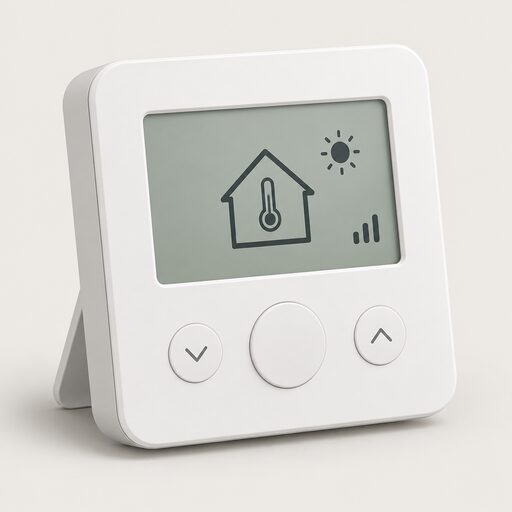 Room Thermostats ExplainedExplains mechanical, digital, programmable, wired, wireless and smart room thermostats, how they call for heat and switch it off, where to site them, how many zones a home needs under the building regulations, and what one degree on the dial is worth.
 Smart Thermostats ExplainedWhat does a smart thermostat actually do, and is it worth it?
 The Full Heating Controls GuideA room thermostat, a programmer and valves on your radiators are the basics.
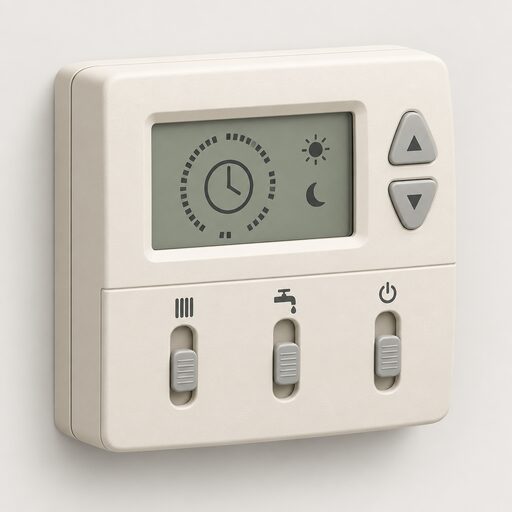 Controls, Thermostats and TRVsWhich heating controls actually cut your bills, and what does each one do?
 OpenTherm Protocol ExplainedOpenTherm lets a smart thermostat and a boiler from different makers work together properly, so the boiler can run gently instead of switching on and off.
 Installing Heating ControlsSwapping a thermostat or programmer looks simple, but which jobs can you safely do yourself and which need a registered installer?