
In this guide
A Netatmo smart thermostat is a connected heating control that replaces a conventional room thermostat and adds app-based programming, remote adjustment and consumption reporting. Netatmo describes the Smart Thermostat as a wireless model that links directly to the home boiler, giving optimum control over heating and energy bills, and as a connected thermostat that allows remote adjustment and programming of home heating from a smartphone or tablet1.
The range is small and clearly split. The standard Smart Thermostat suits most gas, oil, electric and wood boilers and air-to-water heat pumps, and Netatmo states it is compatible with most boiler models3. The Smart Modulating Thermostat is the model for OpenTherm modulating boilers, where it controls the heating circuit temperature precisely rather than simply switching the boiler on and off4. Netatmo also sells Smart Radiator Valves, stated as compatible with 90% of hot-water radiators and pairable with the Smart Thermostat5.
For a household, the appeal is straightforward: local control of the boiler stays in the home, while scheduling and monitoring move to a phone. The dependence that comes with it is a Wi-Fi connection, a Netatmo account and the manufacturer's app, plus a support question the maker has not answered publicly.
What a Netatmo thermostat is and what it does
The product sits in the same category as any other smart thermostat: it takes over the switching and, in the modulating version, the firing rate of the boiler, and it puts the schedule on a phone rather than on a dial or a mechanical timer. Netatmo's own description is of a smart wireless thermostat model for control over home heating and energy bills, remotely controllable via digital devices and smartphone1. Elsewhere the company frames it as a connected thermostat that allows a household to reduce home energy consumption while maintaining comfort2.
The functional core is a heating programme adapted specifically to the daily routine, taking account of the outside temperature and the home's insulation8. That is the same principle as weather compensation and load compensation, applied at the room-control level: the control decides when to start heating based on conditions rather than on a fixed clock time alone. Netatmo's Auto-Adapt function considers the insulation of the house and the outside temperature and automatically determines the time needed to reach the desired temperature4.
What it does not do is change the fuel or the boiler. A Netatmo thermostat on a gas boiler leaves the home on the gas grid and on a gas supplier, with the same boiler, radiators and pipework. The independence it adds is control independence: schedules held locally at the device and at the boiler, with the option to adjust from a phone. The independence it removes is small but real, because the app route depends on a home network and a manufacturer's service. The wider picture of where that trade sits is set out in Heating Controls and Energy Independence.

Remote control and programming from your phone

Netatmo states the Smart Thermostat is totally remotely programmable, so the home temperature can be set whenever and wherever9. The company repeats the same wording on its room thermostat guidance, and adds that the thermostat allows heating to be controlled remotely for maximum energy savings9. In its French-language guidance the same product is described as allowing heating to be controlled remotely whether at the office or on holiday10.
Control runs through the Energy app or the Home + Control app on a smartphone or tablet12. Netatmo also states that the thermostat allows programming of regular heating periods according to days and times, gives usage and energy consumption reports, and offers remote control via the Energy application4. Programming can be handled straight from digital devices, which Netatmo presents as freedom to set the temperature at home5.
Two conditions sit underneath all of this. The first is stated plainly by Netatmo: for the Smart Thermostat to work, a Wi-Fi connection is required12. The second is the app itself. Independent guidance on smart heating controls describes the category as letting a household turn the system on or off and change the temperature using a smartphone when not at home, which is exactly the function Netatmo describes, and it is a function that stops working if the broadband or the manufacturer's service stops13.
Voice control is part of the same chain. Netatmo states that Alexa, Google Home and Apple HomeKit are compatible with the Netatmo Smart Thermostat, which makes voice assistants a convenience layer on top of the app rather than an alternative to it10. For a household weighing how much of its heating should depend on the internet, Smart Heating Controls: Security, Data and Product Support covers the support and data side in more detail.
Compatibility: boilers, heat pumps and radiators
Netatmo states the Smart Thermostat is compatible with most boiler models, naming electric, gas, oil and wood, and with air-to-water heat pumps3. The company also states that a Netatmo Smart Thermostat can be programmed and controlled remotely to keep home heating at the required level on a wood pellet boiler14. The requirement it sets out is an individual boiler, rather than a shared or communal system12.
That last point matters in flats. Netatmo's Smart Radiator Valves are described as suitable whether the home has an individual or collective heating system, in a house or a flat, with a choice of radiator options5. So the valve route can reach homes where the boiler itself is not the household's to control, while the thermostat route assumes a boiler the household can switch.
On radiators, Netatmo states the Smart Thermostat is easy to install on a cast iron radiator, and that output levels of cast iron radiators can be adjusted by defined time slots from a smartphone or tablet15. The company's general position is that a thermostat can be installed on cast iron radiators to use less energy and lower bills15. Its Smart Radiator Valves are stated as compatible with 90% of hot-water radiators and can be paired with the Smart Thermostat5.
| Netatmo product | Suits | Key stated condition |
|---|---|---|
| Smart Thermostat | Most electric, gas, oil and wood boilers; air-to-water heat pumps3 | Individual boiler required12 |
| Smart Thermostat | Wood pellet boiler14 | Remote programming and control14 |
| Smart Thermostat | Cast iron radiators15 | Output adjusted by time slot from phone or tablet15 |
| Smart Radiator Valves | 90% of hot-water radiators5 | Pairable with the Smart Thermostat5 |
| Smart Modulating Thermostat | OpenTherm modulating boilers4 | Precise heating circuit temperature control4 |
Netatmo publishes a compatibility checker at check.netatmo.com for confirming a specific installation before purchase3. For the general question of which controls suit which boiler type, Smart Thermostat Boiler Compatibility covers the wider field.
Wired and wireless models, including the Smart Modulating Thermostat

Netatmo's range divides by what the boiler can accept rather than by appearance. The standard Smart Thermostat is described as a wireless model that links directly to the home boiler1. Netatmo states that these wireless products work with modern combi boilers12. Installation is offered in wired or wireless form, with the same stated time either way3.
The Smart Modulating Thermostat is the more capable unit. Netatmo states that OpenTherm modulating boilers can be upgraded with it, and that it controls the heating circuit temperature very precisely, in addition to the classic functions of the Netatmo Smart Thermostat4. On a home with an OpenTherm storage boiler, Netatmo states the Smart Modulating Thermostat can also regulate domestic hot water production via a dedicated schedule, with hot water production activated, deactivated and its temperature adjusted remotely from a smartphone4.
That hot water capability is not universal across the range. Netatmo notes that some smart, wireless models can also be used to control hot water as well as heat, which is a narrower statement than it first appears9. The general taxonomy of room thermostats includes wired, wireless, programmable, non-programmable and smart types, and the Netatmo range sits in the wireless and smart part of that list9.
The distinction between wireless and smart is worth holding on to. Independent guidance states that a wireless thermostat is not always smart, and that smart thermostats usually add app control, internet connectivity, automation or other connected features16. A Netatmo thermostat is both, which is why the Wi-Fi requirement applies. The protocol question, and what OpenTherm actually changes about boiler behaviour, is covered in OpenTherm: The Modulating Control Protocol Explained and in Does OpenTherm work wirelessly?.
DIY installation: what fitting it involves
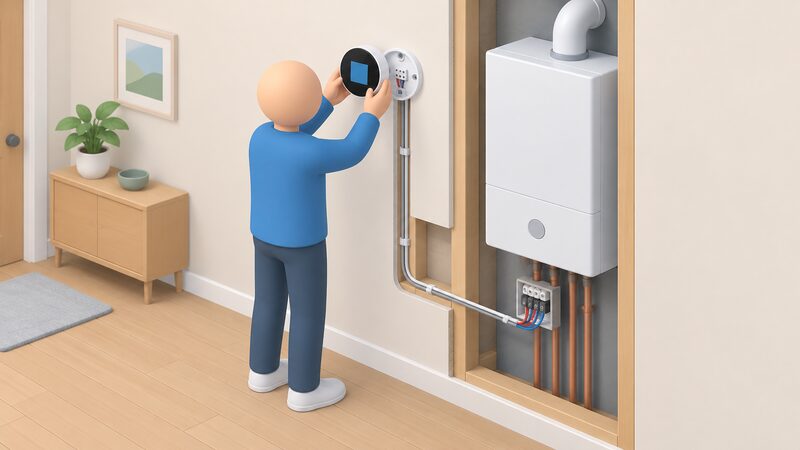
Netatmo states that its smart thermostats are ideal for easy DIY installation, and that installation takes less than one hour whether wired or wireless6. The company offers two routes: a certified Netatmo professional can complete the installation, or the household can set it up at home, which Netatmo describes as quick and simple enough to do14.
The practical content of a self-fit depends on the model. A wireless thermostat needs a position on a wall, power, and a connection at the boiler end; a wired replacement reuses the existing cable run to the old thermostat position. Netatmo's own guidance for the thermostat sets out the requirement for a Wi-Fi connection and an individual boiler, and points to the compatibility checker before starting3.
For context on how the brands compare on this point, independent guidance states that tado says its thermostats can be self-installed and that the guidance it offers is straightforward and simple to follow17. The same guidance states that Google Nest recommends professional installation of the Nest Learning Thermostat but that self-installation of the Smart Thermostat E should be achievable for most17. Google's own product page states the Nest Learning Thermostat should be installed by a professional, while the Nest Thermostat E is described as easy to install yourself18. Netatmo's position is closer to the self-fit end of that spectrum.
Schedules, reports and the savings claim
Netatmo states that a household can save between 25% and 40% on the home heating bill through improved energy efficiency and consumption control6. That is the maker's own figure and should be read as such: it is a claim about the product's effect, not an independently measured result for a particular house. The mechanism behind it is the combination of a schedule matched to the household's routine, Auto-Adapt start times, and consumption reporting that shows what has been used4.
The reporting side is where a smart thermostat earns part of its keep. Netatmo states the thermostat gives usage and energy consumption reports alongside the programming and remote control functions4. Independent research on British households during the cost of living crisis found that those in the top 20% of consumption reducers reported making much bigger changes to their heating practices, in particular heating homes for fewer hours than before and turning the thermostat down lower20. A control that makes consumption visible supports that behaviour, though the research measures household behaviour rather than thermostat performance.
Independent work has also looked directly at running costs. A case study set out to establish the heating costs for households with the Nest, Netatmo and tado smart thermostats compared to the period when the property had a wall-mounted dial thermostat21. That is the right shape of comparison for a household weighing a purchase, and it is a study of costs rather than of comfort.
On the wider question of whether smart controls save money at all, the evidence is mixed and depends on the household. Do Smart Heating Controls Actually Save Money? sets out what the independent work shows. For the settings themselves, Heating Schedules, Setback and Leaving the Heating On covers how schedule design affects consumption.
Support, updates and the product's lifespan
This is the weakest documented part of the Netatmo proposition. When Which? asked manufacturers about update support periods, Netatmo did not provide specific information on update support periods, alongside Energenie, Salus and Eve17. A household therefore has no published statement from the maker on how long the thermostat will keep receiving software updates.
There is one dated figure from a related product. A Legrand product page for the Smarther with Netatmo Connected Thermostat, a surface-mounting white unit, lists a software update duration of three years, and describes the control as adaptive and self-learning, operating on a 2.4G Wi-Fi network7. That is a different product from the Netatmo Smart Thermostat, made under a partnership, so it is an indication of how one Netatmo-connected device is documented rather than a commitment covering the thermostat range.
The comparison that gives the question its edge is Google's. Google ended software and security updates for the first generation Nest Learning Thermostat from 2011, the second generation from 2012 and the second generation EU version from 2014, with the change coming into effect from 25 October 202522. Google states that all other Nest thermostat models sold in the UK, including the Nest Learning Thermostat third generation from 2015 and the Nest Thermostat E from 2018, are unaffected and will continue to receive security updates22.
"After this date, customers will no longer receive software or security updates to their devices."
The lesson for a buyer is that a smart thermostat is a connected device with a service life set by its maker, not only by its hardware. Google Nest Thermostats in the UK: Which Models Are Still Sold and Supported covers that case in full, and Smart Thermostat Subscriptions and App Charges covers the cost side of app dependence.
UK availability and where Netatmo sits in the market
Netatmo sells its thermostats through its own store and through retail channels, and the products are marketed for the UK. The company has stated that from 1 June 2026 its products will no longer be available for purchase in the United States and Canada through its e-shop, a change that applies to those two markets rather than to the UK23.
On price, there is no published Netatmo figure, so prices are retailer-quoted and no range is given here. For scale, independent guidance lists the Google Nest Smart Thermostat E at £19917. Netatmo's own promotional activity has included a subscriber offer giving a free matching accessory with each ORIGINAL Thermostat purchase using a promo code, running from 22 January 2026 to 22 February 2026 inclusive23.
The market position is that of a specialist rather than a mass-market brand. Netatmo was welcomed by CIPHE as a new Industrial Associate in May 2023, with a guest blog introducing the company23. Its differentiators are the OpenTherm modulating model with hot water regulation, the radiator valve range stated as compatible with 90% of hot-water radiators, and a self-fit route that Netatmo presents as taking under an hour6.
Smart thermostats also appear in official energy efficiency thinking. The ECO4 measures table lists Smart Thermostat under the measure type Smarttherm, which places the category within the government's energy company obligation framework rather than only in the consumer electronics market24. Independent guidance on what a smart thermostat is describes the category in similar terms, as a control that adds app and connectivity features to ordinary heating control25.
For a household, the honest summary is that a Netatmo thermostat improves control and visibility, and leaves the fuel, the boiler and the grid dependence exactly where they were. The added dependence is a Wi-Fi connection, an app and a maker that has not published how long it will keep the software current. The comparison with its closest rival is at Netatmo vs tado° smart thermostats, and the wider field at Smart Thermostats: How They Work and What They Do.
Sources25 cited
- Netatmo Smart Thermostat: wireless thermostat, Netatmo, 2026
- Energetic performance, Netatmo, 2026
- How to install a thermostat, Netatmo, 2026
- Smart thermostat and OpenTherm, Netatmo, 2026
- Thermostatic valve, Netatmo, 2026
- Smart thermostat, Netatmo, 2026
- Smarther with Netatmo Connected Thermostat, Legrand UK, 2026
- Should you turn your gas boiler off this summer, Netatmo, 2026
- Room thermostat, Netatmo, 2026
- Reduce energy consumption with eco-friendly practices, Netatmo, 2026
- Reduce energy consumption with eco-friendly practices (Canada), Netatmo, 2026
- Remote heating and smart thermostat, Netatmo, 2026
- Thermostats and heating controls, Energy Saving Trust, 2026
- Pellet boiler, Netatmo, 2026
- Cast iron radiator, Netatmo, 2026
- What is a smart thermostat, Smart Energy GB, 2026
- How to buy the best smart thermostat, Which?, 2026
- Compare thermostats, Google Store, 2026
- Nest thermostats, Google Store, 2026
- Winter demand falls as fuel bills rise, CREDS, 21 October 2023
- Heating your house intuitively (CP787), National Energy Action, 25 January 2018
- Google withdrawing support for older Nest thermostats, Which?, 13 May 2025
- Netatmo offers and launch, Netatmo, 2026
- ECO4 Measures Table v4.0, Ofgem, 29 July 2025
- What are smart thermostats, Uswitch, 2026