In this guide
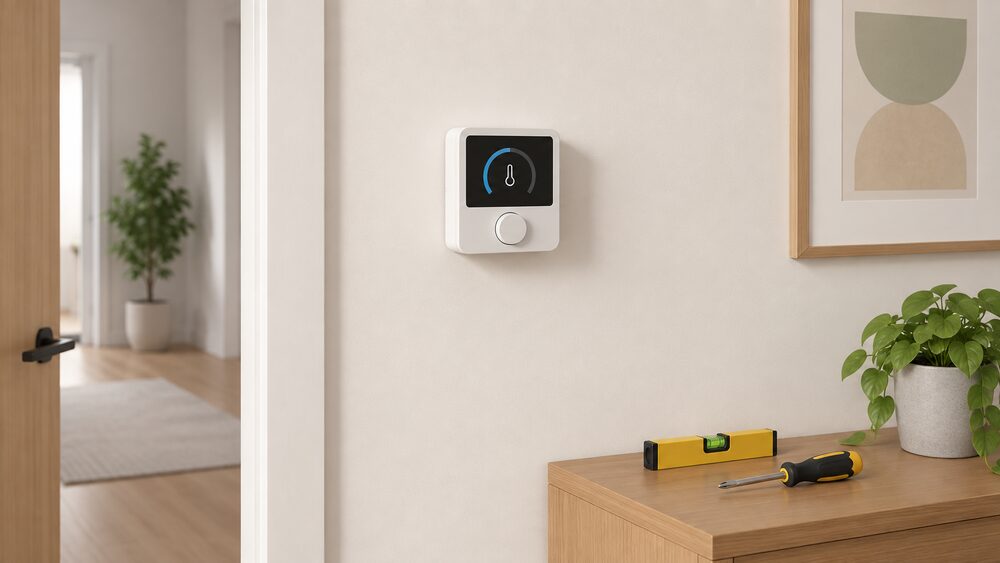
A room thermostat measures the air temperature around it and switches the heating on when the room falls below the chosen level, then off again when that level is reached1. It is the device that stops a boiler, heat pump or electric heater running indefinitely: the thermostat senses the temperature of the air flowing around it and sends a signal to the central heating pump and boiler to stop heating1. Everything else in a control system, the programmer, the radiator valves, the weather compensation, works around that basic switching action.
For most people the lowest comfortable setting is between 18°C and 21°C, a range given consistently by the Energy Saving Trust, the Centre for Sustainable Energy and gas network winter advice2. Moving that dial matters: turning the thermostat down from 22 to 21 degrees is estimated to save around £120 a year in Great Britain and £80 in Northern Ireland5, and official guidance in Northern Ireland puts the saving from one degree at as much as 10 per cent of heating bills6. Published estimates of the cash saving differ widely, from around £60 to around £120 a year, because they rest on different assumptions about home size and fuel price.
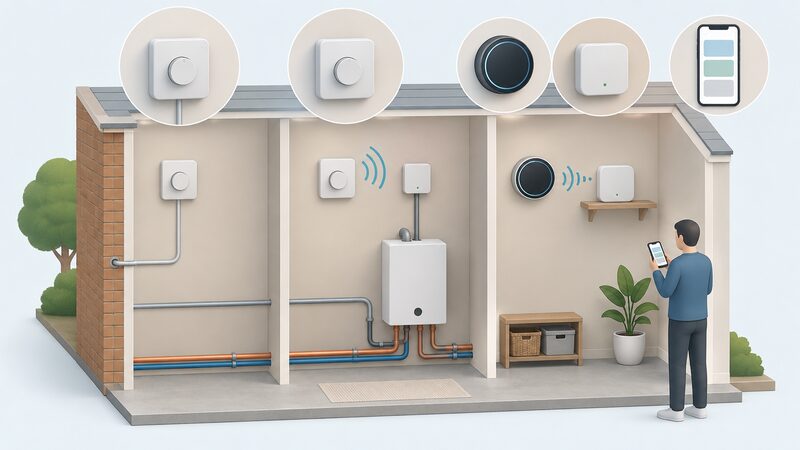
Room thermostats are sold as wired, wireless, programmable and smart, and the categories overlap. A wireless thermostat is not always smart: it sends a signal to a receiver connected to the boiler, which then tells the boiler when to turn the heating on or off, while smart models usually add app control, internet connectivity and automation7. Manual room thermostats are the cheapest, while a smart thermostat kit comes at a higher price8.
What a room thermostat actually does
The thermostat is a switch with a temperature sensor. If the temperature falls below the chosen temperature, the thermostat turns on the heat to warm the home, and it turns the heat off when the desired level is reached13. The boiler uses the thermostat to determine when a room has reached its pre-set temperature, at which point the thermostat sends a signal to the central heating pump and boiler to stop heating1. The same logic appears elsewhere in a heating system: a cylinder thermostat stops the cylinder becoming hotter than it needs to be, so once the water reaches the set temperature the heat supply from the boiler is turned off2, and a storage water heater carries an automatic thermostat to cut off the power supply when it reaches the preset temperature.
That switching is also how a system meets boiler interlock: when no control is calling for heat, the boiler and pump should stop rather than cycle against closed valves.
A room thermostat is not the only temperature control in a wet system. Thermostatic radiator valves control the temperature in a room by reducing the amount of water pumped through the radiators when the temperature goes above a certain level14. The room thermostat governs whether the heat source runs at all; the valves distribute what it produces.
Some models extend the switching logic. Window-open detection temporarily switches heating off when a drop in temperature is detected15. Underfloor controls may shut down if the primary heating temperature drops below a set level, to avoid circulating cool water round the heating system and wasting energy16. A programmable room thermostat adds time to temperature, automatically lowering temperatures when the household is asleep or away from home17.
For independence, the point is blunt: a thermostat reduces how much fuel or electricity a home draws for a given level of comfort, but it does not generate anything. The dependence on a grid, a supplier or a fuel delivery remains; the thermostat only governs how much of it is called for.
Wired, wireless, programmable and smart: the main types compared
| Type | How it connects | Typical characteristics |
|---|---|---|
| Wired (hardwired) | Wired into the walls of the home, which makes installation more complex18 | Fixed position; mains connection; example: Salus RT20, hardwired19 |
| Wireless (RF) | Sends a signal to a receiver connected to the boiler, which tells the boiler when to switch7 | Portable; needs recharging or replacement batteries from time to time |
| Programmable | Wired, wireless, remote controlled, fixed and mobile variants exist18 | Combines time and temperature; lowers temperature automatically when asleep or away17 |
| Smart | Wi-Fi or a mesh such as Zigbee, with a hub or receiver20 | App and voice control, scheduling, open-window detection, zoning7 |
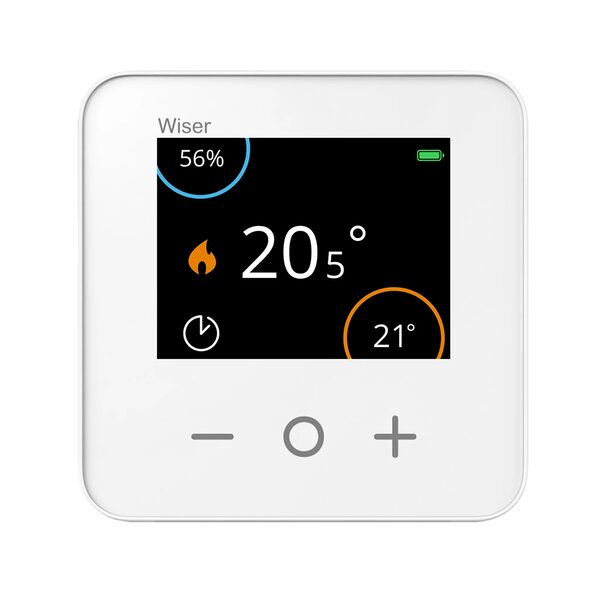
A wired smart thermostat takes the place of an existing wired room thermostat and regulates the temperature in the room13. A wireless one, such as the Wiser Smart Room Thermostat, connects wirelessly to its system so no wiring is required and it can easily be reassigned to different rooms or locations, with separate devices networked using Zigbee mesh technology; it can be freestanding or wall-mounted, with table stand and wall clip included, in white or anthracite20. Electric programmable wireless models provide accurate home temperature information via a digital screen with switchable modes21.
Compatibility is broad. A room thermostat can be used with a gas heater, wood stove, heat pump or gas boiler, whether the central heating is individual or collective8, and a wireless thermostat works with home radiators, an individual or collective boiler, or central heating running on gas, wood or oil. tado° states its Wired Smart Thermostat X is compatible with 95% of heating systems and is available as a wired or wireless thermostat22.
The trade-off sits along the wired-to-smart axis. A wired mechanical or digital thermostat keeps working with no app, no account and no internet, which is why it remains the most self-contained option. A smart thermostat buys scheduling, remote control and room-by-room zoning at the cost of a dependence on a manufacturer's cloud service, an app and a Wi-Fi link. That trade is set out at more length on smart thermostats and wired vs wireless room thermostats.
Recommended settings: 18 to 21°C in the rooms you use
The 18 to 21°C range is the most consistently repeated figure in UK guidance. The Energy Saving Trust advises setting the thermostat to the lowest comfortable temperature, which for most people is between 18°C and 21°C2. The Centre for Sustainable Energy puts the rooms you spend most of your time in between 18 and 21°C to keep warm and avoid damp building up3. Cadent's advice is the same range, framed around health and against damp and mould4. Independent guidance repeats 18°C to 21°C as the comfort and efficiency zone for healthy adults24.
Night and bedroom settings sit lower. Smart Energy GB suggests 16°C to 18°C for a bedroom25. Netatmo gives an ideal daytime temperature of 19 to 21 degrees centigrade and an ideal night-time temperature of between 16 and 17 degrees centigrade8. Sources do not fully agree at the top of the night range, and the household's own comfort, health and occupancy will settle where within the band it lands. Where a home has older or unwell occupants, the health-led advice is to keep the main room within 18 to 21°C rather than economise below it3.
Time usually does more work than temperature. Network winter advice is to set heating to come on just before you get up and switch off after you've gone to bed, and if it is very cold to extend the time rather than turning the thermostat up14. A programmable model automates that, lowering temperatures when the household is asleep or away17. Room-by-room targets are covered on what temperature to set the thermostat and each room and scheduling on heating schedules, setback and leaving the heating on.
What one degree is worth: around 10% and £60 to £120 a year
The percentage figures cluster; the cash figures do not.
| Claim | Figure | Source type |
|---|---|---|
| Saving from one degree down | as much as 10% on heating bills6 | Official (NI Direct) |
| Cut from one degree down | up to 10 per cent | Official (NI Direct) |
| Cost of one degree up | around 10% added to heating costs, depending on the home9 | Independent, citing Energy Saving Trust |
| Saving per degree | between 4% and 8% of the heating bill24 | Independent |
| 22 to 21 degrees | around £120 a year in GB, £80 in NI5 | Independent, citing Energy Saving Trust |
| One degree down | around £60 a year | Independent, citing Energy Saving Trust |
| One degree down | as much as £90 a year27 | Independent |
| One degree down | between £85 and £90 a year in a typical home27 | Independent |
| One degree down | around £6028 | Independent |
The figures rest on different home sizes, different fuel prices at different dates and, in the £120 case, a specific move from 22 to 21 degrees in Great Britain rather than a generic one degree5. The Northern Ireland figure of £80 is lower than the GB figure for the same one-degree change, reflecting a different fuel mix and price base26. One independent guide gives a narrower per-degree band of 4% to 8%24, below the 10% quoted elsewhere.
What is safe to say is the direction and the order of magnitude: a single degree is worth a meaningful share of the heating bill, and it is the cheapest change available because it costs nothing to make. Whether controls pay back their purchase price is a separate question, addressed on do smart heating controls actually save money?.
Where to site a thermostat: inner wall, about 1.5 m up, free air
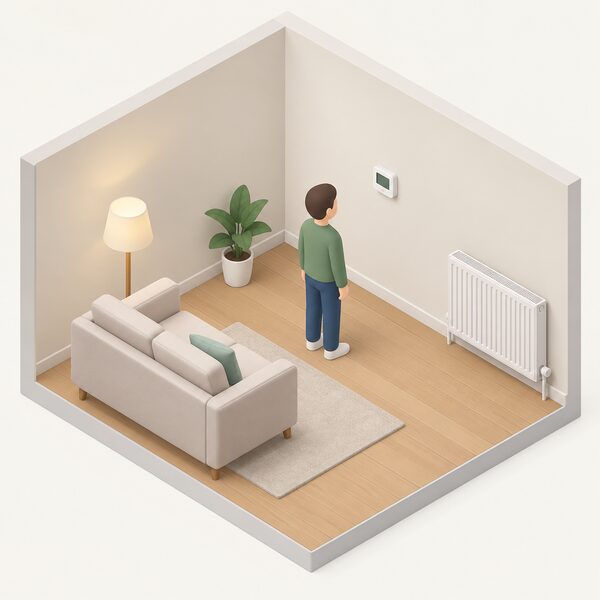
Siting decides whether the number on the display means anything. The recommendation is to position the thermostat on an inner wall in a frequently used room, away from draughts, direct sunlight and heat sources, at approximately 1.5 metres height, in a location representative of the whole house10. Hive suggests around 1 m to 1.5 m up from the floor and away from any direct heat such as radiators29. Several manufacturers converge on the same band: about 1.2 to 1.5 m above the floor in a well-ventilated area with moderate ambient temperature, and around 1.50 m high, out of sunlight and draught. Salus specifies a minimum of 0.2 m away from the door and 1.5 m above floor level, far from heating or cooling sources and not exposed to direct sunlight.
Worcester Bosch states that thermostats should be sited away from direct sunlight and clear of curtains and furniture30. The reason is physical: room thermostats only read temperatures accurately when air can circulate freely around them, so curtains, furniture and heat sources such as lamps or appliances must be kept clear31. Smart thermostat guidance adds that the best position is a place where the temperature is relatively consistent.
Places to avoid, drawn from maker and independent guidance:
- Above radiators or near heating vents10
- Near external doors or windows, where draughts pass10
- In kitchens, where cooking adds heat10
- Near lamps or electronics that generate heat10
- Behind furniture or curtains, or in direct sunlight32
- In a room with additional local heating, which will disrupt control; a wireless thermostat can be moved out of that room33
That rule matters because a TRV and the room thermostat in the same room compete: the valve throttles the radiator, the room never reaches the set point and the boiler keeps firing for the rest of the house12. Heat emitters in the same room as the thermostat should have manual controls instead34. In other rooms, TRVs in non-living spaces such as bathrooms, bedrooms and hallways are commonly set to the midway point35.
A hallway is the classic problem siting. It is central and convenient, but it is also where the front door lets in cold air and where no one lingers, so the thermostat reads a temperature the household never occupies.
How many thermostats and zones a home needs
The building regulations set the floor, and they differ across the UK.
| Nation | Requirement | Source |
|---|---|---|
| England and Wales | Each room should be provided with thermostatic room controls, in new dwellings and when a heat generator such as a boiler is replaced11 | Approved Document L Volume 1 |
| England and Wales (zones) | 1 zone for new dwellings under 150 m²; 2 zones at 150 m² or above; 1 zone for boiler replacement under 150 m², 2 at or above36 | BEAMA Part L guidance |
| Scotland | Dwellings with a total floor area above 150 m² should have at least two space heating zones with independent temperature and time control37 | Domestic Building Services Compliance Guide 2022 |
| Northern Ireland | Central heating systems should be provided with a minimum of two independent heating zones, each controlled by a room thermostat, with TRVs on radiators in rooms without a thermostat except bathrooms38 | Technical Booklet F1: 2022 |
Northern Ireland is the strictest of the four on this point, requiring two zones as a minimum rather than tying the number to floor area38. Installer guidance in Great Britain follows the area rule: one heating zone, meaning one thermostat, for a house under 150 square metres, and two heating zones with two thermostats above that39. As a minimum for a new boiler, independent advice is a room thermostat and a programmer, or a programmable room thermostat.
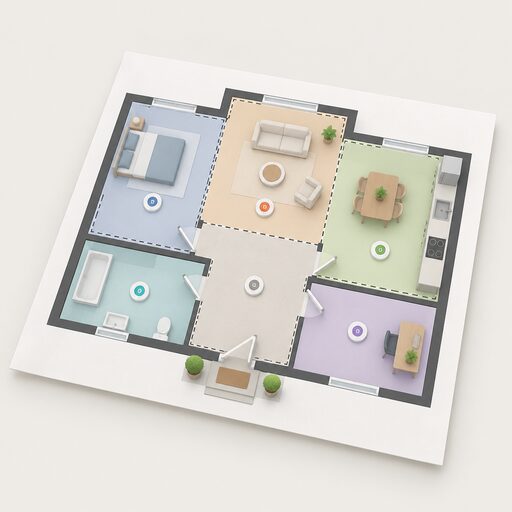
Beyond the minimum, zoning is a product decision. The Hive Thermostat can be added to for up to 6 zones of heating where a multizone heating system already exists40. WundaSmart states up to 30 thermostats per system, controlling 30 different rooms or zones41. Wiser creates zones by assigning multiple smart radiator thermostats to a room thermostat20. A simple two-zone scheme splits the house into two zones of two rooms, with a motorised valve and a thermostat for each zone. One documented four-bedroom home is set up into seven zones, each with its own digitally operated thermostat controller, held at 21.5°C during the cold season.
Two practical limits apply. With electric underfloor mats, all heaters controlled by one thermostat must be installed within the same room or zone42. And more zones mean more devices, more batteries and, in smart systems, more dependence on a single hub. The wiring behind zoning is covered on heating control wiring and the design question on heating zones.
Wiring and installation: isolation first, and when a professional is required
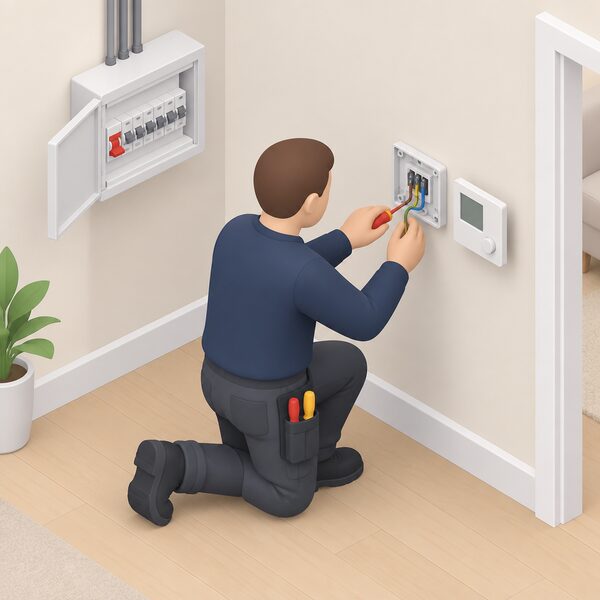
The load-bearing rule is electrical isolation. Netatmo's instruction is unambiguous:
"To connect your thermostat directly to your heating system, cut off the electrical current before starting the installation."
Beyond that, whether a householder can fit a thermostat depends on the product and the circuit. A wired thermostat's installation process is more complex, as it needs to be wired into the walls of the home18. Some products are explicitly described as self-installation, such as the Bosch Room Thermostat II44. Others are not: the Nest Learning Thermostat should be installed by a professional45, and Hive recommends finding a local tradesperson to install its smart thermostat46, while also noting that someone experienced with electrical wiring can technically install a thermostat themselves, though professional help is always recommended47. Electric underfloor heating needs a qualified electrician to connect the system to the electricity supply and install the thermostat48.
Where the work touches the consumer unit, independent guidance is that it is absolutely essential to hire a registered electrician for any installation, replacement or repair49. Fitting a thermostat may also affect a boiler or product warranty, which is covered on does DIY thermostat installation affect my warranty? and the wider job on installing and replacing heating controls.
Replacing a mechanical thermostat with a smart one often runs into the wiring itself: older switching arrangements may not provide a permanent live at the thermostat position, which is the problem set out on fitting a smart thermostat with no common (C) wire.
Smart features that matter
Smart models differ from wireless ones by what they add on top of switching. Depending on the model, a smart thermostat may allow app control, voice control, hot water settings, location-based heating, reminders or alerts, open window detection, routine learning and heating-use tracking7. Makers describe remote control from anywhere via a smartphone app, learning capabilities, geofencing, energy insights and smart home integration with voice assistants including Alexa, Google Assistant and Siri10.
The features that repeatedly earn their place:
- Open-window detection. Heating is automatically switched off temporarily when a drop in temperature is detected15. Which? records it on the Switchbot, Aqara E1 and Drayton Wiser radiator thermostats12.
- Child or keypad lock. Found on the Switchbot and Wiser radiator thermostats12 and, as a key lock function, on the Dimplex AluRad Wi-Fi.
- Boost and override. The Wiser Room Thermostat allows boosting and overriding schedules for a set time and also functions as a signal range extender for other Wiser devices20.
- Geofencing and adaptive heating. tado° lists geofencing and adaptive heating, with individual room control from anywhere.
- Holiday mode and frost protection. Homematic IP lists open-window detection, holiday mode and smart home integration, with temperature adjustable manually at the thermostat, via the app and by voice command.
Independent guidance frames the saving mechanism plainly: remote switching off via a phone, sensors that avoid temperature extremes, and heating or pre-heating certain rooms while leaving unused rooms untouched. A quick tap on a phone can save hours of wasted heat.
The independence cost is real. App control, geofencing and voice assistants all route through a manufacturer's servers and a Wi-Fi connection. If the account, the app or the company goes away, the scheduling usually goes with it, even where the thermostat keeps switching locally. Some products, including the Homematic IP radiator thermostat, offer stand-alone push-to-pair operation with manual adjustment directly on the device50, which preserves basic function without a hub. That distinction is explored on heating controls and energy independence and smart heating controls: security, data and product support.
Checking accuracy and keeping a thermostat reading true
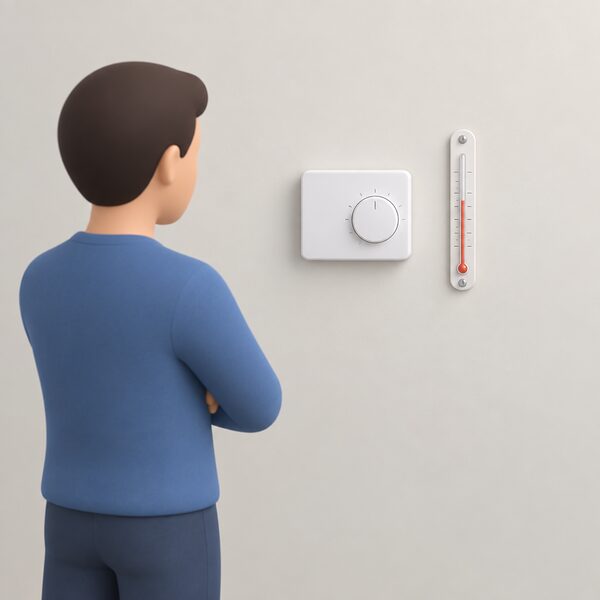
Accuracy is measured, not assumed. Which? puts smart thermostats in a temperature-controlled chamber, measuring how accurately they record the temperature and the relay response time44. Manufacturers publish their own figures: Drayton quotes control accuracy of less than 0.6°C at 4°C/hour with the room thermostat, and less than 0.8°C at 4°C/hour with the radiator thermostat.
For a household, the practical test is comparison. A separate glass thermometer placed beside the thermostat, at the same height, out of sunlight and away from draughts, and left to settle, shows whether the two agree. If they differ persistently, siting is the first thing to examine, because room thermostats only read temperatures accurately when air can circulate freely around them31. Dust in the vents, a curtain falling across the unit, or a table lamp moved next to it will all shift the reading.
It is worth being clear about what accuracy buys. One maker states that the accuracy of a thermostat serves to produce better comfort by maintaining a more accurate room temperature, but does not change the efficiency of the electrical heating appliance itself. A precise thermostat reduces overshoot and swing; it does not make the heater convert electricity any better.
Several current thermostats display more than temperature. The Wiser Smart Room Thermostat includes a humidity sensor with visual temperature and humidity readings20. Homematic IP's glass wall thermostat, a wireless device running on 230 V/50 Hz, has an integrated display showing the current room temperature and relative humidity level, and a CO₂ variant adds CO₂ concentration. Warmup's Konekt Wireless Thermostat measures temperature and humidity and transmits the data to a floor heating actuator or radiator thermostat16. Bosch shows measured humidity on the device display and in its app under the room overview. Humidity readings are useful alongside the 18 to 21°C advice, because the same guidance links that band to avoiding damp building up3.
Batteries are the other maintenance item. Quoted lives vary: five years typical for the Homematic IP basic wall thermostat, two years typical for its basic radiator thermostat, and approximately one year with typical use for the Bosch Room thermostat II. One maker advises replacing batteries every 12 months as routine, and wireless thermostats generally require recharging or replacement batteries from time to time. The Passiv wireless thermostat instead uses a built-in rechargeable battery recharged via USB-C in under an hour. Homematic IP offers a desktop stand for several of its wall thermostats, which it says gives longer battery life.
Worked example: the Herschel iQ MD2 wired thermostat
The MD2 is a wired electric-heating thermostat rather than a boiler control, and it shows what a hard-wired unit looks like in specification.
| Attribute | Herschel iQ MD2 Wired Thermostat |
|---|---|
| Connection | Wired; wired directly to the mains circuit and to the heaters, requires recessing into the wall |
| Load | Up to 3.6 kW of connected heaters |
| Voltage | 110 to 230VAC 50/60Hz |
| Power supply | Mains, 16A peak load |
| Setpoint range | 5°C to 45°C (41°F to 113°F) |
| Programming | 7 x 1 day programmable, 4 periods per day |
| Protection class | IP30 |
| Surface | ABS to UL94-5 fire retardant plastic |
| Installation | Wall mounted |
| Wi-Fi band | 2.4GHz |
| App and voice | SmartLife app; works with Alexa and Google Assistant when paired with the SmartLife app |
| Energy saving | Open window detection |
| Security | Keypad locking feature to prevent unauthorised tampering |
| Price | £69.00 |
Herschel states that the MD2 is suitable for commercial applications such as hotels, care homes, student accommodation and let properties, which is where the keypad lock earns its keep. Compatibility is closed: Herschel controls will only work with Herschel heaters, and the MD2 is not compatible with Remote models, though the Summit White 2600W non-remote model can be used with external thermostat controllers such as the MD2. In one documented installation, XLS white panel heaters were controlled by mains-powered MD2 thermostats, one in each space, giving precise room by room control as well as app control for remote management.
The dependence pattern is instructive. The MD2 switches locally on its own schedule whether or not the internet is present, because it is a mains-wired timer and thermostat in one. The app and voice layer sits on top through a third-party platform, so losing the app costs remote control but not heating. Being locked to one manufacturer's heaters is the more durable constraint. Further Herschel products are described on Herschel thermostats and infrared heating controls, and the wider category on controls for electric radiators, panel heaters and infrared.
Where a room thermostat falls short
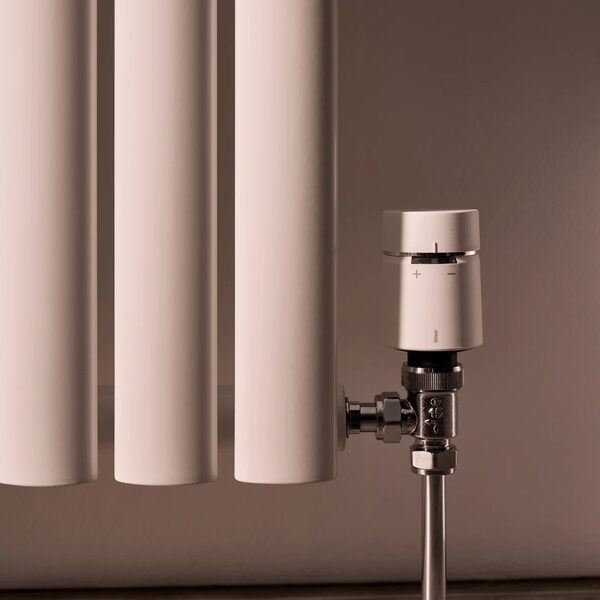
A single room thermostat controls the whole heating circuit from one point in the house. Rooms far from it, or with different exposure, will sit above or below the set point. That is the case for TRVs, and beyond them for smart TRVs and multi-zone systems.
It is also slow where the emitter is slow. Underfloor heating responds very slowly, an effect known as thermal inertia, so it takes longer to heat a room and is usually combined with a timer51. Where underfloor heating fails to warm a room, the checks include whether the room thermostat fitted is calling for heat and whether the thermostats are operating in temperature set-back mode52. Cast iron hot water radiators likewise take a while to increase the temperature of the rooms in a home. None of this is a thermostat fault; it is the response time of the system the thermostat is switching.
And a thermostat cannot compensate for fabric. In an old property with solid walls and not a lot of energy-saving measures, such as no loft insulation or single-glazed windows, it is unlikely that underfloor heating will be sufficient to heat a room on its own53. A control can only distribute and time heat; insulation and draught-proofing decide how much heat is needed in the first place, and that is where the larger share of a household's energy independence is won.
Sources53 cited
- What is boiler interlock, Viessmann, 2022-05-31
- Thermostats and heating controls, Energy Saving Trust, 2026-02-10
- Cold homes and health, Centre for Sustainable Energy, 2026-08
- Energy efficiency advice, Cadent Gas, 2026-09-20
- Tips to improve the EPC rating of your home, Energy Saving Trust, 2026-08-03
- Insulation, nidirect, 2026-09-02
- What is a smart thermostat, Smart Energy GB, 2026-08-19
- Room thermostat guide, Netatmo, 2026-09-20
- Common heating mistakes and how to avoid them, Which?, 2026-01-16
- Heating thermostat guide, tado°, 2026-08-03
- Approved Document L Volume 1: Dwellings, GOV.UK, 2023
- Best smart radiator valves, Which?, 2026-09
- Central heating guide, tado°, 2026-07-07
- Winter advice: stay safe, warm and connected, Cadent Gas, 2026-09-20
- Room thermostat NEA, REHAU, 2026-09-20
- Smart thermostats, Warmup, 2026-09-20
- Heating controls explained, BEAMA, 2025-06-02
- Heating controller guide, Netatmo, 2026-09-20
- VS10BRF wireless digital thermostat 230V, Salus Controls, 2026-09-20
- Wiser Smart Room Thermostat, Drayton Wiser, 2026-09-20
- Wireless thermostat guide, Netatmo, 2026-09-20
- Boilers and underfloor heating compatibility, tado°, 2026
- Take control of your heating at home, Energy Saving Trust, 2026-09-11
- The best way to run your central heating to save money, ivie, 2026-09-20
- Maintaining the ideal home temperature, Smart Energy GB, 2026-08-17
- How to save energy and money if you rent your home, Energy Saving Trust, 2025-11-14
- Draught proofing, Which?, 2026-05-05
- The accessible in-home display, Smart Energy GB, 2026-03-16
- Hive Thermostat Stand, Hive, 2026-09-17
- Timers, programmers and programmable room thermostats, Worcester Bosch, 2026-09-17
- Central heating controls, tado°, 2026-07-07
- Turning down thermostats, Smart Energy GB, 2026-04-22
- Heat the whole house or one room, Uswitch, 2026-08-20
- Approved Document L Volume 1 (Wales), Welsh Government, 2026-04
- Radiator valves, Smart Energy GB, 2026-04-22
- Part L 2022 Heating Controls Guidance, BEAMA, 2022
- Domestic Building Services Compliance Guide 2022, Scottish Government, 2022-06
- Technical Booklet F1: 2022, Building Control NI, 2022-06
- Homeowner FAQs, Drayton Controls, 2023-11-20
- Hive Thermostat, Hive, 2026-09-17
- WundaSmart Room Thermostat, WundaSmart, 2026-09-20
- Can one StickyMat heater be controlled by a thermostat, Warmup, 2026-09-20
- Room thermostat guide, Netatmo, 2026-09-20
- How to buy the best smart thermostat, Which?, 2026-09-17
- Compare thermostats, Google Store, 2026-09-20
- tado vs Hive: which smart thermostat is best, energyhelpline, 2026-09-20
- A simple guide to smart thermostats, Hive, 2025-11-20
- Electric vs water underfloor heating compared, Which?, 2026-05-27
- Consumer units and fuse boxes, NICEIC, 2025-09
- Radiator thermostat basic, Homematic IP, 2026
- Multi-room control, tado°, 2026-07-24
- Why is a UFH system not heating up a room, Grant UK, 2026-09-17
- Underfloor heating pros and cons, Which?, 2026-05-27
 The Full Heating Controls GuideA room thermostat, a programmer and valves on your radiators are the basics.
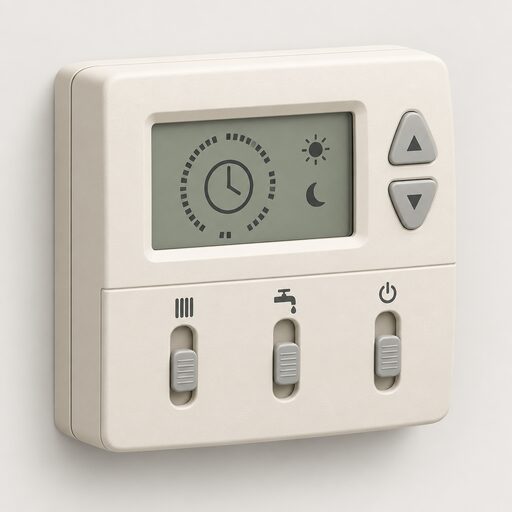 Controls, Thermostats and TRVsWhich heating controls actually cut your bills, and what does each one do?
 Smart Thermostats ExplainedWhat does a smart thermostat actually do, and is it worth it?
 Heating Controls by Home TypeCompares the control arrangements that suit flats, terraces, open-plan conversions, large detached houses, solid-wall period homes and new builds.
 Thermostat and Room TemperaturesWhat temperature should a thermostat be set to, and does it differ from room to room?
 Storage Heater ControlsExplains manual input and output dials, automatic charge control and the smart charging used by modern high-retention heaters.