
In this answer
Short answer
The healthy temperature range for the rooms a household spends most time in is 18°C to 21°C. That figure appears in independent guidance from the Centre for Sustainable Energy, Northern Gas Networks, National Energy Action and Scope, all of which converge on the same band1. The NHS recommends at least 18°C and not below 16°C for older people or those with impaired mobility5.
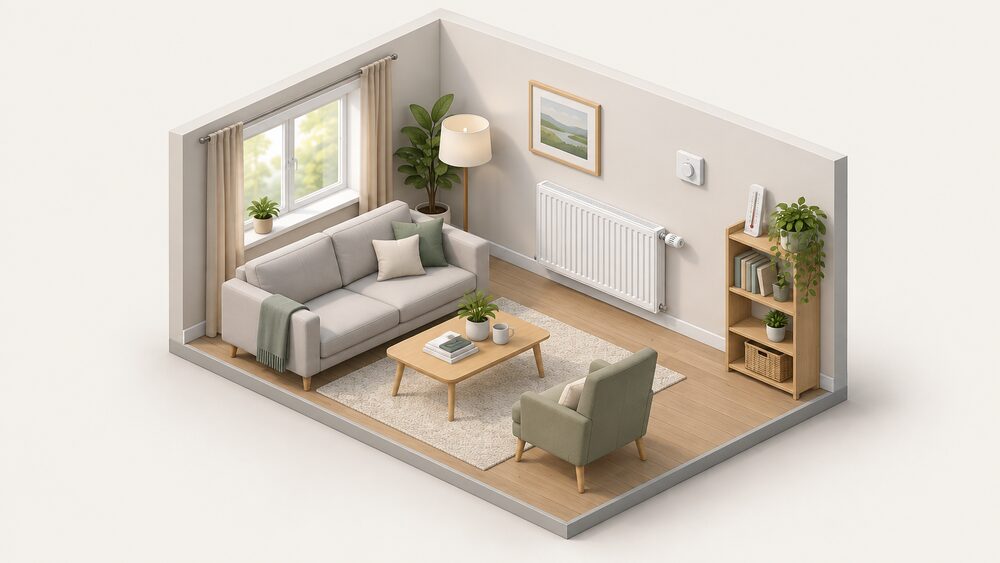
Within that band, rooms differ. The main living room is usually held at the top of the range, 18°C to 21°C, while bedrooms sit lower, at 16°C to 18°C for sleeping. The rest of the house can be kept at 16°C at least. Unused rooms can run lower still, but never below 5°C, the floor that keeps pipes from freezing and damp from forming6.
Why the 18 to 21°C range matters
The range is not arbitrary. It is the band in which a home stays warm enough to avoid the documented health effects of cold and damp, without heating space that nobody is using. The Centre for Sustainable Energy states that the rooms you spend most of your time in should be between 18 and 21°C to keep you warm and avoid damp building up1. Northern Gas Networks frames the same figure as a way to avoid potential health problems2.
The health case is strongest for specific groups. Official winter advice says heating to at least 18°C is particularly important for people with reduced mobility, those aged 65 or over, or those with a health condition such as heart or lung disease7. The NHS advises not below 16°C for older people or those with impaired mobility5. Energy Saving Trust notes that if a house gets too cold it could be dangerous for older residents, people with health conditions and anyone living in a home that is already underheated10.
The energy case runs the other way. Every degree of extra room temperature draws more heat from the boiler or heat pump, and the guidance is consistent that the lowest comfortable setting is the efficient one. The Energy Saving Trust recommends setting the thermostat to the lowest comfortable temperature, which for most people is between 18°C and 21°C11. British Gas Energy Trust gives the same range as comfortable for most people12.
For a household's energy independence, the range is the operating envelope. Holding rooms at the bottom of it reduces the gas or electricity drawn from a supplier, and reduces the load a heat pump or solar array has to cover. It does not remove dependence on the grid or a supplier, but it lowers the volume of energy that dependence costs.
Room by room: living rooms, bedrooms and the rest
Different rooms have different targets because they are used differently. The living room is occupied for long periods while awake, so it sits at the top of the healthy band. Bedrooms are occupied while asleep, when the body's needs are different, so they sit lower. Circulation spaces and unused rooms can run lower still.
| Room | Recommended temperature | Source |
|---|---|---|
| Main living room | 18°C to 21°C | Cadent7 |
| Living room (independent) | 20°C to 22°C | Smart Energy GB6 |
| Bedroom for sleeping | 16°C to 18°C | Smart Energy GB6 |
| Bedroom, night time | 18°C | Centre for Sustainable Energy1 |
| Rest of the house | 16°C at least | Cadent7 |
| Unused rooms | Lower settings where appropriate | Smart Energy GB6 |
| Unoccupied rooms (floor) | at least 5°C | Low Carbon Hub8 |
The living room figures differ between sources. Cadent gives 18°C to 21°C for the main living room7, while Smart Energy GB suggests 20°C to 22°C6. Oftec puts the main room at a minimum of 20°C, on the grounds that living in a cold house can affect health13.
For bedrooms, Smart Energy GB gives 16°C to 18°C for sleeping, noting this may be slightly higher for older adults6. The Centre for Sustainable Energy gives 18°C as the recommended night time bedroom temperature, though some people may be more comfortable in a slightly cooler room1. Official winter advice says people aged 65 and over or with pre-existing health conditions may find bedroom temperatures of at least 18°C overnight7.
Scotland's official statistics use a standard heating regime of 21°C in the living room and 18°C in other rooms for households not requiring an enhanced regime14. That is a statistical definition used in the Scottish House Condition Survey, not a household instruction, but it shows the same two-tier pattern.
Holding each room at its target: thermostats and TRVs
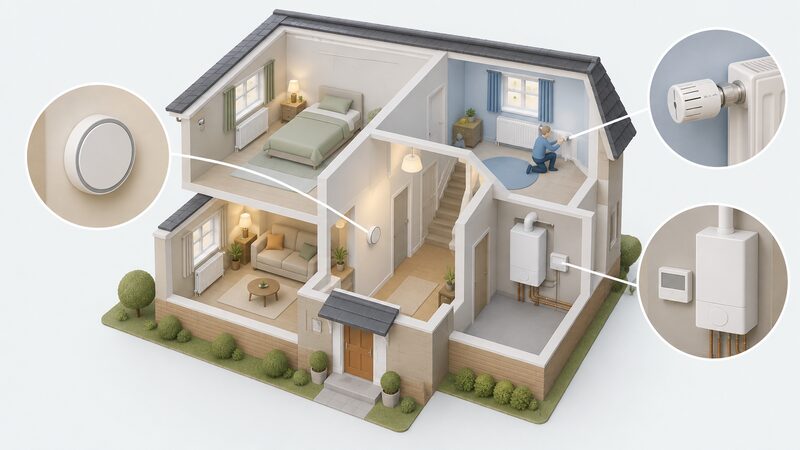
A single room thermostat controls the whole heating circuit, not individual rooms. It turns the heating on until the home reaches the chosen temperature, then switches it off15. To hold different rooms at different temperatures, the system needs thermostatic radiator valves on each radiator, or zoning.
Building regulations now require this. Approved Document L Volume 1 states that for heating systems in new dwellings, or when a heat generator such as a boiler is replaced in an existing dwelling, each room should be provided with thermostatic room controls able to separately adapt the heating output in each room served16. That is the regulatory basis for per-room control.
The recommended control set for a home is a time-controlled programmer, at least one room thermostat, thermostatic radiator valves if there are radiators, and a cylinder thermostat if the system has a hot water cylinder11. Home Energy Scotland gives the same list15.
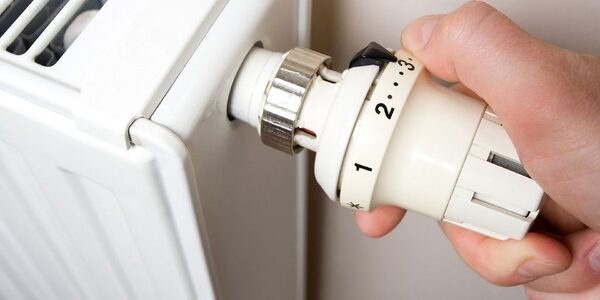
Thermostatic radiator valves have a dial from 0 to 617. The dial is not a calibrated thermometer, and the guidance does not map a specific number to a specific temperature. A common balancing procedure sets all radiator thermostats to 2 as a starting point, after turning them all to 0, then adjusts from there18. The number is a relative position, not a temperature reading.
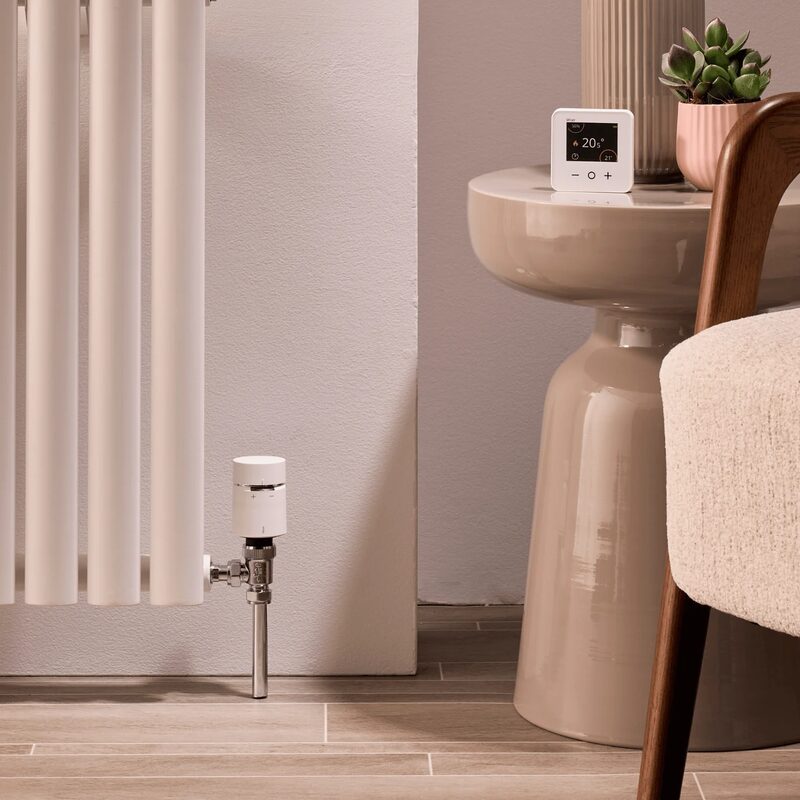
For homes with underfloor heating, the same principle applies through manifold controls rather than radiator valves. For homes with smart TRVs, each radiator can be scheduled independently, which allows bedrooms to run cooler at night and living rooms to warm before occupancy. The TRV guide covers how the valves work, and the zoning guide covers splitting a home into separately controlled areas.
What temperature to set when out or overnight
There is no single setback figure in the guidance. The Energy Saving Trust recommends setting the thermostat to the lowest comfortable temperature, which for most people is between 18°C and 21°C11. British Gas Energy Trust gives the same range12. Ivie states that for healthy adults, a setting between 18°C and 21°C is often cited as the ideal comfort and efficiency zone19.
For unoccupied rooms, the Low Carbon Hub advises keeping rooms warm enough, at least 5°C, to avoid pipes freezing or damp and mould developing8. That is the floor, not a target. For households with health issues, elderly people or young children, the same source advises heating occupied rooms to at least 20°C8.
Overnight, the bedroom guidance applies. People aged 65 and over or with pre-existing health conditions may find bedroom temperatures of at least 18°C overnight7. For others, 16°C to 18°C is the sleeping range6.
The heating schedules and setback guide covers how to programme different temperatures for different periods, and the thermostat temperature settings page covers the whole-home setting in more detail.
Does turning the thermostat down save money?
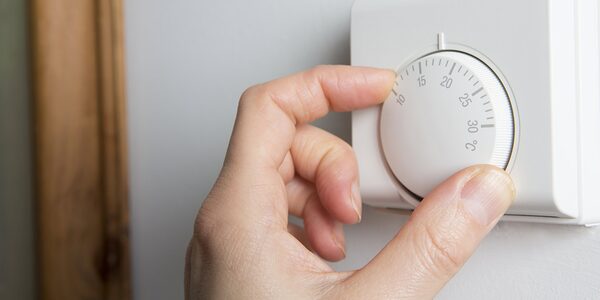
Official guidance states that turning the thermostat down by just one degree Celsius could save as much as 10 per cent on heating bills9. That figure appears in guidance published by nidirect, the Northern Ireland government's online service, in two separate documents9.
A local authority figure puts the saving higher. East Herts Council states that reducing the thermostat by 1°C could save up to 25 per cent of heating bills and associated carbon21. The 10 per cent figure is the more conservative and the one backed by official guidance; the 25 per cent figure is a single local authority estimate.
Smart Energy GB notes that turning the thermostat down by 1°C could save money each year on energy bills, with the amount varying by location and energy price22. It does not give a percentage.
"try turning the thermostat down by just one degree Celsius - you could save as much as 10 per cent on heating bills"
The saving comes from reduced heat demand, which means less fuel burned or electricity drawn. For a household's energy independence, that is the direct lever: a lower room temperature reduces the volume of energy bought from a supplier, and reduces the load a heat pump or solar array must cover. It does not change the dependence itself, but it changes how much that dependence costs.
Where a lower temperature is not safe
The 18°C minimum is not a comfort preference for everyone. Official guidance says it is particularly important for people with reduced mobility, those aged 65 or over, or those with a health condition such as heart or lung disease7. The NHS advises not below 16°C for older people or those with impaired mobility5.
Energy Saving Trust states that if the house gets too cold it could be dangerous for older residents, people with health conditions and anyone living in a home that is already underheated10. The Centre for Sustainable Energy's cold homes and health guidance covers the same ground1.
For households with health issues, elderly people or young children, the Low Carbon Hub advises heating occupied rooms to at least 20°C8. That is above the general 18°C minimum and reflects the higher needs of those groups.
How room temperature fits into whole-home energy independence
Room temperature is the most direct control a household has over its heating demand. Every degree of room temperature translates into fuel or electricity drawn from a supplier, and the guidance is consistent that the lowest comfortable setting is the efficient one11.
The design of a heating system also assumes a room temperature. Design room temperatures are derived from the CIBSE Domestic Heating Design Guide (2026) Table 2-2, and are by default based on the room type and age band of the property23. That means the radiators, boiler or heat pump in a home were sized for a particular room temperature, and running rooms cooler than design reduces the load on the system.
Scotland's Heat Retention Rating, introduced under the Energy Performance of Buildings (Scotland) Regulations 2025, is based on the amount of energy a dwelling requires to maintain comfortable temperature, measured as energy demand per square metre of floor area24. That ties the building's performance rating directly to the temperature it is expected to hold.
For a household, the practical position is this: holding rooms at the bottom of the healthy range reduces the energy bought from a supplier, and reduces the load a heat pump or solar array has to cover. It does not remove dependence on the grid, a supplier or gas. The heating controls and energy independence guide covers the wider picture, including where cloud-connected controls add a different kind of dependence.
Sources24 cited
- Cold homes and health, Centre for Sustainable Energy, 2026-08
- Energy efficiency, Northern Gas Networks, 2026-06-25
- Top energy savings tips, National Energy Action, 2026-07-13
- Using your heating system, Scope, 2026-07-15
- Common heating mistakes and how to avoid them, Which?, 2026-01-16
- Maintaining the ideal home temperature, Smart Energy GB, 2026-08-17
- Stay safe, warm and connected this winter, Cadent Gas, 2026-09-20
- No cost, low cost energy saving, Low Carbon Hub, 2026-08-05
- Insulation, nidirect, 2026-09-02
- Should I turn my boiler's flow temperature down?, Energy Saving Trust, 2026-05-20
- Thermostats and heating controls, Energy Saving Trust, 2026-09-20
- Energy savings tips, British Gas Energy Trust, 2026-02-27
- 10 top tips for homes to save on heating bills this Christmas, Oftec, 2024-12-20
- Scottish House Condition Survey 2021: key findings, Scottish Government, 2023-05-30
- Thermostats and heating controls, Home Energy Scotland, 2026-02-10
- Building Regulations Approved Document L Volume 1 2026, Welsh Government, 2026-04
- Make your home more energy efficient, Confused.com, 2026-07-06
- How to balance your radiators, Which?, 2025-09-16
- The best way to run your central heating to save money, Ivie, 2026-09-20
- Central heating controls, nidirect, 2026-09-02
- Home and business grants, schemes and advice, East Herts Council, 2026-09-17
- Turning down thermostats, Smart Energy GB, 2026-04-22
- Design conditions, MCS Certified, 2026-09-17
- Energy Performance of Buildings (Scotland) Regulations 2025: stock model research, Scottish Government, 2025-10-10
 Thermostat and Room TemperaturesWhat temperature should a thermostat be set to, and does it differ from room to room?
 Heatwaves and HealthWhich homes get dangerously hot in a heatwave, and which rooms?
 Cold Homes and HealthCold homes cause real harm, especially to older people and anyone with a heart or lung condition.
 Radiators and EmittersWill your radiators still heat the house properly with a heat pump?
 Which Homes Suit a Heat PumpMost UK homes can have a heat pump fitted, so the real question is whether yours makes it easy or expensive.
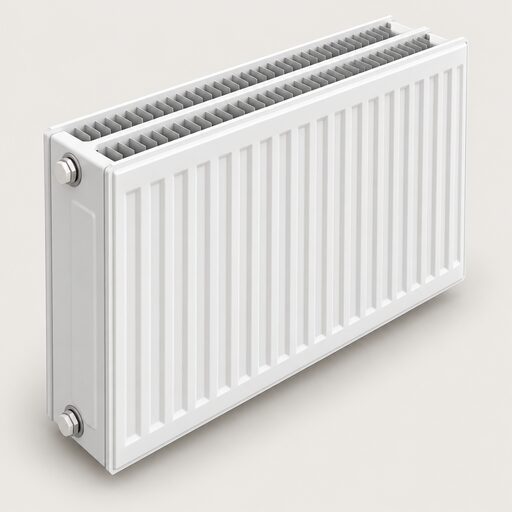 Radiators and Heat EmittersA radiator's real heat output depends on how hot the water inside it is compared with the room, so the figure in a catalogue often overstates what you will actually get.