

In this guide
Heat in a UK home is not a comfort question. Half of UK homes are already at risk of overheating, and the Climate Change Committee projects that hotter heatwaves could see 92% of existing homes overheat by mid-century, creating dangerous conditions for vulnerable people1. The people who die in hot weather are overwhelmingly older: one evidence submission to the London Assembly puts people aged 65 and over at four in five of heat-related deaths, another at 95 per cent of all deaths3.
The risk is concentrated in particular buildings and particular rooms. Flats and mid-terraced houses carry greater overheating risk, as do rooms that face south or west4. Bedrooms matter most because sleep is where heat does its quiet damage: under the assessment standard for naturally ventilated homes, a bedroom may only be warmer than 26°C for 1% of the year's sleeping hours, equivalent to 32 hours in any year between 10pm and 7am, before it is considered unsuitable4.
What follows sets out the thresholds, the groups at risk, the alert system and the practical measures that reduce indoor temperatures, with the limits of each stated as firmly as the benefits.
Why indoor temperatures matter during a heatwave
Outdoor temperature is only half the story. A dwelling's layout, the size and orientation of its windows, its thermal mass, level of insulation, airtightness and ventilation, plus the performance of its heating system, all affect how much heat it gains and how well it sheds it8. Two houses on the same street can sit several degrees apart on the same afternoon.
The Climate Change Committee treats this as a national risk rather than a personal inconvenience. It commissioned Arup to appraise the current and future risks posed by summertime overheating to the UK housing stock at scale, considering what factors influence risk, how homes can be adapted or upgraded to mitigate the impacts, and how much that would cost9. The Committee's own risk assessment names heat exposure in buildings as a priority risk area: risks to human health, wellbeing and productivity from increased exposure to heat in homes and other buildings10.
The scale of exposure is not marginal. Survey evidence shows the proportion of households reporting heat discomfort rose from around 20 per cent in 2011 to approximately 80 per cent during the 2022 heatwave3. That is a fourfold shift in a decade, and it describes ordinary homes rather than exceptional ones.
For a household's energy independence, heat is the mirror image of cold. A home that overheats in summer is a home that will increasingly be tempted to buy mechanical cooling, which means electricity, a supplier and a running cost. A home that manages heat passively keeps that dependence at arm's length. The passive cooling route and the wider home cooling guide set out the options; the health case for taking them seriously is what follows.
Who is most at risk at home
Age is the strongest single predictor. Mortality data shows that the most vulnerable individuals are people over the age of 65, and this age group accounts for 95 per cent of all deaths in one submission to the London Assembly3. The same evidence base elsewhere puts people aged 65 and over at four in five of heat-related deaths3. The two figures come from different datasets and disagree on the precise share; both point the same way.
Age is not the only axis. National polling found that 68% of respondents reported that they or someone in their household experienced at least one negative impact from overheating in the home during summer 20253. Younger adults aged 18 to 34 were disproportionately likely to report at least one negative impact from overheating in the home, at 84%3. Heat is not only a problem for the old, though it is most lethal for them.
Official vulnerability definitions add health status and time spent at home. The Heat and Buildings Strategy equality impact assessment describes households living with a long-term health condition which makes them more likely to spend most of their time at home, or which puts them at higher risk of experiencing cold-related illness, such as a condition affecting breathing, heart or mental health11. That definition is built on NICE guidance on excess winter deaths and illness and the health risks associated with cold homes11. The same people who are at risk from a cold home are frequently at risk from a hot one.
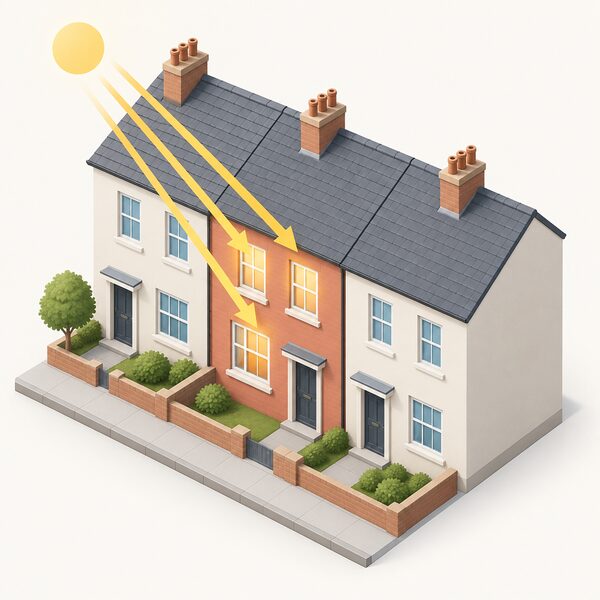
Building type concentrates the risk further. There is a greater overheating risk in certain types of dwellings, such as flats and mid-terraced houses, as well as rooms that face south or west4. An earlier assessment using data from the English House Survey identified around 122,000 dwellings at risk owing to a variety of factors in England12. A separate figure puts approximately 11% of homes as suffering from overheating13. The estimates differ by method and by what counts as overheating, which is why the range is wide.
"There is a greater overheating risk in certain types of dwellings, such as flats and mid-terraced houses, as well as rooms that face south or west"
Heat exhaustion and heatstroke: what to watch for
The evidence base in this guide is strongest on where and when heat harms, and thinner on clinical symptom lists, so the thresholds and the alert system are the reliable material here. What the official record does establish is that the health and productivity consequences escalate without adaptation: increasingly hot summers could lead to a trebling of health and productivity impacts without additional adaptation14.
The mechanism is cumulative exposure in buildings that cannot shed heat. A study of 80 homes by Midland Heart, covering 12 homes compliant with Part O and the anticipated Future Homes Standard, reported that the sun-facing sides of the buildings were extremely hot, and the windows and mechanical ventilation systems were not sufficiently capable of removing temperature gains3. A home that cannot purge its heat overnight holds it into the following day, and the second hot day starts from a higher base than the first.
Official recommendations point at the gaps in monitoring rather than at a symptom checklist. BEIS recommended further research to understand when overheating occurs in existing homes, including ongoing monitoring of temperatures in the housing stock and the number of homes currently adapted14. The Department of Health and Social Care recommended assessing health sector vulnerability to existing and future climate risks, particularly for care homes and home-based care14. Both recommendations imply that the people most exposed are those receiving care at home, where no building manager is watching the temperature.
For a household, the practical reading is that heat illness develops in ordinary homes during ordinary hot spells, not only in extremes. The alert system reflects that: most heat-related mortality occurs during yellow alert periods3. The yellow alert is the one that arrives most often, and it is the one where the deaths happen.
How hot is too hot indoors: thresholds and signs
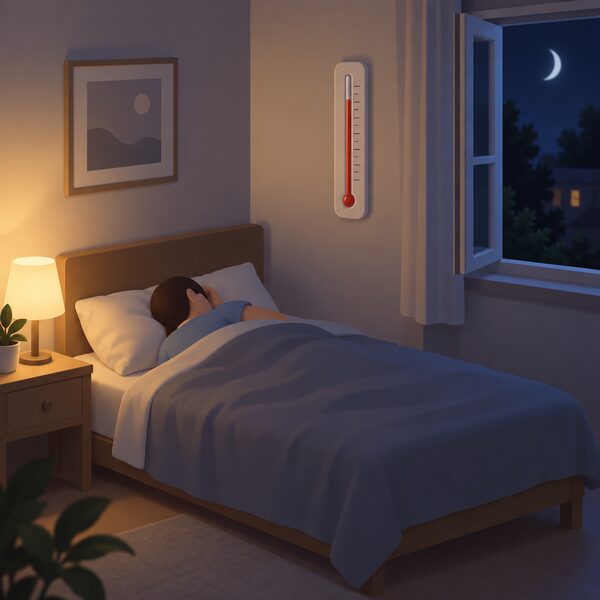
The clearest published threshold applies to new naturally ventilated homes. Under CIBSE TM59, bedrooms may only be warmer than 26°C for 1% of the year's sleeping hours before they are considered unsuitable4. That means for 32 hours in any year, between 10pm and 7am, a bedroom can be oppressively hot and cause sleeplessness, but no more4. The standard is a design limit for new build, not a legal maximum for an existing home, but it is the best available statement of where sleep starts to break down.
At the other end of the scale, guidance for dwellings with elderly or infirm occupants treats the capability of the heating system to maintain an apartment at a temperature higher than 21°C as a sensible precaution8. That is a winter heating standard, and it is revealing: the same guidance that sets 21°C as a floor for the vulnerable treats the ability to hold a room above it as protective. The comfortable band for an older or unwell occupant is narrow.
The World Health Organisation's general advice is that homes should be kept at 18 to 21°C, and the UK Health Security Agency advises homes should be heated to at least 18°C15. Those are cold-weather figures, but they define the range in which the body's thermoregulation is not under strain. A bedroom at 26°C for 32 hours a year sits well above it.
| Threshold | Figure | Applies to | Source |
|---|---|---|---|
| Bedroom overheating limit | 26°C for 1% of sleeping hours, or 32 hours a year between 10pm and 7am | Naturally ventilated homes | 4 |
| Winter floor for vulnerable occupants | Above 21°C capability | Dwellings with elderly or infirm occupants | 8 |
| WHO recommended home temperature | 18 to 21°C | General | 15 |
| UKHSA minimum | At least 18°C | General | 15 |
New homes are meant to carry advice on this. The Home User Guide required for new dwellings should contain advice on ventilation, heating and domestic hot water, on-site electricity generation if applicable, and staying cool in hot weather16. The requirement appears in Approved Document L and in the Northern Ireland building regulations discussion document, so the principle spans the UK, though the guidance is for the occupier of a new home rather than a remedy for an existing one.
CoolToRise: what the project did and who it reached
CoolToRise is the closest thing in the evidence to a measured community heat resilience programme, and its numbers are worth stating precisely because they are often quoted loosely. Across Barcelona and other southern European cities that took part in the project, 8,361 people were directly supported to enhance their knowledge of coping with extreme heat3. A further 381 third sector professionals were trained to deliver advice on heat resilience in communities3.
The project is southern European, so its climate is hotter than the UK's and its results transfer as a model rather than as a British outcome. What it demonstrates is the shape of an effective intervention: train a layer of community professionals, who then reach households directly, rather than relying on public messaging alone. The London Assembly evidence submission cites it in exactly that context, as part of the case that London's homes are not ready for a heatwave3.
The UK has comparable advice infrastructure, though organised around cold. HEAT provides 1-1 mentoring support and advocacy to vulnerable households in England and Wales18. Warmer Homes West Midlands supports people who are finding it difficult to keep up with their fuel payments or may be living in damp, cold homes that could be damaging their health, and provides advice by telephone, through case work, home visits and community events where it is safe to do so19. Cornwall's Winter Wellbeing service reports that over 50,000 households have received help to stay warm, well and safe20.
The pattern is consistent: the UK's household support architecture is built for winter, and the heat advice sits inside it rather than beside it. For a household's independence, that matters less than it sounds. The same measures that keep a home warm in winter, insulation, draught control, ventilation management, also moderate summer heat, which is why the overheating guide and the winter advice overlap more than their names suggest.
Supporting vulnerable neighbours and household members
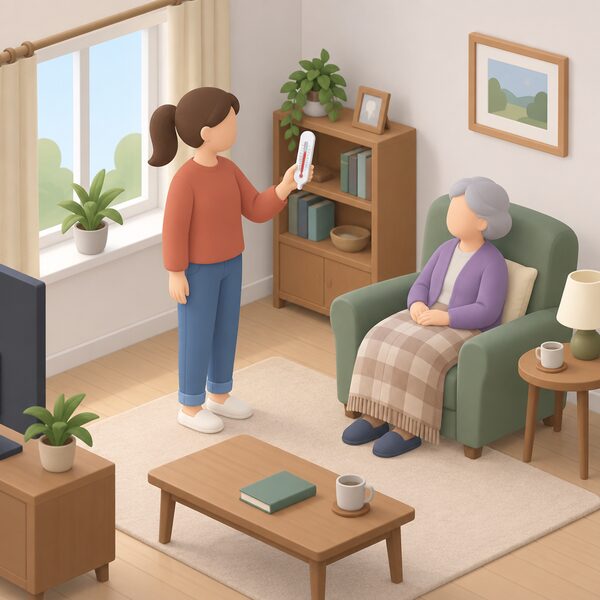
Official guidance is explicit that interventions in a vulnerable person's home need care. If there are members of the household who are considered vulnerable, for example elderly people, children, or those with chronic illnesses, be particularly careful about making changes in the home which could reduce temperature15. A measure that lowers the temperature for a healthy adult can push an older or unwell occupant below the range their body manages best.
The winter guidance makes the same point from the other direction. Keeping a home at a suitable temperature is particularly important if someone has reduced mobility, is 65 or over, or has a health condition such as heart or lung disease21. Those are the same groups that appear in the heat evidence, which is why a single household plan covering both seasons is more useful than two separate ones.
Practical support routes exist and are mostly local. The Household Support Fund is directed at vulnerable households22. The Warm Home Discount has been expanded to a total of around 6 million families23. The Warm Front Scheme helped to improve the energy efficiency of over 2.1 million vulnerable households through the provision of heating and insulation measures24. These are cold-weather schemes, but the insulation and heating measures they funded also affect summer performance.
For a household supporting an older relative, the useful actions are unglamorous: check the actual room temperature rather than asking how they feel, because the sense of thirst and heat diminishes with age; make sure a bedroom can be ventilated at night; and use the advice services that operate by telephone and home visit rather than expecting an older person to navigate an online portal. The overheating and older people page covers the physiology in more detail.
Practical ways to keep indoor temperatures down
Passive measures are the first line, and the evidence for them is strong. Passive measures, which require no energy use, can reduce overheating in up to 80% of dwellings7. That is a modelled figure for a warming scenario, not a guarantee for any individual home, but it establishes that most of the problem is addressable without mechanical cooling.
The single most effective combination is external shading with night ventilation. Evidence from the UK government's Warm Homes Plan shows that combining external shading with night-time ventilation can eliminate overheating risk in some homes, reducing indoor temperatures by 11 to 18°C3. That range is large because it describes the difference between a home that does both and one that does neither; the external shading and night ventilation pages set out how each works.
Insulation cuts both ways, and the evidence says so. Energy efficiency measures such as wall or loft insulation, if installed properly, can reduce overheating risk, whilst also reducing households' energy use7. Solid wall insulation helps create a more even temperature in the home, helps prevent condensation on walls and ceilings, and can reduce the amount of heat building up inside during summer hot spells25. The condition is "if installed properly": poorly executed insulation without adequate ventilation can trap heat and moisture.
Self-build guidance states the principle plainly: insulate walls, roof, and floors to reduce heat loss26. The same fabric that slows heat escaping in January slows heat entering in July, provided the home can purge at night.
Two safety points belong with any hot-weather routine. Using a barbecue indoors is a serious fire risk and deposits harmful toxic gases throughout the home27. If carbon monoxide is suspected, the recommended actions are to stop using all cooking and heating appliances, open the windows, see a doctor at once, and call a qualified engineer to check all cooking and heating appliances28. Both are more likely in a heatwave, when windows are open and appliances are used unusually.

When to seek medical help
This guide reports the thresholds and the alert system rather than clinical advice, and the sources do not provide a symptom list for heat exhaustion or heatstroke. Suspected heatstroke is a medical emergency, and the NHS 111 service or 999 is the route; nothing in the evidence base changes that.
What the evidence does add is timing. Most heat-related mortality occurs during yellow alert periods3. The instinct to treat a yellow alert as a warning about tomorrow is wrong: it is the period in which the deaths are recorded. The point to seek help is when someone's condition deteriorates, not when the warning escalates to amber or red.
The same evidence base shows why the alert system alone will not protect a household. Increasingly hot summers could lead to a trebling of health and productivity impacts without additional adaptation14. The adaptation is partly national and partly domestic: the CCC's own progress reporting continues to flag the gap between the risk and the response2. For a household, the practical conclusion is that the building is the first line of defence, and the alert is the second.
Sources28 cited
- EINAS 2025: Heat and Buildings, GOV.UK, 2025
- Progress in reducing emissions: 2026 report to Parliament, Climate Change Committee, 2026
- Are London's homes ready for a heatwave?, London Assembly, 2026
- Considering summertime overheating in highly insulated homes: factsheet 1b, Welsh Government, 2024
- Considering summertime overheating in highly insulated homes: factsheet 1a, Welsh Government, 2024
- Considering summertime overheating in newer build properties: factsheet 2a, Welsh Government, 2024
- Deepening our understanding of summertime overheating in homes, Climate Change Committee, 2022
- Building Standards 2017: domestic, heating, Scottish Government, 2017
- Addressing overheating risk in existing UK homes, Climate Change Committee, 2026
- UK struggling to keep pace with climate change impacts, Climate Change Committee, 2021
- Equality impact assessment for the Heat and Buildings Strategy, GOV.UK, 2023
- The risks to housing from overheating, Climate Change Committee, 2017
- HFC phasedown reform de minimis assessment, Defra, 2025
- Risks to health, wellbeing and productivity from overheating in buildings, Climate Change Committee, 2026
- Radiator valves and home temperature advice, Smart Energy GB, 2026
- Approved Document L: Conservation of fuel and power, Volume 1, Dwellings, GOV.UK, 2023
- Building regulations discussion document 2023, Northern Ireland Department of Finance, 2023
- Home energy efficiency, Bridgend County Borough Council, 2026
- Hotline opens to help heat up homes and cut energy bills, West Midlands Combined Authority, 2020
- Winter Wellbeing, Cornwall Council, 2026
- Keeping your home warm in winter, Met Office, 2026
- Household Support Fund guidance for local councils, GOV.UK, 2021
- DESNZ annual report and accounts 2025 to 2026: performance report, GOV.UK, 2026
- Warm Front Scheme, Energy and Climate Change Committee, 2010
- Solid wall insulation, Planning Portal, 2026
- Self-build homes: sustainability, Planning Portal, 2026
- Fire safety in the home, Electricity North West, 2026
- Domestic gas installation and health and safety, nidirect, 2025
 Overheating and Hot WeatherIs your home getting uncomfortably hot in summer, and is there anything you can do about it?
 Cold Homes and HealthCold homes cause real harm, especially to older people and anyone with a heart or lung condition.
 How a Home Loses HeatWhere does most heat actually escape from a UK home, and does it change with the age or type of house?
 Overheating and Solar GainWhy do well-insulated homes get too hot in summer, and which windows cause the worst solar gain?
 The Full Insulation and Glazing GuideWhere is your home losing the most heat, and what can you do about it?
 Which Homes Suit a Heat PumpMost UK homes can have a heat pump fitted, so the real question is whether yours makes it easy or expensive.