
In this guide
Air conditioning safety in a UK home comes down to three separate things, and they fail in different ways. The first is electrical: a portable air conditioner draws up to 9.3A and up to 2000W, which is a heavy load for a domestic circuit and a load that a socket, a plug or an extension lead has to carry continuously for hours1. The second is refrigerant: a sealed circuit that a householder should never open, and a gas that in some units is flammable. The third is condensate: water that a cooling unit produces by the litre and has to put somewhere.
The three risks are not equally likely, and they are not equally within a householder's control. Electrical loading and condensate are everyday matters of siting and common sense. Refrigerant is a matter of leaving the sealed system alone and using a certified engineer when work is needed. F-Gas Handler for Stationary Refrigeration, Air-Conditioning and Heat Pump Equipment is a regulated profession in the UK, with minimum training and certification requirements set by Regulation 2015/2067 as retained in UK law2.
What follows sets out each risk in turn, then the practical points that decide whether a unit is safe in a given room: venting, window sealing, noise, placement, and the rules and VAT deadlines that apply to cooling equipment. The thread running through it is that a cooling appliance is only as safe as the circuit it sits on, the room it vents into, and the water it drains to.
Why air conditioning carries three distinct risks
The three risks have different causes and different remedies, which is why they are worth separating rather than treating as one general caution about cooling appliances.
Electrical. A cooling appliance is a sustained high-current load. Electrical Safety First rates portable air conditioners at up to 9.3A and up to 2000W, with a typical range of 900 to 2000W and the higher figure following the higher BTU rating1. That is a load drawn for hours at a time, not in bursts, and it is drawn through a plug, a socket and whatever is between them. The same body's guidance is blunt: do not overload plug sockets, as this can lead to overheating3.
Refrigerant. Cooling equipment contains a refrigerant in a sealed circuit. Where that circuit is opened, the risks depend on the refrigerant type and the location: official guidance on heat pumps notes that there may be maintenance issues with respect to leaks, including working in confined spaces, risk of explosion and toxicity6. That is a description of work on the circuit, not of living with it. A sealed, undamaged unit is not a hazard in normal use; an opened one is a job for a certified person.
Condensate. A cooling unit condenses water out of the air it passes over. That water has to go somewhere, and the consequences of it going the wrong way are damp, staining and, over time, damage to the fabric of the room. The wider point is that moisture in a home needs an exit. Guidance on traditional buildings is explicit that some ventilation is good, both to reduce condensation and ensure the safety of open fires, stoves and gas appliances7.
For a household's energy independence, the electrical point is the one that bites. A portable air conditioner is entirely dependent on the grid and on the circuit it is plugged into, and it offers no storage, no generation and no resilience. It cools while the mains is up and the socket holds. That is the honest limit of what a plug-in cooling appliance does for independence, and it is worth stating before the detail.
Electrical safety: plugs, circuits and cord length
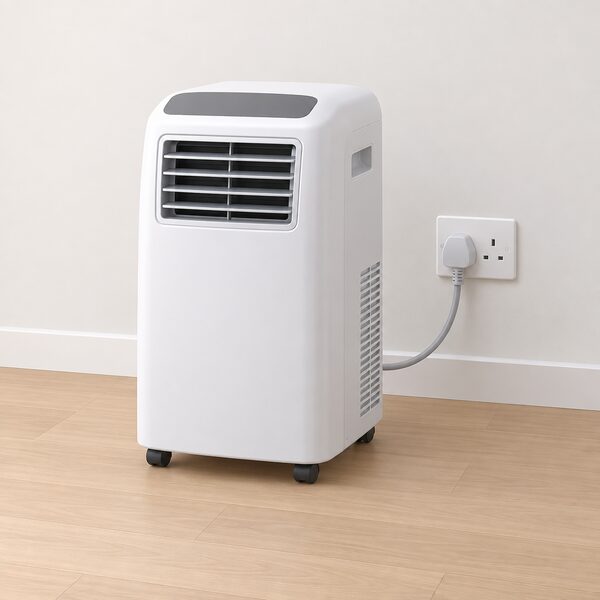
The starting point is the load. Electrical Safety First rates a portable air conditioner at up to 9.3A and up to 2000W, with a typical range of 900 to 2000W and the higher figure following the higher BTU rating1. A standard UK three-pin socket on a ring final circuit is rated for 13A, so a single unit is within the rating of the socket itself. The question is what else is on the same circuit and what is between the unit and the socket.
The maker of the electriQ P18CW states that the unit plugs straight into a standard UK household 3-pin socket at 230 to 240V, 13A, with no special wiring or installation required5. That is a statement about the plug, not about the circuit. A 13A plug on a 13A socket is fine; a 13A plug on a 13A socket shared with a kettle, a tumble dryer or an electric heater is a different proposition, and the guidance is not to overload plug sockets because of overheating3.
Extension leads are the weak point. A lead adds resistance at two connections rather than one, it is often coiled, and a coiled lead under sustained load has nowhere to put the heat. The unit's own cord is 1.5m5, which is short by design and is the length the maker intends to be used. Where a socket is further away than that, the answer is a different socket, not a longer lead.
The protective devices behind the socket matter too. A modern consumer unit will typically contain a main switch, residual current devices, circuit breakers, surge protective devices and arc fault detection devices8. An older unit may have only a main switch and rewireable fuses. The same guidance notes that cables entering the unit must be protected against abrasion and sharp edge8, which is a reminder that the enclosure and its entries are part of the safety system, not decoration.
There is a wider electrical point that applies to homes with three-phase supplies, which are rare domestically but not unknown. The principal danger is the higher voltage that exists between lines, around 400V, and the probability of a lethal shock is correspondingly higher; socket outlets from different phases should not be in the same room9. For a single-phase home this does not arise, but it is the reason a cooling appliance should not be moved between sockets without thought in a building with a three-phase supply.
Refrigerant safety: sealed systems and what must never be opened
A refrigerant circuit is a closed loop. In normal operation nothing escapes it, nothing needs topping up, and nothing about it is a householder's task. The safety position is therefore simple to state: the circuit stays sealed, and any work on it is done by someone certified to do it.
That certification is not informal. F-Gas Handler for Stationary Refrigeration, Air-Conditioning and Heat Pump Equipment and Refrigerated Trucks and Trailers is a regulated profession in the UK, and Regulation 2015/2067 as retained in UK law establishes the minimum requirements for the training and certification of the people who work on this equipment2. The scope covers stationary refrigeration, air conditioning and heat pump equipment, which is exactly the category a home cooling appliance falls into.
The risks that certification addresses are specific. Official guidance on heat pumps notes that depending on refrigerant type and location there may be maintenance issues with respect to leaks, including working in confined spaces, risk of explosion and toxicity6. Two things follow. First, the risk is concentrated in the work, not in the sealed product: a leak being investigated in a confined space is a different situation from a unit sitting in a living room. Second, the refrigerant type matters, which is why the phrase "depending on refrigerant type" appears in the guidance at all.
For a householder the practical rules are short. Do not open, cut, braze, recharge or "top up" a refrigerant circuit. Do not buy refrigerant or charging equipment to service a unit at home. If a unit is losing cooling performance, that is a fault to be diagnosed by a certified person, not a gas to be added. If a unit is damaged, particularly if a pipe is kinked or pierced, stop using it and have it assessed.
"Regulation 2015/2067 (as retained in UK law) establishes the minimum requirements for the training and certification of "
The independence point here is about dependence on a trade rather than on a supplier. A sealed refrigerant circuit means a household cannot maintain its own cooling appliance beyond cleaning filters and clearing drains. That is a real limit, and it is the reason maintenance matters: the less a unit is asked to do in poor conditions, the less likely it is to need the work that only a certified engineer can carry out. The rules themselves are set out in more detail on F-Gas rules for home air conditioning.
Condensate and drainage: when a drain hose is needed and when it is not
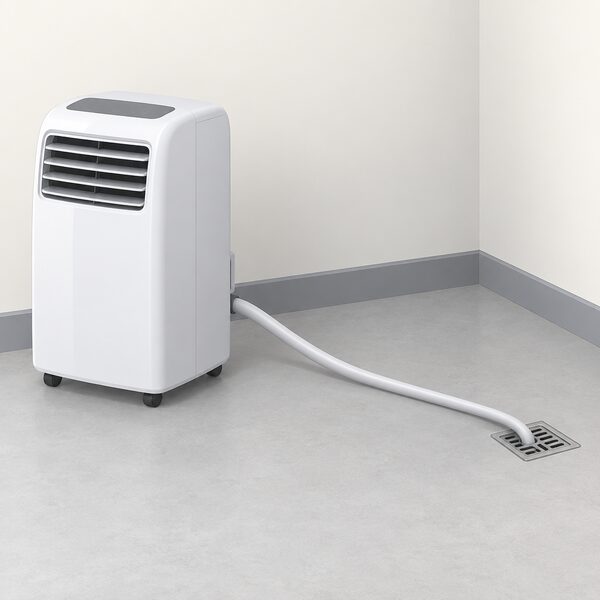
A cooling unit produces water. Air passing over a cold evaporator coil drops below its dew point and the moisture in it condenses, and that water has to leave the appliance. How it leaves depends on the design.
Self-evaporative units deal with most of it internally. The maker of the electriQ P18CW states that the model does not require continuous water drainage for normal cooling use, as it has a self-evaporative system, and that continuous drainage is needed only in dehumidifier (Dry) mode or in very humid conditions5. The same unit is quoted as removing up to 43.2L of moisture per day in its dehumidifying role5, which gives a sense of the volume involved when the machine is working as a dehumidifier rather than as a cooler.
Where a drain hose is used, the physics is unforgiving. Water runs downhill, so the hose must fall continuously from the unit to its outlet, with no uphill section, no loop and no kink. A hose that traps water will back up into the unit, and the result is water on the floor rather than water down the drain. The unit is supplied with a continuous drainage hose as part of its box contents5, so the option is there when Dry mode or a humid spell calls for it.
The wider point is that a home needs a route for moisture out, and blocking the wrong openings makes condensation worse rather than better. Guidance on draughtproofing is clear that some areas should not be blocked or sealed because they play a role in helping ventilate the home: extractor fans, trickle vents, wall vents, heater flues, and underfloor grilles or airbricks10. Kitchen and bathroom windows are in the same category: the advice is not to seal them, because the gaps let out steam and reduce the risk of damp10.
Condensation is not a cosmetic issue. Guidance on insulating at ceiling level notes that it results in a colder attic space above, meaning an increased risk of condensation and pipe freezing11. The same mechanism operates at a smaller scale wherever cold surfaces meet moist air, which is why a cooling appliance and a poorly ventilated room are a poor combination. Indoor clothes drying makes the point: it is important that this is done in a warm and well-ventilated room, as indoor drying could lead to condensation12. A cooling unit is doing something similar, extracting water from the air, and it needs somewhere for that water to go.
Venting: why an unvented unit cannot cool the room
A portable air conditioner is not a refrigerator. It does not destroy heat; it moves it. The heat taken out of the room air is deposited into the refrigerant circuit and then into the exhaust air stream, and that air has to leave the building. If it does not, the unit is running a heater and a cooler in the same room, and the net effect is a rise in temperature.
The maker of the electriQ P18CW states the rule without qualification: all portable air conditioners must be vented out so the heat is removed from the room that is being cooled5. The same source notes that venting can be through a window, a door with a sealing kit, a wall vent or another suitable opening, and that without venting the unit will not cool effectively5.
Independent guidance makes the same point and adds the detail that decides whether venting works in practice. Portable units need to be properly vented to the outside using a special fitting for the window, and a vent simply put through an open window will let heat back in13. That is the difference between venting and appearing to vent. An open window with a hose poked through it gives the exhaust air a route out and gives the outside air a route back in, around the hose, into the room being cooled.
The exhaust hose itself is a constraint. The electriQ P18CW uses a single exhaust hose, typically around 5 inches (about 127mm) in diameter, with a maximum hose length of 1.8m5. A longer run is not better: the exhaust air is hot, and the further it travels through a warm hose inside a warm room, the more of that heat it sheds back into the room before it reaches the outside. Short, straight and sealed is the arrangement that works.
There is a related point about room controls and low-heat dwellings. Approved Document L Volume 1 notes that thermostatic room controls may not be technically feasible in dwellings with low heat demand, for example less than 10W/m214. That is a heating regulation rather than a cooling one, but it illustrates the principle that controls assume a building with something to control. A cooling appliance in a room with no route for the exhaust air is in a similar position: the control exists, but the physical precondition for it to work does not.
Installation and window sealing: what a householder can do
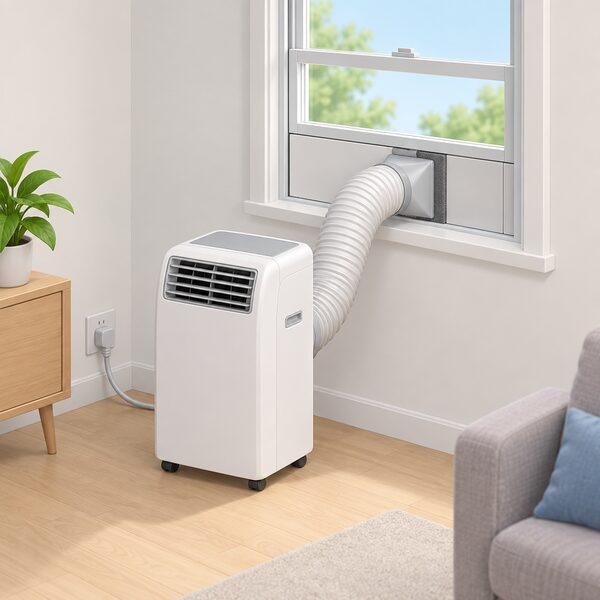
A portable air conditioner is designed to be used without installation. The maker of the electriQ P18CW states that the unit plugs straight into a standard UK household 3-pin socket at 230 to 240V, 13A, with no special wiring or installation required5, and that no installation service is offered for the unit5. That places the whole of the setup, and the whole of the safety responsibility for siting and sealing, with the householder.
The window kit is where most of the practical difficulty lies. The maker states that the supplied kit is designed for sliding or sash windows and does not fit all windows, especially casement or tilt-and-turn styles commonly found in UK homes, and that an additional adaptor or seal kit may be needed5. Casement windows typically open to the side, but can also be hinged at the top or bottom, making them tilt and turn windows15. Neither style presents a flat sliding surface for a window slide bar, which is why the kit fits one and not the other.
Sealing matters for two reasons. The first is cooling performance: an unsealed opening lets the heat that has just been expelled come straight back in13. The second is that the opening is now a permanent hole in the building's envelope for as long as the unit runs. The box contents for the P18CW include the unit, a 1.8m extendable exhaust hose, an exhaust fan outlet and window connector, a fishtail window adaptor, a window slide bar kit, a remote control with batteries, and a continuous drainage hose5. That is the full set of parts available to make the connection, and where the window does not suit them, the gap is the householder's to solve.
For work beyond a portable unit, the competence expectations change. Official guidance on ventilation installers states that those installing and commissioning ventilation systems should typically be a member of a Competent Person Scheme or an equivalent body, and that for lower risk work such as a single intermittent extract fan, adequate training is expected without scheme membership16. That is a ventilation rule rather than an air conditioning one, but it sets the pattern: the more the work touches the building's air paths, the more the competence of the person doing it matters.
Replacement glazing is regulated in a similar way. The regulations apply to thermal performance and other areas such as safety, air supply, means of escape and ventilation17. A window that has been adapted to take an exhaust hose is a window that has been changed, and the safety, air supply and ventilation aspects of that change are the ones a householder is least likely to have considered.
Worked example: the electriQ P18CW 18000 BTU portable unit
The safety-relevant specifications of a single model show how the general points land on a real appliance. The figures below are the maker's own, for this unit only.
| Specification | Value |
|---|---|
| Cooling power | 18000 BTU, 5.27kW5 |
| Maximum cooling area | 46sqm5 |
| Power supply | 220 to 240V, 50Hz5 |
| Plug | Standard UK household 3-pin socket, 230 to 240V, 13A5 |
| Power cord length | 1.5m5 |
| Exhaust hose | Single, around 5 inches (about 127mm) diameter, 1.8m maximum5 |
| Sound pressure level | 55 to 59 dB(A) at 1m, low to high fan5 |
| Sound power level | 65 dB(A)5 |
| Dehumidifier capacity | Up to 43.2L per day5 |
| Dimensions | 39.4 x 77 x 47cm (W x H x D)5 |
| Weight | 35kg5 |
| Thermostat range | 16°C to 31°C5 |
| Lowest operating temperature | 16°C5 |
| Functions | 3-in-1: air conditioner, 3-speed fan, dehumidifier5 |
| Heating function | Heat pump for heating, for year-round use5 |
| Controls | Electronic, with remote control (batteries included); built-in Wi-Fi5 |
| Timer | 24 hours5 |
| Energy rating | A5 |
| Warranty | 12-month hassle-free warranty5 |
Three of these figures carry safety weight. The 1.5m power cord is the length the maker intends to be used, and it is the reason an extension lead is a compromise rather than a solution5. The 1.8m maximum hose length is a limit on how far the unit can be from an outside opening, and it constrains where the unit can safely stand5. The 35kg weight is a handling matter: this is not a unit to be lifted onto a windowsill or moved up a flight of stairs without help5.
The unit is also a reminder that a cooling appliance can be a heating appliance. The maker describes a heat pump for efficient heating, for year-round use5, and the unit is listed as suitable for a home, an office and a conservatory5. A reverse-cycle unit of this kind is covered on air conditioning that heats, and the safety points do not change with the mode: the same circuit, the same venting requirement, the same condensate.
Noise, placement and safe day-to-day operation
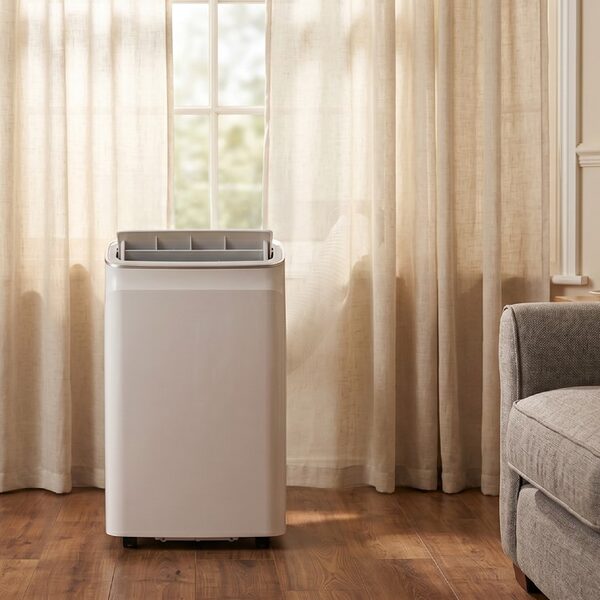
Noise is a safety issue in the sense that it decides where a unit ends up, and where a unit ends up decides whether it is vented and drained properly. A unit placed for convenience rather than for its exhaust route is a unit that will be run in conditions it was not designed for.
The electriQ P18CW is quoted at 55 to 59 dB(A) at one metre across its low to high fan settings, with a sound power level of 65 dB(A)5. For context, that is in the range of ordinary conversation, sustained for as long as the unit runs. The maker provides a sleep mode that reduces fan noise, dims the display and turns off the LED lights overnight5. The unit also has three fan speeds5, which gives some control over the trade-off between noise and cooling rate.
Placement follows from the venting and drainage requirements rather than from preference. The unit needs to be within 1.8m of an outside opening, because that is the maximum hose length5. It needs to stand on a surface that can take 35kg5. It needs to be somewhere the condensate can drain if Dry mode is used5. And it needs to be somewhere the noise does not sit directly beside a bed, which is a matter of the 55 to 59 dB(A) figure at one metre5 and the distance from the unit to the sleeper.
Official guidance on biomass appliance installation lists ventilation, noise and general safety as factors to consider18. The same three factors apply here, and they apply together: a unit that is quiet enough but badly vented is not a safe installation, and a unit that is well vented but placed where it cannot be drained is not either.
There is a wider regulatory context for noise in dwellings. The Northern Ireland decent homes standard includes adequate insulation against external noise where external noise is a problem19. That is a standard for social housing rather than a rule for cooling appliances, but it reflects the same principle: noise is treated as a condition of a decent home, not an afterthought. A cooling unit that runs through the night in a bedroom is part of that picture.
Rules, permissions and VAT relief deadlines
Cooling equipment sits inside a set of rules that are mostly about heating, and the deadlines are the part most likely to matter to a householder considering a purchase.
The VAT position is the clearest. Energy-saving materials installed in residential accommodation and certain charitable buildings are subject to VAT relief at 0% until 31 March 20274. The temporary zero rate applies to installations of energy-saving materials in residential accommodation, and it runs until 31 March 202720. The legislation sets the same window: the rate applies from 1 February 2024 to 31 March 202721. The relief was expanded with effect from 1 February 202422, and the government stated its intention to implement the reforms on 1 February 202423. Earlier changes took effect from April 202224.
Two conditions matter. The first is that the relief attaches to installation, not to a unit bought on its own, which is why a plug-in portable appliance is in a different position from an installed system. The second is the 60% test, which applies to VAT relief for supplies made in Great Britain between 1 October 2019 and 31 March 2022, and for supplies made in Northern Ireland from 1 October 201925. The relief was implemented by amendment to Group 23 of Schedule 8 and Group 2 of Schedule 7A to the VATA 199422.
| Item | Position |
|---|---|
| VAT zero rate on qualifying installations | Until 31 March 20274 |
| Temporary zero rate window | 1 February 2024 to 31 March 202721 |
| Relief expanded to include | With effect from 1 February 202422 |
| 60% test applies to | Great Britain supplies 1 October 2019 to 31 March 2022; Northern Ireland supplies from 1 October 201925 |
| Legal basis | Amendment to Group 23 of Schedule 8 and Group 2 of Schedule 7A to the VATA 199422 |
On standards, the Boiler Upgrade Scheme (England and Wales) Regulations 2022 list BS EN 14511-4:2018, covering air conditioners, liquid chilling packages and heat pumps with electrically driven compressors for space heating and cooling, as an approved standard26. The same scheme rules also list BS EN 14825:2018, covering testing and rating at part load conditions and calculation of seasonal performance26. The two documents disagree on which standard applies, and the conflict is not resolved.
There is also an inspection regime for larger systems. The inspection report must include an assessment of the air-conditioning efficiency and the sizing of the system compared to the cooling requirements of the building, and contain appropriate advice on possible improvements to the system, replacement of the system and alternative solutions27. Separately, non-residential buildings with air-conditioning systems over 290kW were to be equipped with building automation and control systems by 202528. Neither applies to a domestic portable unit, but both show the direction of travel for installed cooling.
Ground source heating and cooling systems have their own exemption conditions, set out in The Environmental Permitting (England and Wales) Regulations 201629. That is a different technology from air conditioning, but it is the one place in the rules where cooling is treated as a system with an environmental permit position rather than as an appliance.
For a household's energy independence, the rules section is where the limits are clearest. A portable cooling appliance depends on the grid, on a socket, on a sealed refrigerant circuit that only a certified person may open, and on a manufacturer for parts and warranty. It stores nothing, generates nothing and cannot be serviced at home beyond filters and drains. What it does offer is cooling without altering the building, which for a rental or a listed property may be the only option available. The wider picture is set out on home cooling and energy independence, and the appliance choices on portable air conditioners.
Sources29 cited
- Ratings of electrical appliances, Electrical Safety First, 2026-09-19
- F-Gas Handler for Stationary Refrigeration, Air-Conditioning and Heat Pump Equipment, Regulated Professions Register, 2026-09-17
- Demand flexibility service: running appliances at cheaper times, Electrical Safety First, 2026-09-19
- VAT on goods and services: rates, HM Revenue and Customs, 2026-07-10
- electriQ P18CW Air Conditioner, electriQ, 2026-09-23
- Living with heat pumps, Local Energy Scotland, 2026-09-20
- How to reduce heat loss from sash windows, Historic Environment Scotland, 2026-09-20
- Consumer units and fuse boxes, NICEIC, 2025-09
- Three-phase power theory, OpenEnergyMonitor, 2026-09-17
- Draught-proofing, Which?, 2026-05-05
- Guide to the conversion of traditional buildings, Scottish Government, 2026-08-10
- Avoid using the dryer, Smart Energy GB, 2026-04-22
- How to keep your home cool in hot weather, Centre for Sustainable Energy, 2026-07
- Building Regulations Approved Document L Volume 1 2026, Welsh Government, 2026-04
- Choosing double glazed windows and doors, Which?, 2026-09-16
- Future Homes and Buildings Standards Consultation Response, UK Government, 2026-03
- Building regulations: doors and windows, Welsh Government, 2026-09-17
- Biomass fuelled appliances: building regulations, Planning Portal, 2026
- Current Decent Homes Standard summary table, Northern Ireland Department for Communities, 2025-08-05
- Extension of VAT energy saving materials relief, UK Government, 2024-01-11
- The Value Added Tax (Installation of Energy-Saving Materials) Order 2024, legislation.gov.uk, 2024-02-01
- VAT energy saving materials and grant funded heating supplies: VENSAV2082, HM Revenue and Customs, 2026-09-17
- VAT energy saving materials relief: summary of responses, UK Government, 2023-12-11
- Spring Statement 2022, HM Treasury, 2022-04
- VAT energy saving materials and grant funded heating supplies: VENSAV3210, HM Revenue and Customs, 2026-09-17
- Boiler Upgrade Scheme: notice of standards, UK Government, 2026-07-21
- The Energy Performance of Buildings (England and Wales) Regulations 2012, legislation.gov.uk, 2026-09-17
- Energy Performance of Buildings Directive 2010/31/EU, legislation.gov.uk, 2026-09-17
- Closed loop ground source heating and cooling systems: exemption conditions, UK Government, 2023-10-02
 Home Battery Fire SafetyHow likely is a home battery to catch fire, and what keeps it safe if it does?
 Generator SafetyCovers the main hazards of running a generator at a home: exhaust fumes and carbon monoxide, hot surfaces and refuelling fires, electric shock and earthing.
 Product RecallsHow recalls and safety notices work for energy equipment in UK homes, who issues them, how to check a product, and what replacement, repair and refund routes exist.
 Carbon Monoxide SafetyHow carbon monoxide arises from gas, oil, LPG and solid fuel appliances, where alarms must be sited and what the requirements are in each UK nation.
 UK Cooling DemandPublished data on air conditioning ownership and home overheating, with projections for summer temperatures in each UK nation, and what rising cooling demand means for summer electricity use.
 Prevent Frozen PipesMeasures that reduce freezing risk in lofts, garages and outbuildings, and the steps to take when a pipe has already frozen or burst.