
In this answer
Short answer
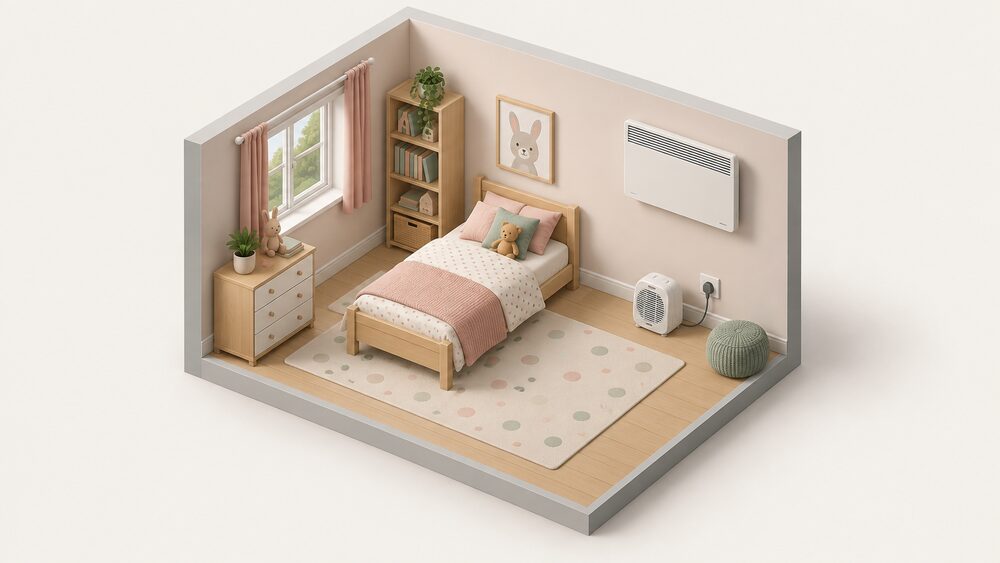
There is no single rule that bans electrical appliances from a child's bedroom, and no single rule that makes them safe there. The Building Regulations do not set standards for the safety of electrical appliances, but they do require that fixed connections of appliances are safe1. That distinction matters: a wall-mounted heater on a fused spur is covered by the fixed-connection requirement, while a plug-in fan heater, night light or tablet charger is not.
What the rules do cover is the wiring and the fixed installation, and the purpose is explicit. These rules have been introduced to help reduce the number of deaths, injuries and fires caused by faulty installations2. Approved Document P provides further practical guidance for undertaking electrical work covered by the Building Regulations1. For a child's bedroom, the practical question is therefore not "is an appliance allowed" but "is the fixed wiring safe, and is the appliance itself suitable for unsupervised use".
The wider context is that children make a household vulnerable in official definitions, which unlocks both safety expectations and financial support. Wales defines vulnerable households as those with a person aged 60 years or over, a dependent child or children under the age of 16 years, a single person household aged under 25 and/or a person living with a long-term illness or who is disabled3. Scotland's enhanced heating regime 3 covers households where any member of a household has a child aged 5 years old or under4.
What the rules and guidance actually say about appliances in a child's bedroom
The Building Regulations draw a line between the appliance and its connection. They do not set standards for the safety of electrical appliances but they do require that fixed connections of appliances are safe1. The same wording appears in the Planning Portal's guidance for common electrical projects: the building regulations do not set standards for the safety of electrical appliances but they do require that fixed connections of appliances are safe2. A permanently wired panel heater, an extract fan or a hard-wired night light falls on the regulated side of that line. A plug-in appliance does not.
Gas appliances in bedrooms carry a separate and older rule. Under the Gas Safety (Installation and Use) Regulations 1998, if a room containing such appliances was used as a bedroom prior to 1998 the landlord will need to do a risk assessment to determine if it can still be used as a bedroom8. That is a landlord duty, and it applies to gas, not to electrical appliances.
For specific products, the guidance is product-level rather than room-level. On electric blankets, if the blanket is to be used by young children, it should come with controls that can be pre-set by a parent or carer9. That is a design condition, not a prohibition.
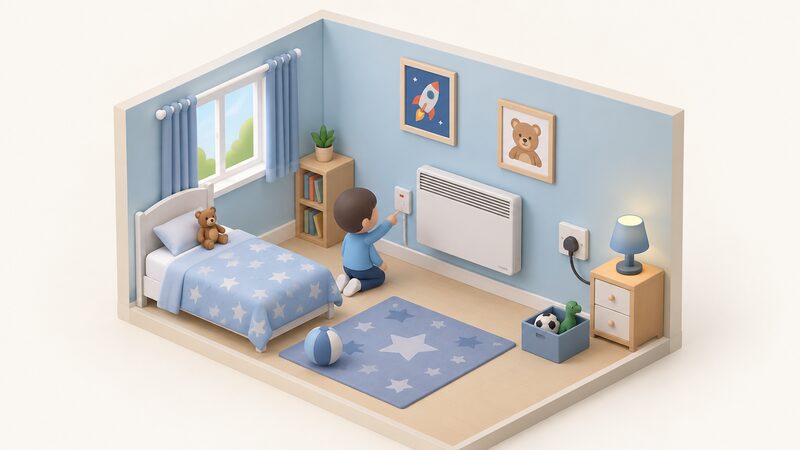
Electrical Safety First identifies the causes of electrical fires as misuse of appliances, poor regulation of electrical safety checks (particularly in the private rented sector) and faulty appliances10. In a child's bedroom, all three causes are live: an appliance left running, a check that was never done, or a product that has failed.
Why children count as a vulnerable household in official definitions
"Vulnerable" is not a single legal status. It is a set of overlapping definitions used by different schemes, regulators and nations, and children appear in most of them.
The ECO4 Flexible Eligibility rules use proxy 3: a person in the household is vulnerable to the cold for reasons including cardiovascular, respiratory and mental health conditions, disabilities, older people aged 65 and over, young children, and pregnant women11. Leeds City Council's Warm Well Homes scheme assists owner occupier households on low incomes with a range of conditions, and states that households with children up to age 5 are considered eligible for ECO4/GBIS-flex12.
Northern Ireland's approach is broader still. The Utility Regulator's Code of Practice for Consumers in Vulnerable Circumstances states that a consumer is deemed vulnerable when their personal characteristics or circumstances reduce their ability to engage effectively and achieve fair outcomes13. That definition is about capability, not about a list of conditions, and a household with a young child and a difficult supplier dispute can fall inside it.
The practical consequence is that a child's bedroom is not just a room. It is a room in a household that may qualify for priority treatment, grant funding and protection from disconnection. The vulnerable and medically dependent households page sets out how those definitions interact across the UK.
Heating and warmth: the temperatures vulnerable households may need to go above
Temperature guidance for a child's bedroom pulls in two directions, and the figures differ by source and by who is in the room.
Smart Energy GB suggests 16°C to 18°C for a bedroom5. The Centre for Sustainable Energy advises that for households with health issues, elderly people or young children, the advice is to heat occupied rooms to at least 20°C7. The NHS position, as reported by Which?, is that it recommends heating your home to at least 18°C, and not below 16°C for older people or those with impaired mobility14.
The lower bound is the more serious one. A substantial number of UK homes experience temperatures that are judged as too low (below 18°C) for the health of vulnerable people, including the under-fives, the over-60s and those with ill-health6. Scotland's official statistics go further and build a heating regime around it: enhanced heating regime 3 covers households frequently occupied during the cold where any member of a household has a child aged 5 years old or under and the household is not a household for which enhanced heating regime 1 or 2 applies4.
At the other end, warmth becomes a hazard. The Centre for Sustainable Energy warns that 24-27º is too warm and can put babies and young children at risk7. The Climate Change Committee has published work on summertime overheating risk in existing UK homes, considering what factors influence risk, how homes can be adapted or upgraded to mitigate the impacts and how much that costs15. A small bedroom with a running appliance, a closed door and a south-facing window is exactly the configuration that work addresses.
| Guidance | Temperature | Applies to |
|---|---|---|
| Smart Energy GB | 16°C to 18°C | Bedroom5 |
| Centre for Sustainable Energy | at least 20°C | Occupied rooms, households with health issues, elderly people or young children7 |
| NHS, as reported by Which? | at least 18°C, not below 16°C | Older people or those with impaired mobility14 |
| Centre for Sustainable Energy | 24-27º is too warm | Babies and young children7 |
| CREDS | below 18°C judged too low | Vulnerable people, including under-fives6 |
For a household's energy independence, this is the awkward part. A child's bedroom needs a narrow temperature band, and holding it there takes either careful appliance choice or continuous heating. Neither is free, and both depend on the grid.
Cost worries and debt: what the figures show for households with young children

Worry about energy costs is not confined to low-income households. Among households with an income between £50,000 and £59,000, 35% report that they are very worried about energy bills this winter, and a further 36% say they are somewhat worried16. That is a majority of a relatively comfortable income band.
For households with children specifically, the pressure shows up in adjacent budgets. One in seven households with children (15%) are not confident that they can afford childcare over the next three months from July 202617. Where childcare and heating compete for the same money, the bedroom temperature is one of the things that gives.
The Financial Vulnerability Classification used in Ofgem's consumer research defines a financially vulnerable consumer as not able to save, who either cannot afford an unexpected expense of £850 or are borrowing more than usual18. That is a higher bar than a £250 debt, and it is the definition the regulator's own satisfaction research uses.
Cold and damp homes carry their own measured anxiety. Cadent's research found that among people living in cold and damp homes, the worry about their children's health stood at 27%19. The Joseph Rowntree Foundation has published work on energy affordability and how to reduce bills for the majority of households16.
Support and savings available to vulnerable households
Support for a household heating a child's bedroom comes from several directions, and eligibility differs by nation.
Beyond the core group, other low income or vulnerable households may also be eligible22. The Household Support Fund provides discretionary support to vulnerable households with the cost of essentials, which may include support with energy bills for any form of fuel used for the purpose of domestic heating, cooking or lighting, including oil or portable gas cylinders, and simple energy efficiency measures23.
Appliance replacement is available through some supplier funds. The EDF Customer Support Fund provides large energy-efficient appliances including cookers, fridges and washing machines to enable you to replace old or broken models and reduce energy bills24. For households where a child's bedroom is heated by an old, inefficient appliance, that route addresses both the safety and the running cost.
For home adaptations, the Disabled Facilities Grant applies a means test that takes account of household savings over £6,00025. In Wales, the Nest scheme requires households to own or privately rent their home, receive a means-tested benefit or live in a low-income household, and live in a home with an energy performance certificate (EPC) rating of 54 (E) or less, or an EPC rating of 68 (D) or less where a household member has an eligible health condition26. Welsh housing stock data shows 82% of dwellings are free from Category 1 HHSRS hazards, and 76% of Private Rented Sector dwellings27.
| Support route | What it covers | Key condition |
|---|---|---|
| Household Support Fund | Essentials, including energy bills for any domestic fuel | Discretionary, vulnerable households23 |
| EDF Customer Support Fund | Cookers, fridges, washing machines | Replace old or broken models24 |
| Disabled Facilities Grant | Home adaptations | Means test on savings over £6,00025 |
| Nest (Wales) | Energy efficiency | EPC 54 (E) or less, or 68 (D) or less with a health condition26 |
Where to get help if you cannot afford safe heating

The first route is the supplier, and the second is the statutory complaint process. Ofgem sets out how to complain about your energy supplier or network operator28. Citizens Advice's consumer service may refer you to the Extra Help Unit if you need support with a difficult or urgent complaint, cannot deal with your energy supplier on your own due to personal circumstances, are considered vulnerable, or are at risk of being disconnected from an energy supply29.
Disconnection protection is strongest for the youngest children. Citizens Advice lists living with children aged under 2 years old among the circumstances that make a disconnection unsafe29. That is a narrower threshold than the under-5 and under-16 definitions used in heating and grant schemes, and households with older children do not automatically get the same protection.
Northern Ireland has its own priority schemes. Priority schemes, both Whole House and Individual Measures, are aimed at low-income households, each with its own vulnerability criteria and income thresholds, generally households who do not qualify for government schemes such as Affordable Warmth30.
For households in rented homes, the safety of the fixed wiring is the landlord's responsibility, and the landlord electrical safety checks page explains what an EICR covers. Where damp or cold is the underlying problem, cold homes and health sets out the health evidence, and fuel poverty in UK households explains how the official measures are built.
Sources30 cited
- Building Regulations and electrics, Welsh Government, 2026-09-17
- Building regulations: general information, Planning Portal, 2026
- New Warm Homes Programme: children's rights impact assessment, Welsh Government, 2024-03-08
- Scottish House Condition Survey 2024: key findings, Scottish Government, 2026-02
- Maintaining the ideal home temperature, Smart Energy GB, 2026-08-17
- Buildings energy findings report, CREDS, 2026
- Cold homes and health, Centre for Sustainable Energy, 2026-08
- Gas safety in the home: FAQs, Health and Safety Executive, 2026
- Electric blankets safety advice, Electrical Safety First, 2026-09-19
- 10 ways to avoid electrical fires in your home, Electrical Safety First, 2026-09-19
- ECO flexibility funding, Ceredigion County Council, 2026-09-17
- Statement of intent, Leeds City Council, 2024-12-23
- Code of Practice for Consumers in Vulnerable Circumstances, Utility Regulator Northern Ireland, 2025
- Common heating mistakes and how to avoid them, Which?, 2026-01-16
- Addressing overheating risk in existing UK homes, Climate Change Committee, 2026-09-19
- Energy affordability: how to reduce bills for the majority of households, Joseph Rowntree Foundation, 2025-11-18
- The new essentials as bills rise, Uswitch, 2026-07
- What drives consumer satisfaction with energy suppliers, Ofgem, 2025-07
- The cold truth, Cadent, 2026-09-20
- Check if you are owed money on your energy bill, Ofgem, 2026
- Gas and electricity, Uswitch, 2026-09-17
- Energy saving grants and funding, Tameside Council, 2026-09-17
- Household Support Fund, House of Commons Library, 2026-02-26
- EDF Customer Support Fund, Charis Grants, 2026-09-17
- Disabled Facilities Grants: what you'll get, GOV.UK, 2026-09-17
- Nest scheme eligibility, House of Commons Library, 2026-05-13
- Private sector housing renewal and adaptations, Swansea Council, 2026-09-20
- Complain about your energy supplier or network operator, Ofgem, 2026
- Struggling to pay your bills, Citizens Advice, 2026
- NISEP annual report 2024-25, Utility Regulator Northern Ireland, 2024
 Electrical Safety for HeatingWill your fuse box cope with electric heating, and does it need its own circuit?
 Smart Plugs and MonitoringWhich appliances are worth putting a smart plug on, and will it really show you what each one costs to run?
 Energy Smart AppliancesCan your washing machine or car charger be told when to use power, and who gets to decide?
 Home Battery Fire SafetyHow likely is a home battery to catch fire, and what keeps it safe if it does?
 Hydrogen Safety in the HomeCan hydrogen actually be used to heat UK homes, and is it safe?
 Siting and LocationWhere can a home battery actually go?