
Short answer
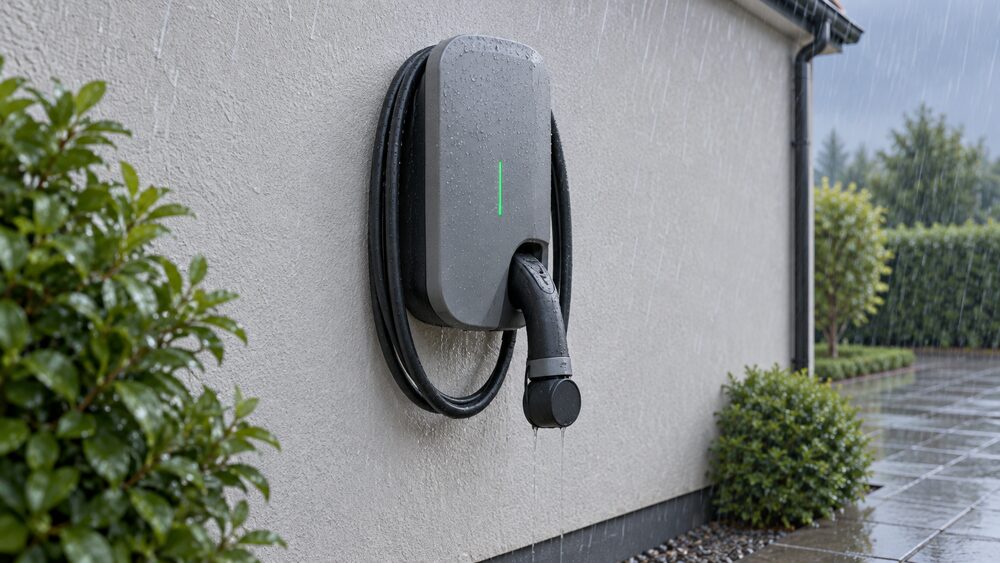
Yes, EV chargers can get wet, and charging an electric car in the rain is safe. The hardware in the car and the equipment used to charge it is designed to be used in dry and wet conditions1, and independent safety guidance agrees that no safety issues should be expected when charging in the rain2. Charging equipment is tested to withstand rain, frost and even heavy snow, provided the charger is a certified one3.
That reassurance rests on two codes printed on the charger's specification: the IP rating, which covers water and dust, and the IK rating, which covers impact. Understanding them tells a household whether a given unit belongs on an exposed driveway wall or under cover, and what protection it keeps if a car nudges it or a storm hits it.
Yes, you can charge in the rain
The question people actually type is whether rain makes charging dangerous. It does not. Charging in the rain is described as completely safe as long as a certified charger is used3, and the same answer is given for the car itself: it is completely safe to charge an EV or PHEV in the rain and take it through a car wash8. The design assumption behind every outdoor charge point sold in the UK is that it will be rained on, frozen and, in some cases, snowed on.
This matters for household energy independence because most home charging happens overnight, outdoors, in whatever the weather is doing. A household that can charge only in dry conditions does not have a dependable charging routine. The ratings exist so that a wallbox on the outside of a house works every night of the year without anyone watching the forecast.
The one place water and electricity genuinely do not mix is in everyday care of the connector. The metal contacts should never be cleaned with water or chemical cleaners, as this can cause corrosion or short circuits, and a tethered cable should be hung with the connector facing downwards when not in use, to prevent water ingress and allow drainage9.
IP ratings: what IP65 and IP55 actually tell you
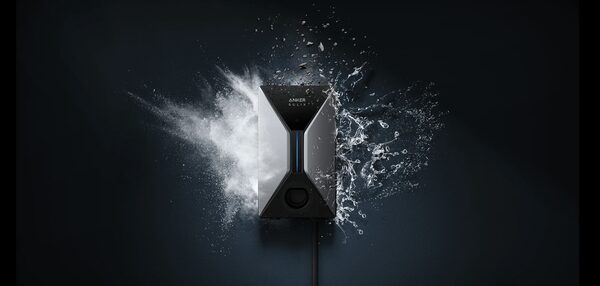
An IP (ingress protection) rating has two digits. The first is protection against solids, the second against water. The second digit is the one that answers "can this charger get wet": the higher it is, the more water the enclosure keeps out. IP65 means the enclosure is completely dust-tight and protected against low-pressure water jets from any direction, but it is not designed for submersion5. That is a strong rating for an outdoor wall: driven rain and even a hosepipe will not get in, but a flooded garage floor is a different matter.
For home charge points, the common ratings are IP55 and IP65. Maker guidance for home chargers is to look for water and dust resistance, with IP55 and IK10 labels as the benchmark4. A charger rated IP55 resists dust and water jets; one rated IP65 goes further and is described as dust-tight and jet-proof, suited to exposed industrial or coastal environments10. Several UK-market home chargers carry IP65 enclosures, including units from waEV-charge, rated for all-weather use11, and the Haier EV Charger, specified with an IP65 enclosure12. The Enphase IQ Bidirectional EV Charger is IP55 rated and UV resistant13.
| Rating | What it means in practice | Where it fits |
|---|---|---|
| IP54 | Weather-rated minimum for connectors; resists splashing water and dust6 | Connector caps and cable plugs |
| IP55 | Water and dust resistant; suitable for indoor and outdoor installation14 | Sheltered or semi-exposed outdoor walls |
| IP65 | Dust-tight and jet-proof; not for submersion5 | Fully exposed outdoor walls, coastal sites |
The difference between IP55 and IP65 is not about rain. Both shrug off British weather. It is about pressure washing, coastal salt spray and long-term dust exposure on a fully exposed wall. For a charger under a carport, IP55 is comfortable; for one on an open gable facing the prevailing wind, IP65 gives more margin.
IK ratings: protection against impact, not water
The IK rating is the other half of the story, and it has nothing to do with water. It measures how much mechanical impact the enclosure can take. This matters on a driveway because charge points get knocked: by a car bumper, a wheelie bin, a passing elbow. A charger can be rated IP65 and still crack open if it has no impact rating at all.
The benchmark for home chargers is IK10, the top of the standard scale, and maker guidance pairs it with IP55 as the labels to look for4. Current UK-market units that carry it include the Enphase IQ EV Charger 2, housed in a rugged IP55 and IK10 rated enclosure that is weatherproof and impact-resistant for both indoor and outdoor installation14, the Anker SOLIX V1 Smart EV Charger, with IK10 impact and IP55/IP65 weather-resistant ratings for indoor and outdoor use15, the Sofar EV11K-AC-02, IP65 and IK10 certified and UV resistant16, and the Hoymiles AC EV Charger, with IP65 and IK10 protection degree suitable for indoor and outdoor installation17.
For a household, the IK rating is what stands between a minor parking misjudgement and a broken charger. An outdoor unit without a stated IK rating may still be tough, but the maker has not published the evidence, and a cracked enclosure eventually compromises the water protection too.
What wet-weather ratings mean for where you mount a home chargepoint
Outdoor mounting is the norm, not the exception. As of 1 July 2026, 33% of UK public chargers were classed as on-street7, equipment that lives at the kerb in all weathers, and public charge points are found in car parks, at supermarkets, hotels, workplaces and service stations18. The reliability rules for public charge points even treat flooding as an expected exemption from downtime reporting, alongside vandalism and power cuts19, which tells a household that outdoor exposure is designed for, not tolerated.
For a home installation, the practical points are these. A charger rated IP55 or IP65 with IK10 is designed for an outdoor wall with no shelter. The connector still needs basic care: cap it after use and hang tethered cables connector-down9. And the installation itself is governed by rules that sit above the weather ratings: in England, home EV chargers fall under permitted development rights, with exceptions for listed buildings, conservation areas and world heritage sites, and limitations on the size and height of the equipment; all EV charging installations must comply with BS 7671, the Wiring Regulations20. A home charger must also be installed on your own property and cannot cross public land, which is why off-street parking such as a driveway, carport or garage is the usual requirement21.
Trailing a cable across a pavement to reach a car is not advisable under any circumstances: it is a safety hazard and may invalidate house, car and public liability insurances22. Households without a driveway have separate routes, covered in charging without off-street parking.
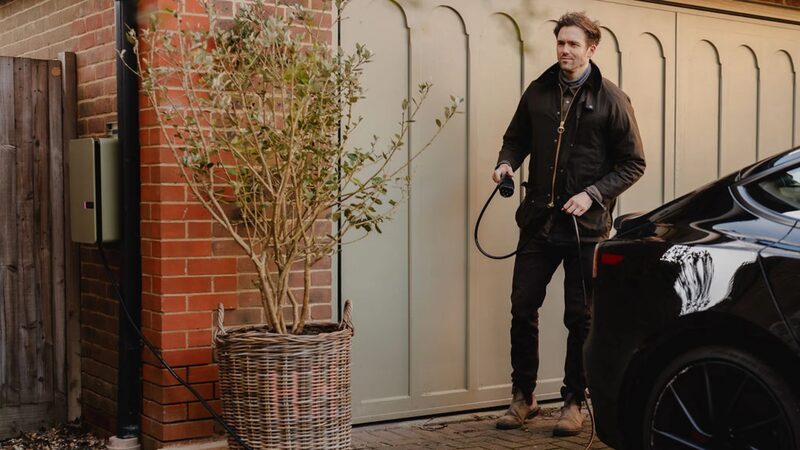
For energy independence, the ratings are what let a household charge from its own wall, on its own tariff, in any weather, rather than depending on a public network. What remains outside the home's control is the electricity supply itself: the charger is weatherproof, but the power behind it still comes through the grid and a supplier. If you are choosing between units, the types of home EV charger and the full EV charging at home guide cover the rest of the decision.
Sources22 sources
- Electric car charging at home, myenergi, 2026-09-17
- EV charging safety, Uswitch, 2022-03-24
- EV charging myths reviewed, waEV-charge, 2025-08-19
- EV charging 101, Wallbox, 2026-09-17
- Ingress protection rating guide, SolaX Power, 2026-06-15
- EV charger types, EcoFlow, 2026-10-30
- Public electric vehicle charging infrastructure statistics: 1 July 2026, GOV.UK, 2026-07-01
- Your ultimate guide to EV charging cables, EVEC, 2026-09-17
- EV cable care and maintenance, Simpson & Partners, 2026-09-17
- Inverter control, IDM Energie, 2026-07-07
- waEV-charge EV energy software, waEV-charge, 2026-09-17
- Haier EV Charger, Haier HVAC, 2026-09-17
- Enphase IQ Bidirectional EV Charger, Enphase, 2026-09-17
- Enphase Energy highlights safety and reliability of IQ EV Charger 2, Enphase, 2026-07-16
- Anker SOLIX V1 Smart EV Charger, Anker SOLIX, 2026-09-19
- Sofar EV11K-AC-02 EV Charger, Sofar Solar, 2026-09-19
- Hoymiles AC EV Charger, Hoymiles, 2026-09-17
- Electric vehicles for home: charging, Electricity North West, 2026-09-19
- EV charging reliability, ChargeUK, 2026-09-17
- EV charger regulations in England: what's changed, NICEIC, 2026-08-19
- EV charging connector types, E.ON Next, 2026-09-17
- EV buying guide, Zapmap, 2024-12-06
 EV Charging in Northern IrelandCan you get a grant for a home charger in Northern Ireland, do you need planning permission, and who do you tell at NIE Networks?
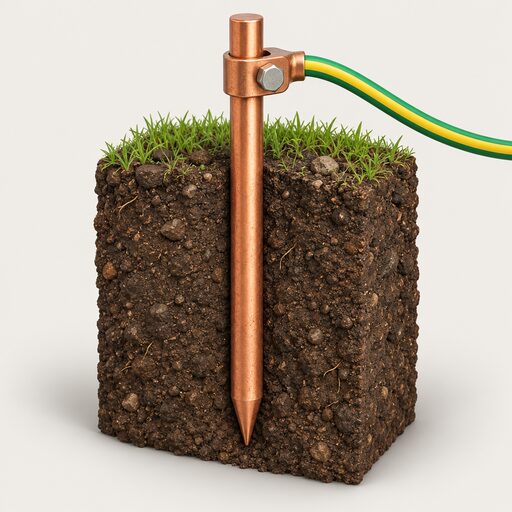 Earthing and PEN FaultsWhy does a home EV charger need special protection against a fault in the electricity network's earth?